
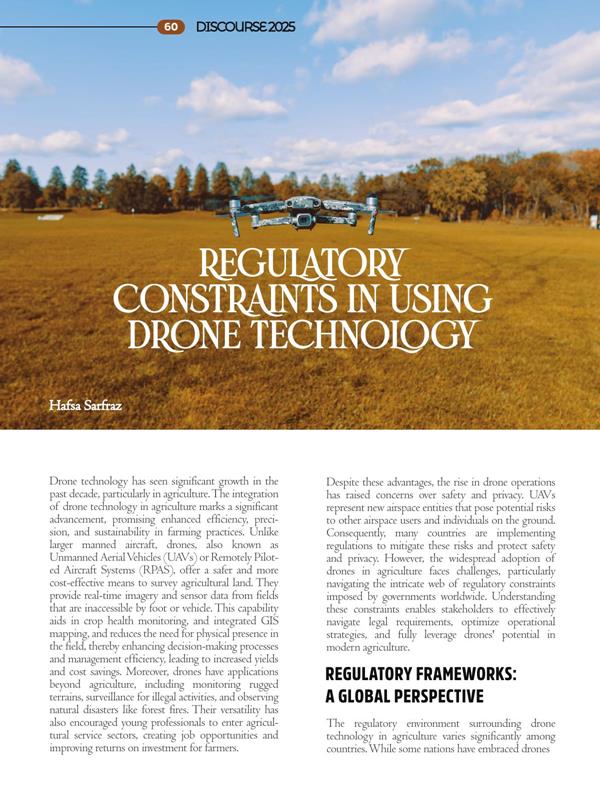
Regulatory Constraints in Using Drone Technology
Drone technology has seen significant growth in the past decade, particularly in agriculture. The integration of drone technology in agriculture marks a significant advancement, promising enhanced efficiency, precision, and sustainability in farming practices. Unlike larger manned aircraft, drones, also known as Unmanned Aerial Vehicles (UAVs) or Remotely Piloted Aircraft Systems (RPAS), offer a safer and more cost-effective means to survey agricultural land. They provide real-time imagery and sensor data from fields that are inaccessible by foot or vehicle. This capability aids in crop health monitoring, and integrated GIS mapping, and reduces the need for physical presence in the field, thereby enhancing decision-making processes and management efficiency, leading to increased yields and cost savings. Moreover, drones have applications beyond agriculture, including monitoring rugged terrains, surveillance for illegal activities, and observing natural disasters like forest fires. Their versatility has also encouraged young professionals to enter agricultural service sectors, creating job opportunities and improving returns on investment for farmers.
Despite these advantages, the rise in drone operations has raised concerns over safety and privacy. UAVs represent new airspace entities that pose potential risks to other airspace users and individuals on the ground. Consequently, many countries are implementing regulations to mitigate these risks and protect safety and privacy. However, the widespread adoption of drones in agriculture faces challenges, particularly navigating the intricate web of regulatory constraints imposed by governments worldwide. Understanding these constraints enables stakeholders to effectively navigate legal requirements, optimize operational strategies, and fully leverage drones’ potential in modern agriculture.
- Regulatory Frameworks: A Global Perspective
The regulatory environment surrounding drone technology in agriculture varies significantly among countries. While some nations have embraced drones with relatively open regulatory frameworks, others have adopted stringent rules addressing safety, privacy, and operational concerns. Adopting regulatory strategies makes safer the use of drone technology.
- United States: The Federal Aviation Administration (FAA) regulates drones under Part 107 of the Federal Aviation Regulations (FAR). Operators must obtain a Remote Pilot Certificate and adhere to rules including altitude restrictions, visual line-of-sight requirements, and prohibitions on flights over people and nighttime operations.
- European Union: The European Union Aviation Safety Agency (EASA) oversees drone regulations through the EU Drone Regulation, effective from 2021. This regulation categorizes drones by risk and imposes operational limitations, registration requirements, and competency standards for operators.
- China: The Civil Aviation Administration of China (CAAC) regulates drones with rules covering registration, flight altitude limits, and restrictions around airports and sensitive areas.
- Australia: The Civil Aviation Safety Authority (CASA) mandates drone operators to obtain certification, follow operational rules, and seek approval for specific drone operations, including agricultural applications.
- India: The Directorate General of Civil Aviation (DGCA) regulates drone operations under the Civil Aviation Requirements (CAR), encompassing registration, licensing, and operational restrictions.
- Primary Regulatory Concerns
Regulatory constraints on drone use in agriculture stem from several key concerns addressed through legislation and enforcement measures:
- Safety: Ensuring safe drone integration into shared airspace with manned aircraft is paramount. Regulations typically include rules on flight altitude, airspace restrictions, and operational limits to mitigate collision risks and ensure public safety.
- Privacy: Drones equipped with cameras and sensors raise privacy concerns, particularly regarding flights over private property or capturing images without consent. Regulations often mandate compliance with data protection laws, limits on surveillance capabilities, and guidelines for data collection and storage.
- Security: Misuse of drones for unauthorized surveillance or interference with critical infrastructure is a significant concern. Regulatory frameworks may include provisions for security clearances, encryption standards, and restrictions on drone capabilities to mitigate security risks.
- Environmental Impact: Drones can cause noise pollution, disturb wildlife, and affect sensitive ecosystems. Regulations may impose operational restrictions, especially in protected areas or during critical periods like nesting seasons, to minimize environmental harm.
- Operational Standards: To ensure reliable and efficient drone operations, regulations often specify technical standards, pilot training requirements, maintenance protocols, and operational procedures. These standards aim to enhance operational proficiency, mitigate risks, and promote responsible drone use.
- Current regulatory setup regarding drone technology in Pakistan
As of 2024, drone technology in Pakistan is regulated by the Pakistan Civil Aviation Authority (PCAA), which has established guidelines to ensure safety, security, and privacy while supporting the use of drones for various activities, including commercial, recreational, and governmental purposes.
Registration and Licensing:
-
- All drones, irrespective of their size, must be registered with the PCAA.
- Operators of drones exceeding a specified weight limit need to obtain a Remote Pilot License (RPL).
- Commercial drone operators must secure specific permissions and adhere to additional licensing requirements.
1.Operational Guidelines:
-
- Drones should be operated within the operator’s visual line of sight (VLOS).
- Flying drones in restricted areas, such as near airports, military zones, and sensitive infrastructure, is prohibited.
- Night-time operations require special authorization.
2. Security and Privacy:
-
- Drones with cameras or surveillance tools must adhere to strict privacy regulations, and any operation near critical infrastructure or large public gatherings requires special approval from authorities.
3. Commercial Use:
-
- Operators using drones for commercial purposes, such as aerial photography, agriculture, or delivery services, must obtain special permissions and comply with additional safety regulations.
- Companies engaged in commercial drone activities must ensure that their pilots are adequately trained and certified.
4. Law Enforcement and Government Use:
-
- Government bodies, including law enforcement and emergency services, have provisions for using drones in surveillance, search and rescue, and other public safety missions.
5. Penalties and Enforcement:
-
- Non-compliance with drone regulations may result in fines, confiscation of equipment, and, in severe cases, legal action.
- The PCAA, in coordination with local law enforcement, is responsible for enforcing these regulations.
- Implications for Stakeholders
Regulatory constraints surrounding drone technology in agriculture have significant implications for various stakeholders:
- Farmers: While drones offer tools to monitor crop health, optimize irrigation, and assess field conditions, compliance with regulatory requirements adds complexity. It may necessitate investments in training, equipment, and legal counsel to navigate regulations effectively.
- Drone Operators: UAV operators must understand and comply with regulatory obligations to operate legally and safely. This includes obtaining certifications, adhering to operational restrictions, maintaining equipment standards, and ensuring compliance with data privacy laws.
- Policymakers: Governments play a pivotal role in shaping regulatory frameworks that balance innovation with safety, privacy, and environmental concerns. Policymakers must consider stakeholder input, technological advancements, and international standards to develop adaptive regulations that foster innovation while ensuring safety and compliance.
- Technological Advancements and Regulatory Evolution
The rapid evolution of drone technology presents both opportunities and challenges for regulatory frameworks:
- Beyond Visual Line of Sight (BVLOS) Operations: Regulatory bodies are exploring rules to facilitate BVLOS operations, enabling drones to cover larger agricultural areas efficiently. BVLOS regulations require robust safety measures, technological standards, and operational protocols to manage risks effectively.
- Autonomous Drones: Advances in AI and automation drive the development of autonomous drones capable of complex tasks without human intervention. Regulatory frameworks must adapt to address safety, liability, and ethical considerations associated with autonomous systems.
- Data Management and Privacy: Drones collect extensive data on crops, soil, and farm operations. Regulations must ensure secure data transmission, storage, and usage, complying with data protection laws, consent requirements, and data anonymization practices.
The adoption of drone technology in Pakistan’s agriculture sector faces several challenges that limit its effectiveness and widespread use. These challenges are diverse, involving regulatory, technical, economic, and social factors.
- Constraints regarding drone technology in Pakistan
1.Regulatory Challenges:
-
- Complex Approval Processes: Farmers face burdensome regulatory requirements, including registration, licensing, and obtaining permissions, which can be time-consuming, particularly for small-scale farmers.
-
- Lack of Specific Guidelines: The general drone regulations provided by the Pakistan Civil Aviation Authority (PCAA) often lack clear guidance for agricultural applications, creating uncertainty and discouraging investment.
2. Technical Constraints:
-
- Inadequate Infrastructure: Rural areas often lack the necessary infrastructure, such as internet connectivity and maintenance services, to support drone operations.
- Technological Limitations: Many drones are not fully equipped for agricultural tasks, and their limited battery life can restrict their use over large fields.
3. Economic Constraints:
-
- High Costs: The initial investment required for drones, along with associated training and maintenance costs, is often prohibitive for small-scale farmers.
- Limited Access to Credit: Farmers struggle to obtain credit or financial support to invest in drones, further hampered by a lack of government subsidies or incentives.
4. Social and Cultural Constraints:
-
- Lack of Awareness: Many farmers are unaware of the benefits of drone technology and lack the knowledge to operate drones effectively.
- Resistance to Change: Traditional farming practices and skepticism about new technologies can lead to resistance against adopting drones.
5. Environmental and Operational Constraints:
-
- Drones are affected by adverse weather conditions, limiting their operational windows in agricultural regions.
- Pakistan’s fragmented landholdings make efficient drone use challenging, particularly over small, scattered plots.
6. Security and Privacy Concerns:
-
- Data Privacy: Concerns about the privacy and security of data collected by drones may deter farmers from using the technology.
- Security Risks: Drones near sensitive areas face restrictions due to security concerns, limiting their effectiveness.
7. Lack of Technical Support:
-
- Insufficient Support: A shortage of technical support and after-sales service, especially in rural areas, poses a significant barrier to drone adoption.
8. Limited Integration:
-
- Adaptation Challenges: Many drones are not fully adapted to local agricultural needs, reducing their practical applicability and value to farmers.
Suggestions to overcome these constraints within the country
1.Regulatory Reforms:
-
- Simplify Approval Processes: Streamline the registration and licensing of agricultural drones with a dedicated regulatory framework, inspired by practices in countries like Japan and the USA.
- Develop Clear Guidelines: The PCAA should create specific guidelines tailored to agricultural drone use, with simplified regulations for small-scale farmers.
2. Technological Advancements:
-
- Infrastructure Investment: Improve rural infrastructure, including internet connectivity and maintenance services, similar to efforts in India and Brazil.
- Promote Innovation: Encourage local development of drone technology to meet Pakistan’s specific agricultural needs, through partnerships between universities, tech companies, and experts.
3. Financial Support and Incentives:
-
- Provide Subsidies and Grants: Offer government subsidies and grants to reduce the cost of drones, following models in China and the European Union.
- Improve Access to Credit: Work with banks to offer low-interest loans or leasing options for drones, modeled on microfinance initiatives in Africa.
4. Education and Awareness:
-
- Training Programs: Implement training programs nationwide to educate farmers on drone technology, similar to those in Australia.
- Awareness Campaigns: Launch campaigns and demonstration projects to showcase the economic benefits of drones in agriculture.
5. Environmental and Operational Adaptations:
-
- Develop Weather-Resilient Drones: Promote drones that can operate in diverse climatic conditions, inspired by Israel’s technology.
- Adapt to Fragmented Lands: Create drone solutions tailored to Pakistan’s fragmented landholdings, including smaller drones and cooperative models.
6. Security and Privacy Measures:
-
- Establish Data Security Protocols: Implement guidelines to protect farmers’ data, modeled on the UK’s agricultural technology policies.
- Use Geofencing Technology: Apply geofencing to prevent drones from entering sensitive areas, following practices in the USA and Europe.
7. Enhanced Technical Support:
-
- Set Up Local Service Centers: Establish rural drone service and repair centers through public-private partnerships, similar to Canada’s agricultural services.
- Ensure After-Sales Support: Encourage comprehensive after-sales support from manufacturers, including maintenance and software updates.
8. Integration with Existing Practices:
-
- Customize Technology: Adapt drone technologies to local crops and conditions through collaboration with agricultural experts.
- Promote Success Stories: Showcase pilot projects where drones have improved productivity, as seen in India’s agricultural initiatives.
Conclusion
Drone technology holds substantial potential to revolutionize farming practices, boost productivity, and promote sustainability in agriculture. However, realizing these benefits hinges on navigating a complex regulatory landscape shaped by safety, privacy, security, and environmental considerations. Understanding diverse regulatory frameworks’ primary concerns and implications enables stakeholders, farmers, drone operators, and policymakers to collaborate effectively, fostering innovation while ensuring responsible and compliant drone use in agriculture. Despite all these regulatory constraints drone technology plays a revolutionizing role in Agriculture. In the years ahead, regulatory frameworks will evolve in response to technological advancements and stakeholder needs, driving progress toward sustainable and efficient agriculture globally.
The writer has an affiliation with the Department of Plant Breeding and Genetics University of Agriculture Faisalabad, Pakistan
Connect with the Pakistan Institute of Development Economics
Subscribe
Select topics and stay current with our latest insights
- +92 51 9248051
- [email protected]
- PIDE, QAU Campus, Islamabad