Discourse SUBMISSIONS OPEN
Articles are invited for the next issue of Discourse Magazine, including but not limited to the following themes:
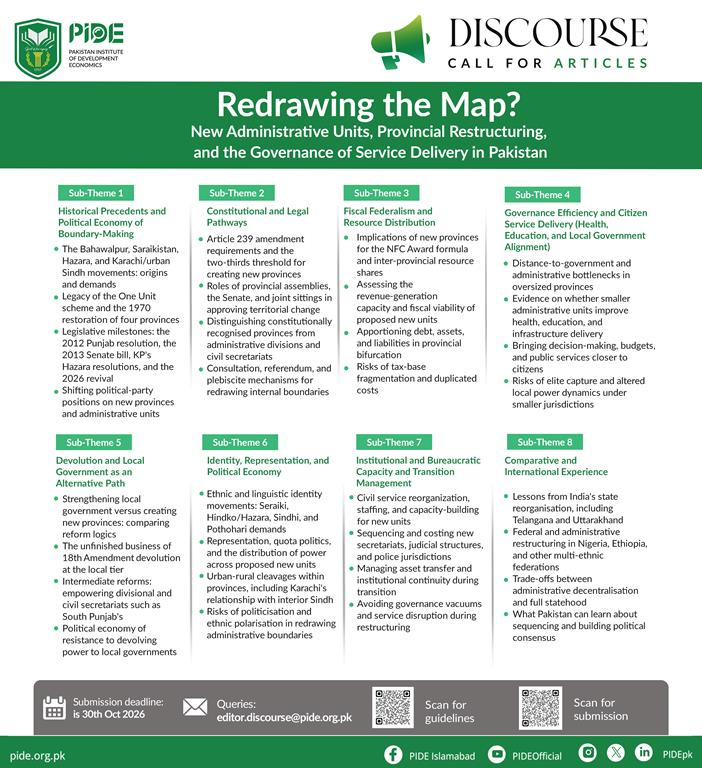
Redrawing the Map?
New Administrative Units, Provincial Restructuring, and the Governance of Service Delivery in Pakistan
Theme overview
Pakistan’s debate over new administrative units and provincial restructuring has re-emerged as a major question of governance, representation, fiscal federalism, and service delivery. Historical demands for Bahawalpur, Saraikistan, Hazara, and Karachi/urban Sindh, together with the legacy of the One Unit scheme and subsequent constitutional developments, show that boundary-making in Pakistan is not merely an administrative exercise but is closely tied to political economy, identity, representation, and the distribution of resources and power. Any restructuring therefore has important implications for constitutional procedures, the NFC Award, provincial fiscal viability, bureaucratic organization, and the relationship between citizens and the state.
This theme invites contributions that critically examine whether creating new provinces or administrative units can improve governance efficiency, strengthen service delivery, and bring decision-making closer to citizens, while also considering devolution and stronger local government as alternative reform pathways. It welcomes evidence-based analyses of the political, constitutional, fiscal, institutional, and identity-related challenges involved in restructuring, including risks of elite capture, ethnic polarization, transition costs, administrative disruption, and capacity constraints. Comparative lessons from other federations are also encouraged to assess how Pakistan can sequence reform, manage institutional transition, and build durable political consensus around any future restructuring.
Historical Precedents and Political Economy of Boundary-Making
- The Bahawalpur, Saraikistan, Hazara, and Karachi/urban Sindh movements: origins and demands
- Legacy of the One Unit scheme and the 1970 restoration of four provinces
- Legislative milestones: the 2012 Punjab resolution, the 2013 Senate bill, KP’s Hazara resolutions, and the 2026 revival
- Shifting political-party positions on new provinces and administrative units
Constitutional and Legal Pathways
- Article 239 amendment requirements and the two-thirds threshold for creating new provinces
- Roles of provincial assemblies, the Senate, and joint sittings in approving territorial change
- Distinguishing constitutionally recognised provinces from administrative divisions and civil secretariats
- Consultation, referendum, and plebiscite mechanisms for redrawing internal boundaries
Fiscal Federalism and Resource Distribution
- Implications of new provinces for the NFC Award formula and inter-provincial resource shares
- Assessing the revenue-generation capacity and fiscal viability of proposed new units
- Apportioning debt, assets, and liabilities in provincial bifurcation
- Risks of tax-base
- fragmentation and duplicated costs
Governance Efficiency and Citizen Service Delivery (Health, Education, and Local Government Alignment)
- Distance-to-government and administrative bottlenecks in oversized provinces
- Evidence on whether smaller administrative units improve health, education, and infrastructure delivery
- Bringing decision-making, budgets, and public services closer to citizens
- Risks of elite capture and altered local power dynamics under smaller jurisdictions
Devolution and Local Government as an Alternative Path
- Strengthening local government versus creating new provinces: comparing reform logics
- The unfinished business of 18th Amendment devolution at the local tier
- Intermediate reforms: empowering divisional and civil secretariats such as South Punjab’s
- Political economy of resistance to devolving power to local governments
Identity, Representation, and Political Economy
- Ethnic and linguistic identity movements: Seraiki, Hindko/Hazara, Sindhi, and Pothohari demands
- Representation, quota politics, and the distribution of power across proposed new units
- Urban-rural cleavages within provinces, including Karachi’s relationship with interior Sindh
- Risks of politicisation and ethnic polarisation in redrawing administrative boundaries
Institutional and Bureaucratic Capacity and Transition Management
- Civil service reorganization, staffing, and capacity-building for new units
- Sequencing and costing new secretariats, judicial structures, and police jurisdictions
- Managing asset transfer and institutional continuity during transition
- Avoiding governance vacuums and service disruption during restructuring
Comparative and International Experience
- Lessons from India’s state reorganisation, including Telangana and Uttarakhand
- Federal and administrative restructuring in Nigeria, Ethiopia, and other multi-ethnic federations
- Trade-offs between administrative decentralisation and full statehood
- What Pakistan can learn about sequencing and building political consensus
Submission Guidelines
- All articles must be submitted through the designated Google Form submission link. (https://docs.google.com/forms/d/e/1FAIpQLSdXhDU1qrxAW8mkL308hkPAPhEufb-JPrN4Ez10a86ubpGjrg/viewform)
- Articles should be original and between 1,000 and 2,500 words; where an article is based on the author’s own research, the original contribution must be clearly identified and articulated.
- The use of figures and tables is encouraged. Please ensure that they are provided in an editable format.
- References to documents, research papers, articles, reports, or other sources should be provided through footnotes.
- Authors must also upload a recent, clear, high-resolution professional photograph through the relevant field in the Google Form.
- The deadline for submission of articles is 30th Oct 2026.
- Authors of accepted articles will be fairly compensated in accordance with the rules and guidelines of Discourse Magazine.
- For any inconvenience, you can reach us at [email protected]
Editorial Policy and Guidelines for Discourse Magazine
- Purpose and Scope
Discourse Magazine aims to inform, analyse, and shape public policy dialogue by publishing insightful, evidence-based articles that meet the research and policy needs of stakeholders — including scholars, practitioners, policymakers, and students. The magazine welcomes contributions that are policy-relevant, analytically rigorous, and clearly written for a broad audience.
The magazine focuses each issue around a themed policy topic, offering general insights into Pakistan’s economy, governance, and development challenges.
- Editorial Independence
- Editorial decisions are made solely on the basis of content quality, relevance, originality, and accuracy, free from undue influence by sponsors, advertisers, partners or others. The editorial team maintains full authority over what is published.
- Contributions by the editorial board or institutional staff are evaluated under the same standards as external submissions.
- Accuracy, Verification & Fact-Checking
- Authors must ensure all factual information, data, quotations, and references are accurate and verifiable.
- When errors are identified post-publication, corrections will be issued promptly and transparently.
- Originality and Plagiarism
- Submissions must be original, previously unpublished work. Simultaneous submissions to other publications are prohibited.
- Proper citation of sources and data is mandatory; unattributed use of others’ work (including self-plagiarism) is unacceptable.
- Editors may use plagiarism detection tools to ensure originality.
- Ethical Considerations
- Content should be respectful, non-discriminatory, and sensitive to cultural, social, and political contexts.
- Personal data, confidential information, or proprietary materials should not be published without consent.
- Authors must disclose conflicts of interest, including financial, institutional, or personal biases that may influence their perspective.
- Contributions & Review
- Submissions should align with announced themes when relevant and meet stated formatting and length guidelines
- Each submission undergoes editorial review. Editors reserve the right to make substantive and stylistic edits for clarity, readability, and length, with author consultation where feasible.
- Ongoing Review of Policy
- This editorial policy should be periodically reviewed and updated to reflect evolving best practices in policy publishing and ethical standards.