
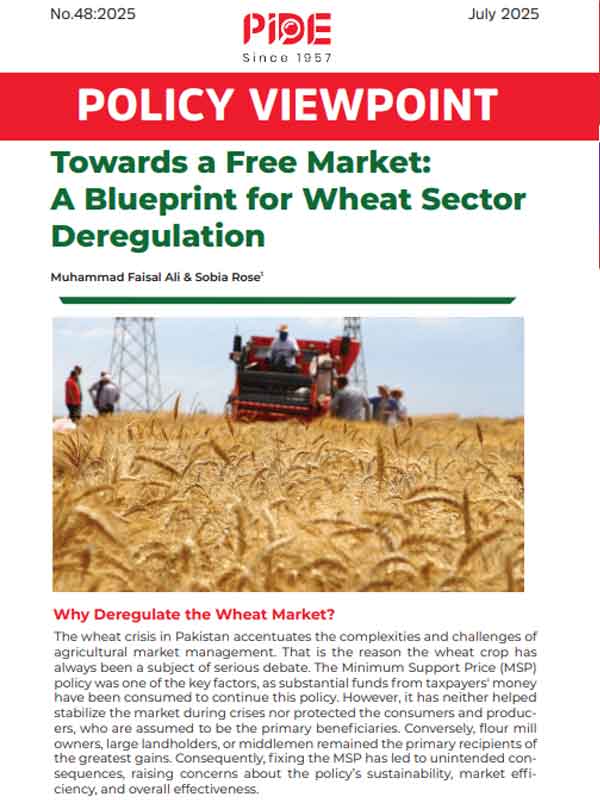
Towards a Free Market: A Blueprint for Wheat Sector Deregulation
Why Deregulate the Wheat Market?
The wheat crisis in Pakistan accentuates the complexities and challenges of agricultural market management. That is the reason the wheat crop has always been a subject of serious debate. The Minimum Support Price (MSP) policy was one of the key factors, as substantial funds from taxpayers’ money have been consumed to continue this policy. However, it has neither helped stabilize the market during crises nor protected the consumers and producers, who are assumed to be the primary beneficiaries. Conversely, flour mill owners, large landholders, or middlemen remained the primary recipients of the greatest gains. Consequently, fixing the MSP has led to unintended consequences, raising concerns about the policy’s sustainability, market efficiency, and overall effectiveness.
Furthermore, following MSP as a policy has created an outsized circular debt [1]on the Government (especially the Punjab Government, with 680 billion until 2023). Following MSP also leaves less area for oilseed crops. Every year, a big chunk of the budget for food departments was utilized in the procurement process and costs associated with the grain storage issues, which was apart from the circular debt. For these reasons, as a potential solution to stabilize the wheat market, a gradual or phased withdrawal of the government in 3 to 5 years has always been suggested.[1] But, this has never been considered as a policy option, and the government abruptly exit the wheat market.
Last year, the Punjab government’s abrupt exit from the market led to significant disruptions. While the decision to exit the wheat market was sound, its execution was not well planned, especially considering the significant reserves held by the government, which discouraged middlemen from investing in wheat procurement from farmers. The large stockpiles held by the government discouraged middlemen from participating in wheat purchases, which suppressed farm-level wheat prices, and millers formed a cartel that severely exploited small farmers. In this scenario, the government’s role must be to take measures that leave the cartels ineffective, but this was not done effectively[2].
The government announced plans to deregulate the wheat market in the whole country, confining its role to just procuring strategic reserves and buffer stocks and has done this in the current Rabi season. While the immediate impact of this withdrawal is not positive, farmers received very low market prices barely covering the production costs. A very sensitive situation where a careful execution of policy becomes much desirable. Although, this policy shift holds a significantly long-term potential to enhance wheat productivity by aligning producers’ incentives with market-driven profitability rather than relying on the government-set support prices. However, all the benefits of the free market can only be realized through consistent, long-term, and sustainable policy. At the same time, there remains a parallel risk that the government may reenter the market. This underscores the need for a comprehensive framework to support and sustain wheat market deregulation. But, for the deregulation of the wheat market, the regulatory framework or specific mechanism remains unclear. Contextually, a comprehensive framework is proposed here to ensure an effective and well-structured deregulation of the wheat sector.