The National Finance Commission (NFC) Award has the spotlight in national discourse again. Fiscal federalism in Pakistan remains a cornerstone of the country’s political economy, as it governs intergovernmental transfers between the federation and the four federating units. The Constitution of Pakistan requires that the NFC be constituted every five years to reevaluate the efficacy of revenue sharing in the light of evolving regional disparities and economic challenges, and announce a new award. The reality is this has not happened because of the political dynamics.
Historically, the division of financial responsibilities became structured with the promulgation of Pakistan’s first constitution in 1956. Since the separation of East Pakistan, there have been only four conclusive NFC Awards (1974, 1991, 1996, 2009) in addition to a Distributional Order 2006. This implies that only four NFC Awards were announced with consensus of all the federating units during a period of over 50 years (1974 to 2025).
After the NFC Award 1974, two attempts were made for the revision in inter-governmental transfers but these were unsuccessful. The much-awaited NFC Award then materialized in 1990-91. This was followed by the NFC Award 1996 for a period of five years (1996-97 to 2001-02), but remained in practice till 2005-06. In 2006, a distribution order from the President of Pakistan replaced the NFC Award 1996. In 2009 the 7th NFC Award was conclusively approved by revising the formula of sharing of resources. A new award was due in 2014, but three NFCs have since been constituted without culmination of an award.
As compared to Pakistan, in India, 15th NFC Award is currently operative. The regularity in consensus building is probably because the fiscal need and thereby the shares of federating units in India are determined by technical assessment of a team of experts. In Pakistan, however, the NFC secretariat neither has the mandate nor the capability to do a similar analysis and political dynamics determine the award, limiting chances of consensus.
The 7th NFC Award
The 7th NFC Award has been cited as a landmark development in Pakistan’s fiscal history. It was a major step towards provincial financial autonomy. It significantly increased the provincial share of the divisible pool from 47.5% to 56% in the first year, and 57.5% thereafter. This shift was aligned with the 18th Amendment (2010), which devolved Concurrent List functions to the provinces. Also, it provincialized Sales Tax on Services and enhanced straight transfers to strengthen provincial tax and revenue base.
To address inter-provincial disparities, for the first time, the award incorporated multiple criteria to distribute the divisible pool beyond population, including the following: population (82% weight); poverty and backwardness (10.3%); revenue collection and generation (5%); and, inverse population density (2.7%). This was a manifestation of a spirit of accommodation among the federating units, enhancing national cohesion and unity.
It exhibited sensitivity to the special situations of the smaller provinces- Khyber- Pakhtunkhwa and Balochistan- by giving them a share respectively for being the frontline province in the war against terrorism and backwardness.
In annexure, the Award also presented projections of public finance over the tenure of the Award-federal and provincial revenues and federal and provincial current and development expenditure. This was done to bring in an element of performance into discussion on NFC transfers to inculcate positive fiscal behavior (higher own source revenue, control over expenditure and better PFM systems).
In summary, the 7th NFC Award was designed to strengthen the provinces, reduce regional disparities and improve the fiscal state of the country through higher revenue mobilization, prudence in development spending and avoidance of profligacy in current expenditure by both the tiers of the government. Through a significant enhancement in provincial revenues, it bought a paradigm shift in the development framework whereby provinces had the lead in the development of the country through improvement in the sectors which were the constitutional responsibility of the provincial governments. A strengthened NFC Secretariat was to monitor the overall finances of all tiers of the government.
Fiscal Impact of the 7th NFC Award
The 7th NFC Award had substantial fiscal, economic and political implications for Pakistan’s federation. Focusing first on the fiscal impact, it strengthened provincial autonomy by allocating more federal resources to the provinces. Federal transfers as a percentage of federal tax revenues increased from 37% in 2009-10 to 62% in 2010-11. Overtime the federal government has developed non-sharable revenue sources, reducing this percentage to 57%. Nonetheless, the NFC Award empowered the provinces to develop and implement their own policies in line with regional priorities, presumably with a focus on social sectors.
A major criticism of the post-2009 NFC arrangement is the limited fiscal space left for the federal government, which is struggling to meet its own expenditure obligations, including debt servicing, defense, and national-level development projects. While true, three important dimensions also need to be highlighted: first, this would not have been the case if federal government would have increased the tax to GDP ratio to 15% of the GDP, in line with the NFC projections as bulk of the fiscal base is still with the federal government.
Second, the federal government did not cut the growth in its current expenditure through structural reforms in pensions, debt management, PFM and devolution as envisaged in the 18th Constitutional amendment. And lastly, the sharper reprioritization required in the federal development expenditure was not fully undertaken whereby the development spending throw- forward continues more or less unabated while provincial subjects are part of federal development portfolio. Provinces in the post 18th Amendment era were gearing up to take on the devolved functional responsibility, especially the larger provinces, but effective devolution never realized.
All in all, the feeble state of federal finances is a combined consequence of the above-mentioned factors which can principally be attributed to political economy dynamics, lack of capacity, indifference to transformational reforms and weak systems.
Turning now to provincial finances, the resource mobilization story is somewhat similar and shows lack of policy and effort consistency. Federal tax transfers (excluding straight transfers, which are part of provincial income collected by the federal government, as per Article 161 of the Constitution) as percentage of provincial revenue receipts increased from 72% in 2009-10 to 82% in 2010-11. It decreases to 75% by 2017-18, indicating growing provincial financial self-sufficiency.
The trend reverts thereafter and in 2024-25 its stands at 77%. This pattern is also demonstrated by the increase in provincial revenue to GDP ratio from 0.7% in 2009-10 to 1.4% by 2017-18 and then to a decline to 1.1% currently. Some broad tax bases are under the provincial fiscal domain- services, immovable property and agricultural income. It is imperative that Provinces mobilize resources from these tax bases to promote growth, development and social welfare.
On the expenditure side, combined expenditure on education and health which was 1.7% of GDP prior to the award increased to 2.8% by 2017-18 and thereafter declines to the current level of 1.8%. The aspiration about a big boost to spending on these two sectors, which directly benefit the masses, was not realized. Since the public sector development pendulum has shifted to the provinces, they need to make their spendings more efficient, value based, strengthen their financial management systems to make the spending more transparent and reprioritize development to maximize growth and wellbeing of the provincial residents.
In sum, higher and equitable resource mobilization is essential to improve the state of public finances in Pakistan. This requires political will, policy consistency and strengthening of the tax apparatus at both the federal and provincial level. Digitalization, data sharing and coordination between the two tiers of government can facilitate this. Also, expenditure reforms, sharper development prioritization and improved expenditure efficiency is crucial to ensure that outcomes are commensurate with the increase in expenditure-a feature largely missing in both tiers of government.
We turn now to the broader economic impact of the 7th NFC Award.
Economic Impact of the 7th NFC Award
The vertical and horizontal sharing formula in the 7th NFC Award were derived with the underlying focus on the broader economic impact of the Award. There were two dimensions of the economic impact. The first focus was on promoting the economic growth process and thereby achieving a higher GDP growth rate. This was to be facilitated, first, by higher development spending by the provincial governments, especially on the social sectors and growth promoting physical infrastructure. This would facilitate faster human capital formation and reduce the physical constraints to growth.
The second impact was expected to be a larger and stronger law and order set-up to tackle terrorism and crime (1%of Gross divisible pool was given to KPK for being the frontline province against war on terror). This would reduce risk perceptions of private investors and thereby raise the overall level of investment in the economy.
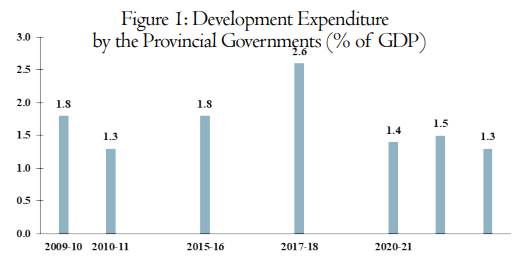
Therefore, the first empirical question is whether the 7th NFC Award led to a higher level of development spending by the four provincial governments. The answer is that, as shown in Figure 1, a peak was attained in 2017-18 at 2.6% of the GDP, but it has since declined by over 1% of the GDP.
| Figure 1
Development Expenditure by the Provincial Governments (% of GDP) |
 |
Likewise, the trend in the overall GDP growth rate has been inconsistent. It increased to 6.1% by 2017-18 and thereafter declined. Therefore, post 7th NFC Award, there has not been a steady and significant increase in economic growth as highlighted in Table 1. There has, in fact, been a small decline in recent years.
| Table 1
Average Five-Yearly GDP growth rates |
|
| Period | Percentages |
| 2004-05 to 2009-10 | 3.7 |
| 2009-10 to 2014-15 | 3.5 |
| 2014-15 to 2019-20 | 3.4 |
| 2019-20 to 2024-25 | 3.4 |
The other economic impact that was envisaged under the 7th NFC Award was to achieve a big reduction in regional disparities among the provinces. Consequently, as highlighted above, poverty/backwardness and Inverse population density were included in the horizontal sharing formula to facilitate a process of catching up by the two relatively backward provinces of Baluchistan and Khyber-Pakhtunkhwa. The first criterion was to enable a larger share of transfer to a province with a higher incidence of poverty. The second criterion reflected the higher unit costs of provision of services in a province with lower population density.
The consequence was the following ratio in per capita NFC transfers in 2010-11, the first year of the Award.
| Table 2
Ratio of Provincial per capita Transfers to National per capita Transfers |
|||
| Province | Share in NFC Transfers
(%) |
Share of Population
(%) |
Ratio of per capita Transfer to National per capita Transfer |
| Punjab | 50.45 | 54.28 | 0.929 |
| Sindh | 23.94 | 23.30 | 1.027 |
| Khyber-Pakhtunkhwa | 16.03 | 16.78 | 0.955 |
| Baluchistan | 9.58 | 5.64 | 1.698 |
| Total | 100.00 | 100.00 | |
Therefore, the award gave a higher per capita transfer to Sindh because of its relatively large contribution to federal tax revenues. Despite being relatively less developed the province of Khyber-Pakhtunkhwa received a lower per capita transfer in relation to the national average because of a relatively low contribution to federal tax revenues and above average population density. Punjab and Baluchistan received the appropriate level of per capita transfers.
The methodology and estimates of the Gross Regional Products (GRPs) of the Provinces have been taken from Bengali (1999) and Pasha (2020). They have been used to extrapolate the size of the four provincial economies up to 2024-25. The estimated average growth rates of the GRPs of each province are presented in Table 3 for different periods. The results reveal that the range of provincial growth rates was 2.5% points in the decade prior to the 7th NFC Award. This range declined to 1.4% points from 2009-10 to 2024-25.
Therefore, there appears to have been some success in achieving an equalization of provincial GRP growth rates. However, this has happened at a time when the national GDP growth rate has declined somewhat. The Gini coefficient of regional income equality has also declined from 0.102 in 2009-10 to 0.092 in 2024-25.
| Table 3
Growth Rates of the Gross Regional Product of the Provinces |
||
| 1999-2000 to 2009-10 | 2009-10 to 2024-25 | |
| Punjab | 4.2 | 3.6 |
| Sindh | 5.0 | 3.1 |
| Khyber-Pakhtunkhwa | 5.1 | 4.1 |
| Balochistan | 2.6 | 2.7 |
| Pakistan | 4.4 | 3.9 |
The final impact that is examined is the change in the Human Development Index (HDI) of the provinces. The UNDP Pakistan Human Development Report of 2020 has estimated the HDI of the Provinces for 2006-07 and 2018-19 respectively. The separate index values of education, health and income per capita have also been highlighted.
The HDI values of each Province is presented in Table 4.
| Table 4
HDI by Province |
||
| 2006-07 | 2018-19 | |
| Punjab | 0.527 | 0.572 |
| Sindh | 0.529 | 0.574 |
| Khyber-Pakhtunkhwa | 0.491 | 0.546 |
| Balochistan | 0.470 | 0.473 |
| Pakistan | 0.529 | 0.570 |
The cumulative increase in the HDI has been the highest in Khyber- Pakhtunkhwa because of significant progress on all three fronts of education. health and income. Baluchistan has shown only marginal improvement in the HDI, with actually a fall in the health index. Overall, the level of inequality among the four Provinces has only marginally improved.
To sum up, the economic impact of the 7th NFC award has perhaps not been as strong as envisaged. The GDP growth slows an inconsistent trend. This perhaps is due to a number of negative factors including COVID-19, floods and increased external vulnerability due to low foreign exchange reserves leading to stabilization measures at the cost of growth, However, there has been some success in reducing regional disparities, with Khyber-Pakhtunkhwa beginning to catch up with the two more developed provinces of Sindh and Punjab. However, Baluchistan continues to remain a visibly backward Province.
Way Forward: Revisiting the Revenue Sharing Arrangements
The analysis in this paper tries to demonstrate that multiple other major factors are behind the current malaise in public finances in Pakistan -it is not the NFC award. Having said that, it is also important to accept that intergovernmental fiscal relations have to alter in the light of the developing fiscal trends. Some suggestions are given below:
The 18th Amendment to the Constitution ensures that the share of the provinces in the award is not reduced. Any downward change in vertical transfers is, therefore, unlawful and indeed undesirable. Also, as the TORs of the last unconcluded NFCs implied, provinces financing purely federal functions is undesirable as it can lead to a moral hazard situation whereby the federal government has no hesitation in indulging in over spending. The solution is proper handing over of the 18th amendment functional responsibilities to the provinces, that is, full implementation of the 18th amendment, in letter and spirit.
Federal government should step out of all provincial function, restructure its ministries and Divisions, limiting itself to only regulatory functions where required. Likewise, provincial governments should not seek funds for devolved functions which should be accompanied with an amicable solution of all outstanding 18th amendment issues (like transfer of workers welfare funds). Provinces, especially the smaller provinces, need to be administratively strengthened and systems set to ensure quality service delivery. Better coordination between federal and provincial governments will minimize duplication and inefficiencies. The National Economic Council will have to play an effective role to ensure service delivery across regions, subnational ownership of and adherence to national policy goals and fulfillment of international commitments, like the SDGs and the IMF program.
Turning to the NFC formula, it does not incentivize provinces to improve their tax collection or efficiency in public spending. A performance-based element could improve transparency, accountability and promote healthy competition among provinces to improve fiscal responsibility. Currently, horizontal distribution is based on four criteria: population, poverty and backwardness, contribution to federal revenue generation and inverse population density. To encourage own resource generation, growth in own revenue mobilization can perhaps be the fifth criterion. To reward provinces for improving social sector outcomes, indicators based on international institutions assessment, like HDI can be used to give grants for better performance. Such changes will make the award somewhat dynamic in character and outcome oriented.
Our analysis indicates that the divisible pool transfers are not as fiscally equalizing as required. There is perhaps a case for some alteration in weights of criteria- some increase in poverty and some reduction in revenue generation. The latter can be diverted to incentivize own resource mobilization, as discussed above.
To keep revenue sharing equitable, relevant and reflective of underlying fiscal realities, the arrangements have to reviewed and altered after the constitutionally mandated period of five years. The probability of ensuring this will rise if the NFC award is based on technical assessment of fiscal need, as is the case in India. The NFC Secretariat needs to be strengthened for this purpose and to effectively monitor fiscal trends of the federation. It should serve as a data and policy hub, which should not only keep the federal government and the parliament informed but also share information with the provinces.
Also, by generating cash surpluses the provinces are, in effect, contributing to financing the budget deficit and thereby curtailing debt expansion. The current arrangement is, however, inconsistent and unpredictable. The provinces should reflect their commitment to the federal government in their expenditure management strategy to minimize disruption in their development activities.
Finally, there is need to institutionalize regular dialogue among the federal and provincial governments through an empowered inter-governmental Fiscal Council to coordinate budgets, spending priorities, economic reforms and taxation issues, in particular, strife for integration and harmonization of the sales tax on goods and services. A Finance Secretaries committee currently exists for discussion on fiscal matters but a formal, institutionalized forum, supported by the NFC secretariat, can perhaps be more effective.
Conclusion
The NFC Award represents one of the most significant instrument for promoting fiscal federalism in Pakistan. While the 7th NFC Award marked a positive shift toward decentralization, most of its projected targets and goals were missed because of deep rooted structural challenges embedded in the country’s public finances. For Pakistan to navigate its economic instability, increasing debt burden, and provincial disparities, a comprehensive and collaborative reform agenda of resource mobilization, expenditure rationalization and PFM for both the tiers of government is not just necessary—it is urgent.
Simultaneously, transparent, inclusive, and outcome-oriented approach to the next NFC Award will be essential to promote fiscal responsibility, equity, sustainability, and national cohesion. Effectively instituted fiscal federalism can lead to a more developed and stable Pakistan.
Dr. Aisha Ghaus Pasha is a renowned economist, academician and politician having served on several key positions including Minister of State for Finance and Revenue, Government of Pakistan, Finance Minister Government of Punjab, and the Director, Institute of Public Policy at BNU.