ABSTRACT
Pakistan’s pharmaceutical industry grapples with challenges stemming from its reliance on imported Active Pharmaceutical Ingredients (APIs). This study examines the root causes obstructing the API sector’s growth, aiming to reduce import dependency and emulate Bangladesh’s success as a signinicant API exporter. Employing a mixed-methods approach, including desk reviews, operational investigations, and stakeholder interviews, the study identifies barriers and proposes a strategic framework for the domestic API industry’s growth. Leveraging artificial intelligence tools and feasibility assessments, it aims to strengthen Pakistan’s pharmaceutical industry, driving economic growth while reducing reliance on imports. The study’s key findings offer vital recommendations to fortify Pakistan’s pharmaceutical industry and enhance its API sector. It advocates for the establishment of a centralised API research centre to address R&D deficiencies and stresses the importance of effective API policy implementation. Engaging pharmaceutical giants in developing local API sources and incentivising technology transfer for off-patent molecules are highlighted as crucial steps. Moreover, fostering joint ventures with other countries and improving the ease of doing business are essential to strengthen API manufacturing. Capacity building for regulatory staff and alignment with international quality standards are imperative to enhance export capabilities. Transitioning the Drug Regulatory Authority from a policing to a facilitation role and leveraging the Higher Education Commission to bridge industry-academia gaps are crucial for industry advancement. The study’s implications are vast, providing actionable insights for investors, policymakers, and regulatory bodies. It enables informed decision-making, facilitates regulatory reforms, and underscores the importance of collaboration between industry and academia. By optimising R&D capacities and promoting commercial research, Pakistan can propel its pharmaceutical sector forward, contributing to economic growth and competitiveness in the global market.
1. PHARMACEUTICAL & API SECTOR
Pharmaceutical Sector
Global Pharmaceutical Sector
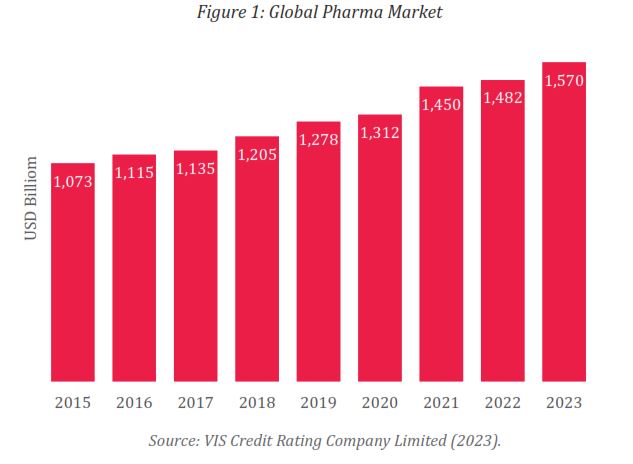
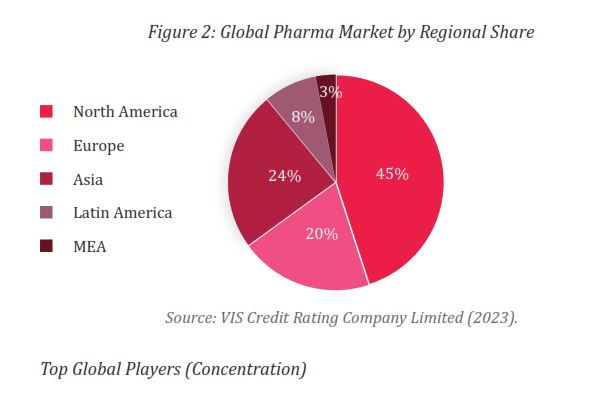
In recent years, the pharmaceutical industry has witnessed significant expansion propelled by new market entrants, innovative therapeutic avenues, and evolving consumer demands. As of 2022, the global pharmaceutical market was valued at USD 1.48 trillion, projected to reach USD 1.57 trillion by the end of 2023, and anticipated to surpass USD 1.7 trillion by 2025. Dominated by the United States and China, these two countries are poised to command over half of the market. North America is expected to maintain its lead with a 45% market share in 2023, while Europe’s share is predicted to decline to 20%. The Asia Pacific region is set to retain its position as the second-largest market with a 24% share in 2023. Latin America, the Middle East, and Africa (MEA) are forecasted to hold 8% and 3% of the global pharmaceutical market, respectively, in 2023. (VIS Credit Rating Agency pharma sector report October 2023).
The pharmaceutical industry is characterized by a concentration of established players, with the top 10 firms generating more than a third (35%) of global revenue in 2022. The United States remains the primary contributor to global pharmaceutical revenue, accounting for nearly 45% in the same year. Notably, China’s share of global revenue has been steadily growing, reaching almost 10% by 2022, positioning it as a significant player in the industry. This trend reflects not only China’s population growth but also its emergence as a leader in various aspects of pharmaceutical production and innovation.