
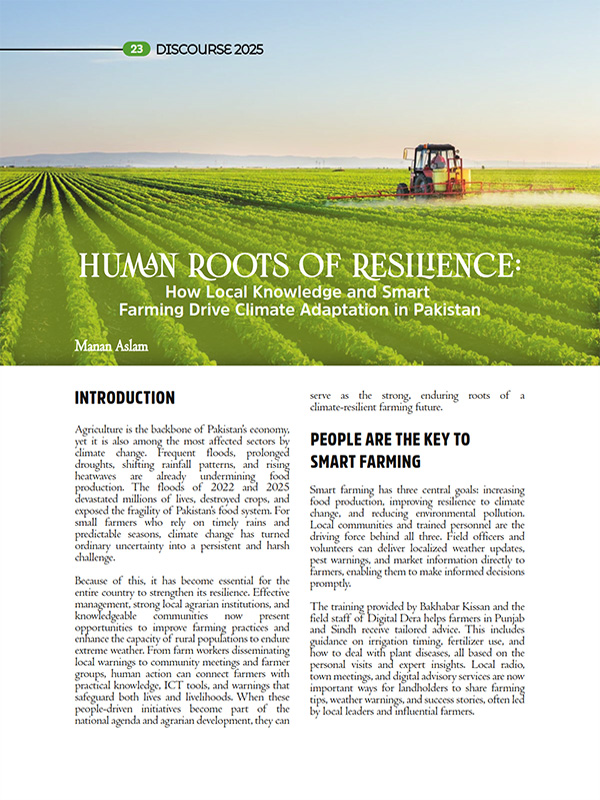
Human Roots of Resilience: How Local Knowledge and Smart Farming Drive Climate Adaptation in Pakistan
Introduction
Agriculture is the backbone of Pakistan’s economy, yet it is also among the most affected sectors by climate change. Frequent floods, prolonged droughts, shifting rainfall patterns, and rising heatwaves are already undermining food production. The floods of 2022 and 2025 devastated millions of lives, destroyed crops, and exposed the fragility of Pakistan’s food system. For small farmers who rely on timely rains and predictable seasons, climate change has turned ordinary uncertainty into a persistent and harsh challenge.
Because of this, it has become essential for the entire country to strengthen its resilience. Effective management, strong local agrarian institutions, and knowledgeable communities now present opportunities to improve farming practices and enhance the capacity of rural populations to endure extreme weather. From farm workers disseminating local warnings to community meetings and farmer groups, human action can connect farmers with practical knowledge, ICT tools, and warnings that safeguard both lives and livelihoods. When these people-driven initiatives become part of the national agenda and agrarian development, they can serve as the strong, enduring roots of a climate-resilient farming future.
People Are the Key to Smart Farming
Smart farming has three central goals: increasing food production, improving resilience to climate change, and reducing environmental pollution. Local communities and trained personnel are the driving force behind all three. Field officers and volunteers can deliver localized weather updates, pest warnings, and market information directly to farmers, enabling them to make informed decisions promptly.
The training provided by Bakhabar Kissan and the field staff of Digital Dera helps farmers in Punjab and Sindh receive tailored advice. This includes guidance on irrigation timing, fertilizer use, and how to deal with plant diseases, all based on the personal visits and expert insights. Local radio, town meetings, and digital advisory services are now important ways for landholders to share farming tips, weather warnings, and success stories, often led by local leaders and influential farmers.
Equally important, the records maintained by trained field workers and analyzed by experienced government staff enable the assessment of soil structure, crop health, and rainfall trends. Farmers who receive such insights from their local officers can adjust sowing schedules, safeguard livestock, or select drought-resistant seed varieties—enhancing their ability to adapt. Skilled individuals thus serve as a crucial bridge between science and the field, translating complex climate data into actionable advice for those who need it most.
Local Ideas and Fair Access
Pakistan hosts numerous agricultural experts, institutions, and non-profit organizations that generate new solutions to farming challenges under climate stress. This environment allows young leaders, researchers, and farmers to collaborate in developing localized responses to agricultural problems.
In Multan and Faisalabad, young researchers and local innovators have built low-cost weather stations and collect the information themselves. These initiatives, led by the community, make sure the weather information is correct and useful for their specific area. In Gujranwala, small farmer groups are experimenting with improved irrigation methods and crop health monitoring systems—reducing waste through better training and innovative agrarian practices. Similarly, partnerships between universities and farmer advocacy organizations are promoting solar-powered irrigation systems, which reduce water and fuel waste through efficient operation and maintenance.
Despite these encouraging developments, a significant gap in agricultural knowledge and resource access prevents widespread adoption. Many small farmers—especially women—lack access to ICT tools, agricultural loans, and farm mechanization equipment. In some regions, weak local leadership and limited government outreach further hinder the flow of reliable information. To address these challenges, the country needs targeted government reforms, comprehensive community advisory programs, and strong collaborations between public institutions, local NGOs, and farmer associations. Without equitable access, the benefits of modern farming will remain confined to a few, rather than strengthening entire communities.
Government Policies for Climate-Ready Farming
Pakistan’s government recognizes the importance of human systems and effective governance in addressing climate change, yet implementation remains inconsistent. The National Climate Change Policy (2021) and the National Adaptation Plan (2023) both emphasize institutional reforms as essential for success. However, coordination and trust among the Ministry of Climate Change, local agricultural departments, and farming groups remain limited.
For policies to be effective and sustainable, developing farming skills and strengthening community engagement must become core components of agricultural planning. This requires not only capital and equipment but also a clear vision that integrates human capacity-building with climate and food security goals. National and provincial governments should collaborate to establish “Agricultural Innovation Centers” within agricultural universities, managed by expert trainers. These centers could serve as hubs where local communities and researchers jointly design training modules, information materials, and ICT tools to support smallholder adaptation.
Investment is another critical factor. The high upfront cost of adopting new practices often deters farmers. Local cooperatives and community banks could fund training and advisory services to help smallholders adapt. Agricultural banks might also introduce special “resilience loans” to finance irrigation systems, solar energy solutions, improved seed varieties, and ICT equipment.
Moreover, Pakistan urgently needs a unified information management mechanism. At present, weather and agricultural data are collected by multiple agencies using inconsistent methods. Establishing a national data center, managed by trained personnel, could help public institutions, private companies, and researchers collaborate more effectively. Clear data-sharing protocols would enhance evidence-based decision-making and reduce duplication of efforts.
People’s Actions for Efficiency and Pollution Reduction
While preparing for climate impacts is vital, behavioral changes and improved management can also significantly enhance resource efficiency and reduce waste. Trained farmers who follow optimized irrigation schedules conserve both water and fuel. Expert advice on soil health and fertilizer application minimizes runoff, lowering pollution levels. In livestock farming, properly maintained management records enable farmers to monitor animal health, track feed use, and reduce greenhouse gas emissions through better nutrition practices.
Local farmer cooperatives and community-supported marketing groups are also helping shorten supply chains by connecting producers directly with buyers. This reduces transport-related emissions and post-harvest losses, which are major contributors to waste. By embedding people-led solutions and sound management practices throughout the agricultural process, Pakistan can advance its commitments under the Paris Agreement while producing food more efficiently and sustainably.
Building Strong Resilience Through Local Youth
New agricultural practices work best when they originate from local needs and are led by people with a vested interest in success. When communities own and manage their solutions, results are more effective and enduring. In many villages, local youth are emerging as “communication leaders”, individuals adept at sharing information and using ICT tools to assist farmers. They help farmers interpret weather forecasts, adopt new technologies, and identify market opportunities, significantly increasing the adoption rate of modern practices.
Women’s participation is equally critical. Although they perform most of the farm labor, women often face barriers to training and resources. Targeted programs that provide access to ICT tools, education, and local support can yield transformative results. Women-led initiatives not only strengthen household resilience but also challenge traditional gender norms, promoting social empowerment alongside climate adaptation.
Challenges and the Way Forward
Despite notable successes, Pakistan still faces long-term challenges in mainstreaming climate resilience. Weak government institutions, limited access to affordable ICT tools, and poor coordination among stakeholders continue to pose obstacles. Many farmers rely more on traditional knowledge or peer advice than on scientific data. Low literacy levels, limited trust in official institutions, and the gap between observation and on-ground practice further slow the diffusion of innovation.
Addressing these issues requires collective effort. Investment in rural education and agricultural training must become a national priority, complemented by initiatives promoting solar and clean energy use. Public awareness campaigns can help small farmers understand the tangible benefits of informed farming. Most importantly, the government must view human expertise and community engagement not as peripheral efforts but as central pillars of agricultural and climate policy. Only a whole-of-government approach, supported by local organizations, research institutions, and the private sector, can transform human potential into lasting resilience.
Conclusion
Integrating human capacity with advanced farming methods presents a unique opportunity for Pakistan. As climate-related challenges intensify, strong institutions and active community participation offer a path from vulnerability to resilience. Through timely information, expert guidance, and better organization, trained local leaders empower farmers to adapt their practices, manage risks, and protect livelihoods.
However, this transformation will not occur spontaneously. It requires strategic investment in people, clear policy direction, and inclusive participation. If implemented wisely, people-centered agriculture can turn Pakistan’s climate vulnerabilities into opportunities for innovation and growth. By empowering local leaders, equipping farmers with knowledge and practical skills, and embedding human-driven approaches into climate adaptation efforts, Pakistan can emerge as a regional leader in climate-resilient agriculture. The goal is not merely to survive climate change, but to build a smarter, stronger, and fairer future for rural Pakistan.
Mr. Manan Aslam is a Faculty Member and Researcher associated with the School of Management, Jiangsu University, Zhenjian, China; and the Department of Agribusinesses and Entreprenuership Development, Faculty of Social Sciences and Humanities at the Muhammad Nawaz Shareef Univeristy of Agriculture, Multan, Pakistan.