Introduction
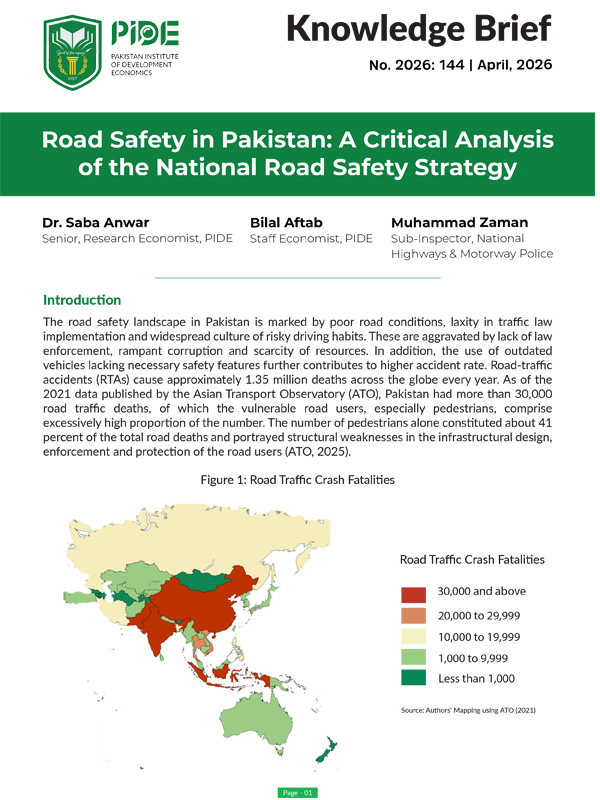
The road safety landscape in Pakistan is marked by poor road conditions, laxity in traffic law implementation and widespread culture of risky driving habits. These are aggravated by lack of law enforcement, rampant corruption and scarcity of resources. In addition, the use of outdated vehicles lacking necessary safety features further contributes to higher accident rate. Road-traffic accidents (RTAs) cause approximately 1.35 million deaths across the globe every year. As of the 2021 data published by the Asian Transport Observatory (ATO), Pakistan had more than 30,000 road traffic deaths, of which the vulnerable road users, especially pedestrians, comprise excessively high proportion of the number. The number of pedestrians alone constituted about 41 percent of the total road deaths and portrayed structural weaknesses in the infrastructural design, enforcement and protection of the road users (ATO, 2025).
On the same note, according to the World Health Organization (WHO), in Pakistan, the road traffic death rate is still significantly high in comparison with the global standards, which highlights the urgency of the universal intervention. The three primary causes of road traffic accidents as highlighted by the motorway police of Pakistan include:
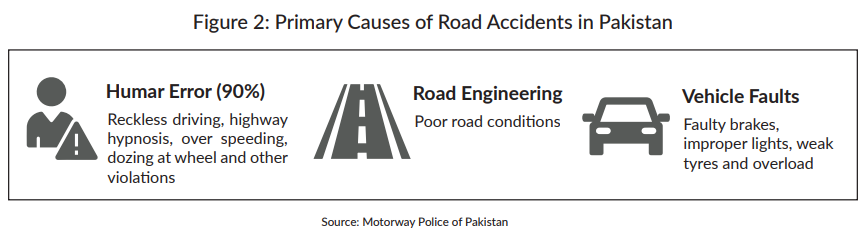
To address these crises and in keeping with the objective of the United Nations Decade of Action on Roads Safety and Sustainable Development Goals (SDGs) Target 3.6 to reduce road traffic injuries and deaths by half by 2030, the Government of Pakistan published the National Road Safety Strategy (NRSS) 2018-2030 (GoP, 2018). The Strategy uses the Safe System Approach, including five road safety pillars: safe road users, safe vehicles, safe roads and roadsides, safe speeds and post-crash response. All these pillars are geared towards enhancing compliance in behaviour, vehicle quality, infrastructure safety, speed, and emergency medical services at the national level (WHO, 2023).
However, its implementation has been hampered by the systemic issues of lax enforcement, corruption, and underfunding. According to infrastructure ratings made under the International Road Assessment Programme (IRAP), a large percentage of the road network in Pakistan is still graded as low-quality in terms of its safety, especially pedestrians and cyclists. Moreover, institutional initiatives like launch of Pakistan Rad Assessment Programme in 2025 demonstrate new dedication to the policy, but little has been done to improve trends in national causality (IRAP, 2025; ATO, 2025). This knowledge brief analyses the execution of the five pillars of the National Road Safety Strategy 2018-2030 and argues whether Pakistan had improved, stayed stable or declined in all the five pillars of road safety governance.
Safe Road Users
The Safe Road Users pillar of the NRSS is aimed at the minimization of behavioural risk factors such as non-compliance with the traffic laws, helmet wearing, seatbelt use, distracted driving, poor training of drivers, and the inefficient enforcement systems that are all identified as determinants of road traffic injuries and fatalities. Although this pillar is a fundamental part of the Strategy, to date, there has been little progress with only little improvement within certain urban centres, but no such significant change. According to the latest WHO Global Status Report on Road Safey 2023, although helmet and seatbelt use is regulated by the law of Pakistan, the adherence to the laws is insufficient, and behavioural risk factors like distracted driving and speeding still play significant roles in the road trauma, highlighting the existing gaps between the law and practice (WHO, 2023).
Empirical research shows that the lack of safety gears usage is widespread: road surveys indicate that a vast majority of motorcyclists and their passengers wear no helmets, and a large majority of drivers and passengers of vehicles do not wear any seatbelts, which dictates the persistence of the current lack of enforcement and compliance with safety standards among the population (Khoso, 2019; Irfan, 2024). The evidence about the driver’s knowledge and attitudes proves that the knowledge about certain rules (e.g. the use of helmet is obligatory) can be at an average level. However, the knowledge about certain laws, e.g. speeding limit, the harmfulness of using cell phones during driving is low. Further, there is negative attitude towards following the rules, especially among younger and less educated motorists, conflicting with the concept of safe road user behaviour (Memon, et al., 2024).
The impacts of enforcement responses have been localized with the most notable cases of improvement through the implementation of automated e-challan systems and more stringent advisories against helmet and seatbelt violations in big cities. Such measures have increased detection and penalty provision among offenders by a small margin. The costliness and faithfulness of these measures however is not balanced beyond the large urban centres, where enforcement is less potent and social consciousness campaigns are less. As a result, despite an increase in visible enforcement activities and technology-based compliance check-ups, the net effect on national road users’ behaviours is rather insert by 2025, and risky behaviour remains prolific and enforcement has not yet reached the necessary strength and coherence to affect mass behavioural charge in line with the aims of the strategy.
Two-Wheelers
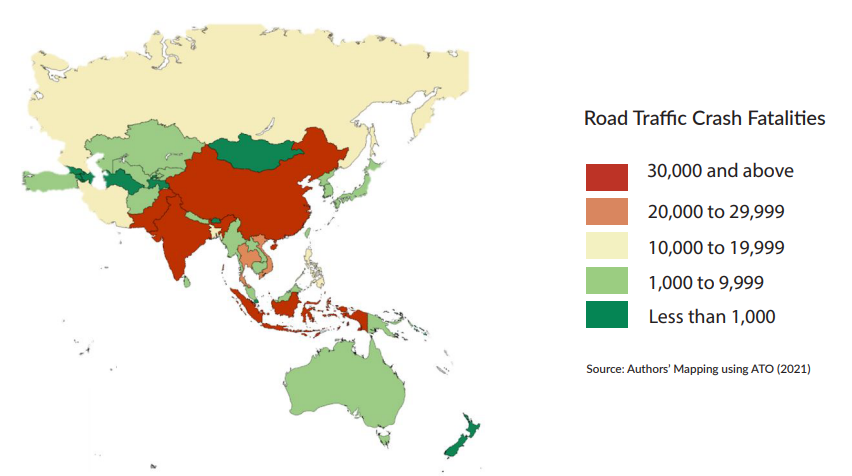
Road crashes are the major cause of death among youth all over the world and these crashes have a considerable injury burden among all countries (Khan et al., 2021; Li et al., 2016). Based on the ATO, it is estimated that 1.35 million deaths and 30 to 50 million injuries result from preventable road accidents every year. Pedestrians, cyclists, and motorcyclists constitute up to 50% of road deaths and a significant proportion of injuries. Vulnerable Road users (VRUs) like two-wheeler riders represented 15.5% of traffic fatalities globally in 2023, with injuries exceeding 82,000 in monitored regions (ATO, 2025). Single two-wheeler crashes are common, particularly amongst the young and the elderly. This underscored the need for targeted interventions such as enhanced visibility and stronger enforcement of speed limits. In Low- and Middle-Income Countries (LMICs), where two-wheelers prevail, the impact of crash can be severe, leading to disabilities in the long terms, and thus increasing socioeconomic costs. Helmet usage is very helpful in avoiding serious and commonly incapacitating head injuries (WHO, 2021). As per the Asian Transport Outlook (ATO, 2024), Pakistan’s vehicle fleet is dominated by the two-wheelers with around 78% of the total vehicles. It is worrying to see the growing proportion of two-wheelers’ users in road traffic crash fatalities: