Why Pakistani Industry Does Not Upgrade: Lessons from the Firm-Level Evidence
Pakistan’s industrial problem is often described in terms of exports, energy, or macroeconomic instability. All of that matters. But none of it gets to the heart of the matter. The deeper problem is that the Pakistani industry has failed to upgrade. Too many firms remain stuck in low-value products, weak production systems, and business models built around survival in protected domestic markets rather than movement into more demanding and more rewarding segments. The puzzle is not that Pakistani firms do nothing. Many of them invest, adapt, and respond. The puzzle is that these efforts so rarely cumulate into sustained gains in productivity, quality, and export sophistication.
This is why the usual diagnosis is too shallow. Pakistan’s industrial weakness is not simply a shortage of capital or an absence of entrepreneurship. It is, above all, a problem of capabilities and incentives. Firms do not upgrade when they lack the internal capacity to absorb better technologies, but they also do not upgrade when the policy environment does not reward that effort. Pakistan suffers from both. The result is a low-upgrading equilibrium: firms do just enough to remain in business, but too little to change what they produce, how efficiently they produce it, or where they can sell it. This basic argument is consistent with the wider literature on innovation in developing countries, which emphasizes that the central challenge is often not invention at the frontier but the accumulation of organizational, managerial, and technological capabilities needed for catch-up.
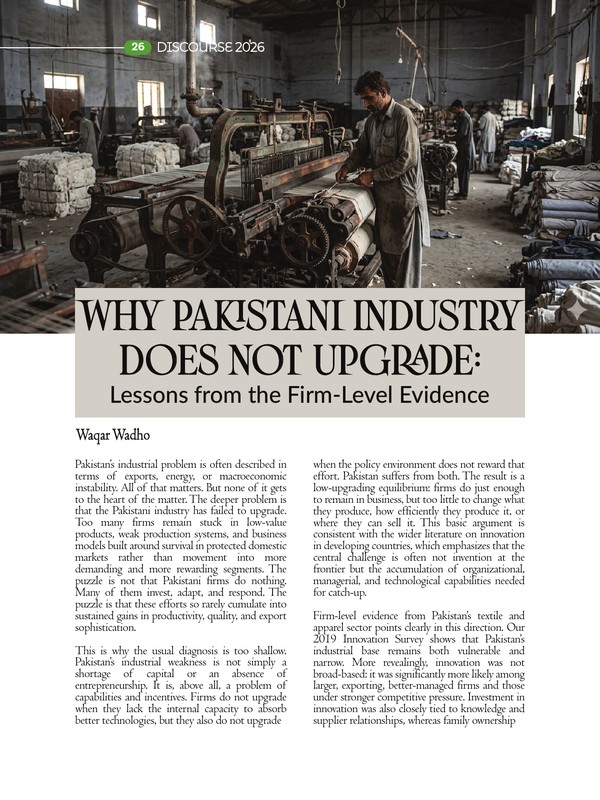
Firm-level evidence from Pakistan’s textile and apparel sector points clearly in this direction. Our 2019 Innovation Survey shows that Pakistan’s industrial base remains both vulnerable and narrow. More revealingly, innovation was not broad-based: it was significantly more likely among larger, exporting, better-managed firms and those under stronger competitive pressure. Investment in innovation was also closely tied to knowledge and supplier relationships, whereas family ownership was negatively associated with it. Management quality itself was low, with an average score of just 0.38, and was worse in family-controlled firms but better in exporting and more competitive ones (Wadho, Chaudhry, and McCartney, 2019)[1].
What this suggests is that Pakistan’s industrial problem is not a simple lack of “innovation” in the abstract. The real problem is that innovation is too often narrow, underpowered, and disconnected from broader organizational change. This is where policy thinking in Pakistan often goes wrong. The word innovation still tends to evoke images of startups, apps, and frontier R&D. Still, in a country like Pakistan, industrial upgrading usually begins somewhere much more basic: with better workflow, tighter quality control, lower defect rates, stronger supplier relationships, more disciplined management, and the ability to meet consistent standards. Those are not glamorous changes, but they are the ones that move firms from low-value production to more competitive segments.
The evidence strongly supports that diagnosis. Wadho and Chaudhry (2018)[2] show that product innovation is associated with higher labor productivity and productivity growth in Pakistani textile and apparel firms, but they also show that innovation is shaped by vertical knowledge flows from buyers and suppliers, exporting, and competition. By contrast, badly designed subsidies can crowd out rather than stimulate private effort. In other words, firms innovate not because they are handed protection, but because they face pressure to improve and have channels through which they can learn. Similarly, Wadho and Chaudhry (2022)[3] find that organizational innovation yields a larger productivity payoff than product innovation and that process innovation also matters greatly. That is an important result. It tells us that Pakistan’s industrial bottleneck lies less in the absence of new product ideas and more in the weakness of management systems, production routines, and firm organization.
International evidence points in the same direction. Bloom et al. (2013)[4], in their well-known experiment with Indian textile firms, showed that relatively basic improvements in management practices raised productivity by 17 percent within a year, largely through better quality control, lower inventories, and improved efficiency. That is striking because the gains did not come from frontier technology. They came from running factories better. The lesson for Pakistan is obvious. Many firms do not need an innovation grant first; they need the ability to monitor production, identify defects, manage inventory, delegate authority, and standardize operations. Until those basics are in place, the returns to more sophisticated technology will remain limited.
The process-upgrading evidence from Pakistan reinforces the point. Wadho and Chaudhry (2024)[5] show that process innovation should not be treated as a vague label. It has concrete manifestations: lower costs, fewer defects, shorter cycle times, more capacity, and better quality. Those outcomes are associated with higher labor productivity and higher sales. Just as importantly, the study does not find that process innovation reduces employment. That is especially relevant in Pakistan, where technological upgrading is often treated politically as a threat to jobs. The evidence suggests something more nuanced and more encouraging: better processes raise efficiency and sales without necessarily shrinking the workforce, though they may increase the demand for more capable workers. The real threat to jobs is not upgrading. It is stagnation. Firms that do not improve eventually lose markets, and economies that do not improve eventually lose industries.
There is another reason Pakistani industry struggles to upgrade: many barriers lie inside firms, not just outside them. Experimental evidence from Sialkot’s soccer-ball producers is especially instructive. Atkin et al. (2017)[6] studied a new cutting technology that clearly reduced material waste and should, in principle, have been profitable for firms to adopt. Yet adoption remained low. The reason was not that firms failed to understand the technology. It was that workers, paid on piece rates, had little reason to embrace a method that initially slowed them down, while owners found it difficult to change shop-floor incentives. In other words, even good technologies can fail to diffuse when firms are organized in ways that block adaptation. This is a powerful lesson for Pakistan. Industrial upgrading is not only about access to technology. It is also about authority, incentives, and organizational control.
Trade policy exacerbates these internal weaknesses. Pakistan has long operated with a policy structure that protects selected domestic producers while taxing the very inputs that would help firms improve. Recent World Bank[7] analysis argues that tariff reforms can boost exports, imports, investment, GDP, and employment, but also stresses that tariff reform alone is not enough; broader reforms in energy, trade finance, regulation, and competition must accompany it. That is precisely the point. A firm that wants to upgrade needs affordable machinery, reliable energy, access to imported intermediate goods, working capital for export orders, and a regulatory environment that does not waste managerial time. When these conditions are absent, firms retreat into defensive strategies. They serve the domestic market, avoid experimentation, and treat upgrading as a luxury rather than a necessity.
The structure of ownership and finance further reinforces this trap. The IFC-World Bank[8] private sector diagnostic describes Pakistan’s private sector as dominated by SMEs that are often informal, mostly family-run, and constrained by distortive policies maintained by special-interest groups. This matters because family ownership is not merely a legal form; in Pakistan, it often entails centralized decision-making, limited delegation, and a preference for caution over long-term capability-building. When firms are also short of finance, the bias toward caution becomes even stronger. Investment then tilts toward what is immediately visible and recoverable, not toward the slower work of improving systems, training managers, or entering new markets.
This is why Pakistan’s failure to upgrade should not be read as a mystery. It is the predictable outcome of a policy regime that has too often rewarded protection without performance and a firm structure that has too often tolerated weak management without consequence. Firms are not upgrading because too many lack the capabilities to do so, and because the surrounding incentive system does not force the issue. Exporters tend to perform better not because exporting is magical, but because export markets demand discipline. Better-managed firms innovate more, not because management is fashionable, but because upgrading is an organizational act before it is a technological one. Supplier-buyer linkages matter because firms learn through production relationships, not through slogans about innovation ecosystems.
The policy implication is therefore straightforward, though not easy. Pakistan does not need another industrial package built around exemptions, ad hoc incentives, and protection for incumbents. It needs a capability-centered industrial strategy. That means designing industrial policy around the actual bottlenecks to upgrading: management-extension programs for SMEs, support for process reorganization and quality control inside factories, supplier-development schemes that deepen learning from production networks, export-linked support that pushes firms into more demanding markets, and targeted incentives for family firms to professionalize management and delegate operational authority. Public support should reward firms that build capabilities, strengthen buyer-supplier linkages, improve processes, and enter export markets, rather than simply subsidizing firms for continuing as they are.
Pakistan’s industrial future will not be determined by whether a few firms become world-class exceptions. It will be determined by whether a much larger set of ordinary firms can make the difficult transition from low-capability production to disciplined, competitive, and export-oriented production. That transition is not blocked by one single constraint. It is blocked by weak management, thin learning networks, internal organizational rigidities, costly inputs, limited finance, and public policy that has too often confused shelter with strategy. Until those conditions change, Pakistan’s industry may continue to produce and, at times, even expand, but it will not truly upgrade. And without upgrading, growth will remain shallow, exports will remain fragile, and industrial ambition will continue to outrun industrial reality.
Waqar Wadho is an associate Professor of Economics at Lahore School of Economics.
[1] Wadho, W., Chaudhry, A., & McCartney, M. (2019, October). Innovation in the Pakistani textiles sector: Preliminary findings of the second round [Conference presentation]. Oxford, United Kingdom.
[2] Wadho, W., & Chaudhry, A. (2018). Innovation and firm performance in developing countries: The case of Pakistani textile and apparel manufacturers. Research Policy, 47(7), 1283–1294. https://doi.org/10.1016/j.respol.2018.04.007
[3] Wadho, W., & Chaudhry, A. (2022). Innovation strategies and productivity growth in developing countries: Firm-level evidence from Pakistani manufacturers. Journal of Asian Economics, 81, 101484. https://doi.org/10.1016/j.asieco.2022.101484
[4] Bloom, N., Eifert, B., Mahajan, A., McKenzie, D., & Roberts, J. (2013). Does management matter? Evidence from India. The Quarterly Journal of Economics, 128(1), 1–51. https://doi.org/10.1093/qje/qjs044
[5] Wadho, W., & Chaudhry, A. (2024). Measuring process innovation outputs and understanding their implications for firms and workers: Evidence from Pakistan. Technovation, 136, 103085. https://doi.org/10.1016/j.technovation.2024.103085
[6] Atkin, D., Chaudhry, A., Chaudry, S., Khandelwal, A. K., & Verhoogen, E. (2017). Organizational barriers to technology adoption: Evidence from soccer-ball producers in Pakistan. The Quarterly Journal of Economics, 132(3), 1101–1164.
[7] World Bank. (2025). From inward to outward: Pakistan’s shift towards export-led growth.
[8] International Finance Corporation, & World Bank. (2021). Creating markets in Pakistan: Country private sector diagnostic.