Automobile Policy 2026–2031: Recommendations from PIDE Research
Executive Summary
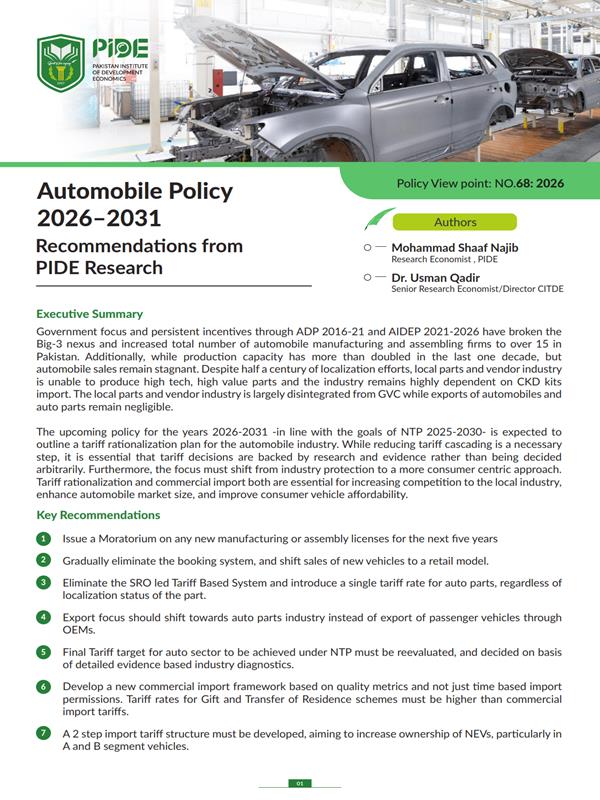
Government focus and persistent incentives through ADP 2016-21 and AIDEP 2021-2026 have broken the Big-3 nexus and increased total number of automobile manufacturing and assembling firms to over 15 in Pakistan. Additionally, while production capacity has more than doubled in the last one decade, but automobile sales remain stagnant. Despite half a century of localization efforts, local parts and vendor industry is unable to produce high tech, high value parts and the industry remains highly dependent on CKD kits import. The local parts and vendor industry is largely disintegrated from GVC while exports of automobiles and auto parts remain negligible.
The upcoming policy for the years 2026-2031 -in line with the goals of NTP 2025-2030- is expected to outline a tariff rationalization plan for the automobile industry. While reducing tariff cascading is a necessary step, it is essential that tariff decisions are backed by research and evidence rather than being decided arbitrarily. Furthermore, the focus must shift from industry protection to a more consumer centric approach. Tariff rationalization and commercial import both are essential for increasing competition to the local industry, enhance automobile market size, and improve consumer vehicle affordability.
Key Recommendations
- Issue a Moratorium on any new manufacturing or assembly licenses for the next five years
- Gradually eliminate the booking system, and shift sales of new vehicles to a retail model.
- Eliminate the SRO led Tariff Based System and introduce a single tariff rate for auto parts, regardless of localization status of the part.
- Export focus should shift towards auto parts industry instead of export of passenger vehicles through OEMs.
- Final Tariff target for auto sector to be achieved under NTP must be reevaluated, and decided on basis of detailed evidence based industry diagnostics.
- Develop a new commercial import framework based on quality metrics and not just time based import permissions. Tariff rates for Gift and Transfer of Residence schemes must be higher than commercial import tariffs.
- A 2 step import tariff structure must be developed, aiming to increase ownership of NEVs, particularly in A and B segment vehicles.
The Auto Industry Development and Export Policy (AIDEP) 2021-2026 has expired with the completion of Fiscal Year 2025-2026. This was the third sector-specific policy for governing the automobile sector after the Auto Industry Development Program (AIDP) for 2007-2012 and then the Automotive Development Policy (ADP) 2016-2021. Based on the focus and continuous efforts particularly in the last decade, for the development and revitalization of automobile industry, a new policy for the next five-year period from 2026 to 2030 is expected to be announced soon.
Pakistan Institute of Development Economics (PIDE) during the last five years has comprehensively undertaken research on the automobile sector of Pakistan, and been a leading voice for much needed reforms for the development of automobile industry and market in the country. As such, this policy viewpoint identifies the areas that the upcoming policy should address and presents recommendations for development of the industry in Pakistan based on PIDE’s research.
Policy Gate-keeping
The AIDEP has expired just a few days before, which means the new policy must be announced soon to ensure that the sector is governed through well-defined and targeted policy interventions without any disruption. However, there is no publicly available draft or information regarding what the new policy would contain for the industry.
This continues to fuel uncertainty among the industry and consumers both with regards to the fate of the industry’s future, while also giving chance to various opportunists within the automobile market to initiate a rumor mill and benefit and exploit on the basis of hearsay.
Whenever a new automobile industry policy is being developed, academia is wondering where is the policy, and why is it being kept in silos giving rise to uncertainty, market distortions, and opportunity to exploit?
While the contents of the policy hold the utmost importance, a transparent policy making process is also essential to eliminate possibility of chaos and uncertainties, and instead create an environment of trust between the government and its policy making process and the industry, consumers and even academia.
Key Recommendations:
- The current AIDEP 2021-2026 shall be extended for six more months till 31 December 2026.
- Draft of the new policy can be publicly shared and presented before presenting to relevant approval forums
- A 45-day feedback period must be given for public feedback on the policy, while conducting necessary stakeholder consultations in the given period as well.
- Following feedback being incorporated, the final draft should/may be presented to the parliament for debate and approval.
Volume-less OEMs
Following ADP 2016-2021, numerous firms were given greenfield and brownfield status and issued automobile manufacturing and assembling licenses. This has resulted in more than 10 new Original Equipment Manufacturers (OEMs) or car brands beginning manufacturing and assembly of vehicles in Pakistan during the last decade.
While on one hand, this has helped dilute the market power and hold on the automobile market of the infamous ‘Big Three’, but it has not translated into expansion and growth of the automobile market in the country. Despite entry of new brands, the annual total production figures have still not reached the same levels that Pakistan’s industry managed with three firms prior to COVID-19, except for outlier year of 2021-22. The industry continues to target and wish for breaking the 200,000 sales barrier every year but is unable to do so.
Consequently, the market share of each brand has been significantly reduced; making automobile business a much difficult affair in the country. Many new local firms that partnered with global OEMs to begin assembly and manufacturing in Pakistan have expanded their partnerships with multiple global brands in order to survive in the industry, while some continue to sale vehicles without establishing manufacturing or assembly facilities in the country. (Table 1).
Table 1: Some Pakistani Business Groups with Multiple OEM Partnerships
| Pakistan based group | Global OEM Partners |
| Lucky Group | Kia (Korea), Peugeot (France), GAC (China) |
| Nishat Group | Hyundari (Korea), Omoda and Jaecoo of Chery (China) |
| Sazgar Group | BAIC (China), Haval, ORA, and Tank of GWM (China) |
| Master Group | Changan (China), Deepal (China) |
| United Group | Jetour of Chery (China), Louyang Dahe (China) |
Moreover, production projections in the policies have never come true either. The AIDP 2007-2012 projected that production shall be scaled up to 500,000 vehicles by 2012 from 161,000 in 2006, while the ADP 2016-2021 set a target of 350,000 units.
The 2021-2026 AIDEP again increased the production target to 500,000. In the last 20 years, the production capacity through establishment of new assembly plants has almost doubled from 275,000 in 2006 to over 500,000 today, but production levels remain low and well below the total production capacity from two decades ago, let alone inching close to the targets being set in the five year policies.
How are the production targets being set, and sales being projected? Is any probable impact of meeting these production and sales projection on exchange rate, road infrastructure and overall economy studied before finalizing the targets?
Is increasing vehicle brands without increasing automobile market size a viable approach in the long term?
What PIDE’s Research Says
Despite repeated efforts, Pakistan’s automobile industry has not been able to scale up production, improve local development and production, and reduce cost of production. Automobile manufacturing and assembling still remains highly import dependent, while the local vendor industry remains disconnected from the global value chain with negligible exports.
Comparatively, Pakistan’s policy environment lags much behind other countries that have managed to develop their automobile industries to compete on a global level through production volumes and technological capabilities.
-The Skewed Policy Environment, Chapter 5, Driving Backwards: What is Wrong with Pakistan’s
Automobile Industry (PIDE)
Recommendations:
- Issue a Moratorium on any new manufacturing or assembly licenses for the next five years.
- Phase out booking system over a period of three years, and shift sales of new vehicles to a retail model.
Localization Obsession vs the Export Dream
Pakistan’s automobile policy has always revolved around the idea of localizing production. Initiated through the deletion program in 1980s, and then replaced by a Tariff Based System (TBS), the original purpose was to develop the capability to manufacture locally. Despite nearly half a century of localization efforts, vehicle production still remains majorly import dependent, as local vendor industry’s capabilities are restricted to low-value parts while all high-value and high-tech parts are imported as Completely Knocked Down (CKD) kits.
In recent times, the focus has shifted towards turning the automobile industry into an export industry. The AIDEP 2021-2026 mandated that five percent of the total production shall be exported, but it did not bear any fruit either.
Can a CKD import dependent automobile industry become competitive for exports? At under 200,000 p.a. production volumes, and individual production capacities of a few thousands, can firms achieve the economies of scales required to tap in to the export market? The new policy should tackle this fundamental issue of the industry.
Automobile OEMs operating in Pakistan have three primary origins: Japan, Korea, and China. The Japanese and Korean automobile firms follow a similar policy. Instead of scaling up production at a single or few places for global exports; firms from both countries partner with local organizations in target countries. They set up assembly plants while supporting the establishment of a local vendor industry targeting the local automobile market or only regional markets at best. This philosophy is best described as Glocalization[1]:conducting business by targeting global markets but modifying products as per the local needs, and often through full or partially localized business operations.
Further, when the AIDEP 2021-2026 tried to make exports mandatory, Japanese firms pointed to the JV agreements with local Pakistani firms which limit production in Pakistan for local sales only and not exporting.
Chinese automobile firms have gained market share in various countries and regions within Right Hand and Left Hand driven markets based on highly competitive pricing and features list, including Europe and Americas. Recently, Chinese firms have expanded production facilities to Latin America, East Asia and now South Asia as well, with local markets and export targeting both. In Pakistan, however, the individual production capacities of these firms for now are just a few thousand vehicles annually. Without a focus on achieving economies of scale, export competitiveness will remain a distant dream. Moreover, since numerous regulations in Pakistan (such as safety standards) vary in comparison to other countries, this affects the export eligibility of vehicles produced in the country.
With such constraints, it is a point to ponder if exporting CBUs of vehicles is even achievable for Pakistan?
Connect with the Pakistan Institute of Development Economics
Subscribe
Select topics and stay current with our latest insights
- +92 51 9248051
- [email protected]
- PIDE, QAU Campus, Islamabad