
ABSTRACT
Unemployment has been acknowledged as one of the most important socioeconomic problems faced by developing nations, especially Pakistan. It is a sign of underlying structural imbalance in the economy, in addition to reflecting the labour market inefficiencies. It is argued that due to the higher education expansion in Pakistan during the last two decades and due to high youth bulge in the country, the young cohort entering the labour market are experiencing high unemployment. So, to understand and analyse this complex phenomenon, the Age-Period-Cohort (APC) model provides a nuanced approach in understanding unemployment rates simultaneously with other control variables. For analysis, data was acquired from the labour Force Survey (LFS) 2001-02 to 2024-25 covering twelve alternative waves. The results indicate that higher education, with increase in skills and productivity, helps individuals to escape from unemployment. However, cohort analysis shows vulnerability of young, educated cohorts to unemployment as compared to the older cohorts. This effect is more pronounced in tertiary education.
1. INTRODUCTION
Unemployment has long been recognised as one of the most pressing socio- economic challenges faced by the developing economies, including Pakistan. It not only reflects inefficiencies in the labour market but also serves as an indicator of underlying structural imbalances in the economy. A significant number of theories try to highlight different reasons for this unemployment. One of these is the Cohort Crowding Hypothesis. It claims that a cohort effect exists when large young labour force entering the job market faces tough competition and experiences unemployment and underemployment due to excess supply of labour force (Freeman, 1979; Welch, 1979; Korenman & Neumark, 1991).
Pakistan’s population is also going through a demographic transition, as young population is touching numbers much higher than past due to high birth rate and declining mortality rate. Najam & Bari (2017) observed that 64 percent of the population is below 30 years of age and 29 percent lies between 15 to 29 years’ age group. In Pakistan, higher population growth rate leads to higher labour force availability and higher unemployment rate consequently (Hafeez, et al. 2020).
Another reason for the cohort effect on unemployment is excess supply of higher education in the labour market. Though no one can deny the important role higher education plays in the development of a country by enhancing its human capital, promoting innovation, and supporting the transition towards a knowledge-based economy. However, true benefits of higher education manifest only if it is really needed in the labour market or is consistent with technological change, industrial revolution and macroeconomic environment of a country (Haim, 2019). Therefore, when labour markets were not adequately responsive, led to unemployment and low earnings in many countries, a phenomenon known as “Overeducation” (Freeman, 1976; Sicherman, 1991) or “Education Inflation” (Collins, 1979) in literature. In such a scenario younger cohort with higher education face significantly higher unemployment, low earnings and mismatch of education as compared to older cohorts (Wang, et al. 2012; Haim, et al. 2019; Boto-García & Escalonilla, 2022).
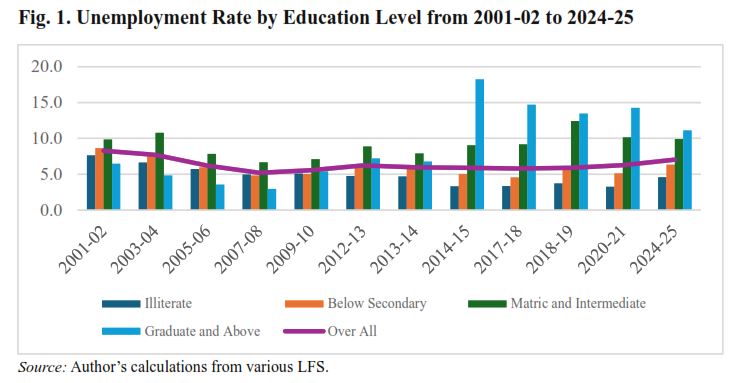
In case of Pakistan, a great change was witnessed in higher education when the University Grant Commission was transformed to Higher Education Commission in 2002. As a result, the average growth rate of higher education was increased by 16 percent, whereas the average growth rate of primary education remained just 5 percent during the last two decades. However, weak institutional management, labour markets inability to absorb increased supply, and poor education quality made it difficult to translate these increased years of schooling into improved human capital (Mustafa, 2023). Moreover, due to worsening economic situation, the labour market in Pakistan was unable to absorb the huge number of skillful labour force that Pakistan was producing (see British Council, 2015). As a result, the average unemployment rate in Pakistan remained between 5 percent and 10 percent during 2006 to 2012, whereas the unemployment rate among the tertiary educated individuals became more alarming as it reached about 18 percent in the year 2014 whereas the average unemployment rate of young graduate was 31 percent.
Figure 1 depicts the given scenario.
Hence, rapid expansion of education along with demographic changes may bring problems instead of opportunities for a developing country like Pakistan. This is because when economic growth is not enough and labour markets are not developed, this expansion could lead to unemployment and lower earnings as many individuals may accept jobs not at par with their educational abilities (Ahsan, 2024).). Therefore, it is imperative to analyse whether individuals are becoming well off overtime or this huge increase in labour force is making matters worse in terms of employment opportunities.
To understand and analyse the complex phenomenon, the Age-Period-Cohort (APC) model provides a nuanced approach in understanding unemployment rates by simultaneously analysing the effects of age, time, and birth cohort. Cohort refers to a group of people who experience certain events such as birth year or entry into a college at the same time. Cohort effects are defined as the formative effects of social events on individuals at a specific period during their life course (Ryder,1965). Therefore, cohort effects are generated by the interaction between individuals’ life histories and macro- socioeconomic environment. In Pakistan massive increase in education expansion, especially higher education, may have affected the employment opportunities when large young and educated cohorts entered the labour market.
Age effect represents the social and biological process of aging and is used to measure the impact of age-related characteristics like experience, physical and mental strength, etc. on employment prospects across their life span. Period effects are variations in the time that affect all population in a society regardless of age and cohort (Yang & Land, 2013) and these may reflect in the form of macroeconomic movements, such as secular and cyclical changes in unemployment and inflation rate, etc.
Each of these three time-related factors have conceptually independent pathways to affect individuals’ employment prospects and are equally important to measure the true returns to education. Therefore, to understand the long-term changes manifesting unemployment rate, the study has used the APC model to capture the effects of age, period and cohort simultaneously as these are important to analyse the impact on unemployment along with other control variables e.g. gender, education level and region etc. For the analysis the data has been acquired from the Labour Force Survey (LFS) 2001-02 to 2024-25 covering twelve alternative waves.
Rest of the paper is arranged in the following manner. In the next section, we reviewed literature related to cohort effect on employment prospects. Section 3 describes the data and discusses the methodology. Descriptive analysis and empirical results for determinants of unemployment rate through APC Model are presented and discussed in Section 4 and last section concludes the study.
2. LITERATURE REVIEW
Research on the impact of cohort effect on unemployment rate flourished after World War II, especially during period 1950-60, when the baby boom was at its high and the age structure in the USA and Europe was changing dramatically (Perry, et al. 1970).
It has been argued that larger cohorts entering the labour market experience greater competition for jobs, resulting in higher unemployment rates, lower starting wages, and underemployment due to stagnant demand in labour market. Moreover, there exists imperfect substitution between old and younger cohorts since young and old workers do not compete for the same jobs and this elasticity of substitution is low for higher levels of education. This low elasticity of substitution is because people associated with jobs demanding higher levels of education undergo a long training, so the new entrants need considerable time to become close substitutes of these old cohorts (Welch ,1979; Shimer, 2001).
Perry, et al. (1970) predicted that the entry of the baby boomers into the labour market would push up the unemployment rate during the 1970s. Later various studies estimated that there is a direct as well as indirect effect of baby boomers on unemployment rate (Flaim, 1979; Biagi & Lucifora, 2008). Shimer (1998) ascertained that the direct effect of baby boomers resulted in 84 basis point increase in the aggregate unemployment rate from 1954 to 1978 and an 81-basis point decrease from 1978 to 1998. According to neoclassical growth model, a rapid increase in labour force may disturb the capital-labour ratio, increase interest rates and lower wages ultimately lead to unemployment. Moreover, if a perfect substitution does not exist between younger and older workers in the labour market then an increase in the youth labour force may affect both cohorts differently. Shimer (1998) found that such demographic shifts, like the baby boom, significantly influenced overall unemployment trends across time.
Subsequent studies confirmed Welch’s findings in different economic contexts. Easterlin (1980) expanded on Welch’s theory, showing that countries with large youth cohorts often experience higher unemployment rates due to the inability of labour markets to absorb the excess labour supply. For instance, Korenman & Neumark (2000) found that larger cohorts in the U.S. labour market experienced higher unemployment and slower wage growth. Their estimates show that large cohort size causes youth unemployment rate by elasticities 0.5 to 0.6. While explaining how labour market dynamics work, they added that with flexible wages the entry of the large young cohort results in employment adjusted with lower equilibrium wage rate. On the other hand, if jobs are fixed and wages are rigid, the unemployment rate of youth declines more sharply. In this case unemployment rate of youth rises more sharply as wages cannot adjust to increase labour supply. They suggested the view that wage rigidity intensifies cohort crowding effects on youth unemployment.
Moffat & Roth (2017) found that the negative impact of cohort size on unemployment is stronger for highly educated groups as compared to less educated groups and most of the effect comes in the early years of their career. Moreover, the rapid expansion of higher education has created conditions like those experienced during the baby boom era, with young graduates facing increased competition and skill mismatches. So, the other reason behind the cohort effect regarding graduate unemployment primarily revolves around the idea of over-education or credential inflation in the labour market, as discussed by Freeman (1976) and it got due attention after publication of his book “The Over-Educated American” in 1976. Freeman’s research ascertains that excess supply of graduates contributes to unemployment, underemployment, and wage compression for graduates. As when labour market does not grow with the education expansion the young, educated cohort faces more competition and subsequently higher unemployment in comparison to their old cohort counterpart.
Theoretical frameworks highlight that the cohort effect on unemployment among young graduates arises from interactions between demographic transitions, macroeconomic conditions, institutional structures, and individual characteristics. Cohorts entering the labour market during recessions or periods of structural change face significant disadvantages in terms of employment opportunities. Wang, et al. (2012) found that graduate unemployment issue in China has grown rapidly and one of the leading arguments attributes it to the quantitative growth of higher education, which leads to a surplus of knowledge-based workforce in the labour market while job opportunities do not grow at the same pace. This formed distinct cohort effects, which caused fierce competition among college graduates in getting appropriate jobs (Bai, 2006). Similarly, Mok & Jiang (2018) also found that higher education expansion in China has increased rapidly in 2000. As a result, on one side unemployment of young graduates increased, and on the other side they were likely to work in informal sector and face lower economic returns as compared to earlier cohorts. It is suggested that the expansion pace of higher education be slowed down nationwide to limit the quantity of graduates.
Moreover, higher education institutions remain weak in training highly skilled workforce to satisfy the technological advancement in the labour market. As it has been argued that structural problem stems from the call for higher education expansion in terms of quantitative growth without the careful mapping of diverse and changing labour market requirements (Mok & Jiang, 2018; Tam & Jiang, 2015).
In case of Pakistan various studies have been conducted to analyse how demographic and individual characteristics influence the unemployment. Like Khan & Yousaf (2013) found that chance of unemployment of young graduates of public university is high as compared to those who graduate from private university. Females have higher chance to being an unemployment as compared to male. Similarly, various studies found that age is negatively related to the rate of unemployment. Moreover, training can play a significant role in securing job. They also found that married people are less unemployed as compared to single due to acceptance of low paying jobs. Whereas rural people are less unemployed than urban people, that may show that urban areas have less opportunities or overcrowded due to large internal migration on one side, while on the other side, it is possible that in rural area people are involved in informal economy (Qayyum, 2007). However, despite the extensive research on unemployment dynamics, no research has been done that analyse that how cohort effects the unemployment in context of Pakistan’s economy. As Pakistan faces a unique demographic transition that is characterised by a large youth bulge population and on the other side higher education expansion after the 2003-04, increases the rapid labour force growth. So, with the persistent structural imbalances and ignoring the cohort-specific labour market experiences may lead to an incomplete understanding of unemployment dynamics.