Executive Summary
Pakistan holds the world’s second-largest salt reserves overall and is the only country with a Himalayan Pink salt reserve. The global market for Himalayan Pink Salt is valued at $500 million – $1.2 billion, spanning food and culinary, wellness, decorative, and other consumer uses. The global market for food and the culinary segment alone was estimated at approximately $500 million in 2026, growing at a CAGR of 3.6%. Despite having huge salt reserves, Pakistan’s overall salt export revenue was only $76.7 million in 2024, which is a small fraction of the global Himalayan Salt market value. The reason behind such low revenue is the lack of value addition. Pakistan exports most of its salt in raw form, worth $0.15 to $0.30 per kg, without proper processing and packaging. The same salt, after proper processing, branding, and packaging abroad, is sold for $8 to $15 per kg in the global market. The opportunity lies in the value gap. This study has presented different value capture scenarios along the Himalayan Pink Salt value chain. Through proper processing, packaging, branding, and by targeting high-value product categories such as wellness and decorative segments and premium products, Pakistan can increase the value realization many times over. The real opportunity lies in capturing this value gap. Pakistan needs immediate actions to capture high value through improved infrastructure, building a Pakistani brand, securing a GI tag, targeting high-value products, improving product competitiveness, and prioritizing regional markets.
Introduction
Salt is one of the widely traded commodities, which serves as an essential input for food, health, industry, and commerce. Apart from its application, several salt products have emerged as premium products in global markets. This is due to growing demand for natural, wellness, and gourmet products. Himalayan Pink Salt stands out among these for its rarity, unique characteristics, and significant appeal in international markets. Pakistan has the world’s only Himalayan Pink Salt reserves. Salt is a fundamental yet often overlooked resource (Rahman et al., 2026). Pakistan has the largest salt reserves, 300 km long, with billions of tons of salt, stretching from Khewra to Kohat (Waheed et al., 2023). Khewra Pink Rock Salt, commonly known as Himalayan Pink Salt, is one of the purest salts available, which is famous for its striking pink color, health benefits, and mineral-rich content. This natural mineral salt is primarily sourced from the Khewra Salt Mines in Pakistan. It is the second-largest salt mine in the world overall and the largest single pink salt reserve.
The Khewra Mine reserves are estimated to contain over 1 billion tonnes of rock salt. The salt in these reserves is 98% to 99% pure and utilized for edible and export purposes. It is considered a valuable salt due to its mineral content and diverse products such as table salt, spa and massage products, home decoration, salt tiles and bricks, salt lamps, salt baskets, other wellness products, among others (Ghani Group, 2025). Although Pakistan has the second-largest salt reserves in the world, the country’s highest export revenue from salt is only $76.7 million, a fraction of the global market (Rahman et al., 2026). This low revenue is due to the lack of value addition because Pakistan’s salt exports are mainly in raw form (Waheed et al., 2023). It is an excellent opportunity for value addition to enhance export revenue.
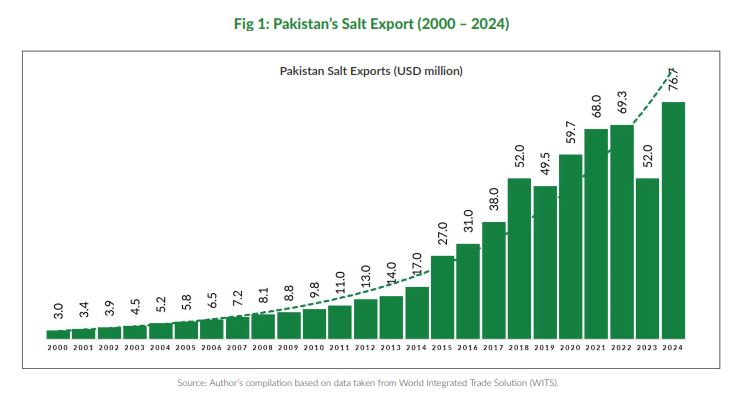
Source: Author’s compilation based on data taken from World Integrated Trade Solution (WITS).
This Policy Viewpoint aims to highlight the current global market for Himalayan Pink Salt, total reserves that Pakistan possesses, Pakistan’s export performance of this salt, and the value gap between current Himalayan Pink Salt exports and high-value salt products by identifying the value addition opportunities.
Global Pink Salt Market and Pakistan’s Contribution
The global consumer market for Himalayan Pink salt is estimated at $500 million to $1.2 billion. The market has a decent compound annual growth rate (CAGR) of 4% to 5%. The United States is the largest buyer of salt from Pakistan. The USA imported $15.4 million worth of salt from Pakistan in 2024. The second-largest market is the United Arab Emirates (UAE), with $13 million in pink salt imports in 2024. The United Kingdom (UK), China, and Afghanistan are in the list of the top 5 importers. In the first quarter of 2025, there was a rapid surge in imports from China; Pakistan exported 13640 tons of salt to China, which was an increase of 40 percent in salt imports from Pakistan to China. Table 1 shows the global market for pink salt.
Table 1: Global Pink Salt Market Scenario.
| Category | Value |
| Global market size (2024) | $500 million – $1.2 billion |
| Compounded annual growth rate (CAGR) | 4% to 5% |
| Pakistan’s largest importer | USA – ~ 49% all shipments (consignment count) |
| Global food and the culinary market | ~ $500 million |
| 2nd largets buyer | UAE – $13 million (2024) |
| Rapidly growing segment | Wellness segment – 9.3% CAGR |
| China – growing market (2025 Q1 growth) | 13,640 tons imported from Pakistan. +40% year-on-year |
Source: Author’s compilation based on data taken from World Integrated Trade Solution, Deepbeez trade data (2024–2025), 6W Research, Pink Himalayan Salt Market Report, Straits Research, and Express Tribune.
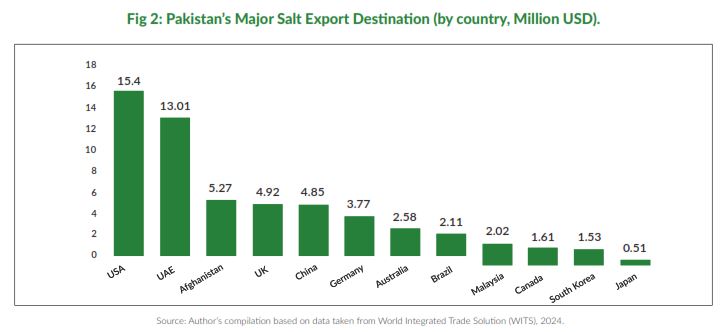
Source: Author’s compilation based on data taken from World Integrated Trade Solution (WITS), 2024.
Pakistani firms have been tempted to pursue the large Western markets such as the USA and EU, but are unable to capture any value in these markets due to a lack of managerial expertise, brand equity, and distribution control. In the meantime, the geographically and culturally closer markets, China, Japan, and South Korea, are being ignored. These markets provide less ‘psychic distance’, better growth opportunities, and enable family businesses to exert greater brand and distribution control.
China is the largest nearby market with explosive growth in the wellness segment. The Japanese market has maximum per-unit premium potential for traceable and recognized natural products having compelling origin stories. Similarly, South Korea’s K-beauty and wellness industry is growing rapidly with rising demand for natural minerals and skincare and spa products. All these markets have an active online consumer culture as well.
Pakistan’s Salt Resources and Export Performance
Pakistan owns over 10 billion tons of salt deposits (Hussain et al., 2021). It includes mainly rock salt; however, it has some limited production of sea and lake salt. The deposits of Himalayan pink salt are commercially viable only in Pakistan. The Khewra Salt Mine has over 1 billion tonnes of reserves, which is centuries’ worth of supply at the current rate of extraction. There is no other country that can genuinely compete on the origin of Himalayan Pink Salt. The annual extraction of pink salt is estimated to be approximately 400,000 tonnes. In 2024, Pakistan achieved a five-year high export revenue, earning $76.7 million, an extremely small figure compared to the global salt market value. The reason behind such low revenue from exports is that Pakistan exports salt in raw form, without proper processing, cleaning, branding, and value addition. This shows there is a big opportunity for Pakistan to improve the value addition and branding.
Table 2: Pakistan’s Pink Salt Resources and Exports.
| Category | Value |
| Overall Khewra Mine Reserves | Over 1 billion tonnes |
| Annual extraction | ~400,000 tons |
| Share of global export of Himalayan salt | ~45% – Pakistan dominates supply |
| Total salt exports (2024) | $76.72 million (Including all salts) |
| Countries Pakistan’s exporting to | 90+ countries |
| Exports sent to all destinations (Nov 2023–Oct 2024) | 3,789 shipments – 10% year-on-year increase |
Source: Author’s compilation based on data taken from the Geological Survey of Pakistan, Pakistan Mineral Development Corporation (PMDC), and Business Insider.