Executive Summary
Pakistan’s founding membership in the World Artificial Intelligence Cooperation Organization (WAICO) offers an early opportunity to shape emerging approaches to AI governance, capacity-building, and equitable access. It can also provide a platform to strengthen Pakistan’s domestic technological capabilities and expand its role in development-oriented AI cooperation. With ICT exports of approximately US$4.6 billion in FY2025–26, more than 34,000 registered IT and IT-enabled services companies, and a growing AI talent base, the country is well positioned to move beyond outsourcing and freelancing toward AI-based products, intellectual property, applied research, technology commercialization, and productivity enhancement. Hence, Pakistan should initially focus its WAICO engagement on three areas: developmental AI demonstration projects, multilingual and resource-efficient AI solutions, and joint talent, research, and commercialization mechanisms. Where relevant, these initiatives can leverage existing CPEC cooperation platforms rather than creating parallel institutional structures.
1. Introduction
Pakistan’s founding membership in the World Artificial Intelligence Cooperation Organization (WAICO) should not be treated as a ceremonial multilateral engagement. It is an early opportunity to help shape an emerging international institution. WAICO’s governance arrangements, cooperation priorities, standards, and development programs are still evolving. In July 2026, Pakistan signed the agreement establishing WAICO in Shanghai alongside 28 other countries1. As an independent intergovernmental organization, WAICO aims to promote international artificial intelligence (AI) cooperation and governance. Pakistan’s Ministry of Foreign Affairs has emphasized equitable access, capacity-building, bridging the global AI divide, and addressing the development priorities of the Global South.
Pakistan must approach WAICO as a platform for contribution, capability-building, and economic transformation, rather than merely for diplomatic representation or access to imported technology. However, limited AI infrastructure, a shortage of specialized AI skills, and weak research commercialization remain key domestic constraints. The central question is therefore not only what Pakistan can gain from WAICO but also how it can use international AI cooperation to generate exports, productivity, technological capability, and improved public services.
2. Why WAICO Membership is Timely for Pakistan
Despite rapid growth in Pakistan’s ICT sector, domestic applications of advanced AI remain limited. The technology industry remains concentrated in software development, IT-enabled services, and outsourcing, while domestic capabilities in high-performance computing, advanced AI research, semiconductor technologies, and research commercialization remain comparatively weak.
Moreover, research and development (R&D) investment remains modest, industry-academia collaboration is limited, and shortages persist in areas such as machine learning, large language models, robotics, and AI chip design. Developing economies more broadly also face constraints in computing infrastructure, high-quality datasets, and advanced AI talent (UNESCO, 2022).
AI adoption across manufacturing, agriculture, healthcare, logistics, and public administration also remains limited, and fragmented public datasets, inconsistent data standards, and evolving AI governance frameworks hinder the deployment of scalable, trustworthy AI solutions. Strengthening AI governance, data ecosystems, and innovation capacity is essential to translate AI research into broad-based economic and social benefits (OECD et al., 2024).
Against this backdrop, Pakistan enters WAICO at a particularly opportune moment. The country’s digital economy is gaining momentum, with ICT exports reaching approximately US$ 4.6 billion, growing by over 20 percent annually, and generating a trade surplus of nearly US$ 3.9 billion. The Economic Survey of Pakistan (2025–26) also reports 34,420 registered IT and IT-enabled services companies. Furthermore, Pakistan has a significant demographic advantage, with nearly 67 percent of its population under the age of 30, an expanding pipeline of computing graduates, and rising internet and smartphone penetration (Economic Survey of Pakistan, 2024- 25; PBS, 2026). These strengths align closely with the objectives of URAAN Pakistan (2024–29), particularly the E-Pakistan pillar, and position WAICO as an important platform for Pakistan to address existing technological gaps.
3. The Strategic Problem Pakistan Must Address
Pakistan’s digital economy remains concentrated in software services, outsourcing, business-process services, and freelancing. These activities remain economically important, but the next stage of development requires a qualitative shift. Pakistan must move from exporting labor hours toward intellectual property and AI-enabled products; from isolated proof-of-concept projects to scalable applications; and from technology imports toward joint development and adaptation. It must also strengthen institutional research, engineering, and commercialization capabilities so that technology adoption translates into measurable productivity gains (WIPO, 2025).
WAICO should therefore be leveraged to address key structural constraints, including inadequate advanced computing infrastructure, fragmented datasets, weak industry-academia commercialization, shortages of advanced AI specialists, and insufficient financing for technology validation and scale-up. Pakistan also needs stronger participation in international AI standards, improved digital infrastructure, and more mature mechanisms for technology commercialization.
4. Pakistan’s Most Appropriate Position within WAICO
In the short term, Pakistan is unlikely to compete with the world’s largest economies in frontier-model development, semiconductor fabrication, or hyper-scale cloud infrastructure. Instead, it can provide real-world environments for testing resource-efficient, multilingual, affordable, and scalable AI applications. International partners can contribute models, computing resources, instrumentation, financing, and research capabilities. Pakistani universities, firms, and public institutions should contribute sector knowledge, relevant data, engineering adaptation, field validation, and commercialization. This would create a co-development model rather than one based primarily on importing finished technologies.
5. WAICO and CPEC 2.0
WAICO cooperation should not add an additional institutional layer within CPEC 2.0. Instead, selected WAICO initiatives should leverage existing CPEC 2.0 mechanisms where clear complementarities already exist. CPEC already includes cooperation platforms in science, technology, and information technology, including joint research, cloud computing, data centers, cybersecurity, satellite navigation, AI, and human resource development. Using these mechanisms can reduce duplication and provide ready institutional channels for selected Pakistan-China-WAICO pilot activities.
The case for linking WAICO with CPEC 2.0 is therefore not to expand CPEC’s mandate, but to use the existing cooperation architecture to demonstrate a limited number of high-impact AI applications. Such pilots should be selected only where AI can deliver measurable productivity, service-delivery, or technology-transfer gains. Example areas include AI-enabled industrial productivity and predictive maintenance, smart logistics, and agricultural intelligence. Other applications can be considered after the initial pilots demonstrate technical and economic viability.
6. Alignment with the Three STI Pillars
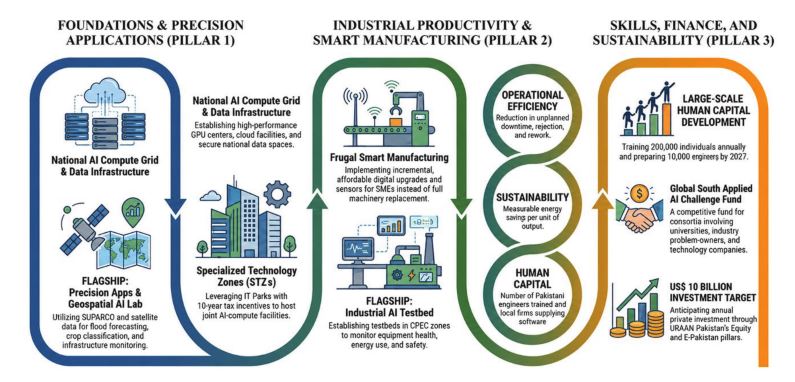
Pakistan’s science, technology, and innovation (STI) priorities can be organized around three interconnected pillars. Pillar 1 focuses on digital infrastructure, space, and precision applications. Pillar 2 covers AI, emerging technologies, and smart manufacturing. And, Pillar 3 addresses technology transfer, applied R&D, advanced digital skills, innovation finance, and start-ups.
Figure 1: Pakistan’s Strategic Framework: A Three-Pillar Roadmap for Development
Source: Author’s Construction
WAICO can support these pillars selectively: infrastructure and data cooperation under Pillar 1; applied AI and industrial transformation under Pillar 2; and research partnerships, skills, technology transfer and innovation finance under Pillar 3.
6.1 Recent Momentum: Diaspora and Silicon Valley Engagement
Pillar 3 has already gained momentum. In July 2026, Federal Minister for Planning, Development and Special Initiatives, Professor Ahsan Iqbal, visited Northern California and Houston, USA, to advance cooperation in AI, start-ups, and technology with the Pakistani diaspora, Silicon Valley leaders, US firms, and universities. The Government of Pakistan also signed a Letter of Intent with Plug and Play Tech Center to open offices in Islamabad and Karachi, support up to 300 university start-ups, and connect Pakistani entrepreneurs with more than 600 corporate partners for mentorship, investment, and market access.
These initiatives provide useful building blocks, but they should not develop as disconnected programs. Pakistan should use a WAICO coordination mechanism to align diaspora expertise, university partnerships, start-up support, and international technology networks with specific national AI priorities.
7. What Pakistan can Contribute as a Founding Member
Pakistan’s participation in WAICO should extend beyond the role of a beneficiary, enabling the country to make meaningful contributions across at least six strategic areas. These six areas represent Pakistan’s potential contributions to WAICO; they should not all be pursued as separate initiatives in the initial phase.
7.1 Representation of the Global South:
Pakistan can highlight that, for many developing countries, the primary AI challenge extends beyond regulating frontier systems to include ensuring access to computing infrastructure, reliable electricity, connectivity, quality datasets, skilled personnel, financing, and technology markets. This aligns with the UN General Assembly’s call to bridge the AI and digital divides and to ensure that safe and trustworthy AI contributes to sustainable development2.
7.2 Multilingual and Culturally Contextual AI:
Pakistan’s multilingual environment, including Urdu, English, and several regional languages, enables contributions to datasets, evaluation methods, and AI applications for translation, speech recognition, public services, education, healthcare communication, and agricultural advisory services. AI language systems should be evaluated not only for technical accuracy but also for dialect coverage, cultural appropriateness, gender bias, and accessibility.
7.3 Development-Sector Applications:
Pakistan can contribute practical AI use cases across agriculture, manufacturing, disaster resilience, health, education, energy, and logistics. These applications would also be relevant and adaptable to several other developing WAICO members.
7.4 Frugal Smart Manufacturing and Resource-Efficient AI:
Pakistan can advocate for AI solutions that require less computing power, bandwidth, and energy, while promoting frugal smart manufacturing by modernizing and upgrading legacy industrial equipment with AI. This approach would improve productivity and resource efficiency in developing economies, distinguishing Pakistan’s contribution from approaches that rely primarily on increasingly large and resource-intensive AI models.
7.5 Responsible and Proportionate Governance:
Pakistan can support AI governance grounded in human rights, transparency, accountability, safety, data protection, and human oversight, consistent with UNESCO’s Recommendation on the Ethics of AI (UNESCO, 2021). At the same time, governance frameworks should apply proportionate compliance requirements that distinguish among low-risk administrative tools, medium-risk commercial applications, and high-risk systems that affect health, employment, finance, security, or fundamental rights.
7.6 A Bridge Between AI Capability and Development Demand:
Pakistan’s strategic relationship with China, membership in international organizations, and engagement with developing countries position it to strengthen cooperation between advanced AI ecosystems and development-oriented applications. This bridging role should not imply technological exclusivity. Interoperability, diversified partnerships, and engagement with