Summary
Pakistan has significantly increased spending on social protection in last few years, yet poverty rates have also increased relative to FY2018-19. This presents a critical policy puzzle: why has increased social protection spending not translated into sustained poverty reduction? The answer does not lie in the absence of poverty reduction efforts or failure of social protection programs in Pakistan, because without BISP or similar interventions, the negative effects of the shocks such as Covid pandemic, the 2022 floods, high inflation, weak job creation and other macroeconomic shocks could have been even more severe. Cash transfers remain essential for protecting poor households from deeper welfare losses and moderate the magnitude of welfare decline.
However, the primary concern is that Pakistan’s social protection architecture remains heavily oriented toward consumption smoothing rather than poverty alleviation, and cannot independently generate employment, economic growth, or adequate public services.
The central policy challenge is therefore connecting protection to opportunity. Despite having a flagship national cash-transfer system, Pakistan’s social protection remains insufficiently integrated with education, health, nutrition, skills development, childcare, agriculture, local infrastructure, climate change adaptation, and labor market opportunities.
Moving from short-term stabilization toward sustainable poverty reduction requires The Cash Plus and Graduation oriented strategies that use income support as a starting point, with multidimensional need assesments that providing intensive livelihood support to households with labor capacity and market potential. Ongoing protection is justified for older adults, disables, and other households constrained by labor force participation. The brief discusses the multidimensional challenges associated with purely protective approaches, examines large-scale evidence from graduation programs, and formulates policy suggestions.
Cash transfers remain essential for protecting consumption, especially when growth is weak and prices rise. The policy gap is that Pakistan’s protection system is still only loosely connected to the services, capabilities, and economic opportunities that support a durable movement out of poverty.
1. Why Social Protection Matters: A Theoretical Lens
Social protection needs to be viewed in terms of a combination of interrelated roles, and not just one program. The role of protection is to prevent a decline in living standards immediately whereas prevention involves enabling households to handle their risks without getting to the state of being poor. Furthermore, the role of promotion involves building assets and capabilities; and that of transformation involves dealing with issues of exclusion from access to resources and services. Such a view, based on the work by Devereux and Sabates-Wheeler (2004), explains why both social assistance and social insurance are needed, but not as alternatives to productive employment.
| Function | Impact |
| Protection | Stabilise minimum consumption during unemployment, disability, old age, disaster or price shock. |
| Prevention | Reduce exposure to future loss through insurance, savings, preparedness and shock-responsive systems. |
| Promotion | Build capabilities and earning potential through health, education, skills, assets, finance and market access. |
| Transformation | Reduce social exclusion and remove barriers linked to gender, disability, location or labour-market status. |
Source: Adapted from Devereux and Sabates-Wheeler (2004).
Social insurance and social assistance represent the two major components of welfare arrangements. Insurance covers risks such as retirement, sickness, and occupational injuries, but it cannot cover much ground in an informal economy. Assistance, on the other hand, which is usually tax-funded or non-contributory, helps address this problem by assisting those people who are unable to satisfy even their basic needs. Welfare states in Germany have traditionally built up welfare state arrangements through insurance schemes, while in Latin America and China, assistance was further extended in the light of the weaknesses of employment-based insurance (Barrientos & Santibanez, 2009; Stolleis, 2013; Zhang & Xu, 2010). Therefore, the takeaway from this experience is that of complementarity.
This Knowledge Brief aims to examine why rising social protection allocations have not translated into sustained poverty reduction and how income support can be connected more effectively with economic growth, essential services and productive opportunities without weakening its protective role.
2. Pakistan’s Social Protection Architecture
Social protection in Pakistan has been developed in multiple layers. Firstly, there were employment-based social security and pension schemes, followed by religious and public assistance schemes, and then an expansive cash transfer program at the national level. The Punjab Employees’ Social Security Institution implements social protection in covered industrial and commercial establishments according to the Provincial Employees’ Social Security Ordinance, 1965. It is not a universal scheme applicable to all public sector employees. Other schemes include the Employees’ Old Age Benefits Institution and public sector beneficent and group insurance schemes.
Following that, social assistance became another layer in social protection in Pakistan. Zakat and Ushr schemes were implemented in 1980, Pakistan Bait-ul-Mal was established in 1991, and Benazir Income Support Programme (BISP) in 2008. Currently, BISP forms the core of targeting, cash transfer, and response to shocks in NSER. According to Taleemi Wazaif and Nashonuma evidence, cash transfers may contribute to school enrollment and nutrition. The National Poverty Graduation Programme (NPGP) includes productive asset provision, interest-free loans, training, and social mobilization. All the listed programmes are quite considerable, but their referral, service delivery, and outcome pathways have yet to be integrated.
3. Poverty across Growth and Shock Periods
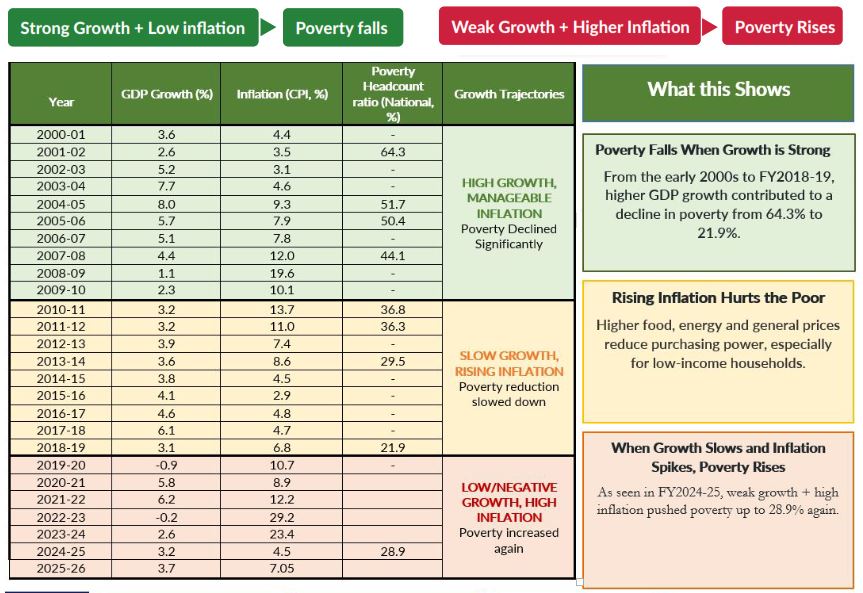
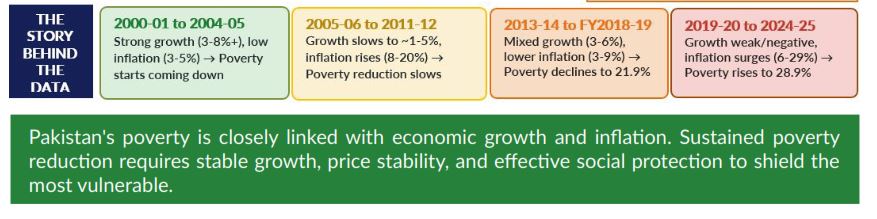
Growth and rising labour returns drove the earlier decline: Poverty dynamics in Pakistan from the beginning of the 2000s suggest that there is a direct connection between poverty alleviation and macroeconomic dynamics. According to studies conducted by the World Bank, national poverty decreased significantly following 2002, when the GDP growth rate was more than 5 percent, and the decrease in poverty was slightly higher than that in the comparator countries with similar GDP growth rate levels. A decomposition attributed about one-third of the observed reduction to higher returns from non-farm employment. Productivity gains outside agriculture, past infrastructure investment, remittances and BISP made different contributions, but the main lesson was that household earnings and productive economic activity mattered greatly (World Bank, 2014). The official CBN headcount later stood at 21.9 percent in FY2018-19.
Stagflation and shocks reversed part of the gain: After FY2018-19, the pandemic, weak and uneven growth, the 2022 floods, macroeconomic adjustment and high inflation reduced purchasing power and disrupted work. The Planning Commission’s latest CBN estimates place national poverty at 28.9 per cent in FY2024-25, with rural poverty at 36.2 per cent. The economic mechanism is straightforward: when output and employment are weak while prices rise, poverty is likely to increase. Social assistance then serves as a buffer to declining consumption, but even a well-targeted transfer cannot fully offset prolonged stagflation or a shortage of productive jobs.
4. Rising Spending, Limited Transformation
The BISP budget rose from Rs180.00 billion in FY2019-20 to Rs722.49 billion in FY2025-26 – a fourfold nominal increase. This is a major fiscal and administrative commitment. The same official series also shows that releases, transfers and beneficiary counts must be distinguished from the annual budget allocation; mixing these concepts creates misleading comparisons.
| Fiscal year | BISP budgetary allocation (Rs billion) |
| 2019-20 | 180.00 |
| 2020-21 | 200.00 |
| 2021-22 | 250.00 |
| 2022-23 | 364.08 |
| 2023-24 | 471.16 |
| 2024-25 | 598.09 |
| 2025-26 | 722.49 |
Source: Finance Division (2026), Pakistan Economic Survey 2025-26, Table 16.4. FY2025-26 release and transfer data are reported through March 2026; the budget allocation is for the full fiscal year.
Figure 1. Pakistan’s CBN poverty trajectory, FY1998-99 to FY2024-25
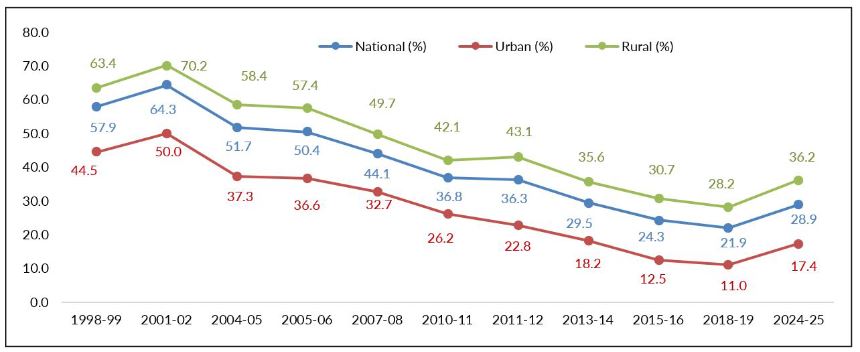
Source: Planning Commission of Pakistan (2026), CBN-based poverty estimates. Survey years shown; connecting lines indicate change between available official estimates, not annual observations.
These two trends require careful analysis. The fact that the nominal increase in expenditures is associated with the increase in the rate of measured poverty alone cannot be seen as proof of the effect of BISP. Poverty is a function of many factors such as economic growth, employment, wages, prices of food and energy, family size, disasters, remittances, among other factors. Thus, a proper conclusion that one can draw from this is that while cash transfers helped cushion welfare losses, the whole process was inadequate in offsetting macroeconomic and structural poverty. Therefore, the policy assessment should go beyond the question of whether expenditure increased.
5. Poverty is Multidimensional, but Support Remains Narrow
Poverty is characterized by many other factors including low education, bad health and malnutrition, lack of assets, access to financing, vulnerability to climate change, disability, caring roles, small local markets, and poor female labour market participation. While transfers could help people avoid absolute poverty and pursue better decision-making, they do not automatically repair schools, create jobs, provide childcare, or link farmers to viable markets.
While safety nets prevent poverty in Pakistan by providing immediate relief from shocks and helping to cope with them, restricted access to productive opportunities limits the ability of these programs to break the cycle of inter-generational poverty. If there is not enough education, healthcare, relevant skill development, job creation, and promotion of female employment, social protection becomes a stabilizing rather than comprehensive system of security measures. This is not an appeal for replacing cash transfers with other forms of assistance, but a call for combining cash with services and opportunities which differ from family to family and location to location.
An effective model of Cash Plus starts with diagnosing the needs of each individual household. While some families would need ongoing cash support and care, others would need a temporary cash top-up and recovery from shock. Yet other families, especially those able to work, might need childcare, training, assets, financial services, apprenticeships, or entrepreneurship connections. The amount of time needed for providing such assistance has to be determined by need and local market conditions.
Table 3: From Cash to Capability reform framework.
| Pillar | Policy direction |
| Protect | Maintain BISP as the national cash-transfer floor. |
| Diagnose | Profile multidimensional poverty and vulnerability. |
| Connect | Link households to education, health, nutrition, skills, jobs, and digital inclusion. |
| Graduate | Scale livelihood, asset-transfer, financial inclusion, and market-linkage pathways. |
| Measure | Track poverty exits, earnings, learning, nutrition, assets, and shock recovery. |
Source: Author’s Proposed Framework
The sequence does not serve as a compulsory process of exit from the program. Continuous protection continues to be a valid objective for those households that are constrained by labor availability; graduation becomes valid only when there is labor availability and opportunity.
6. International Experience: What Cash Plus and Graduation Programmes Deliver
International experience does not point to one standard route out of poverty. The stronger programmes combine predictable consumption support with assets or finance, practical skills, coaching, savings and access to markets. Their results also show that programme scale is not the same as sustained poverty exit. Five experiences are especially relevant to Pakistan.
| Programme and scale | What the evidence reports | Lesson for Pakistan |
| BRAC Targeting the Ultra-Poor, Bangladesh. Close to 400,000 women reached by 2011; the evaluation covered 1,409 communities. | Four years after entry, earnings were 38 per cent higher, per-capita expenditure rose by 8 per cent, and 11 per cent of eligible women had moved above the extreme-poverty line. | Capital and skills can change occupational choices, but gains require intensive support, time and functioning local demand. |
| Six-country graduation evaluation. The randomised evaluation covered 10,495 participants in Ethiopia, Ghana, Honduras, India, Pakistan and Peru. | A year after programme support ended, the pooled results showed lasting gains in consumption, productive assets, savings and food security, although effects and costs varied across settings. | A common package can be adapted across countries, but delivery quality, prices and market access still determine results. |
| Ethiopia Productive Safety Net Programme. Major phases reached about 8 million chronically food-insecure people through public works and direct support. | Predictable cash or food transfers improved food security and consumption. Evidence also shows that asset gains were stronger when safety-net support was combined with complementary livelihood services. | Regular and timely support matters, but transfer value, climate shocks and the quality of livelihood links can limit durable gains. |
| Peru Haku Wiñay/Noa Jayatai. By 2017, the programme was serving more than 121,000 poor rural households across the country. | The package combined productive practices, home improvements, rural enterprise support and financial capability. Official evaluations reported gains in autonomous income and productive capacity. | Territorial adaptation and market links are central. Results cannot be separated from implementation intensity and local economic conditions. |
| Pakistan NPGP. Reported reach of 1,083,648 households through 307 union councils in 21 districts; the 2025 study covered 6,866 households. | The study reports that 84 per cent of treatment households crossed the ultra-poverty threshold. It also reports that 30 per cent lost the NPGP-provided asset during the 2022 floods. | Large-scale delivery is possible, but asset support needs climate protection, post-transfer services, market links and monitoring of sustained gains. |
Source: Bandiera et al. (2017); Banerjee et al. (2015); Berhane et al. (2014); FONCODES (2017); World Bank (2021); and Nawaz, Zizzamia, and Iqbal (2025). Programme reach and evaluation samples are not the same measure.
The comparative record supports three cautions. First, current graduation framework is suitable mainly for work-capable households with viable opportunities; elderly, severely disabled and other labour-constrained households may need continuing protection. Second, coaching intensity, asset quality, programme duration, women’s mobility and local demand shape the outcome. Third, climate and other shocks can reverse earlier gains. International experience therefore encourages careful adaptation and follow-up rather than a uniform administrative target for programme exit.
7. Policy Directions
Protect the cash floor and preserve its real value:
BISP should continue functioning as the country’s minimum protection guarantee, and effectiveness should be reviewed on a regular basis against PBS inflation data, the official poverty gap, household size, payment regularity and transfer coverage. Adjustments should be predictable and evidence based rather than happening through one-off administrative decisions.
Diagnose household needs rather than relying only on poverty status:
A household living below the poverty line can still differ from another in the same living standard; one may be managing a disability, another carrying most of the caregiving burden, another facing seasonal climate shocks. Building dynamic household profiles that capture these differences, income, disability, education, health, gender-related constraints, climate exposure, local economic conditions. This would allow support to be tailored instead of applying the universal package to each household.
Turn Cash Plus into a functioning referral system:
Connect eligible households with existing provincial services in finance, education, primary healthcare, skills, agriculture, and employment. Every referral should have an accountable institution, a clear completion window and a mechanism for tracking whether the service was actually delivered and had the intended effect.
Define institutional responsibilities and measure outcomes:
The federal government’s responsibility is to maintain the national social protection floor, shock-response arrangements and compatibility standards. Provinces should co-finance and deliver devolved services and locally relevant livelihood pathways, while districts should handle household referrals, case follow-up and grievances on the ground.
Program success should not be judged only by changes in consumption and earnings, or merely by allocations and beneficiary numbers, but through changes in education, basic nutrition, primary health care, asset retention, climate resilience and shock responses. The detailed compact, financing arrangements, and accountability dashboard will be developed in the forthcoming companion Policy Viewpoint.
8. Future Research Directions
Comparing aggregate social protection spending against poverty rates only tells part of the story. What’s missing is a credible counterfactual, what household welfare would have looked like without BISP and related programmes. Longitudinal, well-identified impact evaluations are needed to establish whether gains in consumption, earnings, education, nutrition, asset ownership, women’s economic participation and resilience actually hold up once programme support ends, and how this varies across regions and household types. There’s also a case for research digging into the real adequacy of transfers, exclusion and duplication in coverage, the relative cost-effectiveness of different Cash Plus and graduation packages, how ready local service systems actually are, and what financing and implementation capacity is realistically needed at the federal, provincial and district levels.
Pakistan should judge social protection by two questions at once: did it prevent a deeper loss of welfare, and did it connect households with the capabilities and opportunities appropriate to their circumstances? Cash remains the foundation; growth, jobs, services and resilience determine whether protection can become mobility.
References
Bandiera, O., Burgess, R., Das, N., Gulesci, S., Rasul, I., & Sulaiman, M. (2017). Labor markets and poverty in village economies. Quarterly Journal of Economics, 132(2), 811-870. https://doi.org/10.1093/qje/qjx003
Banerjee, A., Duflo, E., Goldberg, N., Karlan, D., Osei, R., Pariente, W., Shapiro, J., Thuysbaert, B., & Udry, C. (2015). A multifaceted program causes lasting progress for the very poor: Evidence from six countries. Science, 348(6236), 1260799. https://doi.org/10.1126/science.1260799
Barrientos, A., & Santibanez, C. (2009). New forms of social assistance and the evolution of social protection in Latin America. Journal of Latin American Studies, 41(1), 1-26.
Berhane, G., Gilligan, D. O., Hoddinott, J., Kumar, N., & Taffesse, A. S. (2014). Can social protection work in Africa? The impact of Ethiopia’s Productive Safety Net Programme. Economic Development and Cultural Change, 63(1), 1-26.
Devereux, S., & Sabates-Wheeler, R. (2004). Transformative social protection (IDS Working Paper 232). Institute of Development Studies.
Finance Division, Government of Pakistan. (2026). Pakistan Economic Survey 2025-26: Social protection. https://www.finance.gov.pk/survey/chapter_26/16_Social_Protection.pdf
Fondo de Cooperación para el Desarrollo Social. (2017). Haku Wiñay atiende a más de 121 mil hogares a nivel nacional. https://www.foncodes.gob.pe/portalante/index.php/transparencia-institucional/reporte-de-denuncias/item/865-foncodes-haku-winay-atiende-a-mas-de-121-mil-hogares-a-nivel-nacional
Government of Punjab. (1965). Provincial Employees’ Social Security Ordinance, 1965. https://www.punjablaws.gov.pk/laws/187.html
Nawaz, S., Zizzamia, R., & Iqbal, N. (2025). Building resilience through state-led asset transfers: Medium-term impacts of the National Poverty Graduation Programme in flood-prone Pakistan. International Growth Centre. https://www.theigc.org/publications/building-resilience-through-state-led-asset-transfers-medium-term-impacts-national
Oxford Policy Management. (2020). Benazir Income Support Programme: Impact evaluation report, 2019 round. Benazir Income Support Programme.
Pakistan Bureau of Statistics. (2026). Press release on Consumer Price Index inflation for the month of June 2026. https://www.pbs.gov.pk/wp-content/uploads/2020/07/Press-Release-June-2026.pdf
Planning Commission of Pakistan. (2026). Poverty estimation 2024-25 (Version 5). Ministry of Planning, Development and Special Initiatives.
Stolleis, M. (2013). Origins of the German welfare state: Social policy in Germany to 1945. Springer.
World Bank. (2014). Pakistan poverty trends, scenarios and drivers. World Bank. https://documents.worldbank.org/en/publication/documents-reports/documentdetail/895401468145474740
World Bank. (2021). The state of economic inclusion report 2021: The potential to scale. World Bank. https://openknowledge.worldbank.org/handle/10986/34917
Zhang, X., & Xu, Y. (2010). From social insurance to social assistance: Process and development in China’s urban social welfare policy. Asia Pacific Journal of Social Work and Development, 20(1), 41-51.