In Lahore, Karachi, and in small towns in between, a subtle shift in energy took place without a government 5-year plan: many millions of Pakistani citizens grew weary of paying for electricity that never arrived. When solar panels started appearing on small factories, homes, and farms, it was more due to high tariffs and daily power outages than anything else, and fewer planners than were expected could have foreseen the trend. It’s a success story by most standards in the world: a quite small fiscal space and mostly market-based decentralization of decarburization.
However, success at the household level has revealed a structural failure at the system level. Pakistan’s power sector remains bound by contracts written decades ago, under which the government must pay private power producers a fixed sum regardless of how much electricity is actually consumed. As more consumers exit the grid for rooftop solar, the fixed cost of those contracts is spread across a shrinking base of remaining customers, pushing tariffs higher and pushing yet more consumers toward solar. It is a self-reinforcing cycle, and Pakistan is now living inside it.
This article argues that the same institutional failure destabilizing household electricity bills is quietly becoming a trade-competitiveness problem, one that will matter far more once European Union regulation catches up with Pakistan’s largest export sector.
The Mechanism: How Expensive Power Actually Works
Pakistan’s power sector runs on a model inherited from the 1990s, when the government signed long-term agreements with Independent Power Producers (IPPs) to attract private investment into generation. Those agreements included “capacity payments” guaranteed revenue paid to power plants whether or not their electricity was actually used[1]. The logic made sense when demand was growing and grid connections were the only source of power. It seems to have little meaning now. As of 30 June 2024, the installed generation capacity in Pakistan stood at approximately 46,000 megawatts (MW), but average annual utilization was around 34 per cent during this fiscal year, which in effect implies that consumers were paying only for two-thirds of the installed capacity. This imbalance has become exacerbated since then, with a 2026 industry projection of more than 51GW of distributed solar off-grid by March of that year, compared to the declining utility-scale power generation, which dropped for four fiscal years in a row.4 What you’re not doing is moving away from fixed costs, you’re moving away from the customers that pay fixed costs. The cumulative effect of this mismatch is circular debt – debts which delay payment from distribution companies to generation companies to fuel suppliers.
As of early 2026, an International Monetary Fund program review cited combined power and gas sector arrears of approximately Rs 5.2 trillion, with gas-sector liabilities alone accounting for over Rs 3.4 trillion[2] , a figure roughly eighteen months on from, and not directly comparable to, the FY2023-24 utilization snapshot above. The government has since moved to renegotiate or terminate a number of IPP contracts; officials involved in the process have estimated potential savings in the trillions of rupees over the remaining life of the agreements, though this figure is self-reported by the task force conducting the renegotiations and its independent verification remains pending[3].
Figure-1: Pakistan Power Sector Circular Debt, FY20-FY24
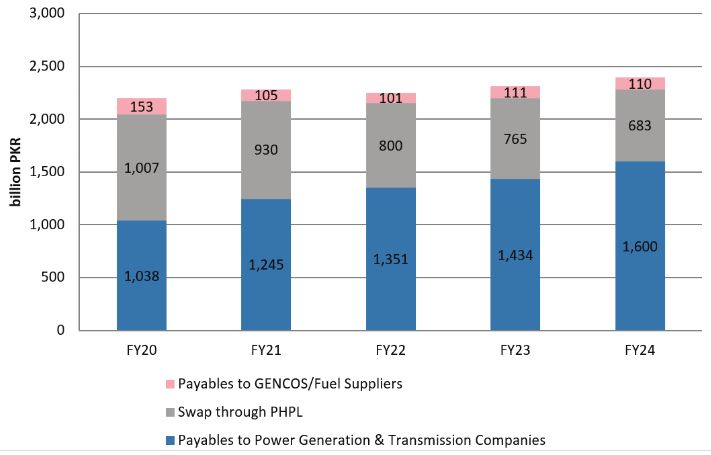
Source: Renewables First, “Pakistan Electricity Review 2025,” citing NEPRA State of Industry Report data.
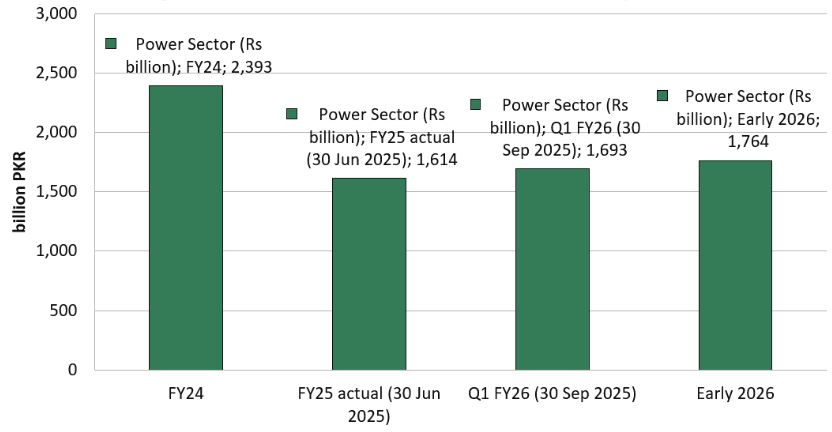
Source: Renewables First, “Pakistan Electricity Review 2025,” citing NEPRA State of Industry Report data.
Who Actually Pays
The burden of this system does not fall evenly. A 2025 analysis of household tariff data by the Pakistan Institute of Development Economics found that the poorest consumers have absorbed a disproportionate share of debt-recovery costs: effective tariffs for the bottom-income bracket rose from roughly Rs 11.72 per kWh in 2018 to Rs 22.44 per kWh in 2025, with nearly 37 percent of that bill made up of circular-debt-related surcharges rather than the underlying cost of generating electricity[4]. Across the wider consumer base, average effective tariffs rose from about Rs 12.5 per kWh in 2015 to Rs 34.45 per kWh in 2025, a rise the same analysis attributes mainly to debt-servicing charges layered onto bills rather than genuine cost increases in generation[5]. In effect, circular debt has been converted into a quasi-tax, collected disproportionately from households with the least ability to pay it, or to opt out by installing their own solar systems.
This is the domestic cost of standing still. The external cost is only beginning to take shape, and it centers on Pakistan’s largest export sector.
The Export Exposure: CBAM, ESPR, and What Is Actually Coming
Textiles account for an estimated 55 to 60 percent of Pakistan’s total exports and around 8.5 percent of GDP, with employment estimates ranging from roughly 4 million (direct, formal employment) to 15 million (the full value chain, including informal and indirect work)[6]. The sector’s competitiveness has long rested on labor costs and preferential energy tariffs for exporters a Regionally Competitive Energy Tariff has offered gas at $6.5 per mmbtu and electricity at 7.5 cents per kWh for export-oriented units since 2018 — rather than on energy efficiency or low-carbon production[7]. That model is now colliding with a shifting European regulatory landscape, and the shift is more layered than most domestic commentary suggests.
It is commonly assumed that the European Union’s Carbon Border Adjustment Mechanism (CBAM), which entered its compliance phase on 1 January 2026, already taxes Pakistani textile exports on the basis of embedded carbon. It does not. CBAM’s current scope covers six sectors: Iron and Steel, Aluminium, Cement, Fertilizer, Electricity, and Hydrogen and explicitly excludes finished textiles and garments[8]. A 2025 analysis published by the Pakistan Institute of Development Economics makes this point directly: Pakistan is not severely affected by CBAM today precisely because textiles fall outside its current scope[9].
The more immediate regulatory pressure comes from a different instrument. In April 2025, the European Commission named textiles, with a specific focus on clothing as one of the first product categories to be brought under its Eco-design for Sustainable Products Regulation (ESPR), which introduces mandatory eco-design standards and a Digital Product Passport tracing a garment’s material and environmental footprint. A textile-specific delegated regulation is expected to take effect around 2027, with compliance obligations extending toward the end of the decade depending on company size[10]. Unlike CBAM, ESPR does not impose a carbon price; it imposes a data and design compliance burden that many Pakistani exporters a large share of them small and medium enterprises without established carbon accounting systems are not currently equipped to meet at scale.
CBAM’s exclusion of textiles is also not guaranteed to last. The European Commission has described its current six-sector scope as a first phase, with a review process assessing further expansion expected to report by 2030[11]. Industry commentary has raised the possibility that this could eventually include synthetic-fibre polymers such as polyester, nylon, and elastane, though this remains a subject under review rather than a confirmed decision. Should expansion eventually reach finished textile products, the exposure would be material: Pakistan generated an estimated $2.3 billion in textile export revenue to the European Union in 2022 alone[12]. No credible, primary-sourced estimate of the cost a fully expanded CBAM would impose on Pakistani exporters was found in the course of this research, and any such figure circulating without a clearly stated methodology should be treated with caution.
What the same PIDE analysis argues and what this article’s broader argument reinforces is that Pakistan currently has no domestic mechanism, such as an Emissions Trading System, that would allow it to price carbon at home and retain that revenue domestically, rather than surrendering it to the European Union in the form of CBAM certificates if and when the mechanism expands[13]. Establishing one would require years of preparatory monitoring, reporting, and verification infrastructure that does not currently exist in Pakistan’s industrial sector at the scale required.
This is where the domestic and external stories converge. The same expensive, unreliable grid power described earlier is also the obstacle preventing textile manufacturers from adopting the clean energy and efficiency measures that would reduce their carbon footprint ahead of these regulations. A 2025 World Bank assessment identified energy efficiency and de-carbonization as areas of significant untapped opportunity within Pakistan’s textile sector[14], though the structural barriers to realizing that opportunity cost, reliability, and financing access are the same ones affecting the wider power sector. Pakistani manufacturers, by one industry assessment, face among the highest industrial electricity tariffs in South Asia[15], which discourages exactly the kind of private investment in clean energy that would otherwise position the sector ahead of, rather than behind, EU compliance timelines.
What Needs to Change
Two interventions would address both the domestic and external dimensions of this problem, and neither is a call for a vague “energy transition.”
First, the structural drivers of circular debt need to be addressed directly rather than managed through periodic bailouts and tariff hikes. This means renegotiating the remaining IPP contracts on a transparent, standardized basis rather than through case-by-case settlements, and shifting new procurement toward competitive, auction-based mechanisms[16]. Reform efforts underway since 2024 have reportedly reduced some of this burden, but their durability and transparency remain open questions rather than settled achievements[17].
Second, Pakistan should begin the preparatory work for a domestic carbon pricing mechanism now, well ahead of any CBAM expansion, rather than waiting for a compliance deadline to force the issue. This includes building the monitoring, reporting, and verification infrastructure that any future Emissions Trading System would require, starting with the industrial clusters concentrated heavily in Punjab most exposed to evolving EU regulation[18].
Pakistan’s rooftop solar boom shows that the country’s households and small businesses are capable of adapting faster than its institutions. The same cannot yet be said for the power sector’s contractual architecture or its industrial carbon strategy. Closing that gap is not a climate policy question alone, it is a competitiveness question for the sector that employs and exports more than any other in the country.
Zuha Aakif is a Staff Economist at the Pakistan Institute of Development Economics (PIDE), Islamabad
Areej Fatima was an Intern, Academic Section at the Pakistan Institute of Development Economics (PIDE), Islamabad)
[1]Institute for Energy Economics and Financial Analysis (IEEFA), “Pakistan’s PKR2.1 Trillion Capacity Payments Crisis Triggers Power Purchase Agreement Renegotiations,” December 2024.
[2]The Nation, 18 May 2026, citing the IMF Extended Fund Facility third review and Resilience and Sustainability Facility second review, early 2026 figures.
[3]Bloom Pakistan, “Energy Task Force IPP Reforms,” February 2026. Note: this figure is the task force’s own self-reported estimate, presented while the same task force requested performance-based financial rewards for its members; it should be read as a claim rather than an independently verified figure.
[4]Pakistan Institute of Development Economics (PIDE), Knowledge Brief No. 135, “Circular Debt and Electricity Tariffs: Unequal Burdens Across Household Quintiles in Pakistan,” 2025.
[5]Ibid.
[6]All Pakistan Textile Mills Association (APTMA), “Achievements”; International Growth Centre, “Phase I – Research on Garments Industry in Pakistan”; Pakistan & Gulf Economist, June 2025. Employment estimates vary by source depending on whether informal and indirect value-chain work is included; figures cited range from approximately 4 million (direct formal employment) to 15 million (full value chain).
[7]APTMA, “Achievements,” describing the Regionally Competitive Energy Tariff policy in place since late 2018.
[8]International Carbon Action Partnership (ICAP), “EU CBAM Enters Compliance Phase and Outlines Path Ahead,” 2026; European Commission, “Questions and Answers on the Carbon Border Adjustment Mechanism (CBAM).”
[9]Syed Sawal Bacha and Muska Mukhtar, “CBAM and the Need for an Emissions Trading System in Pakistan,” PIDE Discourse, April 2025.
[10]REACH24H, summary of the European Commission’s Ecodesign for Sustainable Products Regulation (ESPR) 2025-2030 Working Plan, released 16 April 2025. Readers requiring exact compliance deadlines by company size should consult the European Commission’s ESPR working plan directly.
[11]ICAP, op. cit.; European Commission CBAM Q&A. The possible inclusion of synthetic-fibre polymers such as polyester, nylon, and elastane has been raised in industry commentary but has not been confirmed as an adopted EU decision; it should be treated as a possibility under review, not a scheduled expansion.
[12]Bacha and Mukhtar, op. cit., citing Arisa, “Trends in Production and Trade, Cotton, Textiles and Garments from Pakistan,” September 2024.
[13]Bacha and Mukhtar, op. cit.
[14]World Bank, “Textile Sector: Energy Efficiency and Decarbonization (EE&D) Opportunities,” Pakistan Sustainable Energy Series, 2025. This citation refers to the report’s existence and general subject matter only; specific figures within the full report have not been independently verified for this article.
[15]Consortium for Development Policy Research (CDPR), “Greening Pakistan’s Textile Value Chain,” 2025. This is the organization’s own assessment; no independently verified comparative tariff table across South Asian countries was available at the time of writing.