The concept of ecosystems is born of nature and is based upon the principle of interdependence. Survival & growth of one species is dependent on the existence of some other species. The same rule applies to the industrial world, where one industry is dependent on many other industries for its operations. However, the difference between the two is that the natural ecosystem evolves spontaneously, whereas an industrial ecosystem must be deliberately designed, facilitated, and continuously nurtured.
Over the last century, industrial interdependence has intensified considerably. Advances in science have increased the complexity of industrial processes, while consumers now have greater awareness and higher expectations for product quality and perfection. Higher standards of living, especially in resource-rich countries, have contributed to increased demand for safer and higher-quality products. At the same time, the expansion of international trade that occurred after a shift in global economic order in the late 1940s has exposed domestic producers to increasingly sophisticated global standards (1). After the World Trade Organization (WTO) Technical Barriers to Trade (TBT) Agreement, adoption of harmonized global standards of conformity assessment has become an international norm (2). This has all contributed to complex industrial environments, resulting in a vicious dependence on the existence of various interconnected industries, and a need for delicately crafted industrial policy.
Pakistan Industrial Policy:
While the country does not lack industrial policy initiatives, these have historically existed alongside one another rather than as components of a single, continuously evolving industrial ecosystem strategy. At the federal level, major policies include the Textiles and Apparel Policy 2020-25, Auto Industry Development and Export Policy 2021-26, New Energy Vehicle Policy 2025-30 and National Tariff Policy 2025-30. At the provincial level, Punjab’s Industrial Policy 2018 focused on revamping industrial zones, adoption of good management and operational practices by the industry and expansion in access to financing (3). Khyber Pakhtunkhwa has similarly pursued industrial-development measures centered on industrial growth and rehabilitation, industrial integration and Small & Medium Enterprise (SME) development (4). Pakistan’s policy landscape thus reflects a fragmented growth focus. Nevertheless, policy analysis reveals the presence of many desired components; the real problem is connectivity between them.
The Export Ambition of Government:
In February 2025, the Government announced an ambition to increase Pakistan’s exports to US$60 billion within five years, with export-led growth identified as a cornerstone of the Uraan Pakistan vision. This ambition is significant when viewed against Pakistan’s existing exports. As per the figures of Pakistan Bureue of Statistics (PBS), exports of the country were approximately US$32.1 billion in FY2024-25, meaning that reaching US$60 billion would require almost doubling the exports. The PBS in its quarterly review report export growth of 5.6% QoQ largely led by textile. A representative chart is presented as figure-1. The data of export corroborate Large Scale Manufacturing growth but inter-sectoral variation is very large.
Figure 1: Cummulative Exports (By Group), Data aggregated to represent %.
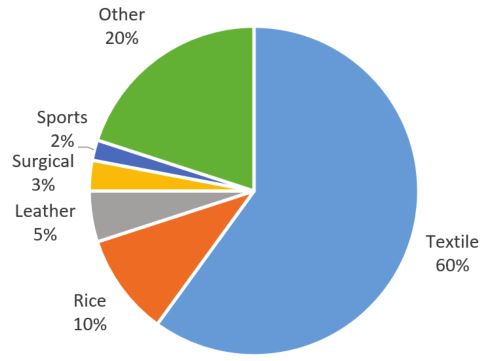
Source: Pakistan Bureau of Statistics, Quarterly Review of Foreign Trade (Jan-Mar, 2025)
Hence, the bottleneck to achieve the export target would not be production; it will be to produce more competitive products and a diversified product range which will require developing the industrial capabilities and connectivity, to access higher-value markets.
Small & Medium Enterprises (SMEs):
SMEs are considered an important component of economic growth. They are not only an employment engine, but also a major supplier and innovation base in a diversified and evolving industrial environment. Pakistan’s National SME Policy 2021, developed by the Small and Medium Enterprises Development Authority (SMEDA) and approved by the Government, seeks to promote SME growth through improved access to finance, and coping infrastructure and human resource challenges, especially through already existing institutional framework of SMEDA (5). Although it has been about 25 years since SMEDA introduced, challenges faced by SMEs are still there, which mainly include market access, appropriate planning, capacity building, environmental and quality issues. Access to finance is important but it is more important to perform sectoral and cross-sectoral needs assessment and appropriate investment planning.
Underlying causes of lack of industrial ecosystem:
The causes can be divided into two categories. The first consists of well-known macroeconomic and structural constraints: economic instability, governance challenges, policy inconsistency, energy in-security, limited access to finance, taxation, regulatory uncertainty etc. The second category is less discussed but is arguably more important for a long-term industrial reform and includes the ecosystem design failures due to following reasons.
Professional Bias and Institutional Silos
Professional bias can be defined as the tendency of institutions or decision makers to approach complex problems predominantly through the lens of a single profession or discipline. While supporting professionals from the same or similar background in a team has some inherent benefits, like it creates specializations, a good team coordination and communication. Excessive specialization can become counterproductive when the problem being addressed is inherently multidisciplinary. Industrial development is exactly such a problem.
Bias in professionalism is especially important when innovation is required to meet market needs. If industrial problems or requirements are viewed only from the perspective of one profession or department, opportunities for cross-sectoral collaboration can be overlooked.
Risk Management
Risk is inherent in every new endeavor. This may be as simple as the risk in a new product launch or the risk of an industrial venture. It is important that risk management is considered in industrial planning, especially in case of SMEs, because they are more vulnerable to risks, due to limited finances and managerial capacity, and less ability to absorb market shocks. In the industrial development perspective, risk management is highly linked with investment strategy. For example, an investment in a component-manufacturing facility may fail if the downstream industry does not develop. Conversely, the downstream industry may fail to emerge because the required component supplier does not exist. Furthermore, risk multiplies when innovation or introduction of new products or services is desired, as the potential benefits and demand of product are not well understood.
In 2024, the State Bank of Pakistan introduced a Risk Coverage Scheme for SMEs but many risk factors cannot be compensated like absence of markets, skills, certification, technology or reliable infrastructure.
Problem oriented rather than sector-oriented policies
It is the most important aspect of industrial ecosystem development. Traditional approach of vertical policy making takes account of specific sectors or specialties. For example, textile industry is considered different from automobiles, and chemicals from pharmaceuticals, but in fact they are interconnected horizontally and so is the commonality in their problems and needs.
Hence policy making needs a shift to the horizontal approach, where one factor may be important for growth and development of many other industries. For example, a lack of accredited testing capacity may affect pharmaceuticals, medical devices, food, chemicals, cosmetics, engineering products and export-oriented SMEs. Similarly, a technology required to produce a certain component of one industry may produce similar components for many other industries. Such approach will not only foster an ecosystem but also cut the import bills of the country.
Way Forward:
Establishing an industrial ecosystem is not something new and many countries like China, United States and Germany have already provided us footprints. The important thing is to identify and eliminate challenges which are not merely limited to financing, but more relevant to designing and developing a priority framework. A more effective priority framework should begin with the problem or national priority, then identify all sectors affected by that problem and develop a coordinated solution. This requires cross-sectoral efforts and detailed mapping of each sector’s problems, needs and opportunities for growth by technical working groups. Such framework shall provide basis for an investment plan, regulatory strategy, labor development and introduction of ecosystem based Key Performance Indicators.
Innovation financing should be considered different from traditional business financing and risks & opportunities for each innovation need to be thoroughly deliberated. Pakistan has demonstrated a promising model in the IT sector through the establishment of incubation centers. These centers do more than simply support newly established IT businesses; they provide an ecosystem where entrepreneurs can present and refine ideas, engage with experts and mentors, evaluate risks and opportunities, and assess the commercial potential of prospective ventures. This approach helps transform promising ideas into viable businesses while reducing the risks associated with early-stage innovation. Similar mechanisms may be followed in other sectors as well.
Pakistan’s current industrial challenge is not simply a shortage of factories. It is a shortage of interconnected industrial capabilities which can only be achieved through an industrial ecosystem where market needs start emerging spontaneously. An environment where a new factory creates demand for suppliers; suppliers create demand for skills; skills create demand for training institutions; innovation creates demand for finance; manufacturing creates demand for testing and certification; and improved quality creates access to international markets. This industrial ecosystem could be the pivot point of Pakistan’s economic growth.
Gereffi G. The global economy: organization, governance, and development. The handbook of economic sociology. 2005;2:160-82.
Espitia A, Pardo S, Piermartini R, Rocha N. Technical barriers to trade. Handbook of Deep Trade Agreements. 2020;9: 343.
Industries, Commerce & Investment Department – Punjab. Punjab Industrial Policy. 2018.
KP-BOIT. Industrial Policy 2020-30. 2020;2.