A country’s foreign policy is shaped by its domestic politics. The 35th President of the United States, John F. Kennedy, once said, “Domestic policy can only defeat us; foreign policy can kill us.” This claim emphasizes the importance of a nation’s foreign policy in the context of international relations.
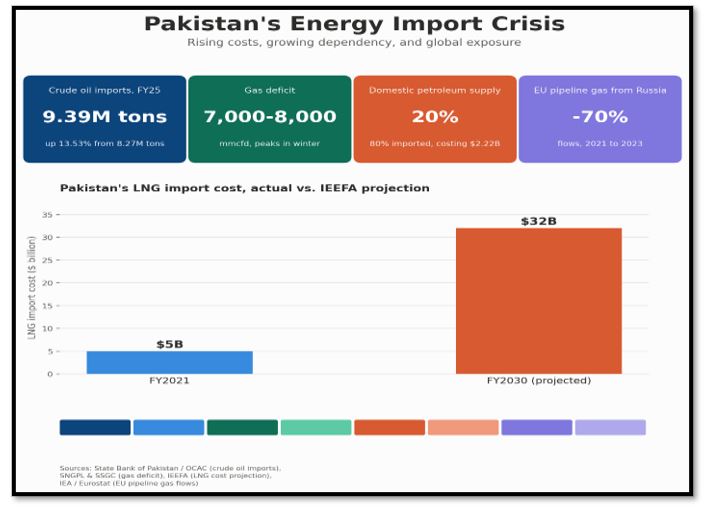
The global energy landscape is changing. Geopolitical conflicts, tensions in the Middle East, disruptions at key chokepoints, and growing fragmentation of worldwide supply chains have shifted how energy security is understood. These changes are especially crucial for Pakistan. The country faces major challenges, such as heavy reliance on imported oil and natural gas, ongoing electricity shortages, rising fuel prices, circular debt, and inadequate transmission infrastructure. Pakistan is a net importer of crude oil; crude oil imports increased by 13.53% to 9.387 million tons in FY25, compared to 8.268 million tons in the same period last year.[1]
Similarly, in the gas sector, Pakistan is also experiencing a crisis; the total gas deficit in Pakistan ranges between 7000 and 8000 mmcd. The usual demand is from 6700 to 7000 mmcd, but during winter, it spikes to 8000 mmcd. Saudi Arabia and the United Arab Emirates make up most of Pakistan’s oil and gas imports, which are quite costly. LNG imports place a substantial burden on Pakistan’s economy and energy sector. According to IEEFA, increased LNG imports in Pakistan could raise the country’s LNG import costs from $5 billion in FY2021 to more than $32 billion in FY2030.[2]
Pakistan’s dependence on imported petroleum is also concerning. Only 20% of the country’s petroleum needs are met domestically; the remaining 80% must be imported, costing $2.22 billion in crude oil and processed products.[3] This dependency makes Pakistan highly vulnerable to fluctuations in international oil prices and possible disruptions to global shipping. Recent geopolitical events clearly illustrate these vulnerabilities. The war in Ukraine significantly affected global energy markets due to decreased Russian energy exports to Europe, with Russian pipeline gas flows to the EU dropping over 70% between 2021 and 2023, which caused a sharp increase in worldwide LNG prices.[4]
Figure 1: Pakistan Energy Crisis
Source: SBP & EU
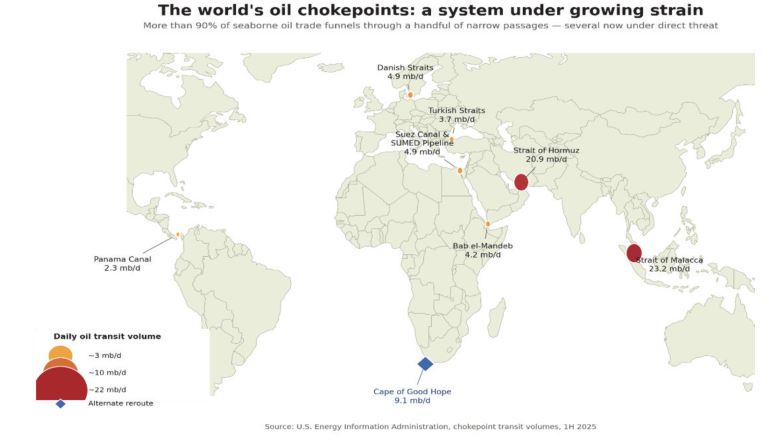
Wars in the Middle East have created numerous uncertainties over sea lanes between oil producers in the Gulf and Asian consumers. Meanwhile, attacks on commercial shipping have increased the costs and transit times of energy shipments, leading to a 256% rise in freight rates on Asia–Europe routes in late 2023–2024, and average transit times have grown by 10-14 days due to rerouting via the Cape of Good Hope.[5] Pakistan is far from these conflict zones, but its economy is directly affected because its energy security depends on the safe shipping of oil and LNG through the Arabian Sea and the Gulf, which carry over 80% of its oil imports.[6]
Perhaps the greatest vulnerability is the Strait of Hormuz. It lies between Iran and the Arabian Peninsula and is one of the world’s most vital energy chokepoints, where about 20–21 million barrels of oil flow daily. This accounts for roughly 20% of all petroleum consumption and nearly one-third of all seaborne oil trade. It’s also crucial for LNG shipments, with approximately 25% of global LNG exports passing through this area, mainly Qatar.[7] Any disruption of this narrow passage, whether caused by military conflict, sanctions, or political escalation, would lead to global price shocks and severely impact supply chains in Pakistan and other economies that rely heavily on oil imports.
Figure 2: World’s Chokepoints
Source: EIA
In this context, Pakistan’s energy policy needs to shift from crisis management to resilience building. One of the most effective ways to do this is through regional energy diplomacy. Pakistan’s strategic position in South Asia, Central Asia, China, and the Middle East offers great potential to become a regional energy and connectivity hub. Iran is Pakistan’s most important neighboring country. Iran possesses vast oil and natural gas reserves and has a high capacity for electricity production. Regional political dynamics and international sanctions do not hinder Iran’s potential as a long-term energy partner for Pakistan, given its geographic proximity and existing cross-border infrastructure.
Table 1: Primary Energy Data in Quadrillion
| Pakistan | Iran |
| Energy Production: 1.927 | Energy Production: 16.704 |
| Energy Consumption: 3.35 | Energy Consumption: 12.05 |
Source: EIA
Although Iran has a more diverse economy than many other Middle Eastern countries, the sale of oil and other liquids remains its main source of revenue. Pakistan can meet its energy needs by increasing its imports from Iran. Iran produces more oil than it exports to Pakistan, but neither country can expand its trade due to ongoing regional and global constraints.
Table 2: Pak-Iran Oil Profile
| Indicators | Iran | Pakistan |
| Proven Crude Oil Reserves | 208,600 Mn/Br | 83.0 Thousand B/D |
| Iran Crude Oil Production | 2,392 (‘000 B/D) | 0.179 |
| Oil Consumption | 1,512 Thousand B/D | 0.989 Thousand B/D |
| Total Oil Export | 2,168 Thousand B/D | – |
| Total Oil Import | – | $17.03 Bn |
| Oil Export to Pakistan | 497.26 M$ | – |
Designed by Researcher
The two countries can cooperate in the energy sector, and trade can be enhanced by the reopening of the gas pipeline between Iran and Pakistan. Through this, Pakistan can satisfy its 25% of energy needs. The project is expected to cost $7.50 bn in total, at a cost of roughly $1.25 billion for Pakistan. The project would provide 750 mcft each day via its 1700 km length, and estimated that at least 5000 MW of power can be produced from Iranian gas. This pipeline can additionally incorporate the wider China-Pakistan Economic Corridor.[8]
However, the project’s future highlights the economic and geopolitical challenges ahead. To revive the pipeline, Pakistan recently requested a new 10-year extension until 2035 and has been working to avoid an $18 billion international arbitration fine due to contractual obligations and the impact of U.S. sanctions against Iran.[9]
Table 3: Pak-Iran Gas Profile
| Indicators | Iran | Pakistan |
| Total Gas Reserves | 33.98 tcf | 20.91 Tcf |
| Total Gas Production | 257,119 Mm³ | 1.165 MMcf |
| Total Gas Consumption | 23.329 bcf | 1.482 MMcf |
| Total Gas Export | 18,425 million m³ | – |
| Total Gas Import of Pakistan | – | $4,566.2 Mn |
| Iran’s Gas Export to Pakistan | 156 M$ | – |
Designed by Researcher
Pakistan’s energy shortage has forced it to depend on electricity imports from Iran to power parts of Balochistan province. Gwadar receives 14 MW of the 70 MW delivered via a 400 km transmission line from Pishin in Sistan-Baluchistan, Iran, which borders Mand in Pakistan’s Balochistan province. Pakistan has agreed to Iran’s offer to supply 3,000 megawatts of electricity. Iran states that it has an official capacity of 85,000 MW for power generation. Currently, Iran exports $34.8 million worth of power to Pakistan.[10]
Table 4: Pak-Iran Electricity Profile
| Indicators | Iran | Pakistan |
| Total Electricity Generation | 343,108 GWh | 46,605 MW |
| Consumption | 236.30 bn kWh | 80,111 GW |
| Electricity Imports | – | 0.49 bn kWh |
| Total Export | 36.6 M$ | – |
| Electricity Shortfall in Peak Periods | – | 8000 MW |
| Iran Electricity Export to Pakistan | 34.8 M$ | – |
Source: Authors’ compilation.
The Pakistani government has agreed to import the necessary coal from Iran. Pakistan is rich in coal resources. However, it lacks the resources, expensive equipment, and coal-refining infrastructure needed to fully harness this potential.
Table 5: Pak-Iran Coal Profile
| Indicators | Iran | Pakistan |
| Coal Reserves | 1,326 million short tons | 3,377 million short tons |
| Coal Production | 1,810 thousand short tons | 9,306 thousand short tons |
| Consumption | 1,585 thousand short tons | 29,254 thousand short tons |
| Total Coal Export | 161 thousand short tons | – |
| Total Coal Imports | – | 21,611 thousand short tons |
| Export To Pakistan | 0.5 million metric tons | – |
Source: Authors’ compilation.
The Iran-Pakistan (IPL) gas pipeline is the main focus of bilateral energy cooperation, but Pakistan’s energy policy for the region should not rely solely on this one project. Instead, it should aim for a diverse strategy that includes pipeline links, cross-border electricity trade, innovative payment methods, and regional energy transportation corridors to protect the energy sector from potential geopolitical shocks in the future.
The best course for Pakistan is to strengthen and grow bilateral relations with Iran while monitoring global and regional political, economic, and other relevant factors. Here are some suggestions that, if implemented, could help Pakistan build positive relationships with Iran.
One practical measurements are under development is barter trade. Iran and Pakistan have signed their first barter trade agreement to exchange Pakistani grains for Iranian LPG.[11] Pakistani law exempts Iranian vehicles transporting Pakistani cargo within Pakistan from taxes. Iran charges Pakistani trucks US$1 per three kilometers for the fuel price discrepancy. Trade using both barter and national currencies would enable the two states to fulfil their economic potential.[12]
Border markets are another underutilized instrument of regional diplomacy. Pakistan and Iran agreed to collaborate on border market construction and truck mobility under the TIR Convention.[13] Both countries established their first border market on May 18, 2023. Creating combined border markets would boost economic activity on both sides and create jobs for locals. In the border towns of Pakistan and Iran, food would be easily accessible with the creation of these markets. The Sistan-Baluchestan province’s border markets with Pakistan are currently open in Saravan-Jaleq, Saravan-Kuhak, Sarbaz-Pishin, and Chabahar-Rimdan, while the Mirjaveh market has merged with Mirjaveh customs.[14]
Similarly, expanding CPEC to Iran could make an “energy nexus” between Pakistan, China, and Iran almost inevitable. The 2,775-km Iran-Pakistan gas pipeline (IP) transports natural gas from Iran to Pakistan. The project has been delayed by local, regional, and global geopolitical issues. Despite these challenges, China and Russia have repeatedly offered to assist Pakistan in building the pipeline. China’s influence in the SCO will help Pakistan connect energy corridors, while Iran’s new accession will provide another opportunity for economic cooperation among the three countries.[15]
Moreover, Pakistan can capitalize on the China-Pakistan-Iran-Turkey Energy Corridor (CPIT) through regional diplomacy.[16] The CPIT strategic energy corridor can diversify energy supply, boost economic growth, and facilitate industrial restructuring.
Figure 3: China-Pakistan-Iran-Turkey Energy Corridor (CPIT)
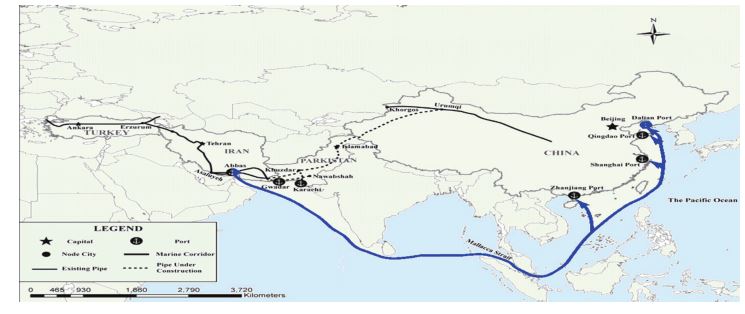
Source: F.-f. Guo, C.-f. Huang and X.-l. Wu / Energy Reports 5 (2019) 828–841
The most noteworthy characteristic of Gwadar and Chabahar ports is their geostrategic significance. Both ports are positioned at the intersection of major energy trade routes, through which 70% of all oil shipments worldwide travel. If geopolitics and geo-economics are kept separate, both ports may catalyze regional growth. China has started implementing its BRI strategy, of which the CPEC is the centerpiece project and Gwadar the keystone.[17]
After re-imposing sanctions on Tehran, the U.S. government has allowed eight countries, including close allies South Korea and Japan, as well as India, Turkey, China, Italy, Greece, and Taiwan, to continue purchasing Iranian oil. Therefore, since all eight countries received waivers from the U.S. to stabilize their economies, Pakistan must use waivers to buy inexpensive oil from Iran and Russia.
Political commitment, institutional coordination, and regional, sustained engagement will be necessary to shift from energy vulnerability to energy resilience. Pakistan has the geographic location, regional connections, and economic incentives needed to become a key player in the region’s energy cooperation. The challenge is no longer about recognizing the opportunity; it’s about developing a strategic vision to transform those opportunities into sustainable economic resilience.
Maria Mansab is a Research Associate at an Islamabad-based think tank and holds an MPhil in international relations from SPIR Quaid-i-Azam University.
[1] “Barter Trade, Border Markets and Energy Cooperation,” Dawn, 2025, https://www.dawn.com/news/1920876
[2] Institute for Energy Economics and Financial Analysis (IEEFA), “Pakistan Energy Report Fact Sheet,” June 2022, https://ieefa.org/sites/default/files/2022-06/FINAL%20fact%20sheet_IEEFA%20pakistan%20report%20fact%20sheet_A4.pdf
[3] Salman Raza, Dr. Khalid Mustafa, and Suleman Akram, Petroleum Sector of Pakistan and Its Trade Dynamics (Karachi: Trade Development Authority of Pakistan, December 2021), page number, https://tdap.gov.pk/wp-content/uploads/2022/03/13-Petroleum-Sector-of-Pakistan-and-its-Trade-Dynamics-1.pdf
[4] International Energy Agency (IEA), Gas Market Lessons from the 2022–2023 Energy Crisis (Paris: IEA, 2025), “Anatomy of a Natural Gas Crisis,” https://www.iea.org/reports/gas-market-lessons-from-the-2022-2023-energy-crisis
[5] United Nations Conference on Trade and Development (UNCTAD), Navigating Troubled Waters: Impact on Global Trade of Disruptions of Shipping Routes in the Red Sea, Black Sea and Panama Canal (Geneva: United Nations, 2024), https://unctad.org/publication/navigating-troubled-waters-impact-global-trade-disruption-shipping-routes-red-sea-black
[6] Salman Raza, Dr. Khalid Mustafa, and Suleman Akram, Petroleum Sector of Pakistan and Its Trade Dynamics (Karachi: Trade Development Authority of Pakistan, December 2021), page number, https://tdap.gov.pk/wp-content/uploads/2022/03/13-Petroleum-Sector-of-Pakistan-and-its-Trade-Dynamics-1.pdf
[7] U.S. Energy Information Administration, “The Strait of Hormuz Is the World’s Most Important Oil Transit Chokepoint,” Today in Energy, November 21, 2023, https://www.eia.gov/todayinenergy/detail.php?id=61002
[8] Kazem Sarabi, “Iran Begins Talks to Export Gas to Pakistan,” Caspian News, May 29, 2022, https://caspiannews.com/news-detail/iran-begins-talks-to-export-gas-to-pakistan-2022-5-29-45/.
[9] Business Desk, “Pakistan Wants Iran Gas Pipeline Project Delayed by 10 Years,” ProPakistani, January 23, 2026, https://propakistani.pk/2026/01/23/pakistan-wants-iran-gas-pipeline-project-delayed-by-10-years/
[10] Ayaz Ahmed, “Scholar: Pakistan Relying on Iran to Provide Energy,” Islamic Republic News Agency (IRNA), April 28, 2019, https://en.irna.ir/news/83294542/Scholar-Pakistan-relying-on-Iran-to-provide-energy.
[11] “Iran, Pakistan look to new era in trade with barter deal,” Press TV, 8 November, 2021. https://theiranproject.com/blog/2021/11/08/iran-pakistan-look-to-new-era-in-trade-with-barter-deal/
[12] Shabbir H. Kazmi, “Can Barter Trade Between Iran and Pakistan Become a Reality?” Eurasia Review, April 10, 2022.
[13] “Pakistan to establish four joint border markets with Iran,” IRNA, 30 November, 2019. https://en.irna.ir/news/83574383/Pakistan-to-establish-four-joint-border-markets-with-Iran
[14] “Pakistan to establish four joint border markets with Iran,” IRNA, 30 November, 2019. https://en.irna.ir/news/83574383/Pakistan-to-establish-four-joint-border-markets-with-Iran
[15] Fatima Raza, “Prospects for Pakistan-China-Iran Trilateral Cooperation: Opportunities and Challenges.” Strategic Studies Vol.39, No.3 (Autumn 2019): 37-52.
https://www.issi.org.pk/wp-content/uploads/2019/11/3-SS_Fatima_Raza_No-3_2019.pdf
[16] Fei-fei Guo, Cheng-feng Huang, Xiao-ling Wu, “Strategic analysis on the construction of new energy corridor China–Pakistan–Iran–Turkey.” Energy Reports Vol. 5 (2019): 828-841.
https://www.sciencedirect.com/science/article/pii/S2352484719300034
[17] “Pakistan Considering to Link Gwadar with Chabahar: Sartaj Aziz,” Express Tribune, September 25, 2017. https://tribune.com.pk/story/1111323/pakistan-considering-link-gwadar-chabahar-sartaj-aziz