INTRODUCTION:
Critical minerals are the strategic commodities of the 21st century. Their supply chains are at the heart of global economic and geopolitical rivalry, underpinning the technologies that are powering the global energy transition, digital transformation, and modern defence industries. However, the key to the strategic advantage is not in the control of the mineral deposits in themselves, but in the capacity to refine, process and turn the mineral deposits into high-value products. As the world is reconfigured in the context of new supply chains, Pakistan has the opportunity to secure its place in this new geoeconomic matrix, given its mineral endowment of $6-8 trillion.[1] Whether that opportunity pays off will hinge on Pakistan’s ability to build industrial capacity rather than remain a supplier of raw materials, a transformation that must negotiate complex domestic governance and regional competition, deciding whether geology becomes a source of resilience or of continued dependency.[2]
THE NEW GEOPOLITICS OF CRITICAL MINERALS
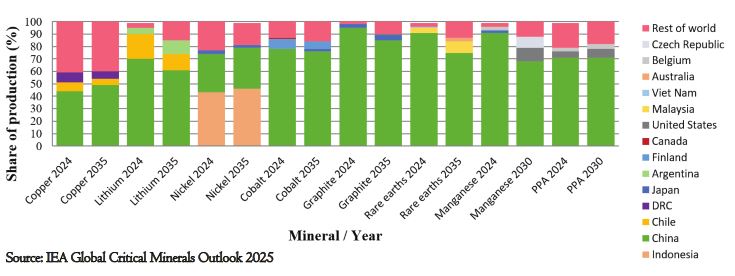
Critical minerals have become a tool of state power in the global energy transition. Today, lithium, cobalt, nickel, copper, and graphite are no longer commodities, but the building blocks of electric vehicles, renewable energy systems, semiconductors, advanced defence systems, and digital infrastructure. Yet the geography of this transition is profoundly unequal. According to the International Energy Agency’s (IEA) Global Critical Minerals Outlook 2025,[3] China is the leading refiner for 19 of the 20 strategic minerals closely tracked by the agency, with an average market share of approximately 70 percent.
Figure 1 Geographical Distribution of Refined Material Production (Base Case)
Source: IEA Global Critical Minerals Outlook 2025
PPA = battery-grade purified phosphoric acid; DRC = Democratic Republic of the Congo. The figures for graphite are based on battery-grade graphite, including spherical graphite and synthetic graphite. The figures for rare earths are for magnet rare earth elements only. The figure depicts the value of the top three producing countries in a given year
For specific minerals, the concentration is even more extreme: China holds 98.7 percent of global refining capacity in gallium, 95.2 percent in graphite, and 95 percent in manganese. Most of these minerals are already subject to some form of export control. China required special export licences for gallium and germanium from July 2023, extended similar controls to graphite by October 2023, and restricted antimony in August 2024. When Beijing barred gallium, germanium, and antimony exports to the USA in December 2024, Chinese antimony shipments fell by roughly 97 percent and prices approximately doubled within months.[4]
The contemporary discourse surrounding critical minerals is often framed as a contest over geological endowment. Yet such a framing obscure the more consequential struggle over industrial capability. China’s approach to critical minerals was never confined to securing mineral deposits; it was rooted in a broader developmental discourse that conceived control over the supply chain as the foundation of national power. Through initiatives such as Made in China 2025,[5] Beijing articulated a vision in which refining, processing, manufacturing, and technological innovation were treated as strategic state objectives rather than outcomes to be left to market forces. Critical minerals were therefore understood not as commodities in themselves but as inputs into high-value sectors, including high-speed rail, electric vehicles, and aerospace, underpinning China’s long-term economic and geopolitical influence.
By contrast, the USA, Japan and most of the liberal industrial world trusted comparative advantage to guarantee mineral supply, seeing little need for state intervention in processing, a stance reinforced by the environmental costs of offshoring such activity. Western nations, therefore, stayed dominant in innovation and finance while slowly ceding the midstream industrial sectors to China. However, it has been argued that a modern day mineral race to catch up with China is an inadequate description of the new geopolitical reality.[6] The current western approaches are essentially reactive, trying to correct longstanding reliance on mainstream critical minerals instead of predicting which materials can drive new technologies. In doing so, policy discourse has largely overlooked minerals at the margins, i.e., materials that possess emerging strategic significance are already mined and refined predominantly within Organisation for Economic Co-operation and Development (OECD) countries, yet remain peripheral to contemporary geopolitical debates.
The debate, thus, moves the analytical lens from a zero-sum game about the significance of today’s value chains to a larger consideration of technological foresight, resource diversification, and strategic advantage moving beyond geographies. The formulated data makes the geopolitical asymmetry real.[7] Among the seven mainstream minerals, critical for energy transition and defense supply chains, OECD economies regularly have the advantage of mining whereas China has the processing advantage in each case, i.e., extraction does not give strategic control, refining does. However, the eleven minerals at the margin have a different pattern: OECD countries are advantaged in both mining and processing as well as in reserves. At present, such minerals are not in contention, but with increasing usefulness in industry, could become the next choke points.
The lesson for Pakistan is not to specialize in the processing of mainstream minerals (where the bottleneck has already solidified around China), but become capable of processing and midstreaming of still-strategically open minerals. Notwithstanding, the centralization of mineral processing in a handful of countries makes the world’s manufacturing sector vulnerable to substantial supply shocks, with the potential to become a site of geopolitical competition, not beneficiary. In the absence of domestic value addition, Pakistan’s mineral wealth may further exacerbate its foreign dependence and undermine its strategic autonomy, putting pressure on Pakistan to deal with competing demands of the major powers without deriving the maximum benefit of its resources in economic and geopolitical terms. But, to leverage the opportunity, Pakistan’s possible path of moving up the value chain depends on overcoming binding domestic constraints, including constitutional fragmentation and high energy cost.
FROM GEOLOGICAL WEALTH TO INDUSTRIAL CAPABILITY
Pakistan is blessed with a geological fortune on an unprecedented scale. The government-affiliated estimates suggest total mineral potential for the country at more than $6 trillion and one source estimates it at $8 trillion. This wealth is spread over nearly 600,000 sq kilometres and includes 92 known minerals , of which 52 are commercially extracted.
Figure 2 Pakistan’s Mineral Resources
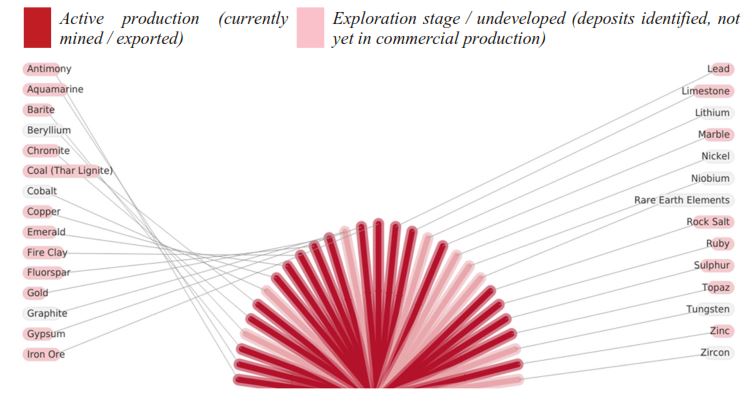
Source: Data adopted from the Government of Pakistan. (2025). Pakistan’s mineral resources, Pakistan Minerals Investment Forum 2025
Despite this mineral resource base, Pakistan’s mining sector has historically contributed less than three percent to GDP. The $6 trillion figure is an unverified estimate, not an official reserve valuation, but even a fraction of this potential represents a transformative opportunity. Among its most strategic assets is Reko Diq, one of the world’s largest undeveloped copper-gold deposits, containing an estimated 5.9 billion tonnes of ore. Commercial production is expected to commence by 2028, with an initial annual output of 200,000 tonnes of copper, rising to 400,000 tonnes after expansion. The project alone is projected to generate approximately US$2.8 billion in annual exports and over US$70 billion in free cash flow over its estimated 37-year operational life.[8] Beyond copper, geological surveys have identified at least 12 of the 17 rare earth elements within Pakistan, alongside promising deposits of lithium-bearing pegmatites, chromite, beryllium, and zircon, positioning the country within the emerging critical minerals landscape.[9]
However, geology does not necessarily equate geoeconomic influence. As discussed before, Pakistan still remains at the bottom of the global mineral value chain. Most minerals are exported in raw or semi-processed form due to the absence of domestic refining and processing facilities, allowing the highest-value stages of production and the associated technology, employment, and industrial learning to accrue elsewhere. This is due to the underlying structural limitations, rather a shortage of mineral resources. The 18th Constitutional Amendment devolved mineral resource authority to the provinces while keeping trade, investment, and industrial policy in the federal domain; hence, creating regulatory uncertainty for investors. This uncertainty is not merely theoretical: in 2019, an International Centre for Settlement of Investment Disputes (ICSID) tribunal awarded Tethyan Copper Company roughly US$5.9 billion in damages after Balochistan’s government denied the company’s Reko Diq mining lease in 2011, a sum equivalent to Pakistan’s IMF bailout package that year, underscoring how quickly weak regulatory clarity can convert geological wealth into fiscal liability.[10]
Meanwhile, high electricity tariffs, limited mineral processing capability, and a lack of technological capacity within Pakistan have hindered efforts to go beyond extraction. These constraints are compounded by growing international expectations surrounding environmental and governance standards, making institutional credibility as important as geological potential. Pakistan’s problems are not only domestic: the IEA notes that building a new critical-mineral supply chain outside existing production hubs is inherently costly, with new mining and refining investments running roughly 50 percent higher than in established producers, a structural disadvantage that complicates diversification even as governments elsewhere seek to reduce reliance on concentrated supply chains.
Investment in Pakistan will thus depend upon more than just its geology; it will depend upon the certainty of the policies, modern infrastructure, technology cooperation arrangements, and the coherence of the industrial strategy that can offset these structural challenges. The real issue is not whether Pakistan has critical minerals but if it can break the commodity trap. Reko Diq, therefore, should not be seen as a single isolated mining project but as the base for a larger industrial strategy, which can be realized to create long-term productive capacity from geological wealth. Indonesia’s experience offers an instructive precedent: successive bans on unprocessed nickel-ore exports in 2014 and 2020 forced smelting investment onshore, and by 2025, the country accounted for roughly 62 percent of global nickel production coupled with a far larger refined-product export base.[11] However, the nickel’s success rested on ample reserves, rising EV-linked demand, and few viable substitutes, conditions Pakistan’s copper and chromite deposits may not share to the same degree. This implies that any beneficiation strategy should be calibrated mineral-by-mineral rather than imported wholesale.[12]
BEYOND EXTRACTION
Pakistan’s mineral strategy should be guided less by ambition than by sequencing:
Rather than attempting to replicate China’s capital-intensive refining model, the country should first build the capacities that make downstream industrialization commercially viable. The focus must not be on billion-dollar refineries, but on mineral beneficiation (upgrading the ore before exportation) that generates higher value with significantly less capital investment. On this, Pakistan should build the Reko Diq corridor as a pilot industrial zone which will incorporate processing areas, logistics, technical training, and allied industries, rather than a standalone mining zone.
Equally critical is to mitigate risk in investments, rather than expanding public expenditures. In Pakistan, limited fiscal space requires attention to reforms that enable the crowding in of private capital. These include the publication of high-quality geological data, the co-ordination of federal and provincial approvals within existing structures, the provision of captive renewable energy to processing plants, and negotiating technology transfer and development of local suppliers under future mining concessions. These are not politically or financially costly as subsidy payments but will require institutional coordination.
Pakistan should avoid assessing success based on the quantity of minerals it is able to extract. The competitiveness in an age of green industry increasingly hinges on responsible mineral production. Integrating robust environmental safeguards, clear community benefits, water stewardship, as well as mine rehabilitation from the beginning, would help build investor confidence and ensure that mineral development is contributing to long-term ecological resilience. Sustainability should not be seen as a compliance requirement but as a strategic opportunity for Pakistan to carve out a niche for itself in the critical minerals market.
CONCLUSION
The changing minerals landscape is an opportunity and a choice for Pakistan. The nation’s rich mineral resources fuel the potential for economic change, especially given the increasing attention from global economy. However, if Pakistan fails to invest in refinement, downstream industries, and a stable industrial policy, it is likely to fall into the same old trap of exporting raw materials and importing high value products. The rising geoeconomic powers will not necessarily be the countries with the most abundant geological resources, but those that turn geological wealth into industrial ecosystems, technological strength, and strategic capacity. It is, therefore, not enough for Pakistan to seek the future but also create it. As the world’s race for critical minerals increases, it is not the minerals under Pakistan’s soil that is going to translate into an economic advantage, it will be the ability to turn these minerals into an industry.
Maheen Khan is a member of Chatham House & Bilal Aftab is a Staff Economist at the Pakistan Institute of Development Economics (PIDE), Islamabad
[1] Khetran, M. (2025, May 19). Unlocking Pakistan’s mineral wealth for sustainable economic growth. Institute of Strategic Studies Islamabad. https://issi.org.pk/wp-content/uploads/2025/05/IB_Khetran_May_19_2025.pdf
[2] Mehlum, H., Moene, K., & Torvik, R. (2006). Institutions and the resource curse. The Economic Journal, 116(508), 1–20. https://doi.org/10.1111/j.1468-0297.2006.01045.x
[3] International Energy Agency. (2025). Global critical minerals outlook 2025. IEA. https://www.iea.org/reports/global-critical-minerals-outlook-2025
[4] Center for Strategic and International Studies. (2025, April 16). The consequences of China’s new rare earths export restrictions. https://www.csis.org/analysis/consequences-chinas-new-rare-earths-export-restrictions
[5] Kuo, K. (2025, June 26). Made in China 2.0: The future of global manufacturing? World Economic Forum. https://www.weforum.org/stories/2025/06/how-china-is-reinventing-the-future-of-global-manufacturing/
[6] Debertd, R., & DiCarlo, J. (2026). Minerals at the margins and the new geopolitics of critical minerals. Energy Research & Social Science, https://doi.org/10.1016/j.erss.2026.104601
[7] Debertd, R., & DiCarlo, J. (2026). Minerals at the margins and the new geopolitics of critical minerals. Energy Research & Social Science, https://doi.org/10.1016/j.erss.2026.104601
[8] Barrick Mining Corporation. (2025). Reko Diq project. https://www.barrick.com/English/operations/reko-diq/
[9] Geological Survey of Pakistan. Mineral resources of Pakistan, https://gsp.gov.pk/geology-mineral-exploration/
[10] The News. (2019, July 13). The Reko Diq timeline. https://www.thenews.com.pk/print/506907-the-reko-diq-timeline
[11] Center for Trade Excellence. (2026, March). How Indonesia’s ban on raw nickel exports provides lessons for fiscal and economic policy in the low-carbon transition. https://cetex.org/publications/how-indonesias-ban-on-raw-nickel-exports-provides-lessons-for-fiscal-and-economic-policy-in-the-low-carbon-transition/; U.S. International Trade Commission. (2025). Export restrictions on minerals and metals: Indonesia’s export ban of nickel. https://www.usitc.gov/publications/332/working_papers/ermm_indonesia_export_ban_of_nickel.pdf
[12] Katadata Insight Center. (2024, April 19). Possible missteps in Indonesia’s minerals downstreaming policy. https://dinsights.katadata.co.id/read/2024/04/19/possible-missteps-in-indonesias-minerals-downstreaming-policy