From Location to Leverage: Pakistan in a New Regional Order
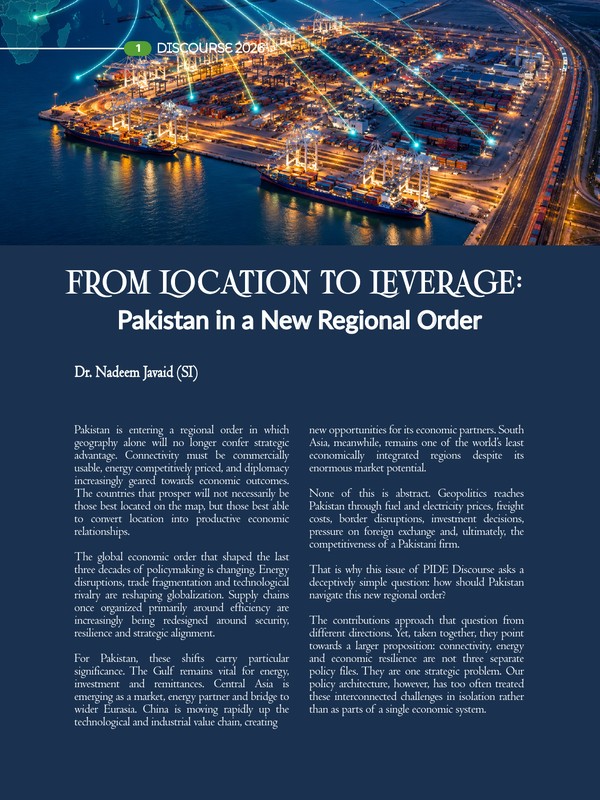
Pakistan is entering a regional order in which geography alone will no longer confer strategic advantage. Connectivity must be commercially usable, energy competitively priced, and diplomacy increasingly geared towards economic outcomes. The countries that prosper will not necessarily be those best located on the map, but those best able to convert location into productive economic relationships.
The global economic order that shaped the last three decades of policymaking is changing. Energy disruptions, trade fragmentation and technological rivalry are reshaping globalization. Supply chains once organized primarily around efficiency are increasingly being redesigned around security, resilience and strategic alignment.
For Pakistan, these shifts carry particular significance. The Gulf remains vital for energy, investment and remittances. Central Asia is emerging as a market, energy partner and bridge to wider Eurasia. China is moving rapidly up the technological and industrial value chain, creating new opportunities for its economic partners. South Asia, meanwhile, remains one of the world’s least economically integrated regions despite its enormous market potential.
None of this is abstract. Geopolitics reaches Pakistan through fuel and electricity prices, freight costs, border disruptions, investment decisions, pressure on foreign exchange and, ultimately, the competitiveness of a Pakistani firm.
That is why this issue of PIDE Discourse asks a deceptively simple question: how should Pakistan navigate this new regional order?
The contributions approach that question from different directions. Yet, taken together, they point towards a larger proposition: connectivity, energy and economic resilience are not three separate policy files. They are one strategic problem. Our policy architecture, however, has too often treated these interconnected challenges in isolation rather than as parts of a single economic system.
Connectivity Is a System, Not a Road
Pakistan’s location at the intersection of South Asia, Central Asia, China and the Middle East has been described as a strategic asset for decades. It is true in principle, but remains insufficiently reflected in economic outcomes.
We have built ports, motorways and energy infrastructure on the correct premise that physical connectivity is essential for regional integration. But infrastructure alone does not create connectivity.
A corridor is not a pipe that moves goods on its own. It is a system. Roads and railways are only its physical layer. Customs, border management, standards, logistics, digital systems, financing, security and diplomatic arrangements determine whether infrastructure actually carries commerce.
A motorway that ends in hours of border clearance is not an efficient corridor. A port without competitive logistics is not connectivity. A railway without predictable transit arrangements may be infrastructure, but it is not yet integration. The lesson is not that Pakistan needs less infrastructure. It is that physical investment must be accompanied by institutional reforms that make infrastructure economically productive.
The same principle should shape our engagement with Central Asia. The opportunity is reciprocal: providing Central Asian economies efficient access to Pakistan’s ports and the Arabian Sea while connecting Pakistani firms to new markets, energy sources and production networks across Eurasia.
Geography creates possibility. Connectivity converts it into economic opportunity.
A corridor Pakistan cannot clear efficiently, price competitively or finance predictably risks carrying someone else’s trade past us rather than generating value within our economy.
From Connectivity to Competitiveness
Connectivity creates value only when firms can use it competitively. This is where energy becomes central.
Pakistan has traditionally viewed energy security primarily as a supply problem. But the more consequential question is what the energy system does to the productive economy.
Energy security should no longer be measured only in megawatts available. It must also be measured in the cost at which a Pakistani firm can produce, compete and export.
PIDE research provides a useful empirical reminder. A study of export-oriented industries finds a robust negative relationship between electricity tariffs and exports: a 1 per cent increase in electricity tariffs is associated with a 0.5 per cent decline in textile exports and a 0.4 per cent decline in other manufactured exports.
The chain is straightforward. Energy costs shape production costs; production costs influence competitiveness; competitiveness determines exports, investment and participation in regional and global value chains. These, in turn, determine the economy’s capacity to withstand external shocks.
Pakistan’s rapid adoption of distributed solar offers another lesson: households and firms respond quickly when technology, incentives and economics align. Regulation, grid management, tariffs and financing must evolve with equal speed.
The objective cannot realistically be complete energy independence. It should instead be energy optionality: a diversified mix of domestic and imported sources, renewables and conventional fuels, centralised and distributed generation, and stronger regional energy linkages.
Resilience Through Optionality
Economic resilience is sometimes confused with self-sufficiency. They are fundamentally different.
In an interconnected world, resilience does not mean producing everything ourselves or retreating behind national boundaries. It means maintaining enough options that disruption in one market, supplier, route or technology does not paralyse the economy.
Resilience comes from optionality: multiple markets, multiple energy sources, multiple transport routes, diversified suppliers and diversified sources of capital.
Pakistan’s geography provides precisely this possibility. We can engage China, Central Asia, the Gulf, South Asia and global maritime markets. Strategic economic space will come not from choosing among these relationships, but from developing the domestic capability to engage productively across them.
The central causal chain is clear:
Geography → Connectivity → Competitiveness → Resilience.
Geography provides the opportunity. Connectivity makes it accessible. Competitiveness determines whether Pakistani firms capture value from it. Resilience emerges when the economy develops sufficient productive capacity—and sufficient alternatives—to absorb shocks without repeatedly sacrificing growth.
Diplomacy as Economic Statecraft
This logic also requires us to rethink economic diplomacy. Energy diplomacy, trade diplomacy, investment promotion and regional connectivity cannot operate as parallel conversations. Whether Pakistan is negotiating transit rights, market access, energy arrangements, technology partnerships or investment, the objective should be to expand the country’s productive economic space.
Recent regional arrangements, including the emerging Makkah framework between Pakistan, Saudi Arabia and Türkiye, also point to a wider search for greater regional agency. The economic test, however, will be whether such strategic cooperation widens the space for trade, investment, technology and productive partnerships.
Geography gives Pakistan relevance; institutions determine whether that relevance becomes economic value.
That requires a shift from transactional diplomacy towards economic statecraft. Credibility, contracts, regulatory consistency and border efficiency all matter. An investor or trading partner ultimately evaluates Pakistan not through the strategic importance we attribute to ourselves, but through the predictability and profitability of doing business with us.
Institutions, Incentives and Outcomes
Pakistan does not suffer from a shortage of strategies or policy documents. The more persistent challenge lies in the institutions and incentives through which they are implemented.
Nor is this merely a coordination problem. Fragmented systems can persist because they distribute protections, discretion and economic rents. Reform therefore requires more than better administrative design; it requires changing incentives. Trade facilitation, competitive energy pricing and regulatory predictability inevitably challenge arrangements from which particular interests benefit. The political economy of connectivity may therefore prove harder than building the infrastructure itself.
The answer is not necessarily another institution. It is to make existing institutions work around common economic outcomes.
This suggests a simple test for policy. A corridor should be judged not by kilometres built, but by the time and cost saved in moving goods. Energy policy should be judged not simply by installed capacity, but by what productive firms ultimately pay. Economic diplomacy should be judged not by agreements signed, but by the trade, investment, technology and market access actually generated.
Evidence, too, must travel further—from research into policy design, from policy into implementation, and from implementation into measurable outcomes. That is where PIDE has a particular responsibility: not merely to diagnose constraints, but to challenge assumptions and help translate evidence into better policy choices.
Pakistan’s geography has not changed. The economics surrounding that geography has.
Our task now is to convert location into connectivity, connectivity into competitiveness, and competitiveness into resilience. Optionality—across markets, routes, energy sources, technology and capital—is what can make that resilience durable.
The new regional order will not reward Pakistan simply for being strategically located. It will reward us only if we become strategically connected, economically competitive and institutionally capable of turning geography into opportunity.
Nadeem Javaid is a Vice Chancellor, Pakistan Institute of Development Economics (PIDE) and Member, Planning Commission of Pakistan