Pakistan is experiencing rapid motorization driven by urbanization, infrastructure development, the expansion of formal housing colonies and informal settlements (katchi abadis), urban sprawl, and a sharp increase in private motor vehicle ownership facilitated by consumer auto financing. Private motor vehicles have grown substantially faster than public transport and other vehicle categories, becoming the dominant component of the national vehicle fleet. Normalized trends for 1990-2025 indicate a strong co-movement among total vehicles, population growth, GDP per capita, and road transport CO2 emissions. Without targeted policy interventions, transport-related emissions are likely to continue increasing alongside population growth and rising incomes.
Rising Population, Urbanization and Rising Travel Demand
Population growth, rapid urbanization, and changing land-use patterns in Pakistan’s major cities have substantially increased travel demand[1]. Urbanization has consistently shifted travel behavior toward greater automobile dependence[2] across many countries. As travel demand rises, trips are undertaken through either non-motorized modes, such as walking and cycling, or motorized modes, including private motor vehicles and public transport[3].
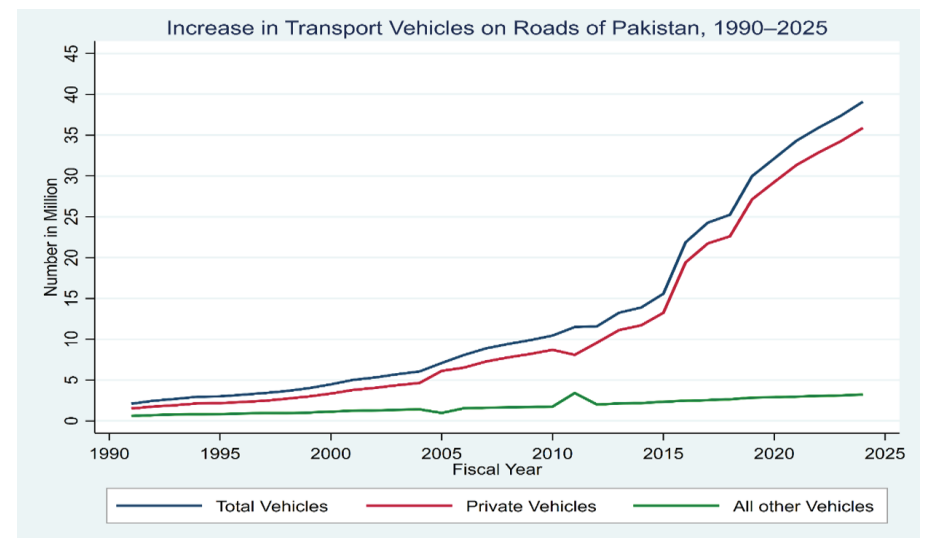
Statistics revealed that national vehicle fleet expanded from approximately 4.47 million vehicles in 1990 to 39.08 million in 2025[4]. Private vehicles, including cars, motorcycles, and jeeps, accounted for most of this increase, rising from 1.42 million in 1990 to 35.87 million in 2025 (Figure 1). In contrast, public transport vehicles, including buses, vans, and rickshaws, increased at a much slower rate. Government policies emphasizing road infrastructure development, urban transport investments, incentives for private vehicle. Meanwhile, the outward expansion of cities through low-density residential developments and informal settlements has increased travel distances and reinforced automobile dependence[5]. These trends have contributed to higher fuel consumption, greenhouse gas emissions, traffic congestion, road accidents, and declining urban livability, particularly in large metropolitan areas such as Karachi, Lahore, Islambad and Rawalpindi
Figure 1: Increase in Transport Vehicles on Roads in Pakistan (1990 – 2025).
Source: Author’s compilation from Economic Survey of Pakistan and related official series
Public VS Private Vehicles
Figure 1 illustrates the widening gap between private and other motor vehicle categories. Private vehicle ownership increased from a few million vehicles in the early 1990s to more than 35 million by the mid-2020s,while the number of other motor vehicles remained relatively stable at approximately 3-4 million throughout the period. The acceleration in private vehicle ownership became particularly pronounced after the mid-2010s. This divergence confirms that Pakistan’s rapid motorization has been driven overwhelmingly by private vehicles.
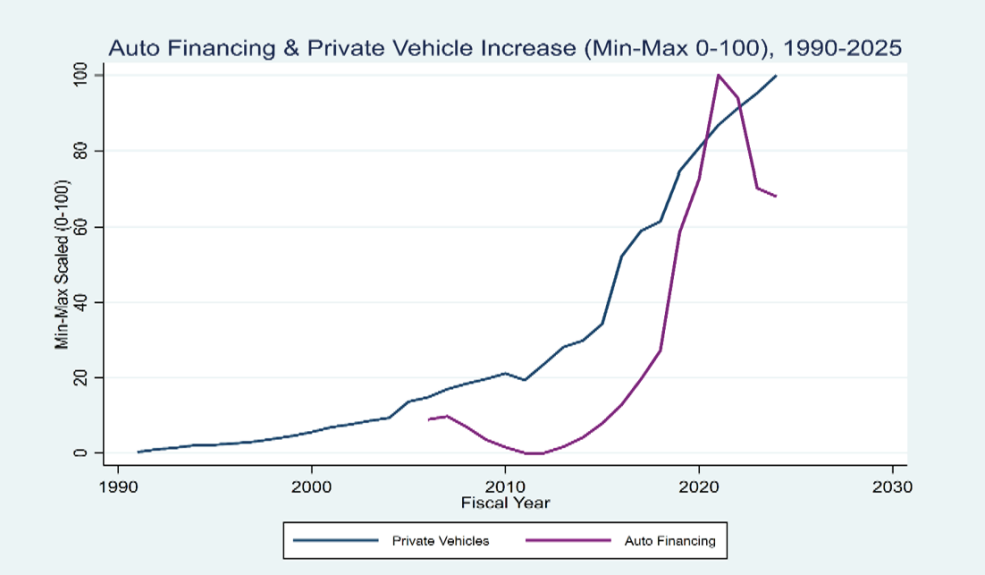
Figure 2 reflect that Auto financing has played a significant role in facilitating this growth. Although private vehicle ownership increased steadily throughout the study period, the sharp expansion of auto financing after 2015 closely coincided with accelerated vehicle purchases, suggesting a strong association between access to credit and motorization. By lowering upfront purchase costs and enabling households to spread payments over time, auto financing has expanded vehicle ownership to a broader segment of the population.
Figure 2: Trends in Private Vehicle Ownership and Auto Financing in Pakistan (Min-Max Scaled, 1990-2025)
Source: Author’s compilation based on data from the Pakistan Economic Survey and the State Bank of Pakistan (SBP), 2025
Figure 3 presents normalized (min-max scaled, 0-100) trends for four key variables between 1990 and 2025: total vehicles, population, road transport CO2 emissions, and GDP per capita. The four variables exhibit a strong degree of co-movement. Population growth has been accompanied by increases in income levels and a rapid expansion of the vehicle fleet. Road transport CO2 emissions have followed a broadly similar upward trajectory. This pattern supports the proposition that urbanization, economic growth, and motorization jointly contribute to increasing transport-sector emissions.
Figure 3: Normalized Trends of Total Vehicles on Roads, Population, CO2 Emissions from Road Vehicles and GDP per capita (constant 2015 US$), 1990–2025 (Min-Max Scaling 0–100).
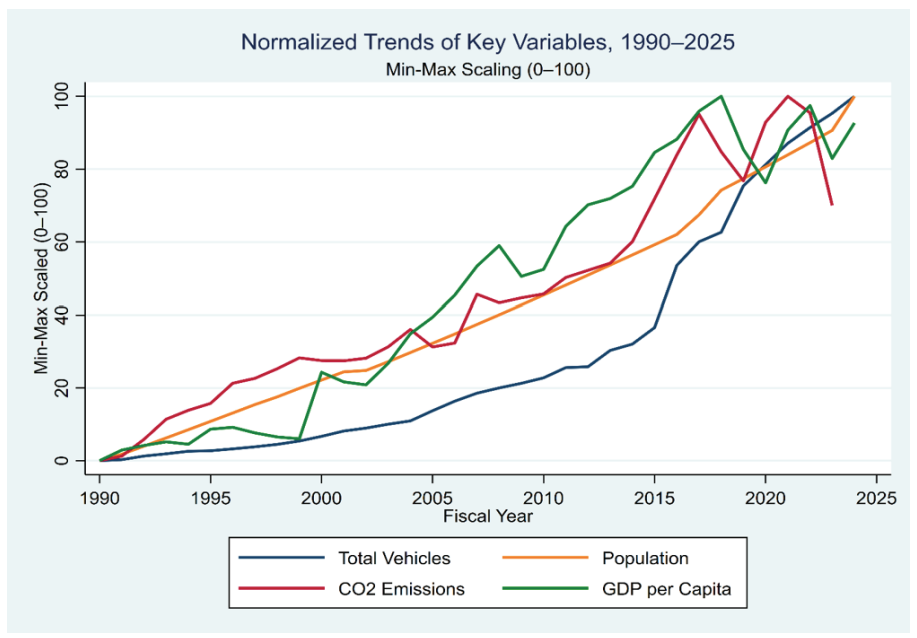
Figure 3: Normalized Trends of Key Variables (1990 – 2025)
Source: Author’s calculations based on data from the Government of Pakistan, Pakistan Economic Survey, the World Bank Open Data and the IEA-EDGAR.
Motorization and Environmental Emissions
The transport sector is a major source of air pollution and greenhouse gas emissions in Pakistan[6]. Road transport CO2 emissions increased from approximately 13.8 million tonnes in 1990 to 43.6 million tonnes in 2023[7]. According to The Urban Unit (2023), transport accounts for approximately 81.3% of Lahore’s estimated CO2 emissions[8]. Beyond its contribution to greenhouse gas emissions, road transportation is also an important source of urban air pollution in Pakistan. Evidence from major cities highlights the broader environmental and public-health costs associated with transport activity. Poor air quality in Lahore is estimated to reduce average life expectancy by approximately seven years. Similarly, transport contributes approximately 53% and 51% of total emissions in Islamabad-Rawalpindi and Peshawar, respectively, and accounts for 33% of emissions in Karachi. During severe smog episodes in November 2024, Air Quality Index (AQI) values exceeded 1,900 in Lahore and 2,000 in Multan, highlighting the magnitude of the air pollution challenge[9].
Two temporary interruptions to the long-term upward trend are evident:
2020: A substantial decline in transport emissions coincided with COVID-19 lockdowns, which significantly reduced travel demand and mobility.
2022: Another decline coincided with catastrophic flooding and a sharp increase in fuel prices, which may have constrained transport activity.
Following these disruptions, the long-term growth trajectory resumed. By the mid-2020s, population, vehicle ownership, GDP per capita, and transport-related CO2 emissions had all returned to, re-accelerated to their highest normalized levels.
Figure 4 provides additional evidence of the close relationship between motorization, energy consumption, and transport-sector emissions. Transport-sector petroleum consumption, primarily gasoline and diesel, increased alongside the rapid expansion of the vehicle fleet. The growth in private vehicle ownership raised demand for transport fuels, contributing to higher energy consumption and transport-related CO2 emissions. The upward trend in transport-sector oil consumption closely mirrors the growth in vehicle ownership presented in Figures 1 and 3, indicating that rising motorization has been accompanied by increased fuel use and, consequently, higher road transport CO2 emissions. A notable interruption occurs in 2020, when COVID-19 lockdowns and restrictions on vehicular movement led to a temporary decline in transport activity, resulting in lower oil consumption and reduced transport-related emissions. This decline is consistent with the downturn observed in road transport CO2 emissions in Figure 3. Following the easing of restrictions, transport-sector oil consumption resumed its upward trajectory, further reinforcing the co-movement among vehicle ownership, economic growth, energy consumption, and transport-related emissions. A further decline in oil consumption was observed in 2022, coinciding with the widespread flooding and sharp increases in petroleum prices. The close co-movement suggests that rapid motorization is an important contributor to rising petroleum demand and road-transport CO2 emissions in Pakistan.
Pakistan has historically introduced Euro-II vehicular emission standards for petrol and diesel vehicles. These vehicle emission standards should be distinguished from fuel-quality standards, which concern the characteristics of transport fuels, including sulfur content. The National Clean Air Policy identifies the upgrading of transport fuel-quality standards toward Euro 5 and Euro 6 as an important measure for improving air quality and reducing transport-related pollution[10]. The gap between policy targets and
Figure 4: Oil Consumption by the Transport and Other Sectors in Pakistan, 1990-2025 (Million Tons).
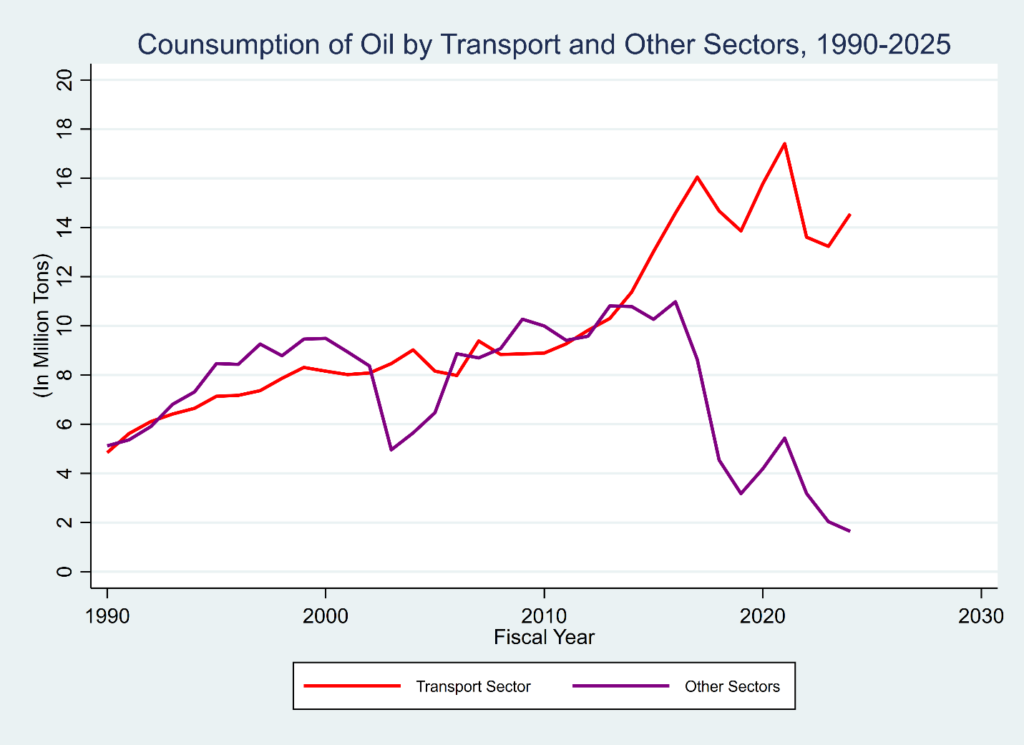
Source: Author’s calculations based on data from the Pakistan Economic Survey (various issues) and the Handbook of Statistics on Pakistan Economy, State Bank of Pakistan.
effective implementation highlights the importance of strengthening fuel-quality regulation, monitoring, and enforcement as Pakistan’s vehicle fleet continues to expand.
Costs of Rapid Motorization
The observed growth in motorization and its close co-movement with fuel consumption and road-transport CO2 emissions have broader economic, environmental, and social implications. Although rapid motorization has generated benefits for consumers, the automotive industry, and government revenues, its social, economic, and environmental costs are substantial, particularly in large urban centers.
Sustainable Transportation: Automobile-oriented urban development encourages sprawl, lengthens travel distances, reduces opportunities for active transportation, and creates barriers for pedestrians and cyclists.
Environmental Vehicle Emissions: Vehicle emissions contribute significantly to greenhouse gas accumulation and urban air pollution, frequently exceeding recommended health standards.
Traffic Congestion: Traffic congestion increases travel time, wastes fuel, and further elevates emissions.
Social Inequality: People without private vehicles—including many low-income households, women, students, elderly people, and persons with disabilities—may face greater mobility constraints.
Road Accidents: Road traffic injuries and fatalities remain a major public health concern.
Balance of Payments Disequilibrium: Transport accounts for a significant share of Pakistan’s petroleum consumption, increasing dependence on imported fuels and placing pressure on the balance of payments.
The policy paradox: Road widening and additional flyovers may temporarily improve traffic flow but can eventually encourage additional vehicle use—often described as induced demand.
These challenges underscore the urgent need for policies that reduce unnecessary private vehicle use while preserving accessibility and mobility.
Policy Recommendations
The strong positive association among motorization, population growth, income growth, and transport-related emissions suggests that targeted policy interventions are necessary to mitigate future emissions, particularly those driven by the rapid expansion of private motor vehicle use. The following complementary regulatory, infrastructural, behavioral, and fuel-quality measures are recommended.
- Strengthen Public Transport Systems
Public transport should be actively promoted through improvements in service frequency, reliability, affordability, comfort, safety, and last-mile connectivity. High-quality and accessible public transport can encourage a shift away from private vehicles and help moderate the growth of transport-related emissions even as population and incomes continue to rise. Particular attention should be given to integrating different public transport modes and improving connectivity between residential areas, employment centers, and major urban destinations.
- Introduce Nationwide Car-Free Sundays
Major Pakistani cities should consider introducing regular car-free days, initially on selected Sundays or other low-disruption d, drawing on experiences from cities and countries that have implemented car-free days, including Jakarta and the Netherlands[11]. Car-free Sundays could reduce traffic volumes and transport-related emissions while creating opportunities for walking, cycling, recreation, and greater use of public transport. Such initiatives could also raise public awareness of alternative modes of mobility and demonstrate the potential environmental benefits of reducing dependence on private vehicles. To maximize effectiveness, car-free periods should be supported by adequate public transport services and clear arrangements for essential and emergency mobility.
- Implement Sustained Public Awareness Campaigns
Long-term public awareness campaigns should educate citizens about the environmental, economic, and public health consequences of excessive private vehicle use. By highlighting the links between transport choices, air pollution, climate change, fuel consumption, congestion, and public health, such campaigns can encourage behavioral shifts toward more sustainable mobility options. Awareness initiatives should be continuous rather than limited to short-term campaigns and should be complemented by practical alternatives, particularly reliable and affordable public transport.
- Accelerate the Adoption and Implementation of Euro 5 and Euro 6 Fuel-Quality Standards
Pakistan should accelerate the adoption, implementation, and effective enforcement of Euro 5 and, subsequently, Euro 6 fuel-quality standards for transport fuels. Pakistan has historically introduced Euro-II vehicular emission standards, while the National Clean Air Policy identifies the upgrading of transport fuel-quality standards toward Euro 5 and Euro 6 as an important measure for improving air quality and reducing transport-related pollution (Ministry of Climate Change, 2023). Given the continued growth in private vehicle ownership and road-transport activity identified in this study, delays in implementing higher fuel-quality standards may constrain progress toward reducing the environmental impacts of motorization.
The government should therefore establish a clear and time-bound roadmap for the effective nationwide implementation of Euro 5 fuel-quality standards, followed by a transition toward Euro 6. This should be supported by strengthened fuel-quality monitoring, regular testing at refineries and fuel distribution points, transparent compliance mechanisms, and effective enforcement. Improvements in fuel quality should also be accompanied by progressively stronger vehicle emission standards so that cleaner fuels are complemented by cleaner vehicle technologies. Together, these measures could contribute to reductions in harmful transport-related pollutants and support Pakistan’s broader objectives of improving urban air quality and promoting more sustainable mobility.
Collectively, these regulatory, infrastructural, behavioral, and fuel-quality interventions can help reduce the environmental costs associated with rapid motorization while preserving mobility and access to economic opportunities. In the longer term, these measures should be complemented by integrated land-use and transport planning, stricter regulation of low-density peripheral development, transit-oriented development strategies, and continued investment in high-capacity public transport systems. Taken together, these measures can help decouple growth in mobility and vehicle ownership from growth in transport-related emissions. In the longer term, they should be complemented by integrated land-use and transport planning, stricter regulation of low-density peripheral development, transit-oriented development, and continued investment in high-capacity public transport systems.
Raheel Hasan Qadar is MS Scholar at Institute of Development Policy (IOB), University of Antwerp, Belgium.
Irem Batool is Chief of Research, Macro Policy Lab at The Pakistan Institute of Development Economics, Islamabad.
[1] (Aslam et al., 2023; Poumanyvong et al., 2012);
[2] (Barter & Kenworthy, 2009; Chaudhry et al., 2025; Newman & Kenworthy, 2006; Yadav et al., 2026);
[3] (Yadav et al., 2026).
[4] (Economic Survey of Pakistan, 2025);
[5] (Litman, 2011).
[6] (Omar & Pakistan Air Quality Initiative, 2025).
[7] (Crippa et al., 2024).
[8] (The Urban Unit, 2023)
[9] (Omar & Pakistan Air Quality Initiative, 2025).
[10] (Ministry of Climate Change, 2023).
[11] (EngX Editorial, 2023; Supertravelr, n.d.).