Executive Summary
This brief examines household and government spending on education in Pakistan, with particular attention to differences across income groups, rural and urban areas, and provinces. Using data from the Household Integrated Economic Survey (HIES) 2024-25 and UNESCO data on education spending, it assesses changes in education spending and identifies groups and regions facing relatively low expenditure on education.
Household spending on education declined as a share of total household consumption, from 3.98 percent in 2018–19 to 2.48 percent in 2024–25. At the same time, the proportion of children aged 5–16 who are out of school declined from 30 percent to 28 percent, indicating that the reduction in household education spending cannot simply be attributed to lower participation.
Public spending on education also remains low. Pakistan’s education expenditure has remained below 2 percent of GDP and around 8 percent of total government expenditure in recent years, with a widening gap relative to India. Household-level data further reveal substantial disparities: education expenditure rises consistently with household welfare and is generally higher among urban than rural households. These disparities are particularly pronounced across provinces.
The findings point to the need for greater and more effectively targeted public investment in education, particularly to support lower-income households, rural populations, and underserved regions.
- Introduction
Education is a fundamental component of human capital development, economic growth, and poverty reduction. Investment in education enhances productivity, improves income prospects, and supports innovation. Financing education is a shared responsibility: government expenditure supports the provision of educational infrastructure and public services, while household expenditure reflects families’ capacity to invest in education. The interaction between these two sources of financing has important implications for access, quality, and equity.
Pakistan’s education sector faces persistent financing constraints. Public expenditure remains low, while inflation and weak economic growth have reduced household purchasing power. These pressures can disproportionately affect lower-income and rural households, potentially widening existing educational disparities across socioeconomic groups and regions.
The HIES 2024–25 reports a substantial decline in the share of household expenditure devoted to education compared with 2018–19. International evidence also indicates that Pakistan allocates fewer resources to education than some regional peers, including India. This brief examines education expenditure across income quintiles, rural and urban areas, and provinces, alongside trends in public education spending.
- Household Consumption Expenditure on Education
Household expenditure patterns provide an important indication of the financial constraints faced by families. As household budgets come under pressure, spending may shift towards immediate necessities and away from expenditures that generate longer-term benefits.
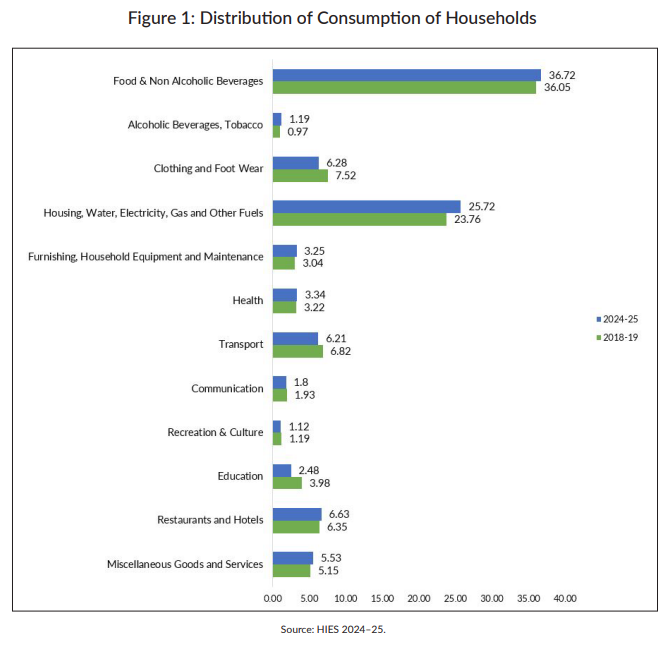
Figure 1 presents the distribution of household consumption expenditure across major categories between HIES 2018–19 and HIES 2024–25. Food and housing account for an increasing share of household expenditure, while education’s share declined from 3.98 percent in 2018–19 to 2.48 percent in 2024–25.
This decline is important because education is not merely a current consumption item; it represents an investment in future productivity and income. A reduction in household education spending may therefore have implications for human capital accumulation, particularly among households with limited financial resources.
Figure 1. Distribution of Household Consumption Expenditure
Source: HIES 2024–25.
The decline in education expenditure raises three questions. First, has the reduction been similar across income groups, or have poorer households faced greater constraints? Second, do rural households allocate less to education than urban households? Third, how do education expenditures vary across provinces?
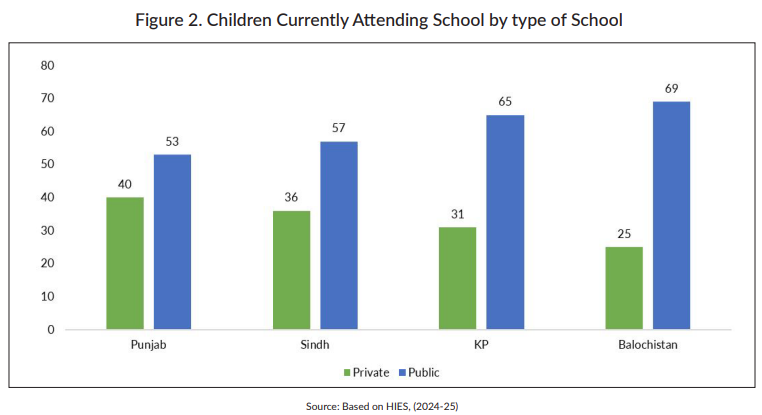
A further consideration is whether households have increasingly relied on public education as a lower-cost alternative to private schooling. Figure 2 shows that a substantial proportion of children attend public schools, while a smaller share (6%-8%) attend madrassas and schools operated by NGOs or trusts.
Figure 2. Children Currently Attending School by Type of School
Source: Based on HIES 2024–25.
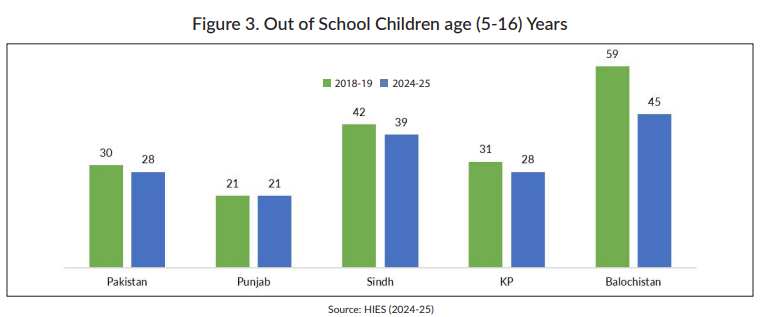
The decline in household education expenditure could potentially reflect lower educational participation. However, the evidence does not support this explanation. Figure 3 shows that the proportion of children aged 5–16 who are out of school declined between 2018–19 and 2024–25. At the national level, the share fell from 30 percent to 28 percent.
Thus, the decline in household education expenditure occurred alongside a modest improvement in school participation. This makes it important to examine whether public expenditure has also changed over the same period.
Figure 3. Out-of-School Children Aged 5–16
Source: HIES 2024–25.
- Public Expenditure on Education
Government expenditure on education as a share of GDP and total government expenditure is widely used to assess the priority governments assign to education relative to other sectors and competing public spending needs. It includes spending by federal, provincial, and local governments on items such as salaries, teaching and learning materials, administration, school infrastructure, and maintenance.
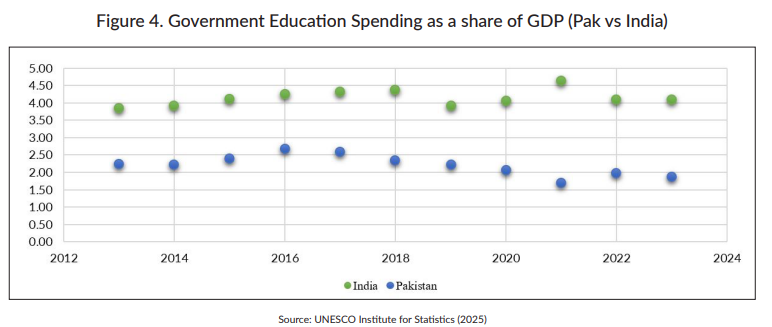
Figure 4 compares government education expenditure as a share of GDP in Pakistan and India between 2013 and 2023. Pakistan consistently spent less on education than India during the period, with the gap becoming more pronounced after 2020.
Figure 4. Government Education Spending as a Share of GDP: Pakistan and India
Source: UNESCO Institute for Statistics (2025).
Pakistan’s education allocation increased from approximately 11% of total government expenditure in 2013 to 15% in 2016, but subsequently declined, reaching about 8% in 2021, with only a modest recovery in 2022 before declining again in 2023. In contrast, India’s allocation rose from approximately 14% in 2013 to 17% in 2016, before declining and stabilizing at around 14–15%. Thus, while both countries experienced a decline after 2016, India consistently maintained a higher share of government expenditure on education. These levels also fall short of the UNESCO and SDG 4 benchmark of allocating 4–6% of GDP or 15–20% of total public expenditure to education.