1. Overview
Pakistan’s automobile sector has undergone major transformations over the last one decade at back of two comprehensive sector specific policies i.e. ADP 2016-2021 and AIDEP 2021-2026. The direction set and incentives extended through these policies have resulted in an expansion of the industry with significant technological development as well. Despite these developments, the automobile industry and market in Pakistan continue to face numerous structural challenges as well.
The forthcoming policy for the years 2026-2031 is expected to address these challenges, however, the delay in approval of the policy is not only creating confusion and chaos, but it has put a temporary stop to the progression of the industry.
The Pakistan Institute of Development Economics (PIDE) has conducted extensive and exhaustive research on the automobile industry, the consumer market, and policy ecosystem. This research has been backed by repeated consultations with stakeholders from both industry and policy side.
As part of these efforts, PIDE recently organized a Consultative Round Table Conference on the upcoming Automobile Industry Policy, a key policy issue. The round table was attended by stakeholders representing the industry, policymakers, development sector, and academia.
This document identifies the primary structural issues existing within the industry and related policy ecosystem and presents crucial recommendations for the forthcoming policy. The recommendations are based on the discussions in the round table conference, therefore, must be considered as PIDE’s recommendations for the policy and not necessarily as the unanimous view of all participants attending the conference.
2. The Automobile Industry: Achievements and Current State
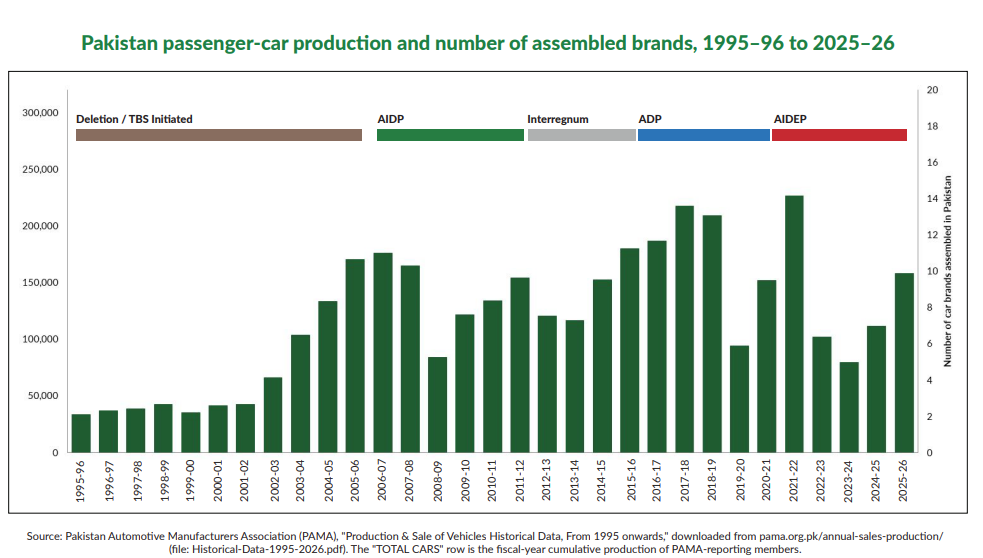
Pakistan passenger-car production and number of assembled brands, 1995–96 to 2025–26
Source: Pakistan Automotive Manufacturers Association (PAMA), “Production & Sale of Vehicles Historical Data, From 1995 onwards,” downloaded from pama.org.pk/annual-sales-production/ (file: Historical-Data-1995-2026.pdf). The “TOTAL CARS” row is the fiscal-year cumulative production of PAMA-reporting members.
Pakistan’s automobile industry has made substantial progress over the past four decades. The sector now comprises over fifteen active assemblers from Japan, Korea, and China, compared with the three-firm structure that dominated the market through much of the 1990s and 2000s.
Production capacity has more than doubled over the past decade to over 500,000 units, while the auto parts and accessories manufacturing sector, comprising approximately 300 Tier 1 and 900 Tier 2 firms, deserves particular recognition.
From only handful ICEVs models available, the vehicle pool has substantially increased with all powertrains on offer to the consumers.
These achievements are real and should be acknowledged. At the same time, structural challenges have persisted across multiple policy cycles.
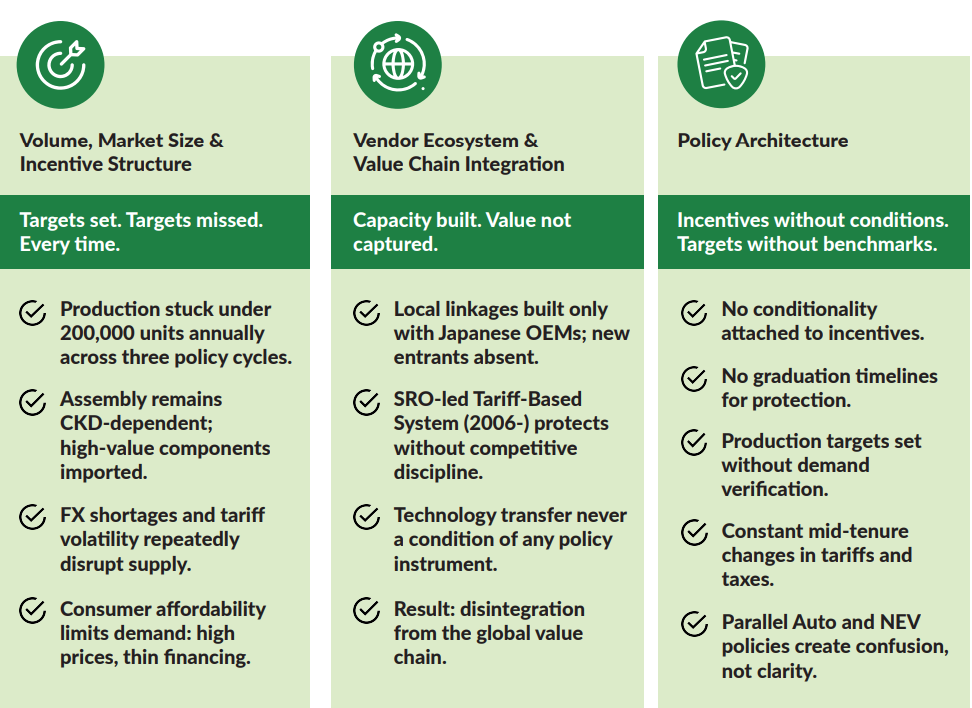
Despite entry of new OEMs and introduction of various models with multiple variants, vehicle production remains stuck under 200,000 units annually, well below the installed capacity.
While firm level competition has increased, doing automobile business has become difficult due to negligible expansion in market size. The A and B segment (hatchbacks and entry level sedans) which form up to 70% of the sales still remains a majorly unexplored area by the new entrants.
The vendor industry’s capabilities remain restricted to low-value components, with all high-value, high-technology parts continuing to arrive as CKD kits. Exports of vehicles and auto parts are negligible, primarily due to the only domestic market focus of the local automobile industry.
While tariffs and taxes are commonly assessed as tools of protection for the local industry, they do tend to add up to the vehicle costs as well, particularly due to the high import dependency of the industry. In some cases, taxes end up making as much as half of the final price of the vehicle.
3. Key Structural Challenges
4. What the Forthcoming Policy Must Address
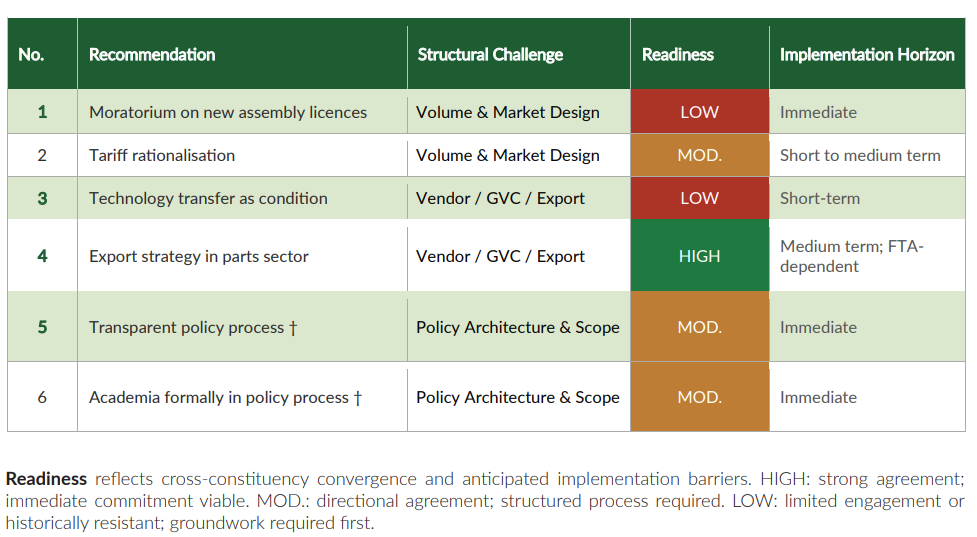
I. Moratorium on New Assembly Licenses for five years
Firm level competition in the industry has meaningfully increased but with negligible increase in the market size market shares of each firm have significantly depleted. Consequently, doing automobile business in the country has become less profitable.
Local business groups have as a result partnered with multiple global firms to try and survive in the industry. As a result, the industry seems to be evolving from the Big Three firms to Big Five local groups despite existence of 15+ OEMs.
While entry of new firms on the face might make it look like expansion of the industry, but it is bringing no new investment as same assembly plant is being used for production of multiple OEM vehicles but it however increases the risk of firm closures while is already hurting consumers through discontinuation of models introduced only five to seven years ago.
II. Evidence-based, phased tariff rationalization
Tariff rationalization to reduce cascading is an essential and timely policy instrument, however, decision for adequate tariff levels must be evidence-backed and implemented in phases.
Phasing must account for structural cost disadvantages including energy, financing, and regulatory compliance costs that currently exist outside the tariff instrument.
Tariff rationalization must be accompanied by concerted reform efforts to address the structural disadvantages facing the industry.
Any tariff reduction in CBU must be supplemented with a reduction in parts and CKD tariff to enable local industry a level playing field to compete. The SRO-led Tariff Based System should be replaced with a uniform tariff rate for auto parts regardless of localisation status.
III. Auto Parts Industry, the focus for next policy
Competition in the automobile assemblers has increased, and to some extent saturated. The auto parts industry is growing at a snail’s pace in comparison. The focus for the policy must shift towards parts manufacturing.
Greenfield status for the vendor sector, skill development support, and access to technology through JV arrangements with global players must be policy instruments in the forthcoming framework, not aspirations deferred to a subsequent cycle. R&D support, currently absent, should be a formal instrument tied to performance conditions.
IV. Export strategy grounded in the auto parts sector
CBU export targets with limited global right hand driven market and low production base without structural enablers are aspirational rather than policy.
The forthcoming framework should redirect export ambition toward the parts sector, address the FTA gap that limits market access in target export markets, and build the anchor OEM relationships and regional trade networks that comparable economies have used to achieve meaningful parts GVC integration.
V. Transparent Policy Development Process
The policy should not be finalised without a publicly available draft, a structured 45-day feedback period, and parliamentary consideration before approval.
PIDE recommends a six-month extension of AIDEP to enable a policy debate. A policy developed without public consultation is more likely to reflect the distribution of access during drafting than the distribution of stakes in the outcome.
VI. Academia formally in the policy process
Research institutions should be included in the diagnostic, drafting, and monitoring phases of the policy cycle rather than consulted after decisions have been made.
PIDE is committed to continuing its contribution to the evidence base and to the structured multi-stakeholder process that effective policy reform requires.