
Executive Summary
Following the 28 February military action (US-Iran war) and the effective disruption of shipping through the Strait of Hormuz, Europe Brent Spot Price FOB series from approximately $72 per barrel at the end of February, exceeded $100 per barrel on 12 March, and reached approximately $118 per barrel at the end of the first quarter of 2026(EIA, 2026). That resulted in a sharp increase in the import cost of petroleum products and added pressure on the power sector’s financing; however, the additional circular debt, load-shedding and working-hour losses attributable to this shock have not been established here. In April 2026, Pakistan’s petroleum crude import bill rose 119.1% year-on-year to Rs. 331,799 million, and petroleum product imports rose 95.9% to Rs. 272,943 million (provisional; PBS, 2026a). For the full fiscal year, the petroleum group import bill reached US$16.86 billion in FY2025-26, an increase of 5.76% from US$15.94 billion in FY2024-25. This headline growth masks divergent components: crude imports rose 31.6% and petroleum products 7.1%, while LNG imports fell 36.1% (PBS, 2026b). As in every previous oil shock, the cost of subsidy, import bills, and estimates of GDP contraction in rupees have been the primary parameters in Pakistan’s policy response. This is a partial calculation that does not separately reflect the lost productive working time due to power outages interrupting production, delaying tasks, or forcing work to be abandoned. The reviewed studies report output, value-added, employment, cost, or export effects; they do not provide a standardized national estimate of productive worker-hours lost. This knowledge brief suggests two policy changes: the creation of an official indicator of productive working hours interrupted and not subsequently recovered due to energy disruptions; and the use of this evidence, alongside fiscal and output measures, to assess electricity-reliability and energy-sector reforms.
1. Introduction: Pakistan’s 2026 Oil Shock in Context
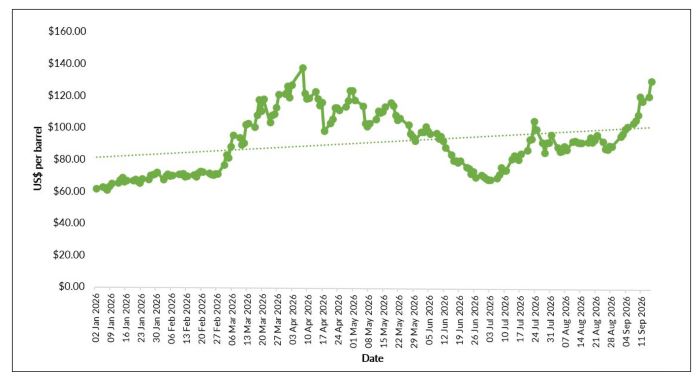
Pakistan is once again experiencing a global oil crisis. The United States and Israel on 28 February 2026 undertook military strikes against Iran, which disrupted commercial shipping through the Strait of Hormuz and drove up crude prices. By late March 2026, Brent crude had increased sharply from its pre-shock level. This volatility is shown in Figure 1. The shock provides the immediate context for examining a wider and continuing problem: the productive working time interrupted by unreliable energy supply is not routinely measured in Pakistan.
Figure 1: Brent Crude Oil Price During Pakistan’s 2026 Oil Shock
Source: Europe Brent spot price (US$/barrel) (FOB), U.S. Energy Information Administration (EIA), 2026.
The daily spot price of Brent crude oil is very volatile during this period as is seen in Figure 1. It reached US$138.21 per barrel on 7 April 2026 and US$130.80 per barrel on 15 September 2026, when supply worries returned in the wake of attacks on Saudi Arabia’s East-West oil pipeline. The disruption temporarily affected one of the major shipping lanes used by Saudi oil exports, and put pressure on short-term supplies, according to the U.S. Energy Information Administration (EIA, 2026). These movements are not evidence of geopolitical and supply disruption of the international oil markets by itself, but they expose Pakistan to higher energy costs and potential pressure on electricity supply; their effects on outage duration and productive working hours require separate evidence. A shock like this due to Middle East conflict comes to the domestic economy in just a few weeks as Pakistan is heavily dependent on imported petroleum and other imported fuels, exposing domestic prices and the power system to international-market and exchange-rate shocks.
In both oil shocks, as in this one, policy decisions are made essentially in terms of fiscal cost, with the finance ministry working out the import bill, the central bank preparing for pressure on the rupee, and analysts issuing estimates of how much GDP will lose. The argument this brief makes is that the productive working time interrupted by electricity shortages is not separately recorded in these assessments. The existing shortages should not, however, be attributed to the 2026 oil shock without evidence of changes in outage duration and affected working time.
2. Energy Import Dependence and the Transmission Mechanism
A global oil-price shock can increase the cost of thermal generation and place additional pressure on tariffs, subsidies, and the power-sector payment chain. Higher import prices can further raise the cost of generation using imported fuels, although the size of the effect depends on the generation mix. Consumer tariffs are not always changed at the rate generation costs are changing; the resulting shortfall may contribute to circular debt, depending on subsidies, distribution losses, and bill recovery. Higher circular debt does not automatically lead to load-shedding, however, as the amount and duration of load-shedding also rely on the availability of generation, fuel supplies, plant dispatch, transmission and distribution limitations, recovery performance, subsidy payments, and regulatory decisions. The oil-price, power-sector financing and productive-working-time channels should therefore be distinguished.
These groups are particularly exposed to interruptions in electricity supply: 49.2% of reported electricity use is by households and an additional 26.3% is by industry (Table 1; Figure 2). Irrigation schedules and small retail operations are also directly affected by outages, with agriculture and commerce accounting for 10.1% and 7.8% of reported electricity consumption, respectively (Finance, 2024). These consumption shares do not measure the number of affected workers or the productive hours lost; the effect depends on the timing of the outage and the ability of each activity to continue or recover work.
Table 1: Sectoral Share in Electricity and Petroleum Consumption, FY2024 (Jul-Mar)
| Sector | Share of Electricity Consumption | Share of Petroleum Consumption |
| Household / Domestic | 49.2% | 0.2% |
| Industry | 26.3% | 6.6% |
| Transport | Not separately reported | 79.2% |
| Agriculture | 10.1% | 0.1% |
| Commercial | 7.8% | 1.8% |
| Power sector / Other (streetlights, general services, and other government) | 6.6% | 12.1% |
Source: Electricity consumption shares for July–March FY2023–24 are reported from NEPRA-State of the Industry Report 2024; Ministry of Finance.
The transport sector dominates petroleum consumption (79.2%), which is why fuel-price shocks are usually discussed as a transport and inflation story. But the 6.6% consumed directly by industry, combined with the indirect exposure of electricity consumers through the generation-cost channel, suggests that the effects can be transmitted more broadly than direct petroleum consumption figures alone indicate. The labour-hours impact must nevertheless be measured from actual interruptions to productive activity, not inferred from consumption shares alone.
2.1 The 2026 LNG Supply Disruption and Electricity Generation
In 2026, the supply of LNG gas was disrupted, and production of electricity was affected. The energy shock of the region in 2026 was both in the form of international energy prices and shortage of imported gas. LNG imports from Qatar are critical for Pakistan, as a large percentage of LNG has to cross the Strait of Hormuz. In May 2026, Pakistan’s Petroleum Division officially admitted challenges with LNG receipts due to congestion in the Strait and stated that it has been in talks with Qatar to receive supplies. This creates a direct exposure through the supply chain, in addition to the impact of higher crude oil prices. (Press Information Department, 2026)
The exposure affected electricity mix, as evidenced by power-generating data. The electricity generation from RLNG decreased around 22.9% in FY2025–26 to 17,130 GWh compared to 22,231 GWh in FY2024–25. RLNG generation in June 2026 was 1480 GWh, down from 2216 GWh in June 2025, with the generation cost reported to have risen from Rs. 21.87 to Rs. 35.51 per kWh. The figures show a significant drop in RLNG-based generation alongside a rise in its unit cost (Nukta, 2026; Mettis Global, 2026)
There is also direct evidence that relates fuel availability to electricity interruptions. In August 2026, the Power Division had cited the delayed arrival of an RLNG cargo and electricity shortfall of around 3,600 MW on account of electricity shortage due to load management in the night time, in addition to the shortage of electricity generation from Mangla (Dawn, 2026). This episode provides evidence in the LNG disruption to electricity supply chain. However, it does not establish that every outage in the window was due to the regional conflict, nor does it measure all the loss of useful working hours across the country.
2.2 Roohop Solar and Unequal Exposure to Outages
Driven by rapid rooftop solar adoption, the impact of electricity shortages on employees and companies is also shifting. The Pakistan Electricity Review 2026 (Renewables First, 2026) states that in December 2025, net-metered solar capacity was recorded at 8.3 GW and total solar power installed in the country was estimated at nearly 38 GW (including systems not fully captured by grid-connected statistics) by June 2025. Distributed solar can help to lower the electricity demand on the national grid during the daytime and ensure that some homes and companies have more electricity available to them. But simply installing solar doesn’t guarantee protection from outages: Solar energy may not be available during grid outages, and solar electricity production is only available during the day. Thus, the impact of solar electricity on productive working hours will be influenced by the access to batteries, hybrid or off-grid systems, the nature of the outage and the nature of the activity. Future estimates should clearly separate workers and firms with a reliable backup from those that remain dependent on grid electricity.
3. Circular Debt and Power-Sector Financial Pressures
The stock of the provisional circular debt for FY2025-26 was put at Rs 1.675 trillion (excluding K-Electric), up Rs 61 billion from the June 2025 stock. The Power Division said that the hike was due to the reduction in subsidies. Circular-debt dynamics might also be influenced by other factors such as losses by distribution companies, delayed payments of subsidy and pressures on the distribution-sector payment chain. However, without a detailed attribution of these factors, the rise should not be interpreted as a contribution of the oil shock to the build-up of the circular debt. Furthermore, any consistent differences in treatment of K-Electric dues should be taken into account prior to comparing balances between dates of reporting. Circular debt provides context on the financial pressures facing Pakistan’s power sector, but changes in its stock do not directly establish the frequency or duration of electricity outages or the number of productive worker-hours lost.
Table 2: Power Sector Circular Debt Trajectory, FY2023-24 to FY2025-26
| Period | Circular Debt (Rs trillion) | Note |
| June 2024 (FY2023-24 close) | 2.393 | Pre-reform baseline |
| June 2025 (FY2024-25 close) | 1.614 | 32.5% YoY decline |
| February 2026 | 1.837 | Reported in-year outstanding balance; DISCO losses cited as an additional pressure. |
| April 2026 | 1.854 | Reported in-year balance; K-Electric dues may be recorded separately. |
| FY2025-26 close (provisional, excl. K-Electric) | 1.675 | Year-end stock; Rs 61bn above June 2025. |
Data Source: Federal Minister for Power; Finance Division, Government of Pakistan (2026). Profit (2026); Energy Update (2026)
In June 2025, US-Israel strikes carried out against Iran, pushed Brent crude futures higher, before tensions eased and prices fell (IEA, June 2025 Oil Market Report). That earlier episode should be treated as a separate event from the February 2026 oil shock. Officials have also pointed to losses suffered by distribution companies and a mid-year budget cut in explaining subsequent changes in circular debt. In fact, whatever the exact contribution of these causes, the pattern is consistent with the wider financing problems documented in the literature: distribution companies face under recoveries and delayed subsidies, and generators face delayed payments (PIDE Knowledge Brief KB-135, 2025). A reduction in the existing debt stock differs from preventing new accumulation through improved recoveries, lower losses and predictable subsidy financing; neither outcome alone establishes that outages or lost working hours have declined.
4. What We Know: Existing Estimates of the Economic Cost
Pakistani researchers have tried to quantify the cost of energy shortages, and their estimates, while not directly comparable across methodologies, indicate that the losses can be large and recurring. Table 3 summarizes selected published estimates. Because the studies cover different periods, sectors and outcomes, they cannot be presented as a comparable annual GDP-loss series or as evidence of the additional losses caused by the 2026 oil shock.
Table 3: Selected Economic Costs of Pakistan’s Electricity Shortages: Published Studies
| Study / Year | Reported outcome (study-specific, not an annual national series) |
| Aziz et al. (2010), for 2009 | Estimated industrial output losses of $3.8bn (reported as 2.5% of GDP); employment and export losses also reported. |
| Siddiqui et al. (2008), selected industrial cities | Estimated industrial output losses of 12-37%, varying by city and sector; findings are not national GDP estimates. |
| Pasha and Saleem (2013) | Estimated the cost of load-shedding to urban domestic consumers using survey-based measures of utility losses, self-generation expenses and other costs. |
Note: Estimates are drawn from individual studies and are not directly comparable because they use different methodologies, periods, sectors and definitions of economic loss.
International research provides an explanation for why the duration of outages and economic losses do not always correlate. In a similar study of Indian manufacturers, Allcott et al., (2016) noted that electricity shortage not only had negative impact on plant revenues, but also on producer surplus, with estimated losses to be smaller due to the fact that plants could store inputs and adjust their operations. Based on Chinese industrial companies, Fisher-Vanden et al., (2015) found that electricity scarcity raised production costs, as companies changed their input mix. Similarly, Hardy & McCasland, (2021) found that electricity supply problems in small firms in Ghana have adverse impacts on firm productivity and that some of the coping strategies such as the use of generators do not entirely mitigate these impacts. As a whole, this literature demonstrates that there is a need to measure adaptation and work that is not recovered following an outage hour, not to see each hour of an outage as equivalent to an hour of lost production.
These estimates are denominated in output, employment or export terms. A nationwide grid collapse in January 2023 illustrates the same distinction at a smaller scale: even where monetary costs are estimated, a separate estimate is needed of how many scheduled worker-hours were interrupted and how much work was subsequently recovered. Monetary output losses and lost working time are related but not interchangeable measures.
Table 4: Electricity Interruption Indicators for Pakistan’s Distribution Companies, FY2024–25
| Distribution company | SAIFI (interruptions per consumer) | SAIDI (minutes per consumer) |
| PESCO | 176.62 | 13,469.55 |
| IESCO | 15.39 | 834.22 |
| GEPCO | 49.49 | 3,833.19 |
| FESCO | 33.31 | 1,185.68 |
| LESCO | 28.16 | 2,982.94 |
| MEPCO | 30.67 | 3,547.00 |
| QESCO | 99.52 | 8,516.45 |
| SEPCO | 76.77 | 1,320.77 |
| HESCO | 129.55 | 7,410.22 |
| K-Electric | 68.46 | 4,152.59 |
Source: NEPRA, Performance Evaluation Report of Distribution Companies FY2024–25, Tables 5 and 6, pp. 12–13.
The results of the indicators reported by NEPRA indicate continued electricity-reliability issues throughout distribution companies. The frequency and duration of interruptions, however, do not indicate the number of workers in service during the outages, whether they were interrupted or how much interrupted work was recovered. The indicators thus give useful background information but cannot replace a direct measure productive worker-hours lost. Additionally, the FY2024-25 data is prior to the 2026 oil shock, and should not be seen as evidence of the shock.
5. The Missing Piece: Productive Worker-Hours Lost
Pakistan does not regularly publish a nationally recognized indicator to convert the electricity outages to productive worker-hours lost. The existing systems give relevant evidence such as the System Average Interruption Frequency Index (SAIFI) and System Average Interruption Duration Index (SAIDI) from NEPRA reports and the World Bank Enterprise Survey for Pakistan reports the outage frequency, duration and losses at the firm level (NEPRA, 2026; World Bank, 2022). These measures do not, however, directly define the total productive worker-hours lost across the country. This gap is highlighted by the energy shock currently underway in the region in 2026. Increased pressure on electricity supply is evidenced by disruptions to imported LNG supplies and decreased RLNG generation, and outages during scheduled working hours may impact factory production, reduce retail operating hours, and delay irrigation with electric tube wells. But not all outages are due to oil shock and the additional impact on working hours has not been measured. Lost working hours is not necessarily equal to the length of an outage: businesses can run on back-up generators; employees can change work schedules or tasks; lost work can be made up through rescheduling or overtime. On the other hand, a restart of machinery and production processes can prolong losses even after the outage has occurred. A good indicator should therefore differentiate work-hours that were interrupted from productive work-hours that were not later recovered.
A preliminary estimate could include a combination of the employment and working hours’ data from the Pakistan Bureau of Statistics Labour Force Survey, along with data on outages from distribution companies or from firms regarding backup power or outage-related losses. Estimated productive hours lost can be calculated using the following formula:
Estimated hours lost = Exposed workers × Outage hours during working time per day × Working days × Unrecovered share.
The number of workers exposed to the risk, the time when workers are on duty and the time during which they are not, must be taken into account. Where possible, results should be presented at a sector level and at a regional level. Hours of productive loss, or lost productive hours must also be separated from labour productivity and the value of lost output, which are influenced by the extent of production and avoidable or recoverable losses. Suppose one million workers are exposed to an average of two outage-hours during working time per day over 20 working days in a month. If 25–50% of the interrupted time cannot be recovered through rescheduling, backup power or later work, the implied loss would be approximately 10–20 million productive worker-hours in that month. Current evidence does not yet establish a defensible estimate of productive worker-hours lost in 2026 or the extra loss due to the regional energy shock. Such an indicator would be complementary to current indicators of electricity reliability and loss of economic output, providing a better indication of difficulties with the energy system in terms of productive time.
The government’s March 2026 work from home policy was implemented mostly to conserve fuel resources (Division, 2026), however, the benefits of remote working do not necessarily protect productive working time when electricity outages impact employees’ homes. The size of this potential overlap depends on the time of outage, the availability of backup power and if the work can be resumed later in the day. The impacts of remote-work options must therefore be separated out from the impacts of commuting and fuel savings, and the impacts of electricity-related work interruptions and unrecovered working hours. There is no nationwide evidence cited in this brief to quantify these effects.
6. Policy Recommendations
The evidence assembled above supports two complementary policy shifts: first, Pakistan should measure the productive working time interrupted by energy disruptions and identify the portion not subsequently recovered; second, it should use this evidence, alongside fiscal and output indicators, to assess electricity-reliability and energy-sector reforms.
6.1 Develop an official indicator of productive working hours lost
Pakistan requires a regularly published national indicator of productive working hours interrupted by electricity outages and energy-related disruptions. Such an indicator should not replace fiscal and output-based measures; rather, it should complement them by showing the labour dimension of energy insecurity. The indicator should distinguish between:
- Gross interrupted worker-hours: scheduled working hours during which workers could not carry out their normal productive tasks because of an outage, after allowing for backup power and alternative working arrangements;
- Net unrecovered worker-hours: gross interrupted worker-hours less interrupted work subsequently completed through rescheduling, overtime, remote work, alternative sites, or other arrangements within a specified reference This is distinct from a measure of lost output or labour productivity.
A practical pilot methodology could match the timing of outages with workers’ scheduled hours, estimate the extent of actual work interruption, and record the hours of work subsequently recovered. It could combine existing data sources:
- PBS Labour Force Survey for workforce numbers, sectoral employment, usual and actual working hours, and regional composition;
- NEPRA and DISCO outage records for outage frequency, duration, timing, location, and affected consumer category;
- Small establishment-level pilot surveys in selected industrial, commercial and agricultural areas to estimate affected shifts, production stoppages, generator use, rescheduling and recovery of lost time;
- Large employer and public-office records for supplementary information on affected staff, operating hours, and remote or hybrid work arrangements.
The Pakistan Bureau of Statistics (PBS) in coordination with NEPRA, distribution companies and employer associations should frame a methodology to measure the productive worker-hours lost due to electricity outages and not subsequently recovered in six months and pilot survey in 12 months. There should be a uniform process for reporting outages, which would be achieved by NEPRA and distribution companies standardising outage reporting. Meanwhile, the Ministry of Energy should evaluate the diversification of LNG supply, fuel stocks, emergency fuel-allocation arrangements and distributed solar with storage to mitigate future energy shocks. Plans for the implementation of the measure should be prepared in advance by the institutions responsible, incorporating costs of data-collection, infrastructure, storage, procurement and maintenance. These suggested indicators would be added to the current fiscal and electricity-reliability indicators and would facilitate policymakers in the process of assessment of the impact of energy disruptions on productive activity.
6.2 Use working-hours evidence to assess energy-sector reform
The reform of the energy sector, specifically the elimination of circular debt, must be viewed and evaluated not only as a fiscal/governance issue but also as an electricity reliability issue, which provides for productive working hours of citizens. Predictability is the critical variable that both investors and workers care about; unpredictable electricity can affect productive work even with available workers. Although circular debt can indicate the existence of financial distress, lowering the amount of debt stock will not mean that the problem will not recur in the future or that the quality of electricity supply will be improved (see Table 2). A valid indicator of lost and unrecovered productive worker-hours will provide extra evidence in assessing network investments, the performance of electricity distribution companies, and outage schedules; claims regarding labour productivity gains or avoidance of output losses will need extra evidence.
Pakistan cannot change world oil price levels, geopolitical instability, or exchange rate pressures. However, Pakistan can improve the validity of evidence used to assess domestic implications of these shocks. A valid, regularly published indicator of lost productive working hours related to electricity outages, based on the data on outages, labour force statistics, and firm surveys, will allow Pakistani policymakers to assess the cost of unreliable energy supply in terms of lost labour time in addition to fiscal and output costs. The methodology for labour market indicators can be developed by the Pakistan Bureau of Statistics (PBS); outages and reliability information can be provided by the Ministry of Energy, NEPRA, and DISCOs, which are the suggested institutions for these tasks.
7. Conclusion
The 2026 Middle East conflict produced a substantial oil-price and shipping shock. Official Pakistani data show a sharp year-on-year increase in crude-oil and petroleum-product import values in April 2026, while official energy statistics demonstrate the economy’s continued exposure to imported petroleum. The additional electricity outages or lost working hours attributable specifically to that shock have not been estimated in this brief. Existing Pakistani studies document significant output and cost effects from electricity shortages, but does not provide a standardized national estimate of productive working hours lost. Pakistan should therefore develop an outage-linked labour-time indicator that distinguishes gross work interruption from unrecovered hours after backup generation, rescheduling, remote work, and other forms of adaptation. An initial pilot would allow this evidence to inform electricity-reliability and energy-sector decisions alongside existing fiscal and output-based indicators.
This study could be extended by running a standardized panel survey of firms and workers in electricity dependent sectors. It would record how long and how often outages occur, the production lost, the use of backup power and the number of workers affected. Future work should also assess fuel-conservation measures, such as work-from-home arrangements, by comparing the energy saved with any change in output. Two questions follow. First, how many working hours does Pakistan lose to power outages across agriculture, industry, commerce and services, and which provinces and cities are most affected? Second, what is the economic value of these losses compared with the cost of a more reliable electricity supply? Answering them would give Pakistan a standardized national measure of working hours lost to electricity disruption, which could guide energy-sector reform and load-management policy.
Declaration on the Use of Artificial Intelligence
AI-assisted tools were used solely for editing the language and refine the sentences in order to clarify, correct grammar and readability of the manuscript. The authors are responsible for the research, interpretation of evidence, verification of sources, conclusion and policy recommendations in this brief.
References
Aziz, N., et al. (2010). Cost of power outages to the Pakistani economy. In Institute of Public Policy, Beaconhouse National University, Third annual report—State of the economy: Pulling back from the abyss. https://sjbipp.org/publications/AR/reports/AR-03-10.pdf
Allcott, H., Collard-Wexler, A., & O’Connell, S. D. (2016). How do electricity shortages affect industry? Evidence from India. American Economic Review, 106(3), 587–624. https://doi.org/10.1257/aer.20140389
Cabinet Division, Government of Pakistan. (2026, March 24). Notifications: Fuel conservation and austerity measures.
Dawn. (2026, March 5). Detrimental effects of power outages, climate change on labourers highlighted. https://www.dawn.com/news/1978528/detrimental-effects-of-power-outages-climate-change-on-labourers-highlig hted
Dawn. (2026, March 11). PM orders third-party audit of austerity plan. https://epaper.dawn.com/DetailImage.php
Dawn. (2026, August 29). Govt apologises for ‘temporary’ night-time loadshedding due to unavailability of RLNG. https://www.dawn.com/news/2025978/govt-apologises-for-temporary-night-time-loadshedding-due-to-unavailabil ity-of-rlng
Energy Update. (2026, July 28–29). Power sector circular debt rises by Rs. 61 billion in FY2025-26 amid budget cut, govt says.
Fisher-Vanden, K., Mansur, E. T., & Wang, Q. (2015). Electricity shortages and firm productivity: Evidence from China’s industrial firms. Journal of Development Economics, 114, 172–188. https://doi.org/10.1016/j.jdeveco.2015.01.002
Grainger, C. A., & Zhang, F. (2019). Electricity shortages and manufacturing productivity in Pakistan. Energy Policy, 132, 1000–1008. https://doi.org/10.1016/j.enpol.2019.05.040
Hardy, M., & McCasland, J. (2021). Lights off, lights on: The effects of electricity shortages on small firms. The World Bank Economic Review, 35(1), 19–33. https://doi.org/10.1093/wber/lhz028
International Energy Agency. (2025, June). Oil market report.
Ministry of Finance, Government of Pakistan. (2024). Pakistan Economic Survey 2023–24: Chapter 14—Energy. Mettis Global. (2026). Pakistan’s power generation rises over 1% in FY26.
https://mettisglobal.news/Pakistans-power-generation-rises-over-1-in-FY26-62000
National Electric Power Regulatory Authority. (2024). State of industry report 2024. https://nepra.org.pk/publications/State%20of%20Industry%20Reports.php
National Electric Power Regulatory Authority. (2026). Performance Evaluation Report https://nepra.org.pk/M&E/PER/Distribution/2026/PER%202024-25%20Distribution%20Companies.pdf
Nukta. (2026). Pakistan power generation rises just 1.2% in FY26 as LNG shortages hit output. https://nukta.com/pakistan-power-generation-fy26-lng
Pakistan Bureau of Statistics. (2025). Labour force survey 2024–25.
Pakistan Bureau of Statistics. (2026). Monthly external trade statistics: April 2026 (provisional release).
Pakistan Bureau of Statistics. (2026a). Monthly advance releases on foreign trade statistics for April 2026. https://www.pbs.gov.pk/wp-content/uploads/2020/07/Release_Statement_April-2026.pdf
Pakistan Bureau of Statistics. (2026b). Monthly advance releases on foreign trade statistics for June 2026. https://www.pbs.gov.pk/wp-content/uploads/2020/07/Release_Statement_June-2026.pdf
PIDE. (2025). Knowledge Brief KB-135. Circular Debt and Electricity Tariffs: Unequal Burdens across Household Quintiles in Pakistan
Profit. (2026a, May 19). Pakistan’s petroleum import bill reaches $13.5 billion in 10MFY26.
Pasha, H. A., & Saleem, W. (2013). The impact and cost of power load shedding to domestic consumers. The Pakistan Development Review, 52(4), 355–373. https://doi.org/10.30541/v52i4Ipp.355-373
Renewables First. (2026). Pakistan Electricity Review 2026. https://uploads.renewablesfirst.org/Pakistan%20Electricity%20Review%202026.pdf
Siddiqui, R., Jalil, H. H., Nasir, M., Malik, W. S., & Khalid, M. (2008). The cost of unserved energy: Evidence from selected industrial cities of Pakistan. The Pakistan Development Review, 47(3), 227–246.
U.S. Energy Information Administration (EIA). (2026). Europe Brent Spot Price FOB (Dollars per Barrel). https://www.eia.gov/dnav/pet/hist/RBRTED.htm
World Bank Group. (2022). Pakistan—World Bank Enterprise Survey 2022 [Data set]. World Bank Enterprise Surveys. https://microdata.worldbank.org/catalog/6461/
Zulfiqar, F. (2026). Work from home (WfH): Challenges, monitoring, and shared responsibility. PIDE Knowledge Brief No. 2026:153.