
A Case for Climate-Centric NFC
For Pakistan’s citizens, climate change has become a lived reality rather than a distant threat, and with each passing day, the dangers of climate-induced disasters are becoming more deadly than ever before. The country is witnessing erratic weather patterns, monsoon cycles, glacial lake outbursts and scorching heatwaves, making the country extremely vulnerable to climate threats.[1] Pakistan stands at a crossroads where the cost of inaction will be insurmountable, necessitating that Islamabad implement a meticulous, proactive adaptation and mitigation strategy to avert losses. Though Pakistan’s contribution to climate change is meagre but that’s not a defence for inaction. With climate change posing an imminent existential threat, it is high time for national introspection to revisit our national priorities, goals and interests. The current system of fiscal distribution under the National Finance Commission (NFC) award between the centre and provinces, as envisioned in the historic 18th Amendment, is falling short of meeting the new realities of climate change, debt and development. The 7 NFC framework, which expired in 2015, has been in effect for nearly 15 years due to disagreement over the new formula between the provinces and the Centre.[2]
Though the award was unprecedented, the framework is riddled with persistent horizontal and vertical imbalance. The formula’s 82% weight on population now feels outdated if not counterproductive. By tying such a large share of resources to population, the system has inadvertently incentivised provinces to prioritise numbers over sustainability, affecting everything from the allocation of National Assembly seats and government job quotas to university admissions and funding for social programmes. This population-focused approach has been one of the factors fuelling high demographic growth. It also fails to address the pressing realities Pakistan faces today, in an era where rising temperatures, erratic monsoons, and depleting water tables are no longer rare warnings but part of a troubling new normal.
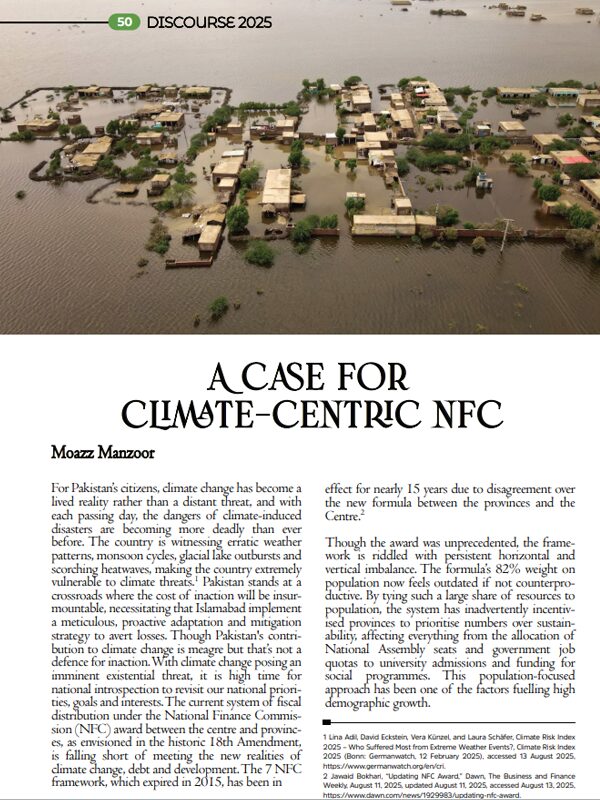
The 2022 floods are a stark reminder that a third of the country was underwater. Crops were wiped out, entire districts were displaced, and the economic loss soared to $ 30 billion. The tragedy was not just climatic; it exposed deep institutional, fiscal fault lines that climate change is not something we can respond to with ad hoc relief; it requires systemic reform. Similarly, provinces that bore the brunt of the devastation lacked the administrative and fiscal muscle to respond swiftly and recover sustainably. The federal government, already strapped for resources, struggled to fill the gap. This alone should have been the wake-up call to rethink how we distribute our national resources and on what basis.
Needless to say, demographics do matter, but the adoption of this one-size-fits-all model has created unintended consequences. It discourages population control, sidelines development performance, and ignores climate vulnerability. Provinces that have stabilised their population or made progress in human development often get penalised, while others benefit simply for being large. It’s a model that might have worked decades ago, but in today’s Pakistan, where climate change, water stress, burgeoning debt, and fiscal constraints dominate the agenda, it no longer makes sense. The world has moved on, and so should we. Brazil, for instance, introduced an ecological component in its fiscal transfers. Its “ICMS-E” model allows a portion of tax revenues to be distributed based on environmental indicators like conservation areas and biodiversity.[3] The results have been transformative, and local governments now actively invest in sustainability because it brings financial rewards. India’s 14th Finance Commission also set a precedent by assigning weight to forest cover in its resource distribution formula, acknowledging the importance of environmental services provided by states like Arunachal Pradesh and Chhattisgarh.[4]
Pakistan doesn’t need to copy-paste these models, but it can certainly draw inspiration. A new, climate-aware NFC formula should be built on multiple criteria that reflect the country’s ground realities and development goals. Population can still be part of the equation, but its weightage must be reduced significantly to avoid distorting incentives. A frozen population baseline, such as the proposed 241.5 million, could help in phasing the shift more smoothly. What should come in, instead, are criteria that promote sustainability, equity, and performance. Likewise, indices of Climate vulnerability must be recognised explicitly; provinces and regions prone to floods, droughts, extreme heat or glacial melt should receive a larger share to invest in adaptive infrastructure. Moreover, forest cover, water resource management, and investment in renewable energy should be included as indicators that attract higher fiscal support. Lastly, provinces taking measurable steps in reforestation, building early warning systems, or climate-proofing their infrastructure must be rewarded.
However, the implementation of these reforms is a challenge. First, political resistance from larger provinces, particularly Punjab, which benefits from the current population-driven formula, may perceive vulnerability indices as reducing their shares. PIDE in its study notes that NFC negotiations are often dominated by provincial interests, complicating consensus on vulnerability-based allocations.[5] Second, data limitations for constructing climate vulnerability indices, such as inconsistent disaster impact records, pose a technical challenge. Third, provincial administrative capacity, particularly in Balochistan, remains weak, limiting effective use of conditional grants.
To counter these threats, a federal-provincial task force could be established to negotiate reforms, ensuring stakeholder buy-in. Meanwhile, a pilot 5% weight for vulnerability indices can be adopted in the NFC Award to build trust and demonstrate efficacy. Additionally, with regard to data limitations, the Ministry of Climate Change and Planning could partner with international organisations like the World Bank to develop robust metrics. Meanwhile, reactivating PFCs would strengthen local-level coordination, ensuring grants reach vulnerable districts. Moreover, capacity-building programs, funded through federal allocations, could mitigate this, ensuring provinces can implement resilience projects. Similarly, a concerted effort must be made to increase provincial taxes. Provinces that expand their tax base, digitise revenue systems, and increase their tax-to-GDP ratio deserve greater transfers. This will encourage autonomy and reduce the culture of dependency on the federal divisible pool. Human development should also be a pillar of progress in literacy, gender equity, health outcomes, and stunting reduction, influencing allocations.
In today’s climate reality, fiscal federalism must do more than divide the pie. It must help us grow sustainably, equitably, and strategically. The case for a climate-centric NFC is no longer theoretical. It is a national imperative. It’s high time we start aligning our financial systems with our environmental vulnerabilities, as without incorporating this critical aspect, the promise of fiscal decentralisation under the 18th Amendment will remain half-baked. While provinces have gained more funds, many have failed to devolve these resources to provincial finance commissions, which are either inactive or non-transparent. A reformed NFC must not just recommend, but mandate the activation and regular functioning of PFCs as part of the broader devolution framework. Only then will equity flow within provinces, not just between them. Pakistan is not short of plans. What we lack is coherence between them. These reforms are a good start, but they cannot happen in a vacuum. Unless the NFC, which shapes the fiscal spine of the federation, reflects these priorities, we will always be running behind disasters.
References
Adil, Lina, David Eckstein, Vera Künzel, and Laura Schäfer. Climate Risk Index 2025 – Who Suffered Most from Extreme Weather Events? Climate Risk Index 2025. Bonn: Germanwatch, 12 February 2025. Accessed 13 August 2025. https://www.germanwatch.org/en/cri.
Bokhari, Jawaid. “Updating NFC Award.” Dawn, The Business and Finance Weekly, August 11, 2025. Updated August 11, 2025. Accessed August 13, 2025. https://www.dawn.com/news/1929983/updating-nfc-award.
Sauquet, Alexandre, Sébastien Marchand, and José Gustavo Feres. Ecological Fiscal Incentives and Spatial Strategic Interactions: the Case of the ICMS-E in the Brazilian State of Paraná. CERDI, Études et Documents, E 2012.19. Clermont-Ferrand: CERDI. Preprint submitted 23 May 2012. Accessed 13 August 2025. https://shs.hal.science/halshs-00700474v1/document.
Aryan, Vishal. Analysis of Relationship Between Devolution Based on Forest Cover by the Finance Commission and States’ Forest Cover. Under the supervision of Professor Saudamini Das. March 10, 2025. Accessed August 13, 2025. https://www.ies.gov.in/pdfs/Vishal-Aryan-march25.pdf.
Amjad, Rashid, Musleh Ud Din, Idrees Khawaja, Nasir Iqbal, and Ahmad Waqar Qasim. The 7th NFC Award: An Evaluation. PIDE Monograph Series. Islamabad: Pakistan Institute of Development Economics, 2012. Accessed August 13, 2025. https://file.pide.org.pk/pdfpideresearch/ms-08-the-7th-nfc-award-an-evaluation.pdf.
[1] Lina Adil, David Eckstein, Vera Künzel, and Laura Schäfer, Climate Risk Index 2025 – Who Suffered Most from Extreme Weather Events?, Climate Risk Index 2025 (Bonn: Germanwatch, 12 February 2025), accessed 13 August 2025, https://www.germanwatch.org/en/cri.
[2] Jawaid Bokhari, “Updating NFC Award,” Dawn, The Business and Finance Weekly, August 11, 2025, updated August 11, 2025, accessed August 13, 2025, https://www.dawn.com/news/1929983/updating-nfc-award.
[3] Alexandre Sauquet, Sébastien Marchand, and José Gustavo Feres, Ecological Fiscal Incentives and Spatial Strategic Interactions: the Case of the ICMS-E in the Brazilian State of Paraná, CERDI, Études et Documents, E 2012.19 (Clermont-Ferrand: CERDI), preprint submitted 23 May 2012, accessed 13 August 2025, https://shs.hal.science/halshs-00700474v1/document.
[4] Vishal Aryan, Analysis of Relationship Between Devolution Based on Forest Cover by the Finance Commission and States’ Forest Cover, under the supervision of Professor Saudamini Das, March 10, 2025, accessed August 13, 2025, https://www.ies.gov.in/pdfs/Vishal-Aryan-march25.pdf.
[5] Rashid Amjad, Musleh Ud Din, Idrees Khawaja, Nasir Iqbal, and Ahmad Waqar Qasim, The 7th NFC Award: An Evaluation, PIDE Monograph Series (Islamabad: Pakistan Institute of Development Economics, 2012), accessed August 13, 2025, https://file.pide.org.pk/pdfpideresearch/ms-08-the-7th-nfc-award-an-evaluation.pdf
Mr. Moazz Manzoor is currently working as an Economic Writer at the INP WealthPK and frequently writes on issues pertaining to economics and public policy.