
A Comparative Synthesis of Seven National AI Strategies and Five Evidence-Informed Policy Options for Pakistan’s National AI Policy 2025
Executive Summary
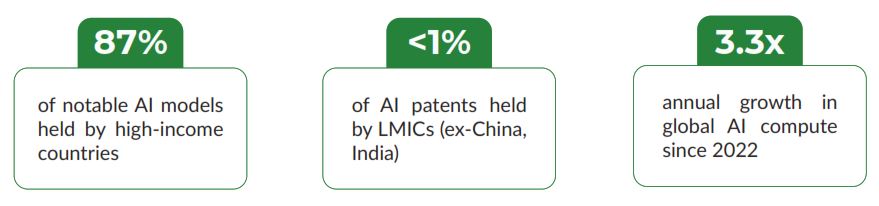
The existing discussion on the potential of integrating artificial intelligence (AI) in workplace environment often focuses on whether it will eliminate jobs of humans in the future. This is a critical question. The technological revolution is indeed a game changer in today’s competitive global economy, as countries exhibiting more advanced digital economies are enjoying higher profit margins by integrating technologies into workplaces (Kreiterling, 2023; Gal et al., 2019). The difference in access to AI technologies, infrastructure and expertise between countries is significant and suggests a growing AI inequality. High income countries, which make up only 17% of the world’s population, practically own the AI industry. They own 87% of AI models, 86% of AI start-ups, and an enormous 91% of the venture funding (World Bank, 2025). Low- and middle-income countries (LMICs), on the flip side (excluding China and India), making up 48% of the global population, are left behind. When it comes to ownership, these nations have less than 1% of all AI models, patents and funding mechanisms (Stanford University, 2026; World Bank, 2025). This economic disparity between high income and LMICs leads us to establish that this AI inequality is a complex phenomenon and should thus not be viewed merely as a conventional digital divide. Developed countries use this potential due to such factors as powerful power grids, extensive computing networks, advanced labour force, and large investment funds (World Bank, 2025).
The National AI Policy 2025 and the Islamabad AI Declaration have laid an admirable foundation for Pakistan’s AI strategy (Government of Pakistan, 2025, 2026). This brief compares seven national AI strategies using the four-C framework of Connectivity, Compute, Context and Competency (World Bank, 2025). Applying this framework to the case of Pakistan, this brief identifies five evidence-informed policy options for implementing the high-level goals.
Options for Policymakers
- Make compute a marketplace, not a trophy
- Invest in language as context
- Export products, not labour hours
- Use procurement as a market maker
- Make the state the first customer, with safeguards (competitive pilots, open tenders, time-limited support)
Conceptual Framework: Connectivity, Compute, Context and Competency
The four-components approach by the World Bank (2025) is more effective than simply measuring the number of AI policies a government has adopted. Connectivity refers to cost-effective networks and reliable electricity. Compute includes the availability of chips and cloud-based computing power. Context refers to the availability of data and languages that are reflective of the local environment. Competency refers to the capability to deploy, customise, and innovate.
Global Evidence: Productivity Multipliers and Commoditised Labour Exporters
According to the most recent study of the International Labour Organization (ILO, 2025) into the impact of generative AI globally, one in four workers currently operates in a profession with some level of exposure to generative AI technologies, though in general it sees job transformation rather than job destruction as more likely to occur. The 2023 webinar knowledge brief on AI and labour markets in developing countries emphasised that gains in automation are enjoyed only by strong firms and experts if not combined with labour market legislation reforms and skill development measures (Amjad, 2023)
The hardware stack brings this reality into sharp relief. The amount of AI computing power worldwide increased by about 3.3 times per year since 2022 to reach 17.1 million equivalent GPUs H100 (Stanford University, 2026). While there are 5,400 data centres in the United States alone, which is more than ten times what any other nation has (Stanford University, 2026), a single foundry in Taiwan produces virtually all the top-end AI chips (Alamsyah, 2024; Goldstein, 2024). The politics of AI seems invisible through one’s browser window, but its political economy is thoroughly concrete: fabs, power, cooling, cables, data centres, cloud deals and export licences.
Comparative Evidence: Seven National Approaches on One Capability Spectrum
No two countries are doing AI nationalisation in the same way. Comparing them against each other is more educational than comparing Pakistan’s AI policy by itself.
China: Industrial Scale and the Limits of Hardware Dependence
China’s true strength lies in its industrial surface area: its factories, its robotics, its logistics, and the immense amounts of operational data. China’s “AI + Manufacturing” initiative targets 100 high-quality industrial datasets and 500 typical application scenarios by 2027 (Government of China, 2026). However, the country’s reliance on sophisticated semiconductors, an area in which it remains dependent on imports despite restrictions, suggests that all this power of AI can be hobbled by a single external chokepoint. For smaller countries, sovereignty is not just a catchy phrase of data residence; it is a map of their dependencies throughout the entire stack.
Implication for Pakistan: industrial datasets at scale are worth striving for, but nothing can replace the hardware layer they lack.
India: Public Compute as Shared Infrastructure
What India did differently was treat compute scarcity as a form of national infrastructure. By October 2025, the IndiaAI Mission had onboarded more than 38,000 GPUs at subsidised rates, along with AIKosh hosting more than 3,000 datasets (Government of India, 2025). India combines this with practical localisation for a nation with hundreds of languages, and ties AI to payment, identity, and public services systems already operating at a national scale. Take away: Public compute lowers barriers to entry, local datasets lower dependency, and procurement takes prototypes to production.
Implication for Pakistan: The compute pooling approach assumes a pool of firms and scientists prepared to use it; Pakistan’s problem is demand, not GPUs.
Saudi Arabia: Capital, Speed and the Limits of Purchased Capability
According to Riyadh’s National Strategy for Data and AI, by 2030, the country aims at ranking among the world’s best fifteen countries in the field and will have approximately 20,000 experts and an investment of about SAR 75 billion (Government of Saudi Arabia, 2020). By 2025, the Public Investment Fund introduced HUMAIN which works on the complete stack, including Arabic multimodal models. The challenge for Saudi Arabia is that while GPU clusters have been announced, it remains to be seen whether the same actually result in the emergence of Saudi companies and Arabic-language intellectual property apart from the funded core, but the strategy itself is proof that the hierarchy of global AI is not fixed in time.
Lesson for Pakistan: capital this size isn’t available, and Saudi Arabia’s own open question, whether spending converts into domestic IP, is a warning against mistaking investment announcements for capability.
Türkiye: Procurement as a Market-Making Instrument
The Türkiye Artificial Intelligence Action Plan (2026–2030) aims to equip five million citizens with AI literacy, train 10,000 high-end experts, generate 2,000 public datasets and one gigawatt data centre capacity along with minimum two per cent of public investments going towards AI (Government of Türkiye, 2026). Significantly, the plan includes the instruction that the government sector becomes the primary customer of its homegrown AI products (Government of Türkiye, 2026), addressing the typical challenge that the country has the required skills and prototypes but lacks the buyer who will take the risk of first-time use.
Implication for Pakistan: this is the most inexpensive lesson of the lot, a procurement policy that allocates a portion of government IT expenditure to domestic AI solutions can deploy existing prototypes without new funding.
Iran: Sanctions, Self-Reliance and the Sovereignty Trap
The 2024 Iranian National AI Document plans on reaching the top ten countries in the world by 2032 based on solid engineering capabilities (Government of Iran, 2024). However, advanced AI technology is uniquely vulnerable to sanctions since the hardware required (chips), software (cloud computing platforms) and funding infrastructure are consolidated and traceable. Open-source software reduces the model problem but cannot manufacture the accelerators or break the capital isolation. The lesson learned for middle powers is not to mix up independence and self-sufficiency.
Implication for Pakistan: the language of sovereignty used in the National AI policy may need to be moderated with the same chip and currency dependency issues facing Iran due to sanctions.
Bangladesh: Starting Point, Candour and the Consumer-to-Producer Gap
The National AI Policy of Bangladesh was still at Draft v2 in February 2026 and surprisingly enough, is one of the few countries that openly acknowledges the fact that it is a consumer and not a producer of AI (Government of Bangladesh, 2026). In 2025, 54.8 per cent households have internet access and rural usage is even less at below 38 per cent (Bangladesh Bureau of Statistics, 2025, as cited in Government of Bangladesh, 2026). Its manufacturing sector presents itself an avenue through quality control, logistics and export readiness. Its open question is same as that of Pakistan: will it be able to transform from a consumer into an adapter before foreign AI platforms dominate?
Implication for Pakistan: Bangladesh’s honesty about being a consumer rather than producer of AI is paying off.
Pakistan’s Position: Real Strengths and One Blind Spot
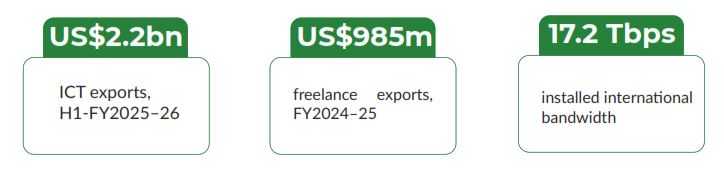
Pakistan also enters the contest with its actual strengths. The ICT exports increased from US$433 million in FY2009/10 to US$1 billion plus in FY2018/19, growing by a compound annual rate of 10.8% per annum (Nayyar et al., 2021), and reached their all-time high of US$2.2 billion in the first half of FY2025–26, of which computer services made 84% and telecommunication services 16% (State Bank of Pakistan [SBP], 2026). It represents approximately half of Pakistan’s services exports, and IT exports have emerged as the second-biggest export category of Pakistan after knitwear with the share of more than 14% in the first half of FY2025–26; along with the rest of the IT and IT enabled services, the digital exports have already crossed US$3.8 billion in FY2024–25 (SBP, 2026). The freelancing alone accounted for US$985 million in FY2024–25, increasing by almost three times in three years. Pakistan is ranked third on Fiverr and fifth on Upwork, around 60% of its freelancers are under the age of 30, and the Labour Force Survey 2024–25 shows that 2.3 million people in Pakistan, i.e., 2.9% of the total employment, are digitally employed or gig workers (SBP, 2026). Also, the connectivity base of Pakistan is quite strong with 200 million telecom subscribers, which amounts to about 80% of the population, with 91% cellular coverage and 81% 3G/4G coverage (Javed & Nayyar, 2025), 17.2 Tbps of international bandwidth capacity, and total data consumption of 27,727 petabytes (SBP, 2026).
Pakistan’s Policy Framework: Commitments and Implementation
National Artificial Intelligence Policy of Pakistan 2025 does not hold back. The policy comprises six strategic pillars and requires a National AI Fund, Centres of Excellence, sectoral road maps, national compute grid, and the training of 200,000 people each year (Government of Pakistan, 2025). It is evident that Pakistan’s gap is not one of lacking policy language but rather any kind of system at all, on a larger scale. Exhibit 1 shows how many of these commitments have just stayed commitments, as compared to what is actually being implemented.
Exhibit 1: Pakistan’s Readiness Gap: Policy Commitments and Actual Status
| Dimension | Policy commitment | Actual status |
| Compute / GPU access | National Compute Grid under the AI Infrastructure pillar | No metered public GPU marketplace is yet operating; access remains ad hoc and institution-specific |
| Local datasets | Urdu, Punjabi, Pashto, Sindhi and Balochi benchmarks under Option 3 | No public benchmark release yet; usable corpora exist in scattered academic projects, not as a national asset |
| Advanced AI
skills |
200,000 people trained annually toward 1 million professionals and 10,000 trainers by 2027 (Pillar 2); a separate Indus AI Week pledge (Feb 2026) commits to 1,000 fully funded
AI PhD scholarships and 1 million non-IT professionals trained by 2030 |
Ambitious targets, but existing AI skills gaps raise concerns over training capacity, quality, and industry readiness. Meanwhile, less than 10% of the computing and IT workforce is skilled in AI and allied technologies, against 75,000+ IT graduates produced annually |
| Public-sector
adoption |
Sectoral roadmaps for agriculture, health, education, governance | Live use limited chiefly to NADRA and FBR; PwC
puts the cost of continued non-adoption elsewhere at up to US$7bn by 2030 |
| Funding | National AI Fund; Rs 283bn-costed ecosystem programme; separate $1bn AI investment pledge by 2030 (Indus AI Week) | Rs 1bn released against Rs 283bn costed. The FY2025–26 federal budget allocated Rs 4.8bn to Science & Technology and Rs 13.5bn to MoITT combined under 0.11% of the Rs 17.6 trillion outlay
suggesting the gap is a pattern, not a one-year shortfall |
| Connectivity | Universal broadband access referenced in the policy | Around 200 million telecom subscribers nationally, on a backbone the Prime Minister has described as 234,000km of fibre, six submarine cables, roughly 58,000 cellular towers and 20+ modern data
centres, but access remains markedly weaker in KP, Balochistan, GB and AJK |
| Regulatory / audit capacity | Risk-based governance under the Secure AI Ecosystem pillar | Regulatory design exists on paper; no independent
technical audit body has been named for high-risk systems |
Note. Author’s compilation based on Ahmad (2026); Digital Watch Observatory (2026); Government of Pakistan (2025); Government of Pakistan, Press Information Department (2026); Javed and Nayyar (2025); Ministry of Informa-tion and Broadcasting (2026); PwC Pakistan (2025, as cited in Zareen, 2026); Usi (2026); and Zareen (2026).
Five Evidence-Informed Policy Options
Pakistan cannot afford to subsidise all AI start-ups at once, design a frontier solution, establish data centres across the cities, digitalise every ministry, and educate millions to an advanced level. Budget limitations mean that prioritisation becomes necessary. The five options listed below are purposefully narrow in scope and each ownable by an existing organisation, and measurable within a budget year.
Option 1: Making compute a marketplace, not a trophy: A transparent national system letting universities and start-ups buy subsidised, metered GPU access (with published pricing and utilisation data) matters more than a single showcase supercomputer. This is first a contracting decision, not an infrastructure one, and what might have been a constraint for Pakistan in this matter may prove itself an asset in disguise. Pakistan spends around Rs 2.1 trillion (equivalent to US$7.5bn) annually on capacity payments for 10–12GW of power generation capacity that is mostly idle (Qadir et al., 2025; Salman et al., 2026). Independent power producers operate at less than 50% of utilisation rates, which drives up grid costs (SBP, 2026). Allocating even 1–2GW of this capacity to data centres could earn Pakistan between US$700m and US$1.5bn annually from electricity sales and help attract foreign investment several times the country’s FY26 net FDI inflows. The load profile works well with the asset because levelised cost of computing favours high load factors and is relatively unaffected by electricity price; US$125/MWh baseload price supports load factors above 64% (Nøland et al., 2024). The scale looks reasonable: 3.2 million GPUs at 300W translate to 960MW or 8.4TWh a year (Chien, 2023). Moreover, data centres can offer grid flexibility, not extra peak demand (Takci et al., 2025), and AI-driven HPC facilities offer this option more affordably (Zhou et al., 2024). Digitalisation and institutional quality make developing countries attractive for foreign direct investment (Nguyen, 2025), and reliable electricity supply makes connectivity influence on FDI even more positive (Mensah & Traoré, 2023).
It makes more sense to use a hybrid approach (elastic cloud and domestic GPUs using excess energy). The problem of cooling is important: One Pakistani data centre had a Power Usage Effectiveness ratio of 3.3, indicating “poor and inefficient operations” (Uddin et al., 2014), and the grid lacks large-scale storage capacity (SBP, 2026). This can be run by one entity to make prices uniform. Subsidised entry will be possible only after registration, which can then be verified from the utilisation dashboard.
Thinking of sovereignty in terms of ‘sovereign enough’: Pursuing the frontier model to compete with the US and China will prove costly. Instead, it is all about control of sensitive data, local adjustment of open models, diversified relationships with cloud providers and chip manufacturers, and rich Urdu and regional language datasets: the ability to swap out providers without changing strategy.
Option 2: Investing in language as context: Urdu, Punjabi, Pashto, Sindhi and Balochi datasets, speech corpora and evaluation benchmarks are long-lasting national assets, like India’s, Saudi Arabia’s and Türkiye’s bets on their languages (Government of India, 2025; Government of Türkiye, 2026).
Option 3: Exporting products, not labour hours: Domain models, cybersecurity services, data engineering and workflow integration matter more than labour hours, since a firm that delivers an outcome is harder to automate than an individual whose task can be packed into a prompt.
This means AI-enabled business process outsourcing (BPO) and business services, cybersecurity services, data engineering, fintech solutions, AI-enhanced software products and SaaS, workflow automation, and domain models exports priced on outcome and IP, rather than labour hours as they are currently measured. Incentives of PSEB and TDAP could be revised to reward productisation, recurring export revenue and IP generation, instead of employment numbers or service export volumes which they currently incentivise.
Option 4: Procurement as a market maker: Developing countries typically invest in training, contests and innovation hubs, only to fail to generate demand for winning prototypes due to lack of large domestic buyer to take the risks of early adoption. The Turkish case shows that a state can act not just as a regulator but as a market maker (Government of Türkiye, 2026). Unless Pakistani banks, hospitals, farmers, logistics firms and other public bodies adopt and integrate home-grown solutions, talent will migrate to foreign customers or freelance or remain stuck at the prototype stage.
Option 5: Making the state first customer comes with its dangers too: inefficiencies of domestic producers protected, cronyism in contract awards, vendor lock-ins, low competition and procurement of suboptimal solutions. These dangers are manageable via competitive pilot procurement, open tenders, technical performance criteria, interoperability standards, evaluations of pilots and limited-time assistance that persists only if performance is demonstrated. The objective is to create a domestic market, not a list of perpetually protected suppliers.
The Brief in One Line
Pakistan does not need to out-compute China or out-spend Saudi Arabia. It would benefit from a working compute marketplace, a procurement system that buys what it trains people to build, and a scorecard honest enough to say when a pilot has failed.
References
Ahmad, N. (2026, June 12). Pakistan’s AI moment: Rs9bn prescription for a structural problem. Business Recorder. https://www.brecorder.com/news/40425068
Alamsyah, N. (2024). Artificial intelligence initiative in Taiwan: A systematic literature review. In 2024 Ninth International Conference on Informatics and Computing (ICIC) (pp. 1–5). IEEE.
Amjad, M. H. ( PIDE 2023). Artificial intelligence (AI) and policy in developing countries.”
Chien, A. A. (2023). GenAI: Giga$$$, terawatt-hours, and gigatons of CO2. Communications of the ACM. https://cacm.acm.org/opinion/genai-giga-terawatt-hours-and-gigatons-of-co2
Digital Watch Observatory. (2026, February 10). Pakistan pledges major investment in AI by 2030. https://dig.watch/updates/pakistan-pledges-major-investment-in-ai-by-2030
Gal, P., Nicoletti, G., Renault, T., Sorbe, S., & Timiliotis, C. (2019). Digitalisation and productivity: In search of the holy grail – Firm-level empirical evidence from EU countries (OECD Economics Department Working Papers No. 1533). OECD Publishing. https://doi.org/10.1787/5080f4b6-en
Goldstein, H. (2024). Defending Taiwan with chips and drones: Taiwan doubles down on its silicon shield strategy while the US promises a storm of drones. IEEE Spectrum, 61(10), 2.
Government of Bangladesh. (2026). National AI policy (Draft v2). Information and Communication Technology Division.
Government of China. (2026). Implementation opinions on the “AI + manufacturing” special initiative (Etcetera Language Group, Trans.; B. Murphy, Ed.). Center for Security and Emerging Technology.
Government of India. (2025, October 12). Transforming India with AI: Over ₹10,300 crore investment & 38,000 GPUs powering inclusive innovation [Fact sheet]. Press Information Bureau. https://static.pib.gov.in/WriteReadData/specificdocs/documents/2025/oct/doc20251012664501.pdf
Government of Iran. (2024). National artificial intelligence document of the Islamic Republic of Iran (Document No. 7816/1403) [Policy document]. Supreme Council of the Cultural Revolution.
Government of Pakistan. (2025). National artificial intelligence policy 2025. Ministry of Information Technology and Telecommunication.
Government of Pakistan. (2026). Islamabad AI declaration.
Government of Pakistan, Press Information Department. (2026, February 9). Indus AI Summit 2026 concludes in Islamabad with landmark policy frameworks and global partnerships (PR No. 108). https://pid.gov.pk/site/press_detail/31885
Government of Saudi Arabia. (2020). National strategy for data and AI. Saudi Data and Artificial Intelligence Authority. https://sdaia.gov.sa/en/SDAIA/SdaiaStrategies/Pages/NationalStrategyForDataAndAI.aspx
Government of Türkiye. (2026). Türkiye yapay zekâ eylem planı (2026–2030) [Türkiye artificial intelligence action plan (2026–2030)]. Ministry of Industry and Technology. https://www.sanayi.gov.tr/yapayzekaeylemplani
International Labour Organization. (2025). Generative AI and jobs: Occupational exposure assessment [Research brief].
Javed, S., & Nayyar, S. (2025). Digital leadership and literacy as strategic levers for employee outcomes in Pakistan’s telecommunication sector. Business Review, 20(2), 22–43. https://doi.org/10.54784/1990-6587.1728
Kreiterling, C. (2023). Digital innovation and entrepreneurship: A review of challenges in competitive markets. Journal of Innovation and Entrepreneurship, 12(1), Article 49.
Mensah, J. T., & Traoré, N. (2023). Infrastructure quality and FDI inflows: Evidence from the arrival of high-speed internet in Africa. The World Bank Economic Review, 38(1), 1–23. https://doi.org/10.1093/wber/lhad021
Ministry of Information and Broadcasting. (2026, February 10). PM announces $1bn investment, 1,000 fully funded PhD scholarships in AI by 2030. Government of Pakistan.
Nayyar, G., Hallward-Driemeier, M., & Davies, E. (2021). At your service? The promise of services-led development. World Bank. https://doi.org/10.1596/978-1-4648-1671-0
Nguyen, V. B. (2025). Digitalization’s divergent impact on FDI inflows: A comparative analysis between advanced and developing countries. Transnational Corporations Review, 17(3), Article 200148.
https://doi.org/10.1016/j.tncr.2025.200148
Nøland, J. K., Hjelmeland, M., & Korpås, M. (2024). Will energy-hungry AI create a baseload power demand boom? IEEE Access, 12, 110353–110360. https://doi.org/10.1109/ACCESS.2024.3440217
Qadir, A., Baig, M., & Dar, I. B. (2025). Strategic approaches to managing independent power producers in Pakistan: Addressing capacity charges and advancing SDG-7 through Innovation 4.0. Pakistan Journal of Engineering and Technology, 8(1), 64–72. https://doi.org/10.51846/vol8iss1pp64-72
Salman, S. M., Naseem, M. R., Iqbal, A., Aziz, A., & Hassan, M. (2026). Paying for power not produced: IPP capacity payments, circular debt, and the regressive welfare impact on Pakistan’s energy sector. Journal for Social Science Archives, 4(1), 613–648. https://doi.org/10.59075/jssa.v4i1.515
Stanford University. (2026). 2026 AI Index report.
State Bank of Pakistan. (2026). The state of Pakistan’s economy: Half year report 2025–26.
Takci, M. T., Qadrdan, M., Summers, J., & Gustafsson, J. (2025). Data centres as a source of flexibility for power systems. Energy Reports, 13, 3661–3671. https://doi.org/10.1016/j.egyr.2025.03.020
Uddin, M., Alsaqour, R., Shah, A., & Saba, T. (2014). Power usage effectiveness metrics to measure efficiency and performance of data centers. Applied Mathematics & Information Sciences, 8(5), 2207–2216. https://doi.org/10.12785/amis/080514
Usi, V. (2026, June 22). Pakistan’s AI future. The News. https://www.thenews.pk/magazine/money-matters/1421801-pakistans-ai-future
World Bank. (2025). Digital progress and trends report 2025.
Zareen, S. (2026, July 27). AI-enabled public governance in Pakistan: Policy 2025. Pakistan Today. https://www.pakistantoday.com.pk/2026/07/27/ai-enabled-public-governance
Zhou, Y., Paredes, Á., Essayeh, C., & Morstyn, T. (2024). AI-focused HPC data centers can provide more power grid flexibility and at lower cost (arXiv:2410.17435). arXiv. https://doi.org/10.48550/arXiv.2410.17435