
ABSTRACT
This study investigates the major determinants of national savings and total investment in Pakistan from 1981 to 2023 using the ordinary least squares (OLS) approach. The results of the savings function suggest that savings in Pakistan are significantly influenced by inflation, remittances, GDP, deposit rates, and the age dependency ratio. On the other hand, foreign direct investment (FDI) and gross domestic product (GDP) are found to be positive determinants of total investment. However, a comparison with selected Asian countries reveals that Pakistan lags behind all of them in both savings and investment rates. To follow the path of sustained economic growth taken by these countries, Pakistan needs to increase its total investment through higher national savings. Moreover, both savings and investment can be enhanced in the economy through operational policy measures that take into account the key determinants of both national savings and total investment.
1. INTRODUCTION
The economic performance of a country is influenced by multiple factors. Among such factors, the two key macroeconomic variables are savings and investment, which play a significant role in promoting economic growth. Therefore, the role of savings and investment in the development process has been extensively examined in the literature (e.g., Thomas, 2006; Mualley, 2011; Sajid & Sarfaraz, 2008; Mohan, 2006).
Both the classical and modern economic theories, such as Harrod-Domar and Solow growth models, focused on the fact that higher savings facilitate capital formation and investment, thus enhancing productive capacity and long-term economic growth. Therefore, as per the Harrod-Domar (1946)1 economic growth model, the economic growth rate of a country is well defined by the level of savings and the capital output ratio (the amount of capital needed to produce one unit of output). Hence, a prerequisite for higher investment is the availability of higher savings. The Solow (1956) growth model also suggests that savings affect the economic growth through increased capital formation, which consequently leads to economic growth. Moreover, the new growth theories of 1980s (e.g., Romer, 1986, 1990; Barro, 1990; and Lucas, 1988) reconfirmed the view that high saving rates are important for higher GDP growth rates. In the economic literature, the major determinants of high savings rates are population growth, economic growth, per capita income, terms of trade, foreign capital, interest rate, inflation, tax rate, and foreign savings, among others (see Fry, 1995; Gupta, 1993; Edwards, 1996; Ali, 2016; & Khan, 1988). On the other hand, the major determinants of investment are cost of finance, bank credit, foreign capital inflows, imports, exports, foreign aid, private capital outflows, workers’ remittances, development of financial institutions, among others e.g. see Blejer & Khan (1984); Jorgenson (1967); Guimaraes & Unteroberdoerster (2006); Sakr (1993); Veemon & Mataya (1996); Khan (1988); Looney (1997). Moreover, higher level of savings and investment not only reduce a country’s foreign capital dependency but also play a vital role in the deployment of domestic resources (Lewis, 1954). Therefore, a deep understanding of the determinants of savings and investment is crucial for suggesting effective economic policies.
From Pakistan’s perspective, Husain (1995) discussed that many of the differences in economic performance between Pakistan and other South Asian countries were attributable to Pakistan’s low rates of savings and investment. Therefore, as a developing country, Pakistan should adopt policies that enhance its savings in order to enhance its economic growth. Also, Pakistan’s economic growth remained low due to rising foreign debt and debt servicing, high inflation, political instability, low exports, low investment in human capital, and the poor law and order situation of the country. Furthermore, Pakistan has been stuck in a low-saving and low-investment trap2, which has significantly stifled its growth potential. A low savings rate limits the availability of investable funds, while inadequate investment hampers sustainable economic growth. This slow growth, in turn, generates fewer domestic savings, thus perpetuating the cycle. Historically, in Pakistan, all periods of high growth have coincided with substantial inflows of foreign savings, such as external loans, grants, and remittances, and when these inflows diminish, economic growth weakens because by then the domestic savings and investment are insufficient to sustain this momentum.
However, despite various policy interventions during the last several decades, Pakistan has persistently experienced low savings and investment rates compared with its neighboring countries, which has constrained its productivity growth, employment generation, and economic development. In this context, identifying the factors responsible for low savings and investment is of considerable policy importance. Moreover, the past literature has examined such factors for the case of Pakistan, but most of them focused on either investment or savings and relied relatively on old datasets. Therefore, to capture the impact of recent decades (i.e., demographic transitions, increased remittance inflows, changes in inflation, rising public debt, and fluctuating foreign investment), it is imperative to conduct a fresh empirical assessment using updated data. Hence, the objective of this study is based on three motivations. First, the extraordinary importance of savings and investment for economic development. Second, consistent low savings and investment are a big challenge for Pakistan compared to its regional countries. Finally, there exists a lack of in depth analysis that jointly examines the determinants of both savings and investment for a long period. To achieve this objective, this study has employed the ordinary least squares (OLS) approach to investigate the determinants of savings and investment functions for the case of Pakistan over the period 1981-2023.
The rest of the paper is arranged as follows: Section 2 provides a brief view of Pakistan’s economy in terms of its savings and investment behavior, especially with respect to selected Asian countries. Section 3 presents the theoretical framework and the most relevant brief empirical literature review, while Section 4 describes the data sources and methodology of the paper. Section 5 provides results and discussion, and Section 6 concludes the study. Finally, Section 7 offers policy implications derived from the findings of this study.
2. OVERVIEW OF PAKISTAN’S ECONOMY
Table 1 shows the trends of savings and investment in Pakistan and highlights the relationship among three key macroeconomic variables i.e. GDP, national savings and total investment during the last four decades.
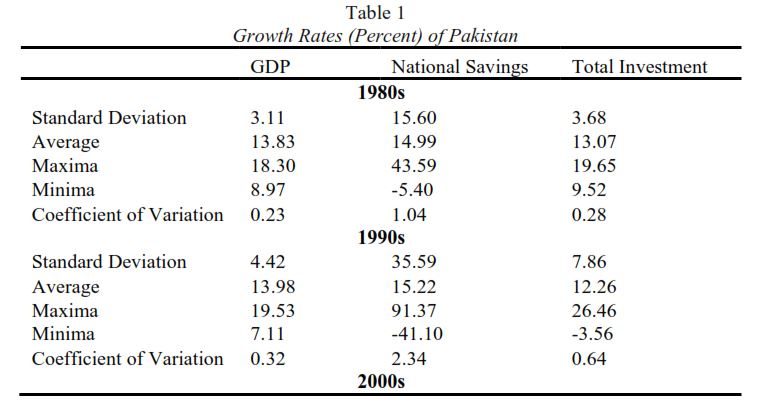
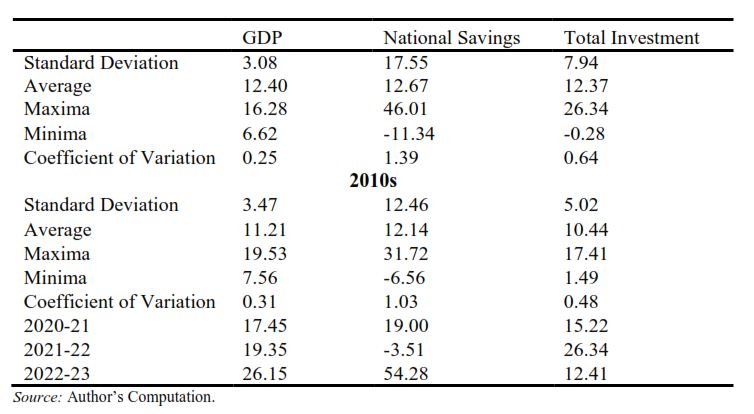
During almost all of the reported decades, the growth rate of national savings was more volatile than that of the GDP and investment (See coefficient of variation). Moreover, the growth rate of GDP on average remained in the range of 9-17 percent, investment in the range of 10–20 percent and savings in the range of 12–21percent during the period under review. To address the persistent weakness in the national savings, the program of Structural Adjustment Programme (SAP)3 was launched in 1989-90. In addition, the government has rationalised the National Savings Scheme (NSS) by offering very attractive returns on various certificates and bonds.
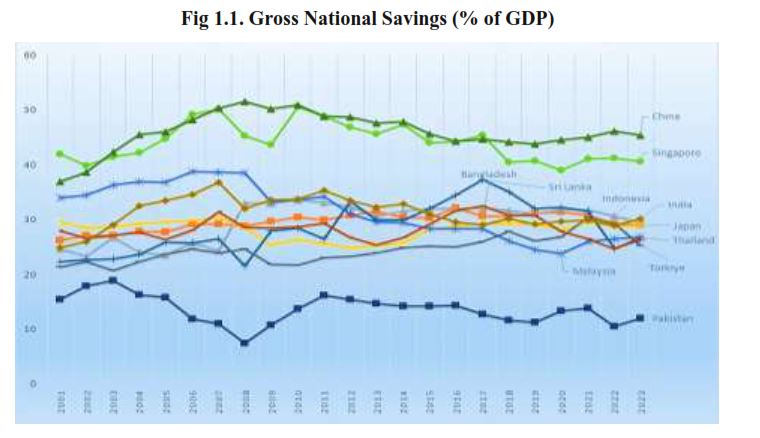
A comparison of Pakistan with selected Asian economies in terms of savings and investment performance is presented below in Figures 1.1 and 1.2.
Fig 1.1. Gross National Savings (% of GDP)
SAP restrict the government to abstain bank borrowing to finance its budget deficit.
Fig 1.2. Total Investment (% of GDP)
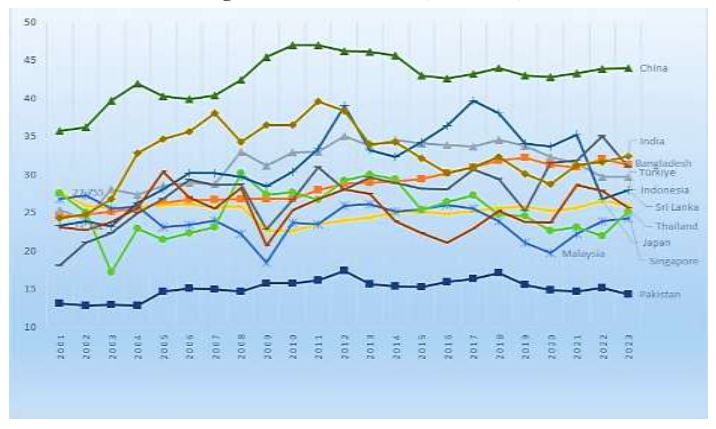
During the decades of the 1960s and 1970s, Pakistan’s total investment as percent of GDP was almost comparable to that of most Asian countries (Nasir, et al. 2004). However, during later decades up to 2023, Pakistan’s total investment rate remained largely stagnant, fluctuating between 12 and 17percent of GDP. As a result, Pakistan recorded the lowest investment rate among the selected Asian countries, as shown in Figure 1.2. In contrast, the investment rate of other countries ranged between 20 percent and 47 percent during 2001-2023. Similarly, the gross national savings of Pakistan as percent of GDP performed even more poorly than its total investment rate (see Fig 1.1). Consequently, both the investment and savings rates of Pakistan are lower than all other Asian countries. These figures suggest that the aforementioned Asian countries not only achieved higher savings and investment rates but also sustained them over time, thereby supporting higher and more sustained economic growth.
2.1. Savings-Investment Gap of Pakistan
In 2015, Pakistan ranked 151st out of 175 countries in terms of its investment rate, significantly lower than Asian countries including India (32nd), Sri Lanka (36th) and Bangladesh (40th).
As shown in Figure 1.3, in Pakistan, the savings-investment gap has been negative for most years. The persistent imbalance has continued over time and poses a big challenge to the economy. It could become more problematic if Pakistan’s liabilities to the rest of the world exceed the value of its foreign assets. The major drivers behind this persistent imbalance are several structural economic challenges such as a large trade deficit, high inflation, a low capital output ratio, persistent fiscal deficits, rapid population growth, and weak currency. Consequently, Pakistan has remained trapped in a low- savings and low-investment cycle, which is one of the major factors behind its slow economic growth.
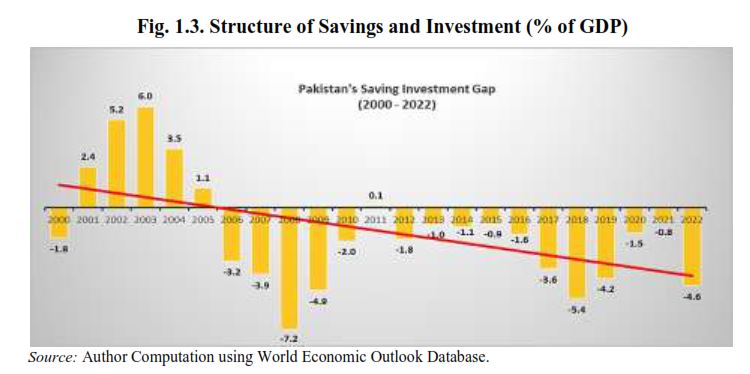
In a nutshell, a negative savings-investment gap is neither inherently good nor bad. There are countries that traditionally maintain high savings rates, and they require dissaving countries to absorb their surplus savings; otherwise they might find it difficult to sustain those high levels of savings. However, at the same time, such countries face many risks associated with exposure to external debt, foreign business cycles, and fluctuations in foreign currencies over time. On the other hand, if dissaving countries continue to experience persistently low savings rates, their debt burden may continue to rise. Therefore, the risk of borrowing at higher interest rates and accumulating liabilities that exceed the value of their assets may increase. This situation could ultimately create financial imbalances and contribute to instability in the global economy.
LITERATURE REVIEW
3.1. Theoretical Literature
The theoretical foundation of the present study is built on the Harrod-Domar Growth Theory. The key concept of this theory is based on the fact that economic growth depends on the level of savings and the productivity of employed capital. The higher level of savings increases the availability of funds for future investment leading to economic growth, this concept is in line with the Solow Growth Model as well. The determinants of the savings function are derived from the Life-Cycle Hypothesis and Permanent Income Hypothesis. The rationale of these theories suggests that individuals make savings decisions based on expected lifetime income, consumption needs, and demographic characteristics. For this reason, the current study has employed the variables such as GDP growth, remittances, inflation, interest rates, and age dependency ratio in the savings model. The determinants of investment function are derived from the Neoclassical Theory of Investment and Accelerator Theory. The Neoclassical approach suggests that investment is influenced by the cost of capital, availability of finance, and expected profitability, however the Accelerator Theory links the investment to economic growth and output expansion. Therefore, variables such as domestic savings, lending interest rates, foreign direct investment, public debt, and GDP are used as determinants of total investment function in this study. For detailed theoretical development of savings and investment functions see Tables 2 and 3.