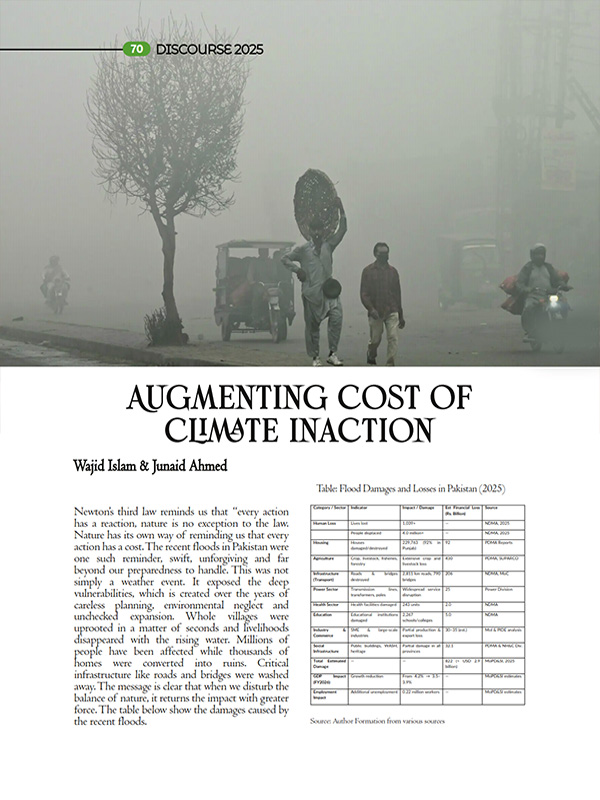
Newton’s third law reminds us that “every action has a reaction, nature is no exception to the law. Nature has its own way of reminding us that every action has a cost. The recent floods in Pakistan were one such reminder, swift, unforgiving and far beyond our preparedness to handle. This was not simply a weather event. It exposed the deep vulnerabilities, which is created over the years of careless planning, environmental neglect and unchecked expansion. Whole villages were uprooted in a matter of seconds and livelihoods disappeared with the rising water. Millions of people have been affected while thousands of homes were converted into ruins. Critical infrastructure like roads and bridges were washed away. The message is clear that when we disturb the balance of nature, it returns the impact with greater force. The table below show the damages caused by the recent floods.
Table: Flood Damages and Losses in Pakistan (2025)
| Category / Sector | Indicator | Impact / Damage | Est Financial Loss (Rs. Billion) | Source |
| Human Loss | Lives lost | 1,039+ | — | NDMA, 2025 |
| People displaced | 4.0 million+ | — | NDMA, 2025 | |
| Housing | Houses damaged/destroyed | 229,763 (92% in Punjab) | 92 | PDMA Reports |
| Agriculture | Crop, livestock, fisheries, forestry | Extensive crop and livestock loss | 430 | PDMA, SUPARCO |
| Infrastructure (Transport) | Roads & bridges destroyed | 2,811 km roads, 790 bridges | 206 | NDMA, MoC |
| Power Sector | Transmission lines, transformers, poles | Widespread service disruption | 25 | Power Division |
| Health Sector | Health facilities damaged | 243 units | 2.0 | NDMA |
| Education | Educational institutions damaged | 2,267 schools/colleges | 5.0 | NDMA |
| Industry & Commerce | SME & large-scale industries | Partial production & export loss | 30–35 (est.) | MoI & PIDE analysis |
| Social Infrastructure | Public buildings, WASH, heritage | Partial damage in all provinces | 32.1 | PDMA & NH&C Div. |
| Total Estimated Damage | — | — | 822 (≈ USD 2.9 billion) | MoPD&SI, 2025 |
| GDP Impact (FY2026) | Growth reduction | From 4.2% → 3.5–3.9% | — | MoPD&SI estimates |
| Employment Impact | Additional unemployment | 0.22 million workers | — | MoPD&SI estimates |
Source: Author Formation from various sources
In the northern regions of Khyber Pakhtunkhwa, Malakand division, huge rocks have rolled down and wiped out entire villages as a result of cloud bursts. It was not mere a chance, rather it was a consequence of our own choices. The same mountains that turned out to be a sign of fear for the locals once stood as a sign of beauty and glory. It was covered with thick pine and walnut forests; however, humans have deprived its natural beauty and made it bare, stripped of their roots. The mountains are reduced to stones and patches of grass. Being a beautiful valley, rainfalls and cloudbursts are not new to it. Nevertheless, human interventions have perturbed the whole ecosystem. The mountains where trees once held the soil firm are now witnessing emptiness and a widespread human population. Ultimately, the nature strikes back through flash flood and made the area uninhabitable for the coming few decades, to reclaim its territory.
The nature shows no restrain of taking back what belongs to it. In major cities, residential societies have been built on the dry beds of rivers, resultantly every monsoon, nature reminds us of our arrogance. The same story unfolds in Swat, where people encroach upon the river’s path each year. Locals say that if a river stone appears in your field, it is the “egg” of the river, and one day, whether in ten years or a hundred, the river will come to claim it. That old wisdom carries a warning we have long stopped listening to, nature never forgets its territory.
Our ancestor’s knowledge was far better than ours, to live in harmony with the land. They understood the logic of the hills, where water flows, where wind settles, and where a home should or should not be built. The older generations knew how to live with the land. Today, we build wherever our greed allows, guided by cement rather than sense. The hills that once echoed with folk wisdom now resound with construction noise. We call it progress, but it’s just ignorance in a modern form.
Pakistan’s problem is not only climate change; it is the priority of choosing to ignore planning altogether for it. Cities are expanding without any understanding of geography or ecology. Houses sprawl across fragile plains, riverbeds, and flood zones. No one is heeding to the indigenous knowledge that once kept communities safe from disaster, even there is no planning from government.
Many countries have entire cities located along rivers and coastlines, but their infrastructure is resilient, adaptive, and in harmony with the environment. They don’t fight against nature; instead, they learn from it. The tragedy in Pakistan lies in doing the opposite, rivers’ beds, forests, and hills are converted into residential societies, and then we wonder why floods sweep away our homes and fields.
The North–South climate debate is not without merit. It is a fact that Pakistan contributes a little to the global greenhouse gas emissions. Still, the country ranks among the vulnerable and affected by climate change. For instance, in 2010 flood, the country lost 2.4 million hectares of unharvested crops. Similarly, in the floods of 2022, UNDP estimated that 33 million people were directly affected with 1730 fatalities and a loss and damage of $30 billion, apart from $16.3 billion for reconstruction and rehabilitation. Now, in 2025, the country again incurred heavy losses.
Still, unfairness in the global climate narrative does not exempt us from our responsibilities. We may not have caused the storm, but we have stripped away the trees that could have softened its blow. Pakistan may not control global emissions, but some things are in our control. We have control over deforestation, construction on waterways, and respecting the natural course of rivers. These basic things do not require any international funding or complex interventions. These are steps in our own hands. If we continue to ignore them, then we alone will bear the cost of our negligence.
Nature is not cruel, it follows a strict balance. When it is disturbed, nature restores itself with any cost. The floods, landslides, and heatwaves are not random acts of fate but the consequences of decades of neglect and exploitation. The vengeance of climate change is not just in rising waters; it is in the silence of the forests we cut, the rivers that return for their land, and the mountains that crumble under our carelessness. The land once looked after us is no reminding us of the bargain we broke.
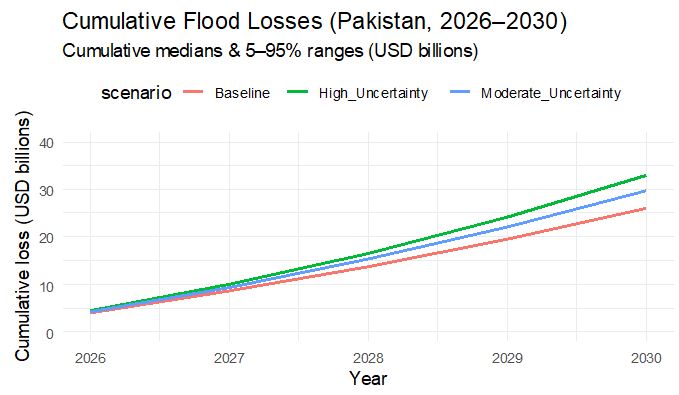
If we do not give proper attention to the issue of climate, Pakistan will bear more losses in the coming years. The below graph shows the future projection that how climate can induce losses in the coming years till 2030. In the baseline scenario the country can anchor $20 to $22b, in moderate case the losses can be $27 to $30b, while in extreme case the losses can reach to $35b to $40b.
Source: Author formation
The nature reclaims what we are neglecting but still it offers us a chance to rethink and rebuild. The recent floods are not just a disaster, it is a call for policy action and environmental responsibility. Firstly, there is need of integrating nature into the development planning. No project should be carried out without the prior permission of the relevant authorities. Secondly, climate resilient infrastructure should be promoted in the flood prone areas. Thirdly, it is the need of hour to strengthen early warning and disaster preparedness, which the country currently lacks. Also, it is important to revive the indigenous and local knowledge to mitigate the losses and promote sustainability because local problems need local solution. Besides, reforestation and preserving natural ecosystem should be made a national security priority, it can solve many of the problems of the country. Lastly, sustainable planning should be carried out to lessen the impact of the repeated disasters and coordination between different departments should be enhanced.
Mr. Wajid Islam is a Research Economist working at the Pakistan Institute of Development Economics, and a member of the institute’s Macro Policy Lab.
Dr. Junaid Ahmed is currently serving as the Chief of Research at Pakistan Institute of Development Economics. His research focuses on issues related to Development Economics, International Trade and Regional Integration.