Energy Security in an Era of Geopolitical Uncertainty
Renewed tensions involving the USA, Israel, and Iran have again exposed the fragility of worldwide energy markets. Any escalation around the Strait of Hormuz, via which nearly 1/5th of global oil supply passes (Power, 2026), raises immediate concerns over supply disruptions and price volatility. For a country like Pakistan, this vulnerability is not merely a result of Middle Eastern geopolitics but a symptom of deeper-energy-security weaknesses: heavy reliance on imported energy, an ageing refining sector unable to meet domestic fuel demand, inadequate strategic petroleum reserves, and delays in critical energy reforms.
Energy security goes beyond physical availability of fuels and rests on 04 complementary pillars: availability, accessibility, affordability, and resilience. Pakistan faces severe gaps across all pillars, with inadequate local production and refining capacity that sustains import dependence, and reliance on a single maritime route exposes energy supplies to external disruptions.
Middle East Conflicts & Global Oil Market Volatility
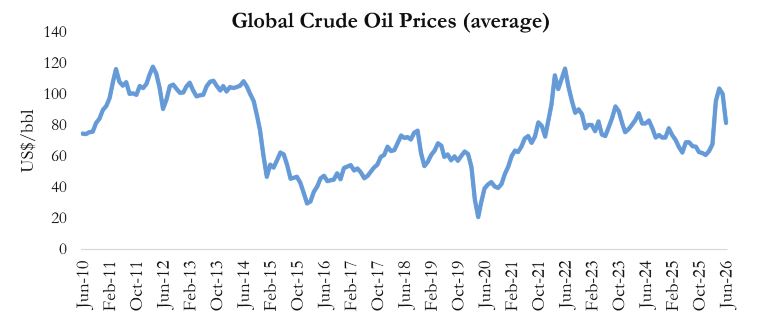
Since 2010, international crude oil prices have experienced repeated cycles of geopolitical shocks, supply disruptions, and changes in global demand. Prices remained elevated at around US$ 80-110 per barrel during 2010-14 before falling sharply in 2014-16 as US shale production expanded and OPEC maintained output. Prices recovered to about US$ 70 per barrel by 2018 but fell sharply during the COVID-19 pandemic, reaching roughly US$ 23 per barrel in 2020 amid the collapse in global demand. As economies reopened, prices surged above US$ 120 per barrel in 2022 (World Bank, 2026) following Russia’s invasion of Ukraine and tightening global supply conditions. Renewed geopolitical tensions in the Middle East later pushed crude prices close to US$ 120 per barrel, reaching US$ 119.5 amid concerns over disruptions via the Strait of Hormuz, before averaging about US$ 81.7 per barrel in June 2026 (Figure 1).
Figure 1: Month-wise Global Crude Oil Price Trend
Data Source: World Bank Commodity Prices
*Crude oil, average spot price of Brent, Dubai and West Texas Intermediate, equally weighted.
*Historical prices are presented in nominal terms; therefore, comparisons across periods can be interpreted with caution as they do not account for inflation.
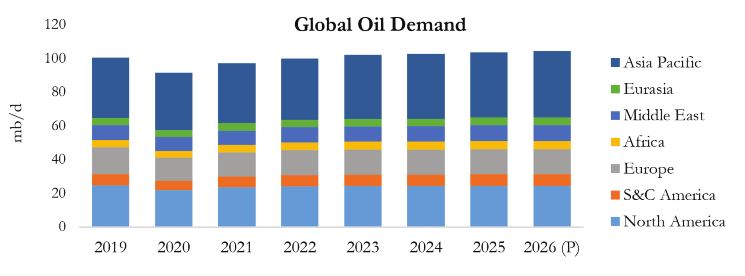
What has changed is the scale of underlying demand pressing against that supply. Global oil consumption, having fallen from 101 million barrels per day in 2019 to 92 million barrels per day at the height of the pandemic, has since recovered to roughly 105 million barrels per day (IEA, 2025), driven overwhelmingly by industrial growth across Asia-Pacific alongside steady consumption in North America and Europe (see figure 2). Other regions, including the Middle East and Africa, have seen gradual increases, reflecting rising energy needs in developing economies.
Figure 2: Yearly Global Oil Demand Trend & Projections
Data Source: IEA, Oil 2025 Analysis and Forecast to 2030
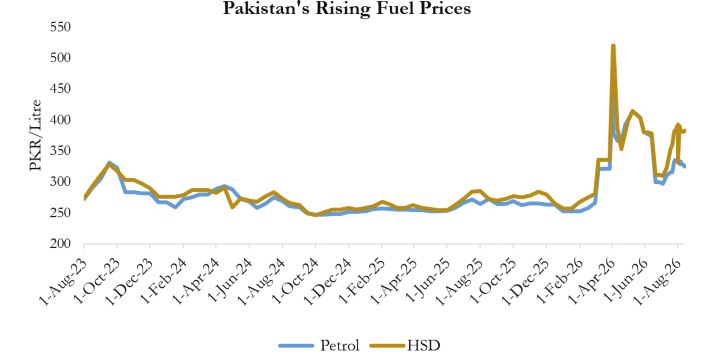
Pakistan transmits these external shocks into its domestic market almost immediately. As global oil prices rise, the impact is quickly passed through to local fuel prices via government adjustments, as happened when consumer fuel prices were revised upward in Sept-2023, and again through the recent escalation tied to the US-Israel-Iran conflict. As a result, petrol and diesel prices rose from PKR 272.9 and PKR 273.4 per litre on 1-Aug-2023 to PKR 324.98 and PKR 382.79 per litre by 13-Aug-2026 (Ministry of Energy, 2026), respectively (Figure 3), raising transportation, food and industrial costs across the economy.
Figure 3: Pakistan’s Rising Fuel Prices Amid Geopolitical Tensions
Data Source: Ministry of Energy (Petroleum Division)’s Public Notifications
*The prices reported here are therefore explicitly dated to 13-Aug-26.
Pakistan’s Structural Energy Vulnerability
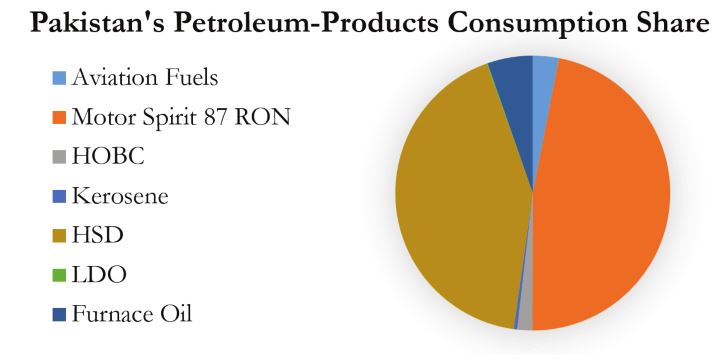
Pakistan’s exposure operates via key macroeconomic channels: the current account and foreign exchange, imported inflation, fuel-price adjustments and transport & production costs. The country imported about 8.2 million tonnes of oil equivalent in petroleum products in FY25 alone (HDIP, 2025), on top of constant crude imports that reached 9.8 million tonnes, a 19.4% increase driven by refineries scrambling to lift capacity utilization and meet transport-led fuel demand. The transport sector, which alone consumed 14.59 million tonnes of petroleum products in FY25 and accounts for 89% (HDIP, 2025) of petroleum-product consumption when petrol (Motor Spirit) and HSD are combined (Figure 4), transmits these cost shocks directly into freight rates, food prices and household budgets.
Figure 4: Pakistan’s Petroleum Products Consumption Share by Fuel (FY25)
Data Source: HDIP, Pakistan Energy Yearbook 2024-25
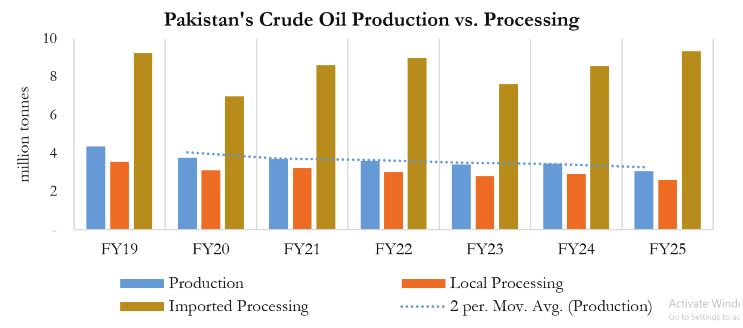
The country’s own crude production offers little relief. Domestic output has declined steadily over the past six years, falling to 3 million tonnes of oil equivalent in FY25, with the sharpest contraction occurring between FY19-20 amid COVID demand collapse and subsequent underinvestment in exploration. Thus, Pakistan’s crude throughput remains heavily import-dependent.
Figure 5: Trend Analysis of Pakistan Crude Oil Production vs. Processing
Data Source: HDIP, Pakistan Energy Yearbook 2024-25
The composition of these imports has also shifted structurally toward transport fuels: motor spirit (petrol) dominates the import basket with a 69% share in FY25 (HDIP, 2025), while furnace oil imports have fallen to near zero as power generation has moved away from oil-fired plants. This is, in one sense, a positive structural adjustment, but it also means Pakistan’s import bill is now concentrated almost entirely in the fuels for which domestic refining capacity is least able to compensate.