
ABSTRACT
This study provides an in-depth review by covering more than seven decades of Pakistan’s capital markets development, structural reforms and integration with global financial systems. It focuses on the growth trajectory of stock and bond markets, synthesising key empirical research studies on volatility, market efficiency, macroeconomic linkages and policy reforms. The analysis provides insights to understand how capital markets serve as mechanisms for mobilising savings, allocating capital and enabling risk sharing in order to achieve the objective of economic modernisation in line with the vision of Uraan Pakistan.
1. INTRODUCTION
Financial markets are platforms or systems where buyers and sellers participate to trade financial instruments/assets/securities[1]. The two key financial markets in Pakistan are stock and bond markets, collectively known as the capital market[2] of Pakistan. These markets create and develop financial products to provide returns to those with excess funds (lenders/investors) and to supply these funds to those who are in need i.e. borrowers. Hence, capital markets are central to mobilising savings into productive investments by enabling a risk-sharing mechanism. The aspect of information transparency is critically important in these markets in order to ensure that markets set prices efficiently[3].
Pakistan’s capital markets cover numerous asset categories and follow different regulatory structures, but essentially they all work by bringing together both buyers and sellers to trade in some asset by adopting the auction or price-discovery mechanism[4]. Capital markets include many players e.g. firms approach capital markets to raise funds for their prospective investments; speculators look into different asset classes in order to make predictions on expected future prices of those assets; hedgers through the means of derivatives market try to mitigate various risks, and finally the arbitrageurs follow this market to take advantage of anomalies detected in capital markets. Furthermore, brokers usually act as intermediaries between buyers and sellers to receive fee or commissions for their services. In bond market both government and corporate bonds are traded. Government bonds are issued through auctions by the State Bank of Pakistan (SBP) on behalf of the Ministry of Finance and primary dealers (i.e. banks and designated financial institutions nominated by SBP) who participate in the competitive bidding process. Whereas, corporate bonds are issued in the primary market via public offerings or private placements with the approval of Securities and Exchange Commission of Pakistan (SECP) and often need a credit rating. However, in the stock market firms raise capital from stock market using initial public offerings (IPOs) or by issuing corporate bonds.
Capital market can be classified based on four dimensions i.e. type of claim, time duration, settlement timing, and structure. The nature of a claim determines whether it represents debt or equity. The trading of bonds/loans come under debt market while trading of shares/stocks come under equity market. Similarly, based on time duration, if the claim is short-term (less than one year), it falls under the money market, whereas long-term financing falls under the capital market. The cash market involves immediate settlement, while transactions in the futures market are settled at a predefined future date. (See Figure 1).
As far as the core functions of capital markets are concerned, they include efficient allocation of available funds, performing pivotal intermediation role between savers and borrowers while ensuring low-cost transactions and easy access to information. These capital markets also create liquidity and ensure security for dealing in financial assets. Ultimately, due to the existence of capital markets, the global economy moves more smoothly.
Fig. 1. Classification of Capital Markets
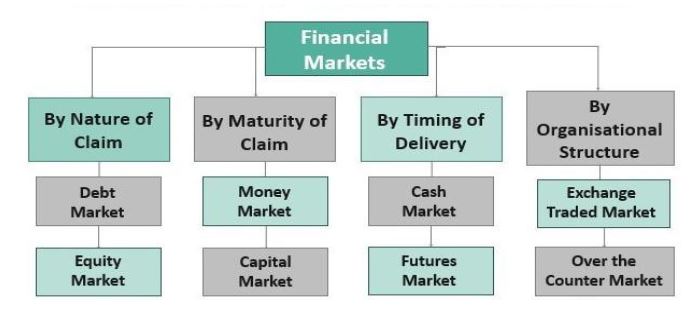
Source: Adapted from Saunders & Cornett (2019), Financial Markets and Institutions.
Despite more than seven decades of the development of Pakistan’s capital markets, the existing literature on capital market of Pakistan is fragmented and mostly focused on isolated aspects such as volatility, market efficiency, macroeconomic linkages, investor behaviour, market anomalies etc. (for details see Zulqarnain & Shah, 2013; Attari & Safdar, 2013; Omar, et al, 2022; Rehman, 2013; Anjum, 2020). Likewise, literature covering Pakistan’s bond market (Uppal, 2024) largely investigates fiscal and institutional challenges instead of unfolding the overall evolution of the bond market in Pakistan. Consequently, an integrated approach is missing in literature that comprehensively explains the development of these markets (since 1947 till 2025), synthesises the accumulated empirical evidence across both stock and bond markets, and links these insights to contemporary national development priorities such as Uraan Pakistan. This gap limits a holistic understanding of the development of Pakistan’s capital markets and, consequently, its policy implications. The present study addresses this deficiency by providing a detailed review of the evolution of Pakistan’s capital markets and synthesising evidence from the existing empirical literature. Accordingly, the objective of this review is to fill this gap by giving an integrated understanding of Pakistan’s capital markets development and its policy implications. To achieve this purpose, the study pursues three research objectives:
- To document the historical evolution of Pakistan’s stock and bond markets from 1947 to 2025.
- To review and synthesise the existing literature on Pakistan’s capital markets to highlight key findings, achievements and research gap.
- To propose policy directions and strategic interventions for aligning capital market development with the objectives of Uraan Pakistan.
Section 2 of the paper discusses the historical evolution of Pakistan’s capital markets, while Section 3 provides the methodology of this review, and Section 4 gives literature review covering over several decades of empirical research to examine the factors influencing capital markets’ performance. Section 5 establishes the linkage between Pakistan’s capital markets and the vision of Uraan Pakistan. Finally, Section 6 provides conclusion and key recommendations.
2. HISTORICAL EVOLUTION OF PAKISTAN’S CAPITAL MARKET
A comprehensive overview related to historical performance assessment of stock market and bond market is provided in this section.
2.1. Stock Market Evolution
The Stock market is a financial market used by publicly traded companies to raise capital while it is used by investors to earn returns (i.e. capital gain and dividend)[5]. Stocks are traded on stock exchanges or in OTC markets. In the primary stock market new issues of stocks are sold via IPO, subsequent trading of stocks occurs in the secondary market (where investors buy and sell already owned securities). The stock market mobilises available funds of both domestic and foreign investors across different segments of the economy. The stock market is known as the barometer[6] of the economy because it covers all industries from almost all segments of the economy. In addition, using stock market shareholders, business community, and prospective investors gain useful information.
The index of the stock market is basically a measurement of the value out of a section of the stock market and it is calculated using pricing information of the selected shares. This tool is used by investors in order to describe the stock market and for the purpose of comparison between various available investments e.g. the [7]KSE-100 index is a measurement of the value of 100 selected listed stocks on the Pakistan Stock Exchange.
KSE – 100 → KSE – 30 → KMI – 30 → KMI – All → KSE – All [8]
2.2. Major Stock Market Indices
The KSE-100 Index was introduced in 1991 with a base value of 1,000 points[9]. The index is composed of 100 companies. The selection of these 100 companies is based on their sectoral representation and the highest free-float Capitalisation, representing approximately 80 percent of the total free-float capitalisation of the listed companies.
The stock market of Pakistan has a fairly long history. The historical stock market progress is given in figure 2.
Fig. 2. Pakistan’s Stock Market Growth
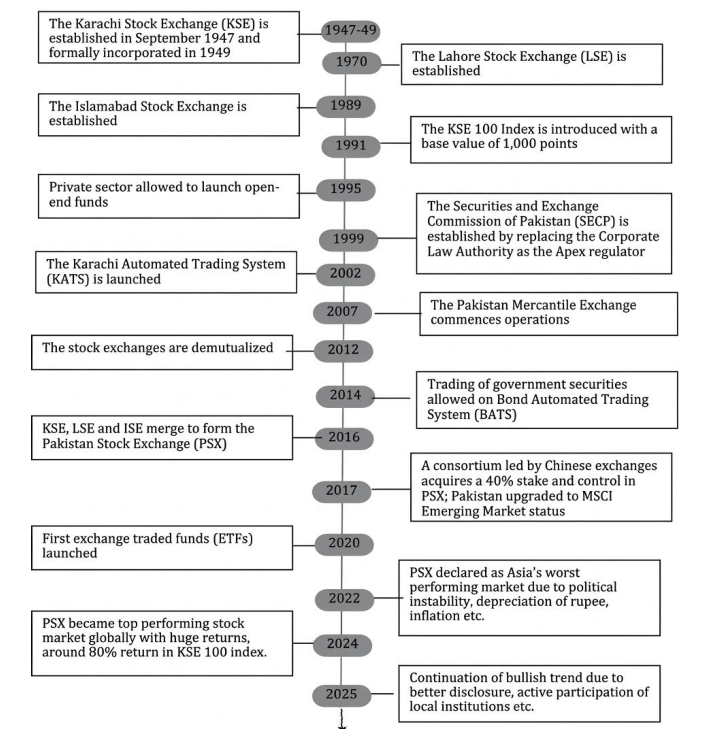
Source: Adapted from ICMA Pakistan (2025), CFA Institute Research Foundation (2021), and Pakistan Stock Exchange (PSX), with updates.
Over 75 years, Pakistan’s stock market has evolved from a small exchange with just five companies into a trillion-rupee marketplace showing gradual expansion. Paid up capital grew from just Rs. 0.04 billion to Rs. 1,727 billion in 2025 showing a massive rise in listed companies’ size and investor participation (See Table 1). Likewise, the rise in market capitalisation reflects the long term expansion of Pakistan’s equity market. Major jumps have been observed during the 1990s (responsible factors were liberalisation and privatisation). The post-2000 surge was due to reforms and foreign inflows while recent trend shows major reforms such as Roshan Digital Account (RDA) to include overseas Pakistanis, Sahulat account opening. Although the structural growth and capitalisation expanded enormously, the number of listed companies is still very low suggesting the strong need for new listings and deeper market reforms to improve investor confidence.
Table 1: Pakistan’s Stock Market Indicators (1947-2025)
| Dates | No of Listed Co. | Paid up Capital/
Listed Capital (Rs. in Billion) |
Market Capitalisation (PKR Billion) |
| September 1947 | Karachi Stock Exchange Came into Existence | ||
| 1949 | 5 | 0.04 | n.a. |
| 1950 | 15 | 0.12 | n.a. |
| 1960 | 81 | 1.00 | 1.87 |
| 1970 | 291 | 4 | 9.65 |
| 1980 | 314 | 8 | 9.77 |
| 1990 | 487 | 28 | 53.71 |
| 1997 | 781 | 209 | 465 |
| 2000 | 762 | 229 | 391.9 |
| 2010 | 651 | 815 | 2732 |
| 2020 | 531 | 1421 | 8035 |
| 2021 | 533 | 1485 | 8,297.3 |
| 2022 | 531 | 1553 | 6,500.8 |
| 2023 | 524 | 1665 | 9,062.9 |
| 2024 | 525 | 1716 | 14,496 |
| 2025 | 527 | 1727 | 13,996 |
Source: PSX
The KSE-100 Index broke all previous records by surpassing 150,000 points in 2025, delivering annual returns of over 80 percent. (Figure 3). This remarkable increase is due to strong macroeconomic indicators (i.e. lower interest rate and inflation), six new listings (three in main board and three in GEM board) were recorded and the lower price to earnings ratio compared with regional countries offer higher returns for long term investors. Moreover, the budget 2025 had also a positive impact on PSX due to no changes in capital gain and dividend taxes, while withholding tax on interest income from fixed deposits and savings increased by 5 percentage points. Finally, around 60,000 new investors registered during 2025 and daily average trading volume crossed 827 million shares per day. The remarkable performance has been observed in oil & gas, banking, cement, fertiliser while textile and engineering showed low performance (See Figure 3).
Fig. 3. KSE-100 Index Trend: 2015 – 2025
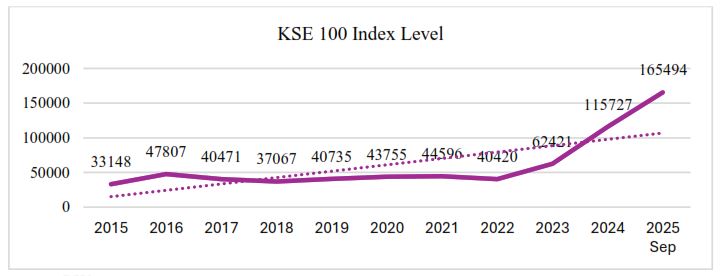
Source: PSX
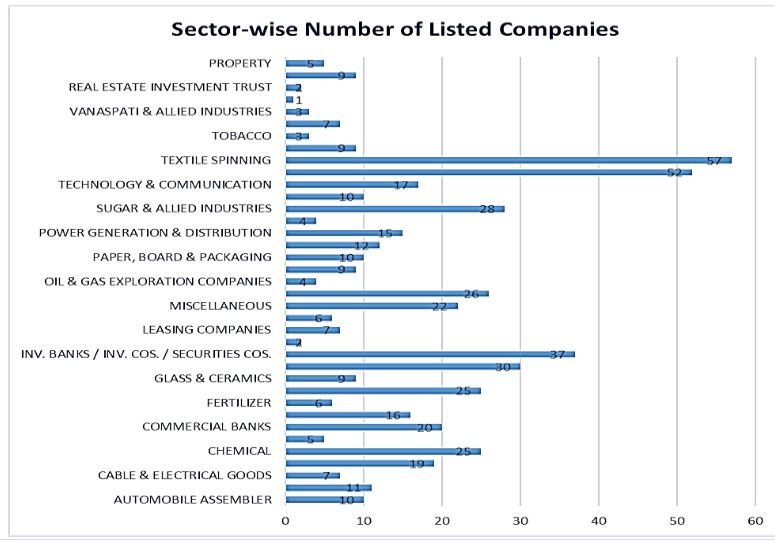
However, the equity market of Pakistan is still dominated by traditional industries like textiles and manufacturing, while sectors like technology and financial sectors are emerging as strong new sectors. Because diversification is limited, therefore a few sectors account for the majority of listed companies, thus highlighting the scope for broadening the capital market participation of underrepresented industries such as agricultural processing, real estate and services (See Figure 4).
Fig. 4. Listed Companies of PSX
Source: PSX as of October 2025
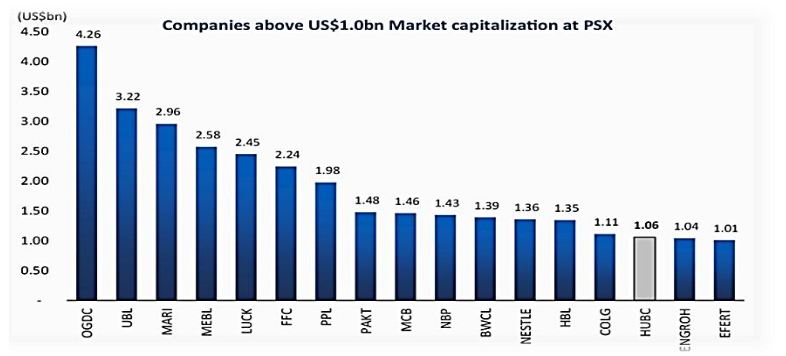
As shown in Figure 5, most of the market value in Pakistan’s stock market is concentrated among energy, banking, and fertiliser sectors. Oil & Gas Development Company (OGDCL) leads with the highest market capitalisation of USD 4.26 billion followed by UBL and MARI Petroleum, while other major players include Meezan Bank (MEBL), Lucky Cement (LUCK), and Fauji Fertiliser (FFC) each exceeding USD 2 billion (See Figure 5).
Fig. 5. PSX Market Capitalisation of Largest Companies
Source: PSX as of September 2025
The Stock Market is supposed to be the gauge of the economic and political health of an economy that discounts every material information to the pricing of securities. As shown in the Fig 6, from 2000 till 2024 the stock market remained resistant to external shocks during most of the years. Also, it outperformed any other parallel market/asset in terms of returns i.e. real estate and savings accounts (for details see also Figure 9).