
Executive Summary
With 20% of global trade under consistent risk through Hormuz, Pakistan is already receiving diverted cargo but lacks policy readiness to retain it. Turning geography into destiny needs timely alignment of reforms to make the ports competitive.
Pakistan is strategically located at the intersection of Middle East, South Asia, and Central Asia. Recent disruption in supply chains following regional conflict has created a strategic window for Pakistan to realign its ports located outside but in closest proximity of the conflict zone as alternate to major transshipment hubs of Gulf. This is a rare opportunity for transforming the short-term gains into long-term revenue generation and sustained growth of the economy. Pakistan has a favorable strategic position and cost-effective port labor. It has great potential to transform its ports into transcontinental trade hubs. In this context, a critical evaluation of Jebel Ali port, Dubai and Salalah port, Oman is performed to identify key gaps in policy structure for ports. This brief highlight that despite of strategic position and cost effectiveness Pakistan lacks a broad policy approach that must focus cost rationalization, infrastructure development, automation, integration of free zones, skill development, connectivity and security enhancement. Ultimately, it is identified that Pakistan can convert the temporary, conflict-driven shift into durable gains only by means of coherent policy measures aligned with global best practices.
1 .Introduction
Global marine trade has undergone substantial changes following the recurrent geopolitical and regional tensions such as the ongoing Gulf conflict. This evolving situation raises serious apprehensions about the security risks of conventional marine paths, stressing the need for restructuring the shipping routes and exploring alternate ports. It also highlights the importance of utilizing the potential of adjacent locations outside the conflict region. In this backdrop ports now are not only transit outlets but operate as a broad ecosystem that integrates trade flow, economic competitiveness and industrial growth.
The maritime geography of Pakistan places it in a unique position of considerable geostrategic value. Its coastline runs along the Arabian Sea in proximity to the strait of Hormuz, one of the most crucial choke points of global supply chains. A sizeable proportion, approximately one fifth of the global energy and commercial shipping flows through this route[1]. Frequent escalation of tension in the Gulf region always disrupts marine transportation in this corridor and compels prioritizing reliable and cost-effective alternates. In this context, the ports of Pakistan have gained substantial strategic relevance. Given their immediate location outside the conflict zone while remaining sufficiently close to Gulf ports they serve as risk-free replacements for major transshipping hubs. The shift in regional dynamics has paved way for Pakistan to capitalize the conflict and emerge as a major logistics hub. This prospect also augments country’s development plan for Gwadar port in China Pakistan Economic Corridor (CPEC) project. However, Pakistan can benefit from shifting global supply chains only if its ports function as risk free key nodes in marine networks and maintain the operational standards as per international benchmarks.
This brief discusses the capacity and operational dynamics of the Pakistan’s ports in the context of varying transshipping activities during clash in the Gulf region. It utilizes the development model of Jebel Ali Port, Dubai and Salalah Port, Oman to emulate the international standards and evaluate the performance gaps. It also highlights the measures that must be adopted to convert the fleeting gains into lasting and sustained transformation.
2. Dynamics of Pakistan’s Ports During Conflict
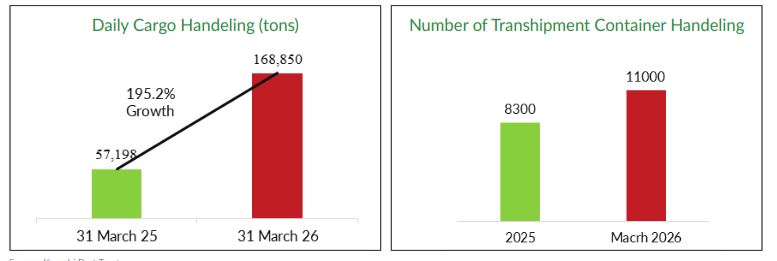
Pakistan’s port infrastructure is composed of three main ports Karachi Port, Port Qasim, and Gwadar Port. Each of those is characterized by distinct operational features. Karachi port is country’s oldest and one the South Asia’s busiest deep seaport. It has three terminals with multiple berths to handle containerized cargo and three oil piers to handle liquid cargo. In recent Gulf conflict this port has observed a substantial increase in shipping activities. Approximately 75% of the redirected cargo shipments are handled at Karachi port. The increase is also reflected in terms of container volumes at terminals. Karachi port has approximately 11,000 cargo containers from transshipping and about 133 vessel calls in the month of March. This volume is significantly higher than the total handling on the same port during whole previous year.
Figure1: Cargo and Transshipment handling at Karachi Port
Source: Karachi Port Trust
Shipping lines are increasingly offloading their cargo in Karachi port following the disruption of Dubai, Salalah and other ports in Gulf due to Hormuz closure by Iran on second March. This rerouting of the carriers is benefiting Karachi port in term of revenue through port various port charges and fee. However, the revenue gains are for temporary and may not be materialized in post war long term due to urban congestion and limited expansion capacity of the port.
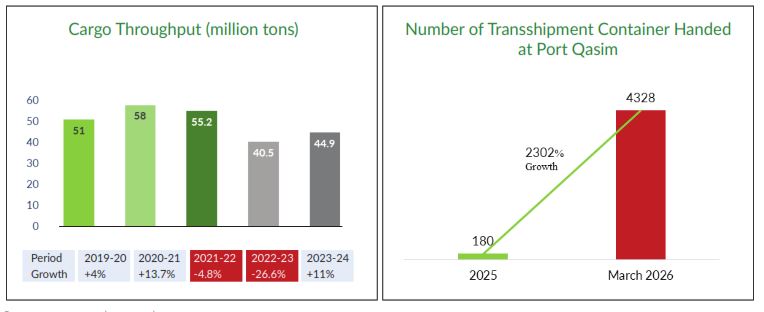
Port Qasim is attributed as country’s premium industrial port. It has a relatively modern infrastructure and plays a crucial role in country’s trade and economic growth and handles about 51% of total coastal trade. This port has significant potential for expansion. During March 2026, following the Hormuz conflict, it handled approximately 25% of the redirected cargo shipments in the region. The port has picked up with handling about 4000 TEUs including more than 900 cargo containers in a single day in the month of March. The overall transshipment growth has been approximately 2,302 percent this time.
Figure 2: Cargo Handling at Port Qasim
Source: www.pqa.gov.pk; www.arabnews.com
Port Qasim, despite having expansion capacity and updated infrastructure, faces few constraints in operational revival due to its upstream location.
Gwadar is a warm water, deep sea port located on the Arabian Sea touching the doorway of the key shipping routes of the Persian Gulf, just at the exit of the Strait of Hormuz. Given its proximity to established shipping routes and deep sea capacity it offers a substantial long-term potential to Pakistan. Gwadar basically is a transshipment port yet has potential to function as transit port for land lock countries like Afghanistan and Central African Countries (CAR). During the Gulf conflict this port has marked its entry to the regional transshipment network by berthing a vessel. The shipping volumes are still building up in the port that indicates its strong potential as a major transshipment hub for Pakistan.
Regardless all the strategic advantages, utilization of the ports in Pakistan has remained below average. It indicates that ports mainly suffer from institutional barriers, inefficiencies, lack of coherence, limited connectivity with hinterland that compels adoption of broad reforms structure.
3. Comparative Evaluation of Port Models
In recent past, Dubai port has emerged as one of the main coastal hubs given the success of Jebel Ali port. The port is among top ten busy ports of the world, famous for its huge shipping capacity, modern operations, uninterrupted logistics, easier connectivity and multidimensional free zones. Likewise, Salalah port, Oman is a major transshipping hub offering a cost effective and stress-free alternate to congested routes like Strait of Hormuz. Since ports in Pakistan are operating less than their capacity and are overall underperforming, identifying functional lags by evaluating the successful port models is of critical importance. Following table presents a comparative picture of Pakistan’s ports with Dubai and Oman ports in terms of physical infrastructure, capacity, service efficiency, and connectivity.
Table 1: Comparative Evaluation of Port Infrastructure
| Indicators | Karachi Port, Port Qasim, Gwadar Port, Pakistan | Jebel Ali Port, Dubai | Salalah Port, Oman |
| Capacity & Scale | |||
| Berths | Karachi 33, Port Qasim 15 | 100+ | 20+ |
| Draught Depth (m) | Karachi 12-13, Port Qaim 12-13, Gwadar 14.5+ | 15-17 | 16-18 |
| Throughput & Utilization | |||
| Berth Occupancy Ratio (BOR) | Karachi 45-50%, Port Qasim 43-67% | 65-75% | 60-70% |
| Total Capacity in TEUs[2]) | Karachi 12.5, Port Qasim up to 7, Gwadar 400 potential | 19.4 | 5 |
| TEUs/year | Karachi 2.65 million, Port Qasim 1 million | 15.5 million | 4.3 million |
| Seaport Service Efficiency | |||
| Cargo Volume | Karachi: high; Port Qasim: High, Gwadar: Low | Extremely high | High |
| Number of Ship-to-Shore (STS) cranes | Karachi 6, Port Qasim 5, Gwadar 5 | 29 | 27 |
| Turnaround Time | Inconsistent reporting | 24-36 hours | 10-20 hours |
| Accessibility and Connectivity | |||
| Port Liner Ship Connectivity Index (PLSCI) (2026Q1) | Karachi 310, Port Qasim 131 | 775 | 236 |
| Strategic Positioning | Arabian Sea, near Strait of Hormuz but outside direct conflict zone | Inside Gulf, dependent on Strait of Hormuz access | Arabian Sea, directly on main East-West shipping route |
| Port Gate Facilities | Partially digital and fragmented | Fully automated 24/7 operation | Fully automated 24/7 operations |
| Hinterland Connections | Weak transportation network especially with Gwadar | Advance multi modal connectivity with air, and roads | Limited domestic connectivity, advanced marine connectivity |
Source: Author’s Compilation based on UNCTAD and Ministry of Maritime Affairs Pakistan data
From this comparison it is evident that Pakistan’s ports despite their potential are operating far below the status of transshipping hubs in the global networks. They have limited physical infrastructure, underutilized their capacity, and provided less efficient port services. For instance, the BOR in Karachi and Port Qasim are below global optimal of 50-70% BOR. The PLSCI of these ports also reveals their less connectivity to global container shipping networks. Similarly, the seaport service efficiency is among lowest in the world ports. The number of STS cranes that enhance the port throughput has remained only 5 to 6 per port till date. Besides these, the turnaround time of vessels is inconsistent with weak transportation and hinterland connectivity of Pakistan’s ports.
These distinctions among the port models fundamentally exist in their structure. For instance, Dubai port’s success is rooted not just in operational capacity but on its integrated approach to reduce transaction costs and enhance the throughput efficiency from its broad ecosystem of free zones, industrial clusters and logistics parks. Salalah, with limited capacity, demonstrates the significance of the geostrategic positioning on the main shipping corridors. It has achieved functional efficiency by emerging as a transshipment hub without enforcing diversion from primary marine routes. In contrast, ports in Pakistan operate as independent shipping nodes and limited inland integration to the economic systems.
Competitive costs always remain a decisive factor in port choice of shipping lines. Pakistan has advantage in lower labor cost and risk premium however these do not effectively translate into port services efficiency due to higher port charges, limited infrastructures, and procedural delays. In addition, the labor in Pakistan is unskilled or semi-skilled that needs to be more skilled and productive as per Dubai port’s model. Suboptimal capacity utilization is another major obstacle for Pakistan’s port efficiency as compared to other ports. Similarly, lack of automation and technology adoption, limited inland and marine connectivity are some of the issues that need immediate consideration in policy framework.
The Container Ports Performance Index (CPPI) of ports is another critical point for global stakeholders and development of ports as sustainable nodes. In this context, performance of Karachi port is quite fluctuating. Whereas, port Qasim has shown a gradual improvement over time. In comparison, Salalah and Jebel Ali ports show an overall high value of CPPI. This indicates that maritime trade efficiency and vessel time in ports need improvement on priority basis in Pakistan.
[1] https://unctad.org/
[2] TEU: Twenty-foot Equivalent Unit