Key Takeaways
- Among HIES households identified as likely protected-category consumers, only about 1 in 3 have all the characteristics used here as proxies for independent online registration; about 65 percent lack at least one of them.
- Around 45 percent of protected-proxy households lack a smartphone or tablet to scan the QR code; among those with a device, about 36 percent do not meet the education proxy used in this analysis for English-language understanding and digital literacy, a compulsion for filling the online registration form.
- The selected registration prerequisites indicate greater potential barriers for poorer households: the share of households in the bottom 40 percent of the per-capita income distribution falls from 47.5 percent among protected-proxy households to 30.3 percent among those meeting the selected proxies for independent registration. Barriers are also highest in Punjab and rural areas (about 69 percent).
- The one-time registration has no evident mechanism for updating records when occupants change, a risk particularly higher for the 17.7 percent grid-connected households occupied by non-owners.
- Consumers are exposed to a cliff-edge penalty: a single month above 200 units locks a consumer out of the protected category for six billing cycles, regardless of consumption in the following months.
- The government has not yet adopted a widespread communication strategy on the upcoming change in subsidy provision for protected consumers.
- A shift toward household welfare-based targeting, supported by integration of electricity-user records with existing household data and periodic updating, would reduce both inclusion and exclusion errors.
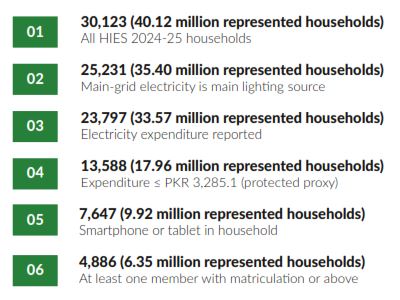
Households’ Sample Flow
Introduction
For low-income households in Pakistan, electricity bills constitute a disproportionately high share of income making them acutely vulnerable to tariff hikes needed to address fiscal and circular debt pressures. Since subsidy relief is currently tied to consumption rather than income, a considerable share of subsidy spending may reach non-poor households, leaving less fiscal space to cushion the energy burden on those who are genuinely price-vulnerable. To counter this, the Government of Pakistan plans to substitute its untargeted electricity subsidy with a targeted subsidy to provide relief primarily to low-income households.
In July 2022, the tariff schedule for non-Time-of-Use residential electricity consumers was revised through S.R.O. 1166(I)/2022 dated 25 July 2022.[1] The revision raised the lifeline consumer limit to 100 units per month and created a new category of protected consumers. This category covers residential consumers whose consumption has not exceeded 200 units in any of the preceding six months.
Resultantly, these consumers were charged a subsidized tariff as long as the monthly usage remains up to 200 units of electricity. While this extended relief with regards to electricity expenditure to a much larger proportion of the residential consumers, it also increased the burden on an already fiscally constrained government, as the subsidy to residential consumers has increased from PKR 199 billion in FY22 to PKR 423 billion in FY26 (Ministry of Energy, 2026)[2]. These costs add to pressure on a power sector that also carries a large stock of circular debt, which fell sharply in FY25 as a result of bulk repayment but rose again in FY26 (Figure 1; fiscal years run July–June) representing ongoing high accumulation of circular debt.
The two are related but distinct. Circular debt is the stock of unpaid obligations across the power supply chain and has several drivers: distribution losses, under-recovery of bills, delayed release of budgeted subsidies, gaps between notified tariffs and the cost of supply, and capacity payments. In FY26, for example, the Power Division attributed PKR 262 billion of additions to DISCO inefficiencies, PKR 64 billion to under-recovery and PKR 194 billion to non-payment by K-Electric.[3] Untargeted residential subsidies are therefore one fiscal pressure among several and not the primary cause of circular debt. The concern this viewpoint raises is whether they are well targeted.
Figure 1: Power Sector Circular Debt (PKR Trillion)
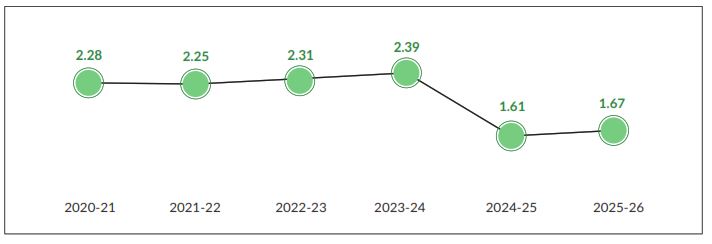
Source: NEPRA State of Industry Report 2025 (FY21–FY25) & Power Division data reported in The News, 18 August 2026 (FY26)[4][5]
Moreover, multilateral donor agencies have also identified tariff-based subsidies as a major source of inefficiencies and fiscal imbalance within the power sector, pushing Pakistan to eliminate these subsidies. World Bank (2024)[6] emphasizes that the subsidy mode adopted by the government is not fulfilling its intended objective as consumption-based tariff subsidies though create huge fiscal costs, but the maximum benefit is not attained by those most deserving. The Staff Level Agreement (SLA) between Pakistan and the International Monetary Fund (IMF) following the third review of 37-month Extended Fund Facility (EFF) and second review of 28-month Resilience and Sustainability Facility (RSF) for Pakistan included achieving energy sector viability as a policy priority for the upcoming months.
The SLA has emphasized timely tariff adjustments to ensure cost recovery while stressing upon the need to avoid price subsidies on energy tariffs as they have high fiscal costs with distortionary impacts (IMF, 2026)[7]. Consequently, the Government of Pakistan has initiated a cross-subsidy verification process to determine eligibility of households for receiving the subsidized electricity tariff. The verification process which requires households to register themselves on an online portal was announced not via a government notification or any major awareness campaign but through information printed on the consumer electricity bills (Figure 2). It is imperative to understand that the registration process is based on three related but distinct arrangements:
- Protected-consumer status is a tariff category: A residential non-ToU consumer whose consumption has not exceeded 200 units in any of the preceding six months is billed at protected slab rates.
- The lower tariffs paid by protected and lifeline consumers are financed through two channels: the federal tariff differential subsidy and cross-subsidies from other consumer categories.
- As a reform measure under the IMF Resilience and Sustainability Facility (RSF), the Government of Pakistan has committed to replace the existing structure with a targeted framework for low-income consumers by January 2027, linked to Benazir Income Support Programme (BISP) National Socio-Economic Registry.[8]
The QR-code based portal access and registration mechanism analyzed in this viewpoint links the second and third arrangements. From May 2026 onwards, bills of consumers receiving subsidized tariffs carry a QR code. This viewpoint therefore evaluates an operational data-verification requirement that precedes a planned targeted subsidy, not the final eligibility rules. The question is whether the design of this initiative itself may exclude the households the reform intends to protect (Figure 2).
At the time of this revision (1 October 2026), the official documents available for this viewpoint does not confirm DISCO-level coverage, including the position of K-Electric, a registration deadline, or a formal subsidy-suspension rule. The bill shown in Figure 2 indicates that the subsidy may be suspended, but does not establish a uniform national rule. The analysis should therefore be read within this administrative limitation.
Figure 2: Subsidy Verification QR Code
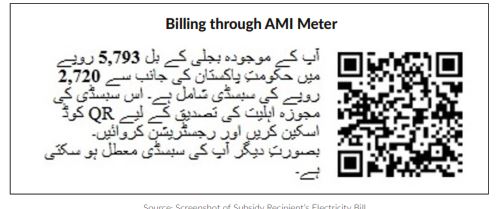
Source: Screenshot of Subsidy Recipient’s Electricity Bill
While the initiative by the government to identify deserving households for tariff subsidy is a much-needed step, this policy viewpoint examines whether the verification process itself creates registration barriers for households in lower socio-economic strata. The policy concern is two-sided: potential exclusion error when vulnerable households face difficulty completing verification, and inclusion error when higher-income households qualify because low electricity consumption is used as a proxy for need. International examples are then used to identify alternative policy options.
Current Verification Mechanism
The data verification mechanism introduced by the Government of Pakistan for subsidy eligibility among residential consumers is a four-step process as explained below.
Figure 3: Targeted Electricity Subsidy Verification Mechanism

* The owner details are automatically captured from the DISCO data.
Source: Power Information Technology Company
Figure 4: Subsidy Verification Portal
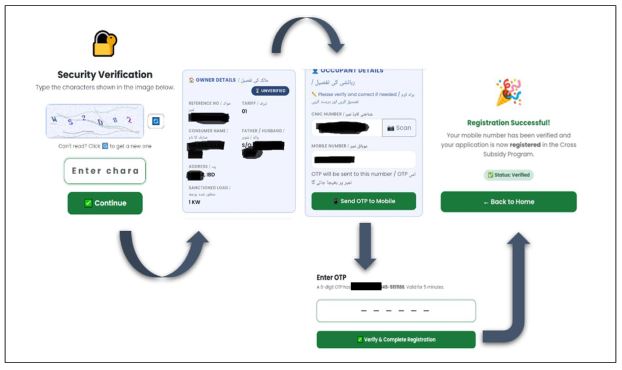
Source: Cross Subsidy Program Registration Portal
Once the OTP is entered, then the registration confirmation message is displayed after which the data will be verified to determine subsidy eligibility of the household.
Verification Design and the Risk of Excluding Eligible Households
Based on the aforementioned mechanism, a household is likely to need the following five characteristics (Figure 5) to complete the registration process independently:
Figure 5: Household Prerequisites for Subsidy
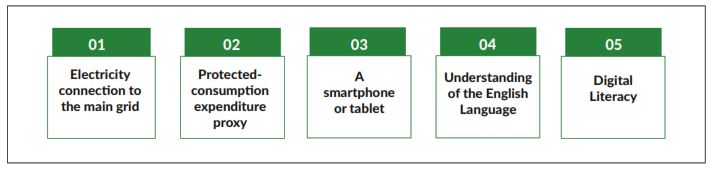
Note: HIES identifies electricity expenditure, device ownership and education proxies; it does not directly observe protected tariff status, English-language proficiency, digital literacy or successful registration.
Source: Based on Authors’ Analysis
To evaluate how many households meet these five conditions, the analysis uses the latest Household Integrated Economic Survey (HIES 2024-25) data. All percentages are weighted using HIES household sampling weights and account for the survey’s stratified, clustered design (158 strata and 2,153 primary sampling units). They are therefore estimates for all households in Pakistan’s four provinces and Islamabad, and 95 percent confidence intervals are reported in each table. Household counts are unweighted sample sizes.
Two variables have missing values. First, 1,434 main-grid households (5.2 percent) did not report electricity expenditure. These households are also less likely to meet the registration prerequisites. Fewer own a smartphone or tablet (50.2 vs 66.9 percent) or have a member with matriculation (38.8 vs 60.2 percent).
Second, 8.0 percent of households did not report income. These households are excluded from the income-quintile tables only. The share is similar among protected-proxy households (8.2 percent) and the final group (6.3 percent). However, missing income is concentrated in Khyber Pakhtunkhwa, which accounts for 38 percent of households without income data but only 13 percent of those reporting it. The quintile tables should be read with this in mind.
Of the 30,123 households, 27,752 reported income and are classified into quintiles (Table 1). Income quintiles are based on per-capita household income and are weighted. Each quintile contains one-fifth of households nationally.