Exploring the Untapped Potential of the Dairy Sector to Enhance Exports
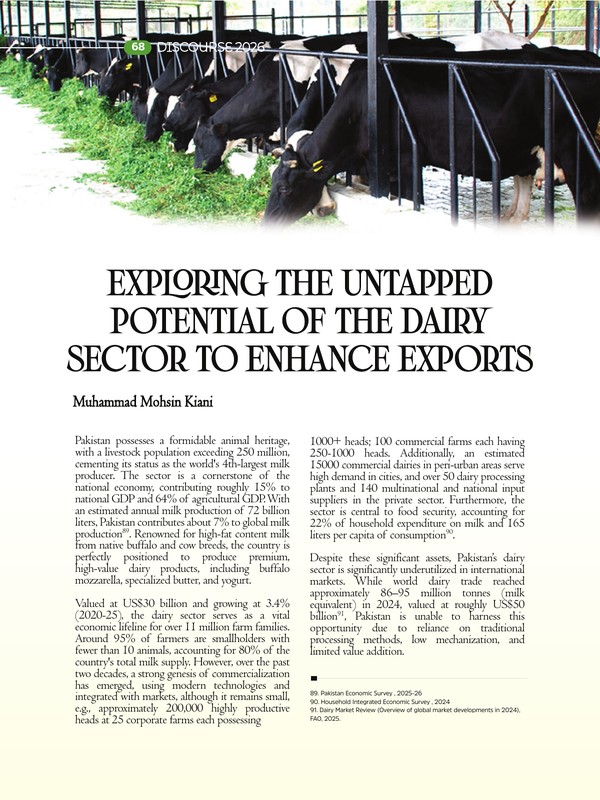
Pakistan possesses a formidable animal heritage, with a livestock population exceeding 250 million, cementing its status as the world’s 4th-largest milk producer. The sector is a cornerstone of the national economy, contributing roughly 15% to national GDP and 64% of agricultural GDP. With an estimated annual milk production of 72 billion liters, Pakistan contributes about 7% to global milk production[1]. Renowned for high-fat content milk from native buffalo and cow breeds, the country is perfectly positioned to produce premium, high-value dairy products, including buffalo mozzarella, specialized butter, and yogurt.
Valued at US$30 billion and growing at 3.4% (2020-25), the dairy sector serves as a vital economic lifeline for over 11 million farm families. Around 95% of farmers are smallholders with fewer than 10 animals, accounting for 80% of the country’s total milk supply. However, over the past two decades, a strong genesis of commercialization has emerged, using modern technologies and integrated with markets, although it remains small, e.g., approximately 200,000 highly productive heads at 25 corporate farms each possessing 1000+ heads; 100 commercial farms each having 250-1000 heads. Additionally, an estimated 15000 commercial dairies in peri-urban areas serve high demand in cities, and over 50 dairy processing plants and 140 multinational and national input suppliers in the private sector. Furthermore, the sector is central to food security, accounting for 22% of household expenditure on milk and 165 liters per capita of consumption[2].
Despite these significant assets, Pakistan’s dairy sector is significantly underutilized in international markets. While world dairy trade reached approximately 86–95 million tonnes (milk equivalent) in 2024, valued at roughly US$50 billion[3], Pakistan is unable to harness this opportunity due to reliance on traditional processing methods, low mechanization, and limited value addition. Consequently, instead of acting as a global dairy powerhouse, Pakistan’s dairy sector has faced challenges, with recent data indicating a trade deficit approaching US$37 million in 2024[4]. To unlock its vast potential and transition from a subsistence-based industry to an export-oriented sector, Pakistan must adopt a multi-pronged strategy on technology and reforms to boost its export revenue, uplift rural livelihoods, and transform the trade deficit into a substantial trade surplus.
Pakistan is uniquely positioned to access substantial dairy markets in its neighborhood, which imports billions in dairy products; it includes China which is a massive market with over $12 billion in annual dairy imports; Middle East & GCC Including Saudi Arabia ($2.54 billion) and other GCC countries ($11.05 billion) and regional markets; Malaysia ($1.5 billion), Indonesia ($1.8 billion), and Central Asian Republic States ($4.2 billion)[5].
Pakistan has a significant advantage in value-added products that match international demand. It includes high-fat products: ghee, butter, and cheese, targeting China, Asia, and Africa, worth US$13.12B[6] market, whey & by-products targeting global fitness and nutrition markets globally worth US$22.6B, and specialty camel and goat milk products tailored for health-conscious consumers in the GCC markets[7].
Amid these opportunities, the dairy sector in Pakistan has a strong appetite for public and private sector investment. Analysis of the dairy sector in many developing countries has suggested that the private sector usually makes these investments, although the public sector also plays a catalytic role. Pakistan can learn from Turkey and India to improve the productivity and competitiveness of the dairy sector by leveraging modern technology in milk production, processing, value addition, and marketing, and by creating an enabling regulatory and policy framework for private-sector investment.
The Uraan Pakistan initiative (National Economic Transformation Plan 2024–29) has identified the dairy sector as a pivotal subsector for transforming Pakistan’s agriculture-based economy, aiming to turn it into a competitive, export-oriented industry. The vision is for Pakistan to transition from high production to high-value, export-oriented processing. The target is to generate a formal exportable surplus by boosting farm-level productivity, reducing supply chain losses, formalizing the supply chain to meet international safety standards, and achieving US$500M in exports by 2029, scaling up to US$2B by 2035.
To accelerate the development of the dairy sector, enhance productivity and achieve these export targets through private investment, the following comprehensive policy interventions are proposed, focused on policy reforms, institutional strengthening, and technological solutions.
In terms of policy reforms, implement comprehensive deregulation of milk markets to create an enabling, fair, and business-friendly environment for farmers and investors. At the same time, strictly enforce quality and safety standards to curb adulteration. Furthermore, abolish import duties and cap taxes on critical technologies, including modern machinery and genetic materials, at 5% or less to encourage mechanization. Consequently, reduce the General Sales Tax (GST) on value-added dairy products from 18% to 5% to boost processing, improve affordability, and formalize the sector. The government may simplify loan acquisition for small farmers by recognizing alternative forms of collateral, such as livestock. Additionally, stop the smuggling (illegal import) of milk powder into the country and offer special, cost-efficient carriage rates for the transportation of livestock to facilitate farmers. Concurrently, it may enact the National Animal Health, Welfare and Veterinary Public Health Act, 2026, and implement a national FMD (Foot and Mouth Disease) control, surveillance, and traceability system aligned with WOAH standards to unlock lucrative export markets.
Productivity enhancement is required by increasing the lactation yield of milking animals from 2000 liters to 4000 liters to achieve food security and create a surplus for exports. It may start by developing private-sector-led genomic technologies for screening breeding bulls and heifers, and by scaling up sexed-semen and embryo-transfer labs to improve the genetic potential of livestock breeds and ensure affordable access to these technologies for small-scale farmers.
Empowerment of dairy farmers may be the epicenter to the strategic planning through organizing smallholders into Farmer Entrepreneur Groups (FEGs) to centralize services, facilitate bulk purchasing of inputs and promote mechanization focused on; Silage, hay, and Total Mixed Ration (TMR) technology, Climate-smart housing and manure management systems, adoption of Calf Milk Replacer (CMR) to save calves and Cold chain logistics (chilling tanks) at the farm level. In addition, Incentivize FEGs to establish small-scale, mechanized rural processing units for value-added products like cheese, butter, and ghee, along with quality-testing labs, focusing on antimicrobial resistance (AMR) and toxic residues, and aligning standards with Codex.
Lastly, facilitate the dairy exporters through formally designate the dairy industry as a “priority product line” in the National Export Development Fund to unlock funding and facilitate strategic Business-to-Business (B2B) partnerships to target emerging markets in China, MENA (Middle East and North Africa), CARS (Central Asian Republic States), Russia, Indonesia, and Malaysia., Asian, African, and GCC requirements.
In conclusion, Pakistan’s dairy sector holds immense untapped potential for export-led growth, rural employment generation, and food security. A coordinated, public-private partnership approach—where all stakeholders in the dairy value chain are integrated with markets and backed by clear policies, targeted incentives, and robust infrastructure—can transform the dairy sector into a globally competitive sector that enhances farmers’ incomes, boosts exports, and ensures food security.
[1] Pakistan Economic Survey , 2025-26
[2] Household Integrated Economic Survey , 2024
[3] Dairy Market Review (Overview of global market developments in 2024), FAO, 2025.
[4] Pakistan Bureau of Statistics, 2024-25
[5] Dairy industry Sources, 2026
[6] FAO STAT, 2025-26
[7] Pakistan Agriculture and Food Export Vision, 2040, MNFSR