
Executive Summary
Pakistan’s electricity system is being reshaped by rooftop solar, falling grid sales, and increasingly unaffordable tariffs. The Integrated System Plan (ISP) 2025-35 proposed 600 MW/1,500 MWh of battery storage costing US$900-910 million. NEPRA approved the plan but excluded this package because system optimization had not established its cost and value. Batteries can shift solar generation, support frequency, relieve network constraints and protect industrial demand. Their value depends on location, operating conditions and alternatives. The proposed package primarily addresses frequency support and requires comparison with resources providing equivalent reliability. Consumer batteries also warrant assessment, subject to availability and controllability. The economic question is whether storage delivers greater lifetime net benefits than feasible alternatives. Financial returns, system savings and national economic benefits require separate assessment. Lower fuel use may not reduce contractual obligations or tariffs. Appraisal must include losses, degradation, replacement, financing, and end-of-life costs, avoid double counting, and compare avoided fuel imports with equipment imports and financing obligations. Storage decisions should integrate rooftop solar, grid planning, tariffs, CTBCM, contractual obligations, and industrial demand. Priorities are hourly and locational evidence, transparent appraisal, and competitive service pilots. Procurement should specify buyers, funding, performance, and risk allocation. The Power Division should coordinate this work, supported by system planners, DISCOs and CPPA-G, with NEPRA reviewing appraisals and tariff implications. Safety, recycling and funded decommissioning arrangements should be specified before procurement. Expansion should depend on independently verified performance, demonstrated net economic value and financial sustainability. These conditions would make storage investment responsive to Pakistan’s reliability, affordability and wider economic needs.
1. Introduction
Pakistan’s electricity consumers are rapidly becoming electricity producers. By March 2026, registered net-metering capacity had reached 7,319 megawatts (MW) and was included within Pakistan’s total installed generation capacity of 49,651 MW. Between July-March FY2025 and July-March FY2026, the household share of consumption fell from 49.6 percent to 47.5 percent, which the government attributes to tariff-driven shifts to alternative sources and conservation (Finance Division, 2026, pp. 244-245).
In February 2026, the National Electric Power Regulatory Authority (NEPRA) replaced net metering with net billing for new prosumers under the NEPRA (Prosumer) Regulations, 2026. Electricity a prosumer buys from its Distribution Company (DISCO) is billed at the applicable tariff, while exported electricity is credited at the national average energy purchase price (NEPRA, 2026c, Regulation 14). As this price covers only energy costs and excludes capacity payments (Yousuf, 2026), exported solar is worth less than the grid electricity it replaces, creating an incentive to consider storing surplus solar, subject to storage losses and lifetime costs.[1] Prosumers with contracts signed before 9 February 2026, however, keep the earlier net-metering terms until their agreements expire, subject to the amendment’s exception for material modification changing the facility’s maximum electrical output (NEPRA, 2026e).
If storing solar makes sense for a household, does it also make sense for the grid, and if so, where, how much and at what cost? The Integrated System Plan (ISP) 2025-35 proposed a phased Battery Energy Storage System (BESS) package of 600 MW of power capacity and 1,500 megawatt-hours (MWh) of storage (500 MW/1,200 MWh in 2025-29 and 100 MW/300 MWh after Chashma-5 nuclear plant integration), costing around US$910 million including a 30 percent allowance for installation, logistics and contingencies (NEPRA, 2026a, submitted IGCEP, Section 5.4 and Table 5-2).[2] MW measures the rate at which the battery can deliver power, while MWh measures the energy it can store. On average, the proposed package could discharge at full power for 2.5 hours. The submitted plan primarily sizes this package for fast frequency support during low-load conditions and major generation contingencies (NEPRA, 2026a, submitted IGCEP, Section 5.4). Its economic value should therefore be tested against alternatives delivering the same reliability service.
NEPRA approved the ISP but excluded the BESS package, highlighting that “its cost has not been incorporated in the generation optimization exercise” of the Independent System and Market Operator (ISMO) (NEPRA, 2026a, sec. E(xvii), pp. 28-29). This is not a verdict that storage lacks value; it is a refusal to commit consumer-funded or tariff-recoverable investment before its economic justification is established. For the BESS package to be reconsidered, NEPRA requires a comprehensive technical and economic analysis covering optimal sizing, duration, technology, siting, system-reliability needs, congestion management, costs and benefits, and the effect of consumer-level BESS.[3]
In September 2026, NEPRA made co-located BESS mandatory in the first wheeling auction: solar and wind projects qualify only if their BESS firm capacity is at least 10 percent of their renewable firm capacity. NEPRA called this a proportionate market-development and project-risk-management measure, treating mandatory co-location as a transitional arrangement. This requirement does not by itself establish the optimal size or location of storage, or a net saving for consumers. Higher project returns and lower system costs must be assessed separately (NEPRA, 2026b, paras. 5.3-5.7 and Annexure A).[4]
This Policy Viewpoint argues that Pakistan should procure battery storage for clearly defined services, with payment linked to verified performance. Pakistan’s policy gap is not the absence of battery proposals; it is the absence of an integrated framework linking storage with rooftop solar, locational grid needs, tariffs, CTBCM, fuel and capacity contracts, and industrial demand. Without this framework, investment may add costs without addressing the constraints that justify it. Its scope covers utility-scale and behind-the-meter BESS and the evidence required to establish their technical need, financial viability, and economic justification. As such, it does not prescribe a national storage target or select battery chemistry. Any decision regarding BESS would require reliable information on where solar and storage are connected, timing and length of grid flexibility needs, and what costs storage can actually avoid under current contracts and settlement rules. The evaluation should consider alternative options for providing the same service in terms of life-time cost and benefit, and separate the returns to the individual, the system and the national economy. The sections that follow examine the services batteries provide, the information such decisions require, the conditions under which savings reach consumers, and how procurement and performance verification can support transparent investment decisions.
2. Solar Has Moved Ahead of the Grid
Grid electricity sales have stopped growing. Retail sales by DISCOs and K-Electric Limited (KE) peaked at 124.6 terawatt-hours (TWh) in FY2022 before falling to 111.5 TWh in FY2025. Over the same years, NEPRA’s average sales price for the Central Power Purchasing Agency (Guarantee) Limited (CPPA-G) system almost doubled, from PKR 23.03 per kilowatt-hour (kWh) to PKR 44.15 per kWh between FY2022 and FY2024 (Figure 1) (NEPRA, 2022, 2023, 2024, 2025).[5] The rise in prices alongside lower sales after FY2022 does not establish causation because economic activity, electricity outages, extreme weather, and conservation all affect sales. Falling grid purchases also do not necessarily imply lower total electricity use where consumers increasingly generate their own electricity.
Figure 1: Retail Grid Sales and Average Sales Price in Pakistan
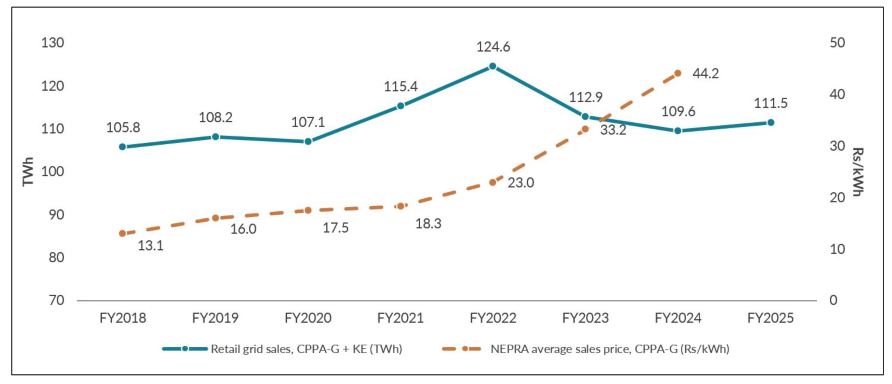
Source: Authors’ calculations based on NEPRA (2022, 2023, 2024, 2025). Sales cover FY2018-FY2025; the published price series covers FY2018-FY2024. The FY2025 CPPA-G price is reported as not published in Table 55 of the 2025 report and is therefore omitted from the price series.
More recent partial-year data, from the Pakistan Economic Survey 2025-26, indicate that electricity consumption increased by about 3.8 percent during July-March FY2026. However, this is not directly comparable with the full-year sales series presented in Figure 1. The disaggregated analysis reveals a more specific pattern (Figure 2). DISCO sales to agricultural consumers fell by about 47 percent between FY2022 and FY2025. Likewise, industrial sales dropped by 15 percent during the same period. Domestic sales fell by 6 percent from FY2022, although the last two fiscal years show a recovery; compared with FY2018, domestic sales were 6 percent higher in FY2025. Notably, commercial sales increased by around 13 percent between FY2018 and FY2025, despite a modest 3 percent increase since FY2022 (NEPRA, 2022, 2023, 2024, 2025). The government attributes the fall in agricultural consumption partly to changes in irrigation and a switch to solar alternatives (Finance Division, 2026, p. 245).[6]
As grid sales fall, capacity, network and administrative costs do not decline automatically. When largely fixed costs are recovered from fewer billed units, the cost per remaining unit rises. This can reinforce the incentive for households, farms and firms to invest in their own solar and batteries, while consumers unable to make that investment carry a larger share of the system’s costs. Storage policy therefore affects not only dispatch, but also the financial sustainability and distributional fairness of the grid.
Figure 2: DISCO Sales by Consumer Category
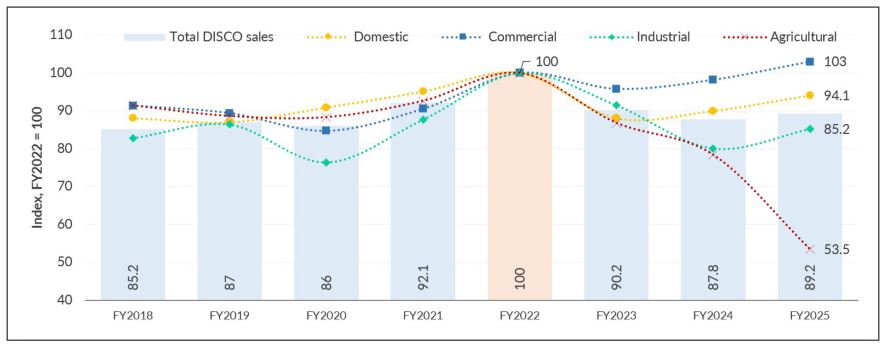
Source: Authors’ calculations based on NEPRA (2022, 2023, 2024, 2025). The index sets each category’s FY2022 sales equal to 100. FY2025 endpoints: total 89.2; domestic 94.1; commercial 103.0; industrial 85.2; agricultural 53.5. Calculation: each index equals annual category sales divided by that category’s FY2022 sales, multiplied by 100; values are rounded to one decimal place. The bars exclude KE.
The rapid expansion of rooftop solar must also be considered before storage investment decisions are made. NEPRA reported that registered net-metered capacity increased to 5,484 MW in FY2025 from 86 MW in FY2020. The number of DISCO net-metering consumers increased from roughly 38,000 in FY2022 to more than 350,000 in FY2025 (Figure 3) (NEPRA, 2020, 2021, 2022, 2023, 2024, 2025).[7] Registered net-metered capacity captures only part of Pakistan’s distributed solar deployment. Satellite-based estimates suggest that total capacity is substantially higher once systems outside the net-metering framework are included (TransitionZero & Policy Research Institute for Equitable Development, 2025).[8]
Figure 3: Registered Net-Metered Solar Capacity and DISCO Net-Metering Consumers
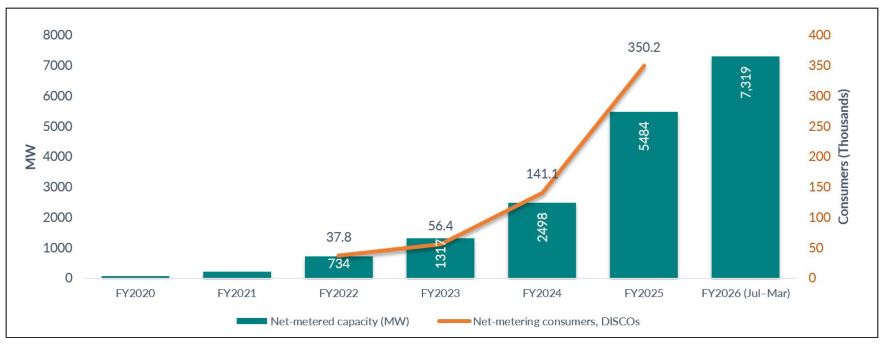
Source: Authors’ calculations based on NEPRA (2020, 2021, 2022, 2023, 2024, 2025) and Finance Division (2026). FY2026 capacity is the stock reported at the end of March 2026; the consumer-count series is available through FY2025.
In FY2025, domestic net-metering consumers exported approximately 316 GWh more electricity than they imported. In contrast, commercial and industrial prosumers remained net importers, purchasing approximately 297 GWh and 1,845 GWh more from the grid than they exported, respectively (Figure 4) (NEPRA, 2025, Section 5.10, pp. 83-85). [9] Since sunlight is a prerequisite for solar exports, annual net exports alone do not establish that a household can meet its demand at night or during cloudy periods without the grid. NEPRA’s annual aggregates do not show when electricity flows in each direction, although timing is critical for a storage decision.
Figure 4: Exports and Imports of DISCO Net-Metering Consumers by Category, FY2025 (GWh)
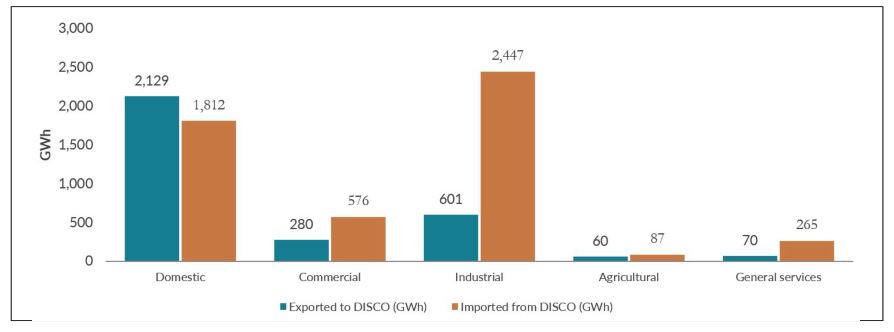
Source: Authors’ calculations based on NEPRA (2025).
3. What Batteries Can Do, and What They Cannot
The International Energy Agency (IEA, 2019) defines power system flexibility as the capacity to manage variations and uncertainty in electricity supply and demand reliably and cost-effectively across different timescales. Batteries are one of several sources of power-system flexibility; other options include grid reinforcement, demand-side management and more flexible operation of existing power plants. [10] Therefore, any storage proposal should be assessed against such alternatives, and its value evaluated by the service it is procured to provide (Table 1).
Table 1: Battery Services and Pre-Procurement Evidence
| Service | What the battery does | Evidence needed before procurement |
| Energy shifting | Stores low-cost electricity, such as midday solar, and releases it in higher-cost hours | Hourly costs and marginal generation; round-trip efficiency; degradation and cycling assumptions; which generation is displaced |
| Frequency response | Injects or absorbs power within seconds of a disturbance | Required response speed and duration; telemetry and performance tests |
| Capacity adequacy | Supplies output during hours of system stress | Timing and length of scarcity hours; usable energy, recharge opportunity and availability when called; contribution to reliable capacity |
| Congestion relief | Relieves an overloaded line or transformer at a specific location | Loading data for that node; cost of the network alternative |
| Backup and resilience | Supplies protected load during outages | Cause, frequency and duration of outages; protected load; usable duration and recharge; value of avoided interruption |
| Voltage and reactive-power support | Injects or absorbs reactive power to help keep local voltage within limits | Node-level voltage data; inverter capability; connection and grid-code requirements |
| Grid-forming and black-start capability | Establishes voltage and frequency or helps restart a defined part of the system | Restoration plan; system-strength study; testing protocol; protected charging source |
Source: Adapted from Bowen et al. (2019) and the International Renewable Energy Agency (IRENA, 2019).
The specification must follow the service. A battery sized for seconds of frequency response is not automatically suitable for several hours of evening energy shifting. Procurement should therefore state round-trip efficiency, usable state-of-charge range, expected cycles, degradation, augmentation, availability, response time, and the performance test against which payment will be made. Pending the availability of hourly dispatch and network data, the potential applications of BESS in Pakistan include locational congestion relief and network support, evening energy shifting, fast frequency response, industrial reliability and capacity adequacy. Their priority must be determined by service requirements, location, costs, and available alternatives. Where multiple services are combined, the appraisal must account for constraints on power, stored energy, and availability, while ensuring that overlapping benefits are not counted twice (Bowen et al., 2019).
A preliminary Pakistani planning example illustrates the difference a defined service can make. For Gwadar, the Power Division, along with the Private Power and Infrastructure Board (PPIB), carried out a preliminary sizing analysis to solarize 24 water-pumping stations and a desalination plant, proposing 9.7 MW of solar photovoltaic (PV) capacity coupled with 18.26 MWh of BESS, with estimated annual savings of PKR 987 million and an expected payback of 2.7 years (Finance Division, 2026, p. 247). These are preliminary estimates for the combined solar and battery configuration; they do not establish the battery’s incremental return.[11] By contrast, ISMO’s modelling for the wheeling auction revealed that the 10 percent co-located BESS requirement would reduce system-level curtailment by only 1.1 percentage points for solar and 0.3 percentage points for wind, with a negligible effect on marginal prices (NEPRA, 2026b, paras. 3.2-3.5 and 5.3).[12] Hence, the battery’s service, the site, and the load all must be known before it is sized. The latter results describe a particular modelled auction configuration, while the Gwadar estimates concern a specific combined project; neither can be generalized to all storage investment.
4. Information Before Investment
NEPRA’s requirements for a technical and economic study are, in effect, a list of missing information. Addressing these gaps requires data for the location and hour at which storage creates value (Table 2).
Table 2: Information a Storage Decision Requires
| Information | Question it answers | Main holder |
| Rooftop solar and consumer batteries by feeder and transformer | Where is daytime surplus created, and where are local limits close? | DISCOs; ISMO; NGC |
| Hourly demand and net load by DISCO and grid node | When does the evening ramp begin, and how steep is it? | DISCOs; ISMO |
| Dispatch, curtailment and ramping records | Which plants would a battery displace, and when? | ISMO |
| Network loading and constraints | Where could storage defer a line or transformer upgrade? | National Grid Company of Pakistan Limited (NGC); DISCOs |
| Contract terms and costs | Which costs are avoidable under existing contracts? | CPPA-G; Power Division |
| Tariff, contract and settlement rules | Will an avoided system cost become a cash saving and reach consumers or industrial buyers? | NEPRA; CPPA-G; ISMO; Power Division |
Source: Authors’ analysis. PPIB (2023) is used for the institutional succession of AEDB.
Rooftop solar must first be mapped by location, and DISCOs already hold part of this information. Under the NEPRA (Prosumer) Regulations 2026, DISCO must decline additional distributed generation once the capacity connected to a distribution transformer reaches 80 percent of its rating (NEPRA, 2026c, Regulation 3(5)). Since August 2026, DISCOs are allowed to approve systems of 25 kilowatts (kW) or below without obtaining NEPRA’s concurrence (NEPRA, 2026d).[13] A DISCO should therefore be able to map, transformer by transformer, the total rooftop solar capacity connected to it and how close that capacity is to the 80 percent limit.
The Prosumer Regulations govern distributed generation but do not establish a dedicated framework for registering and coordinating consumer batteries (NEPRA, 2026c, reg. 2(1)(ix) and Schedule I). Storage data are therefore also needed to assess the contribution of consumer-level BESS. NEPRA itself cautions that, given the potentially huge deployment of consumer-level BESS, the requirement for grid-level BESS may change materially and may even become redundant (NEPRA, 2026a, sec. E(xvii), pp. 28-29).[14] Unless behind-the-meter batteries are registered, neither their size nor their operation can be incorporated into the planning. Consumer storage can substitute for utility storage only where its location, operating schedule, availability and controllability meet the relevant service. Uncoordinated household backup capacity cannot automatically replace frequency response or network support.
The ISP considered three demand-growth scenarios and adopted the low-growth case as its reference, projecting peak demand to rise from 26,950 MW in 2025 to 35,521 MW by 2035 (NEPRA, 2026a, pp. 20-21). The Chairman’s additional note identified substantial differences among the demand projections submitted by ISMO, the DISCOs and CPPA-G, and recommended their reconciliation (NEPRA, 2026a, Additional note of the Chairman, p. 2). However, annual peak-demand projections alone are insufficient to assess storage requirements. The same report also cited ISMO’s estimate of a 12,000 MW decline in daytime demand, which is roughly equal to the combined output of must-run plants. (NEPRA, 2026a, Additional note of the Chairman, p. 1). Assessing storage needs therefore requires hourly load and dispatch data to identify periods of solar curtailment, the timing and magnitude of the evening ramp, and the generating plants available to meet it. ISMO also reported that these operational challenges were becoming more significant (NEPRA, 2026b, paras. 3.7 and 5.6).
NEPRA recorded its displeasure at ISMO’s disclaimer of responsibility for the accuracy, integrity, and completeness of the data used in the ISP. The note of the Member (Tariff and Finance) records that about 640 MW of KE renewable projects, competitively auctioned in late 2024, were left out of successive drafts of the plan despite NEPRA’s repeated queries; one was optimized only after ISMO re-ran it with corrected data (NEPRA, 2026a, sec. E(v) and Additional note of Member [Tariff and Finance]). NEPRA’s own State of Industry Report FY2025 also prints a domestic net-export figure of 199 GWh, while its export and import columns imply 316 GWh (NEPRA, 2025, sec. 5.10).[15] Thus, any storage decision based on flawed data would inherit its errors.
5. From Battery Operation to Tariffs and the Economy
A battery can lower consumers’ bills only when the avoidable system costs it displaces exceed its total additional costs and the resulting net savings are passed through to consumer tariffs. The chain has five links, and each must hold (Figure 5). The least certain links are whether a physical displacement becomes an avoidable cost and whether the avoided cost becomes an actual cash saving. This is the financial pathway. National economic appraisal must also recognize reliability and environmental benefits that do not immediately become cash savings, and distinguish them from transfers between consumers, utilities and government (Asian Development Bank [ADB], 2017).[16]