Industrial Policy at a Crossroads Why Pakistan: Must Shift from Protection to Comparative Advantage
Industrial Policy at a Crossroads
Pakistan’s industrial growth has consistently lagged behind that of other Asian economies, such as Vietnam, Bangladesh, and India. While these countries have expanded their manufacturing sectors, diversified their exports, and integrated into global value chains, Pakistan remains reliant on a narrow range of exports—primarily textiles—and imports most of its industrial inputs.
This situation is the result of several factors: economic policy decisions, underlying structural weaknesses, and investor behavior. The high cost of doing business, policy uncertainty, inefficient logistics, skill shortages, and a persistent preference for protection over competitiveness have collectively hindered industrial development.
Policy Instability and Macroeconomic Volatility
For industrial investment to flourish, stable and predictable policies are essential. However, Pakistan’s economic landscape is characterized by recurring balance-of-payments crises, frequent IMF stabilization programs, and abrupt policy shifts. Changes in tariffs, tax rates, and regulatory regimes create uncertainty, discouraging long-term capital investment. Manufacturing projects often require planning horizons of 10–20 years, but policy continuity rarely lasts more than a few years.
Macroeconomic volatility further complicates investment decisions. High inflation, sharp interest rate swings, and volatile exchange rates increase financial risk and make long-term industrial planning difficult.
Security Perceptions and Investment Risk
Although security conditions have improved compared to a decade ago, international investors still view Pakistan as a higher-risk destination than many competing economies. Political instability, geopolitical tensions, and regional security concerns affect investment decisions. Global manufacturers looking to diversify their supply chains often prefer countries like Vietnam, Indonesia, or India, where perceived risks are lower and policy continuity is stronger.
Much of FDI in Pakistan is market-seeking, reliant on reaping demographic dividend from the country’s large, rapidly urbanizing and young population. While this brings some technological advances, improves managerial skills, and raises governance standards, it adds very little to exports or the external account.
High Cost of Doing Business
Pakistan’s manufacturing sector faces structural cost disadvantages that undermine its competitiveness. Energy tariffs for industry are among the highest in the region, driven by capacity payments and inefficiencies in the power sector. Complex taxation—such as super tax, turnover taxes, and advance withholding taxes—increases costs and imposes a high tax burden on documented firms.
This results in a paradox where the most compliant businesses face the highest taxes, while informal operators remain outside the system.
Regulatory complexity also raises barriers to entry. Navigating permits, interacting with multiple agencies, and managing bureaucratic processes can delay investment and further increase costs.
Skills Deficit
The competitiveness of industry increasingly depends on skilled labour capable of operating modern technology and participating in global value chains. Pakistan’s education system produces few technically trained workers compared to Asian manufacturing leaders. Technical and vocational training is limited, resulting in shortages of skilled technicians, machinists, and engineers.
Countries that have successfully industrialized have invested heavily in skills development aligned with industry needs. Pakistan’s human-capital strategy has yet to make this transition, so the country remains focused on basic, low-value-added goods or relatively simple assembly sectors such as automobiles and cell phones.
Logistics and Infrastructure Constraints
Export competitiveness relies heavily on logistics efficiency. Pakistan’s logistics system remains underdeveloped in comparison to regional competitors. Rail freight has declined, making the country heavily dependent on road transport. Ports, railways, and inland transport networks lack integration, resulting in costly and slow movement of goods from production centers to ports. These inefficiencies raise export costs and reduce reliability for international buyers.
Protection and the Behavior of Domestic Industry
An often-overlooked constraint is the incentives facing the domestic industry. Many sectors have operated for decades behind high tariff walls and regulatory protection. Instead of promoting technological upgrading and global competitiveness, prolonged protection has led to industries dependent on state support.
The automobile sector illustrates this problem. Despite decades of tariff protection, Pakistan’s auto industry remains small and inward-looking, with insufficient production volumes and negligible exports. If tariffs were removed, domestic producers would struggle against imports produced on a larger scale elsewhere. Consequently, Pakistani consumers pay high prices for vehicles that lag behind international standards in technology and value.
A similar situation exists in parts of the polyester-based textile sector. Outdated technology and limited scale have reduced productivity, and tariff protection on inputs has increased production costs. Rather than encouraging modernization, protection has slowed technological upgrading.
The broader consequence is that consumers receive poorer value, industries remain insulated from the pressures that drive innovation, and exporters are denied competitive inputs.
Neglected Sectors with Comparative Advantage
While protection has sustained certain manufacturing sectors with limited global prospects, investment in areas where Pakistan possesses a genuine comparative advantage has been modest.
Agriculture is one of Pakistan’s strongest natural advantages, but investment in productivity, processing, and value addition is limited. Modern food processing, seed development, and agricultural technology could significantly expand export potential.
Mining is another underdeveloped sector. Pakistan has significant mineral resources, but limited investment in exploration, refining, and logistics has constrained its export contribution.
Tourism remains untapped despite Pakistan’s natural landscapes, historical heritage, and cultural diversity.
Similarly, services such as information technology, digital services, and business outsourcing are emerging sectors of comparative advantage. Pakistan’s young population and growing digital talent base offer significant potential, but these sectors still receive less policy attention than traditional manufacturing.
Trade Agreements and Export Capability
Pakistan’s trade agreements have generally benefited partner countries more than Pakistan itself. Bilateral agreements facilitate imports without generating equivalent export growth. Without improvements in competitiveness, trade liberalization can widen trade deficits rather than strengthen the domestic industry.
Dumping and Domestic Manufacturing
Dumping—imports sold below production cost or below domestic prices in the exporting country—can harm domestic manufacturers. Anti-dumping duties are important to ensure fair competition. However, not all low-priced imports constitute dumping; often, foreign producers are simply more efficient due to scale, technology, or supply-chain advantages. While protection against genuine dumping is justified, indefinitely shielding inefficient industries is not a substitute for productivity improvements.
A Strategic Shift Toward Comparative Advantage
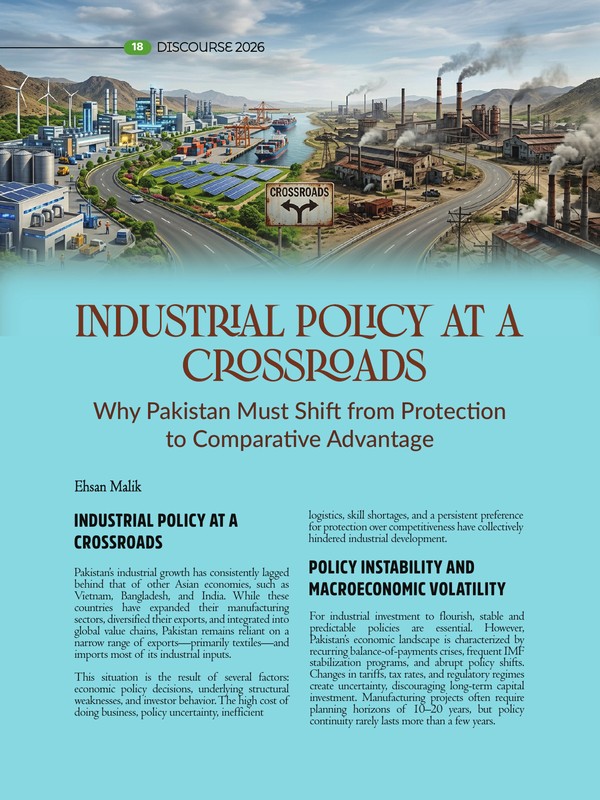
Pakistan’s industrial policy must move beyond the debate between protection and liberalization. The central question should be whether state support is helping industries achieve global competitiveness. Protection may be justified temporarily to allow sectors to build scale, upgrade technology, and integrate into global markets, but this is unlikely in sectors like automobiles and chemicals that lack upstream capability and scale.
When decades of protection fail to produce competitiveness, policy must change. Pakistan should focus resources on sectors with clear or emerging comparative advantages—agriculture and food processing, mining and minerals, tourism, IT and digital services, pharmaceuticals, and selected manufacturing niches.
Conclusion
Pakistan’s industrial challenge is not simply about tariffs or trade agreements; it stems from deeper structural issues—policy instability, high costs, weak logistics, limited skills, and an entrenched preference for protection.
A shift toward competitiveness and comparative advantage is essential. By directing investment toward sectors with genuine potential and reducing reliance on long-term protection, Pakistan can build a more dynamic, diversified, and export-oriented economy.
The choice is not between industry and markets, but between sustaining protected industries with limited prospects or building globally competitive sectors that can drive sustainable growth.
Ehsan Malik is a former Chief Executive Officer of Unilever Pakistan and of the Pakistan Business Council.