
Executive Summary
The possible gas supply via the Iran-Pakistan pipeline is still considered a strategically significant option. However, it cannot be considered under the same conditions as were present when the agreement was signed in 2009. The possible supply of 750 MMCFD of gas could provide an additional energy source, but its economics and absorptive capacity must first be demonstrated before further consideration.
The proposed pricing formula would mean that the Brent equivalent slope would be around 13.45 percent. At a Brent price of $75, this translates into $10.09 per MMBtu and the obligation to purchase almost $2.84 billion worth of gas on an annual basis. However, the key question is the total cost of delivery via pipeline (including all costs associated with construction, financing, operations, security, insurance, losses in the system, and exchange risk) versus the marginal/avoidable cost of currently used LNG supplies. Legal sanctions and supply risks remain unresolved. Iran has threatened arbitration with reported exposure of up to $18 billion, a figure that has not been independently verified or adjudicated.
The limited sanctions relief issued in June 2026 (OFAC General License X) was itself revoked and replaced by a wind-down license (General License X1) on July 7, 2026, underscoring that no authorization to date has established clearance for pipeline gas, construction, or project financing. The proposed way forward would be conditional revival, subject to independent legal and technical review, sanctions clearance, renegotiated commercial terms, verified demand, and milestone-based investment. Pakistan should consider negotiating a settlement and developing a solid defense against the threat of litigation, in case these steps are not taken in the next 12-18 months.
Key Numbers and Decision Facts
| CONTRACT & SCALE | PRICE & EXPOSURE | MARKET BENCHMARKS | RISK & DECISION |
| 750 MMCFD
Initial contracted supply |
13.4–13.45%
Illustrative Brent-equivalent slope; contract index to verify |
13.37%
Qatar 2016 Brent slope |
UP TO US$18 BN
Reported claim; not adjudicated |
| 1.05 BCFD
Expandable supply capacity |
US$10.1
Per MMBtu at US$75 oil |
10.2%
Qatar 2021 Brent slope |
750 MMCFD
Demand absorption to validate |
| 25 YEARS
Reported contract term |
US$2.84 BN
Indicative annual gas purchase |
12%
Illustrative negotiation reference |
90 DAYS
Initial appraisal window |
| 7.8 BCM
Approximate annual volume |
US$282 MN
Annual effect of US$1/MMBtu |
DELIVERED COST
Required final comparison test |
CONDITIONAL
Preferred revival pathway |
Notes: Annual estimates assume 750 MMCFD, approximately 1.03 MMBtu per Mcf, and full-year offtake. Contract terms, calorific value, and claim exposure require verification against the GSPA, amendments, and official legal records.
Sources: GSPA/ISGS/Petroleum Division (2019); Oxford Institute for Energy Studies (2026); OGRA (2026); QatarEnergy/PSO (2016, 2021) & authors’ calculations.
1. A Strategic Option Under New Constraints
Pakistan’s gas sector is no longer defined solely by supply shortages and has become an issue of managing production depletion along with uncertainty regarding the future demand and economic situation. Against this backdrop, the Iran-Pakistan (IP) Pipeline has once again regained policy attention following the geopolitical developments of 2026. However, the project’s feasibility cannot be assessed only by relying on past experiences and the possibility of arbitration. Rather, the pertinent policy issue that arises here is whether Pakistan’s gas market can absorb an extra 750 MMCFD of gas import under such circumstances. Consequently, the justification for the IP pipeline can no longer be evaluated solely in terms of supply shortages. Instead, it must be evaluated in light of uncertainties surrounding demand, contractual obligations, and assurances of long-term energy security.
The IP pipeline originated as part of the proposed Iran-Pakistan-India (IPI) pipeline project. With India’s departure from the Iran-Pakistan-India (IPI) Gas Pipeline project in 2008, Pakistan signed a Gas Sale and Purchase Agreement (GSPA) in June 2009[1]. Under the agreement, Pakistan was to receive with an initial contracted supply of 750 MMCFD, expandable to 1.05 BCFD of natural gas from Iran’s South Pars gas field. Under the agreement, the pipeline’s total length is approximately 1,953 km. Iran is responsible for constructing and operating 1,172 km from the Pars Economic Energy Zone at Asaluyeh to the Iran-Pakistan (IP) border. On the other hand, Pakistan is required to construct and operate 781 km of the pipeline from the IP border to Nawabshah[2].
Although Iran claims to have completed its portion by 2012, Pakistan had not begun construction by 2014. In March 2014, Pakistan served a force majeure notice to Iran under the GSPA, citing U.S. sanctions on Iran as events excusing it from completing the project. Iran rejected the notice but extended the deadline for completion by an additional decade to March 2024. In February 2024, Pakistan’s interim government approved the construction of an initial 80 km section from the IP border to Gwadar as a last-minute effort to avoid legal action by Iran for noncompletion. This decision provided Pakistan an additional 180-day extension, pushing the deadline to September 2024.
Figure 1: Pakistan’s Gas Supply Structure
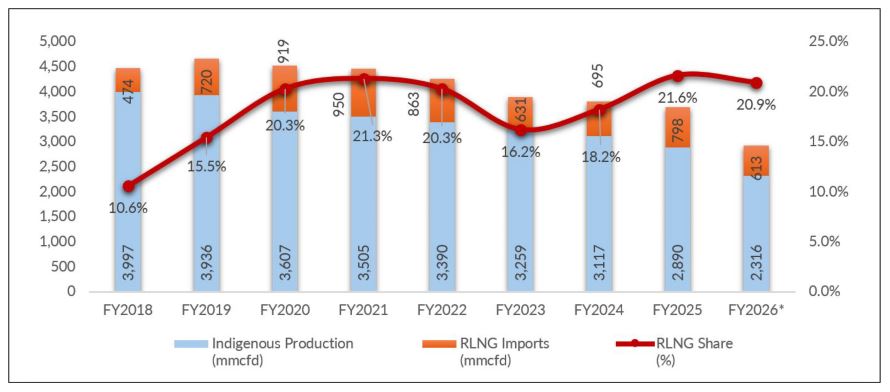
Source: Pakistan Economic Survey & HDIP Energy Yearbook (various issues) * FY2026 covers July 2025-March 2026 only.
Since the project’s inception in 2009, Iran has served Pakistan with three notices under the GSPA. The first notice was delivered in February 2019, when Iran signaled its intent to initiate arbitration and invoke the penalty clause. The second notice was delivered during November-December 2022 and served as an ultimatum to Pakistan to get ready to face US$18 billion worth of penalties in case of failure to complete its part. Public sources also report the possibility of arbitration of the case in September 2024 and about US$18 billion at stake. Forum, status of filing, legal grounds, and quantum must be checked against the GSPA, the notices and official documents (ISSRA, 2024).
Regardless of the credibility of these claims, it still does not solve the main policy problem that Pakistan faces: whether the project needs to be revived in the current market, fiscal, and geopolitical conditions. This Policy Viewpoint seeks to answer this question by looking at the strategic rationale behind the project, price competitiveness, legal and financial constraints, and revival options that will secure Pakistan from additional economic risks.
2. Price Competitiveness Depends on Delivered Cost
Comparing commodity prices alone does not provide enough insight into the economic viability of the project. Factors such as transmission, financing, operation, maintenance, security, and insurance costs, system losses, and foreign exchange risk in case of pipeline gas need to be taken into account. As a result, the appropriate benchmark is the delivered cost of the imported gas (IP gas) along with the marginal or avoidable cost of Pakistan’s LNG imports.
The price provision in the Gas Sales and Purchase Agreement (GSPA) is 78% of the then existing crude oil parity with the standard conversion ratio of about 5.8 MMBtu per barrel, that is equivalent to a Brent slope of about 13.45% in relation to the Brent price (ISGS[3], 2019; Gomes, 2013). This is broadly comparable to Pakistan’s Qatar LNG agreement of 2016 (13.37%) but higher than the 2021 Qatar agreement (10.2%) and the 2017 Ente Nazionale Idrocarburi (ENI) agreement (12.14%) (OGRA, 2018-2026). At the Brent price of $75 per barrel, the formula in terms of IP gives a commodity price of around $10.09 per MMBtu, implying annual purchase commitments of about $2.84 billion for a full offtake of 750 MMCFD[4]. Each US$1/MMBtu increase in the contract price would raise Pakistan’s annual import bill by roughly US$282 million. The contractual crude marker, averaging period, lag, caps or floors, adjustments, and delivery point should be verified against the GSPA.
Table 1: Gas Prices under Alternative Oil-Price Scenarios
| Pricing Benchmark | Brent Slope | $50/bbl | $75/bbl | $100/bbl | $125/bbl |
| IP gas (reported 78% crude parity; illustrative Brent equivalent) | 13.45% | $6.72 | $10.09 | $13.45 | $16.81 |
| IP gas (illustrative renegotiation scenario) | 12.00% | $6.00 | $9.00 | $12.00 | $15.00 |
| Qatar 2016 (15-year contract) | 13.37% | $6.69 | $10.03 | $13.37 | $16.71 |
| Qatar 2021 (10-year contract) | 10.20% | $5.10 | $7.65 | $10.20 | $12.75 |
| ENI (15-year contract) | 12.14% | $6.07 | $9.11 | $12.14 | $15.18 |
Source: Authors’ calculations based on ISGS (2019); Gomes (2013) & OGRA (2018–2026)
The results show that the case for revival cannot rest solely on price competitiveness. Moreover, commodity prices are not the delivered costs. Gas pipelines require substantial investment in transmission infrastructure, which must be financed, and for which security must be provided and over which long-term commitments must be made; LNG imports bring terminal, shipping and regasification costs (which typically add around US$0.4–1.3/MMBtu to LNG costs (SBP, 2021[5]; OGRA[6], 2018–2026), but do not necessitate comparable infrastructure investments across borders to the same extent. A comparable estimate of Pakistan-side pipeline costs remains unavailable from Inter-State Gas Systems (ISGS) or other public sources, preventing a comprehensive delivered-cost comparison.
Spot LNG cargoes traded at around US$18.40–19.10/MMBtu in the wake of the 2026 regional conflict (IEEFA, 2026), reflecting severe geopolitical supply disruptions. Hence, during times of crisis, prices do not necessarily reflect the long-term profitability of energy infrastructure investments, since short-term price hikes can exaggerate competitiveness of the alternative supply source and hide risks that come with its financing, contracting, and operation (Sharples, 2026; Fattouh, 2026).
However, the situation that underpinned the rationale for the project in 2009 has changed significantly. It should be noted that the country is operating LNG import terminals and has also witnessed the fast deployment of solar power generation and changes in the pattern of demand and weaker industrial gas demand. Therefore, the challenge lies in ensuring the absorption of the extra 750 MMCFD. The project’s contribution to energy security also requires careful assessment. Diversifying supply is valuable only if it does not create new fiscal or contractual vulnerabilities. For this reason, any revival should be preceded by a transparent delivered-cost assessment covering infrastructure, financing, security, and contractual obligations.
3. The Binding Constraints Extend Beyond Price
Recent diplomatic engagement reaffirmed both governments’ commitment to address these issues and advance the project. However, it does not resolve the legal, financial, and market doubts that have delayed implementation for over fifteen years (Ministry of Foreign Affairs-GOP, 2024; ISGS, 2024; ISGS, 2025)[7]. The principal constraint facing the IP pipeline is neither the availability of gas nor even the competitiveness of its pricing formula. It is whether Pakistan can absorb, finance, and pay for another long-term imported gas commitment without increasing sanctions-related, fiscal, or circular-debt risks. OFAC General License X, issued in June 2026, authorized specified Iranian-origin oil and petroleum transactions only through 21 August 2026 at the latest, but OFAC revoked it on 7 July 2026 and replaced it with General License X1, a wind-down-only authorization. Neither license has established clearance for pipeline gas, construction, financing, insurance, or future payments (U.S. Department of the Treasury, 2026a, 2026b, 2026c).
Conditions today differ substantially from those prevailing when the GSPA was signed (Table 2). Pakistan did not have any LNG facilities in 2009; there were major domestic gas shortages, and long-term demand projections appeared predictable in that country. By 2026, Pakistan will have already obtained LNG facilities and LNG agreements, face greater uncertainty regarding future gas demand, pay higher tariffs, suffer from circular debt, and be under sanctions threat.
Table 2: Contextual Shift in Key Parameters since the GSPA was Signed (2009 vs. 2026)
| Strategic issue | When GSPA was signed | Current context | Preconditions for revival |
| Domestic gas balance | Domestic gas production was near 4,000 MMCFD and shortages were expected to deepen | Indigenous gas declined to about 2,890 MMCFD in FY2025; mature field depletion continues | Quantify the net gas deficit after domestic supply, existing LNG contracts and realistic demand |
| Demand absorption | Strong long-term demand growth was assumed | Average RLNG use was about 613 MMCFD during Jul–Mar FY2026 (Pakistan Economic Survey FY 2025-26), below the proposed 750 MMCFD IP supply | Prepare a sector-wise offtake plan for power, fertilizer, export-oriented industry, general industry and households |
| Import infrastructure and delivered cost | Pakistan had no LNG import infrastructure | Pakistan now has two LNG terminals and long-term LNG contracts; IP would still require about 781 km of Pakistan-side pipeline | Compare IP delivered cost with RLNG delivered cost, including pipeline capex, financing, terminal charges and system losses |
| Commercial terms | Long-term oil-indexed gas pricing was accepted | Reported IP slope is about 13.45%, close to Qatar 2016 at 13.37%, and above Qatar 2021 at 10.2% | Renegotiate price slope, cap/floor, price-review clause, phased volumes and take-or-pay terms |
| Gas-sector financial health | Imported-gas exposure was limited | Gas-sector circular debt is reported around PKR 3.4 trillion; tariff delays (IMF, 2026), UFG and payment arrears constrain the sector | Link any new import commitment to cost recovery and circular-debt management |
| Sanctions and financing | Sanctions risk existed, but the project was newly signed | The sanctions framework remains in force. General License X was revoked and replaced by General License X1 (wind-down only) on 7 July 2026; neither has established clearance for pipeline gas, construction, financing, insurance, or payments. | Obtain a transaction-specific legal opinion, applicable authorizations, and written banking, insurance, and financing confirmation before commitment |
| Legal exposure | No active implementation dispute | Arbitration has been publicly threatened; the forum, filing status, and reported exposure of up to US$18 billion remain unverified | Complete independent legal review of the GSPA, amendments, notices, force majeure and potential contractual exposure |
| Energy-security value | Pipeline gas was viewed mainly as shortage relief | Supply diversification remains valuable, but may shift risk from LNG markets to sanctions and fixed-contract exposure | Treat IP gas as a strategic option, not an unconditional construction obligation. Also require Iran to provide independently verified evidence of a firm exportable surplus and contractual guarantees of uninterrupted delivery, including during winter peak-demand periods, before construction is authorized |
Source: Authors’ analysis based on Ministry of Finance (2025–26); IMF (2026); ISGS (2024, 2025); U.S. Department of the Treasury and OFAC (2026b, 2026c)
Table 2 addresses Pakistan’s absorptive capacity but does not assess whether Iran can reliably supply the contracted volume over the life of the agreement. Two supply-side questions require independent scrutiny before any irreversible commitment is made. First, Iran must demonstrate a firm, long-run exportable gas surplus: in 2023, domestic consumption absorbed over 95 percent of total production, while an estimated 300 mcm/d of gas is required for reinjection into aging oil fields to maintain reservoir pressure, yet actual reinjected volumes have been running at only 30–37 mcm/d, creating a structural competition between oil-field maintenance, domestic consumption, and export commitments.
Secondly, there is no guarantee that production will remain sustainable over the course of the 25-year contract period – South Pars is responsible for about 80% of all national production, production rates have noticeably slowed down after 2021, and it is believed that the capital necessary for reversing this trend will cost more than double the contracted $17 billion in early 2025 (Corbeau & Mitrova, 2026). Pakistan should treat Iran’s exportable surplus and production sustainability as preconditions for its energy plan that need independent verification.
Contrary to cancellation recommendations, Table 2 presents preconditions for the project that should be met before construction can start. This list includes sanctions clearance, competitive delivered prices, confirmed demand for gas, acceptable financial exposure, seasonal assurance of supply, and proper geopolitical risk management. Compliance with these preconditions should precede any construction decisions. Not only diversification of import sources but also the ability of suppliers to provide a stable flow in the face of potential threats from both domestic and domestic and geopolitical risks is an issue of energy security; otherwise, a new corridor becomes vulnerable to seasonal under-delivery.
4. Policy Choices and Their Trade-offs
Both an immediate start and complete abandonment of the project appear inappropriate in the current scenario. Moving ahead now would be risky for Pakistan for several reasons, whereas abandoning the project would mean that legal liability will arise and the opportunity of future supply will be lost. The best way to deal with the situation is to pursue a conditional revival strategy.
Table 3: Policy Options
| Policy Option | Potential Benefit | Principal Risk | Assessment |
| Continued Deferment | Avoids immediate sanctions, financing and construction exposure | Prolongs contractual uncertainty and weakens Pakistan’s negotiating position | Unsustainable |
| Immediate Construction | Signals commitment and may preserve the project option | Sanctions, financing, stranded-asset and fiscal risks before gas trade is cleared | Premature |
| Termination and Legal Defence | Removes future construction and offtake obligations | Potential arbitration or settlement exposure; loss of a strategic supply route | High-risk |
| Conditional Revival | Preserves the option while allowing price, sanctions, demand and fiscal risks to be managed | Requires coordinated negotiation and strict decision gates | Preferred |
Source: Authors’ proposals based on analysis
5. Conditional Revival Framework and Immediate Priorities
Prior to any construction decision, the proposed framework sets out a sequence of actions given in Table 4. Each phase focuses on a specific legal, commercial, or technical uncertainty, allowing policy decisions to be based on evidence.
Table 4: Conditional Revival Framework
| I · Legal & contractual review |
| Action: Audit the GSPA, quantify Pakistan’s liability under its penalty clauses, and reconcile Pakistan’s position with the reported dispute/claim exposure. It should also seek a without-prejudice standstill or tolling arrangement during review and negotiation. |
| Responsible: Law & Justice Division; Attorney-General’s Office; Petroleum Division; ISGS; independent external counsel. |
| II · Sanctions clearance |
| Action: Obtain a transaction-specific legal opinion, applicable OFAC authorizations, and written banking, insurance, equipment, and financing confirmations. |
| Responsible: Ministry of Foreign Affairs; Petroleum Division; Finance Division; State Bank of Pakistan; specialist sanctions counsel. |
| III · Commercial renegotiation |
| Action: Renegotiate price, volume, delivery point, and take-or-pay terms as a single package, sequenced after the sanctions scope is confirmed. |
| Responsible: Petroleum Division; ISGS (vs. NIGC); Finance Division; ECC; OGRA. |
| IV · Demand & allocation validation
Fertilizer, export-oriented industry, general industry, power sector, and gas utilities |
| Action: Commission an independent demand study covering power, captive, and industrial offtake, measured against the current LNG-surplus baseline. |
| Responsible: Petroleum Division (independent consultant); Power Division and NTDC through the IGCEP; NEPRA; Finance Division. |
| V · Phase investment with fiscal safeguards
Capital commitment should be staged after the first four conditions are sufficiently met |
| Action: Commit capital in tranches tied to engineering and EPC milestones; construction should proceed only after all conditions are met and the connected system is operationally viable. |
| Responsible: Finance Division; Planning Commission and CDWP; ECC and Cabinet; ISGS. |
Source: Authors’ proposals based on analysis
6. Conclusion
The IP pipeline is neither an automatic solution to Pakistan’s energy problem nor an outdated project that must be abandoned once and for all. Its strategic importance depends on its ability to provide gas at competitive prices along with meeting sanctions-related, funding, demand, and contractual considerations in the current energy and financial context of Pakistan. While energy diversification will remain an important priority, it should not entail entering into an unbreakable contract that adds to Pakistan’s fiscal, legal, and geopolitical risks.
Construction must take place only after the fulfillment of well-defined legal, business, financial, and energy security requirements. These requisites consist of an individual contract review, sanction review for the specific pipeline, renegotiating the commercial deal, validated sectoral gas demand, and an analysis of total costs. Therefore, Pakistan should take up a time-bound renegotiations before advancing with any binding changes, payments, and construction of the pipeline once these conditions have been satisfied. The provisional revival approach is the most reasonable course of action to keep the strategic gas supply choice open while guaranteeing energy security. It is important that Pakistan alone, on its own terms, defines the potential surplus of exportable gas from Iran, long-term reliability of supply, especially in winter months, and the enforceability of contractual guarantees of supply.
References
Cedigaz. (2025). When demand assumptions reverse: Pakistan’s LNG experience in 2025. https://www.cedigaz.org/when-demand-assumptions-reverse-pakistans-lng-experience-in-2025/
Corbeau, A.-S., & Mitrova, T. (2026, January 26). Iran’s Natural Gas Paradox: Vast Resources, Limited Export Capacity. Center on Global Energy Policy, Columbia University. https://www.energypolicy.columbia.edu/irans-natural-gas-paradox-vast-resources-limited-export-capacity/
Fattouh, B. (2026, April). The anatomy of the Strait of Hormuz oil shock (OIES Energy Insight 181). Oxford Institute for Energy Studies. https://www.oxfordenergy.org/publications/the-anatomy-of-the-strait-of-hormuz-oil-shock/
Global Energy Monitor. (2023). Iran-Pakistan pipeline. https://www.gem.wiki/Iran-Pakistan_Pipeline
Gomes, L. (2013). Natural gas in Pakistan and Bangladesh: Current issues and trends (Working Paper NG-77). Oxford Institute for Energy Studies. https://www.oxfordenergy.org/publications/natural-gas-in-pakistan-and-bangladesh-current-issues-and-trends/
Institute for Energy Economics and Financial Analysis. (2026). Pakistan’s LNG surplus crisis: Assessing evolving energy dynamics and the need for flexibility. https://ieefa.org/resources/pakistans-lng-surplus-crisis-assessing-evolving-energy-dynamics-and-need-flexibility
Institute for Strategic Studies, Research and Analysis. (2024, November 4). Iran’s notice on the Iran-Pakistan gas pipeline: Challenges and legal options for Pakistan. https://issra.pk/pub/insight/2024/Iran%27s-Notice-on-The-Iran-Pakistan-Gas-Pipeline-Challenges-and-Legal-options-for-Pakistan/Insight.html
International Monetary Fund. (2026, April 23). Pakistan: Third review under the extended arrangement under the extended fund facility (IMF Country Report No. 26/101). https://www.elibrary.imf.org/view/journals/002/2026/101/article-A001-en.xml
Inter-State Gas Systems (Private) Limited (2019). Financial statements for the year ended June 30, 2019. Audited by Deloitte Yousuf Adil, Chartered Accountants. https://isgs.com.pk/wp-content/uploads/2020/01/ISGS-Annual-Audited-Financial-Statements-2018-19.pdf
Inter-State Gas Systems (Private) Limited. (2024). Iran Pakistan (IP) gas pipeline project. https://www.isgs.com.pk/index.php/iran-pakistan-ip-gas-pipeline-project/
Inter-State Gas Systems (Private) Limited. (2025, May 26). Pakistan, Iran commit to early resolution of gas pipeline project. https://www.isgs.com.pk/index.php/2025/05/26/pakistan-iran-commit-to-early-resolution-of-gas-pipeline-project/
Ministry of Energy, Petroleum Division, Government of Pakistan. (2026). Gas sector circular debt update. https://petroleum.gov.pk/NewsDetail/NzZiMzM5ODItZDk3ZC00MjhkLTg3Y2MtMDhlMTZmOWIxYThm
Ministry of Finance, Government of Pakistan. (2026). Pakistan Economic Survey 2025-26: Energy. https://www.finance.gov.pk/survey/chapters_26/Economic_Survey_2025_26.pdf
Ministry of Foreign Affairs, Government of Pakistan. (2024, April 24). Joint statement between Islamic Republic of Pakistan and Islamic Republic of Iran at the culmination of the visit by the President of Iran. https://mofa.gov.pk/press-releases/joint-statement-between-islamic-republic-of-pakistan-and-islamic-republic-of-iran-at-the-culmination-of-the-visit-by-the-president-of-iran
Molnar, G. (2022). Natural gas pipeline infrastructure costs (IEA Working Paper). International Energy Agency. https://www.iea.org/reports/natural-gas-pipeline-infrastructure-costs
National Assembly of Pakistan. (2013, March 13). Questions for oral answers and their replies, 50th Session, Question No. 110. National Assembly Secretariat. https://www.na.gov.pk/uploads/documents/questions/1363181720_496.pdf
Nephew, R. (2017). Collateral damage: The impact on Pakistan from U.S. sanctions against Iran. Columbia University, Center on Global Energy Policy. https://energypolicy.columbia.edu/publications/collateral-damage-impact-pakistan-us-sanctions-iran/
Oil and Gas Regulatory Authority. (2018–2026). RLNG weighted average sale price determinations (Monthly determination letters). Government of Pakistan. https://www.ogra.org.pk/rlng-notified-prices-3
Sharples, J. (2026, March). The Iran war and disruption to LNG (Oxford Energy Comment). Oxford Institute for Energy Studies. https://www.oxfordenergy.org/publications/the-iran-war-and-disruption-to-lng/
U.S. Department of the Treasury, OFAC. (2026a). Iran sanctions.
U.S. Department of the Treasury, OFAC. (2026b, June 22). General License X.
U.S. Department of the Treasury, OFAC. (2026c, July 7). Issuance of amended Iran-related general license (General License X1): Revocation and wind-down of the June 22, 2026 authorization.
U.S. Energy Information Administration. (2024, October). Country Analysis Brief: Iran. https://www.eia.gov/international/content/analysis/countries_long/Iran/pdf/Iran%20CAB%202024.pdf
[1]ISGS (2019). https://isgs.com.pk/wp-content/uploads/2020/01/ISGS-Annual-Audited-Financial-Statements-2018-19.pdf
[2] ISSRA. (2024, November 4). https://issra.pk/pub/insight/2024/Iran’s-Notice-on-The-Iran-Pakistan-Gas-Pipeline-Challenges-and-Legal-options-for-Pakistan/Insight.html
[3] Note 14.1.2 of the ISGS FY2018 audited financial statements.
[4] Converting via the standard industry factor of 1 barrel ≈ 5.8 MMBtu: price (US/MMBtu) Slope × Brent (US$/bbl) across four slope scenarios
[5] State Bank of Pakistan (SBP). 2021. The State of Pakistan’s Economy: Second Quarterly Report 2020–21. Special Section: LNG Sector in Pakistan – Attaining Sustainability through Deregulation and Structural Reforms. Karachi: State Bank of Pakistan. https://www.sbp.org.pk/reports/quarterly/fy21/Second/qtr-index-eng.htm
[6] https://www.ogra.org.pk/rlng-notified-prices-3
[7] https://mofa.gov.pk/press-releases/joint-statement-between-islamic-republic-of-pakistan-and-islamic-republic-of-iran-at-the-culmination-of-the-visit-by-the-president-of-iran