
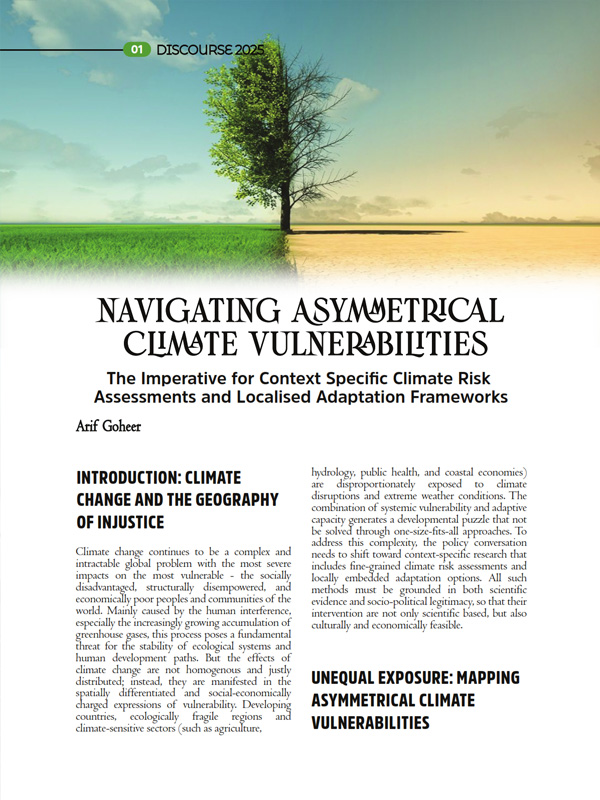
Navigating Asymmetrical Climate Vulnerabilities
Introduction: Climate Change and the Geography of Injustice
Climate change continues to be a complex and intractable global problem with the most severe impacts on the most vulnerable – the socially disadvantaged, structurally disempowered, and economically poor peoples and communities of the world. Mainly caused by the human interference, especially the increasingly growing accumulation of greenhouse gases, this process poses a fundamental threat for the stability of ecological systems and human development paths. But the effects of climate change are not homogenous and justly distributed; instead, they are manifested in the spatially differentiated and social-economically charged expressions of vulnerability. Developing countries, ecologically fragile regions and climate-sensitive sectors (such as agriculture, hydrology, public health, and coastal economies) are disproportionately exposed to climate disruptions and extreme weather conditions. The combination of systemic vulnerability and adaptive capacity generates a developmental puzzle that not be solved through one-size-fits-all approaches. To address this complexity, the policy conversation needs to shift toward context-specific research that includes fine-grained climate risk assessments and locally embedded adaptation options. All such methods must be grounded in both scientific evidence and socio-political legitimacy, so that their intervention are not only scientific based, but also culturally and economically feasible.
Unequal Exposure: Mapping Asymmetrical Climate Vulnerabilities
The spatial and social asymmetries of climate vulnerability are products of complex and interdependent biophysical, socio-economic, and institutional dynamics. The differential impacts of climate change manifest through geographically specific exposure patterns and uneven adaptive capacities across communities and ecosystems. Low-lying coastal zones are increasingly imperiled by sea-level rise, saline intrusion, and intensified storm surges, threatening both human settlements and ecological integrity. In contrast, arid and semi-arid regions experience progressive desertification, hydrological stress, and land degradation, undermining agricultural productivity and water security. For smallholder farmers, shifting agro-ecological zones and erratic precipitation patterns have destabilized traditional cropping systems, thereby exacerbating food insecurity and rural poverty.
Urban environments, particularly informal settlements and peri-urban areas, face distinct climate-induced risks. The absence of resilient infrastructure amplifies vulnerabilities to heat extremes, flooding, and disease proliferation, resulting in cascading socio-economic impacts. Moreover, vulnerability is not merely spatial but deeply intersectional, mediated by gender, age, disability, class, and access to resources, thus reinforcing pre-existing inequalities and governance deficits. Climate change, in this sense, functions as a threat multiplier, compounding socio-political fragilities and developmental disparities, particularly across the Global South where adaptive capacities remain constrained.
These asymmetrical exposures underscore the inadequacy of uniform adaptation prescriptions and necessitate context-differentiated, justice-oriented policy frameworks. Understanding the geography of vulnerability demands integrative assessment methodologies that combine climate science with social inquiry, institutional analysis, and participatory diagnostics. Such an approach enables decision-makers to distinguish between site-specific sensitivities and adaptive capacities, thereby informing equitable resilience strategies. Mapping and addressing these asymmetries is therefore not only a scientific imperative but also a moral and political one, essential for reorienting climate governance toward inclusivity, distributive justice, and transformative adaptation that protects the most exposed and empowers the least resilient.
Beyond Global Models: The Case for Context-Specific Climate Risk Assessments
While global climate models and scenarios have substantially advanced our understanding of Earth’s changing climate system, their applicability to local and sectoral decision-making remains limited without appropriate downscaling and contextual interpretation. The heterogeneity of climate impacts, shaped by geography, socio-economic structures, and governance systems, demands analytical approaches that move beyond global generalizations toward fine-grained, site-specific risk diagnostics. Comprehensive climate risk assessments must integrate the triad of hazard, exposure, and vulnerability, capturing both biophysical processes and social dimensions of risk. This integrated approach provides the empirical foundation necessary for evidence-based adaptation planning and resilient development policy.
Context-specific assessments are particularly crucial for data-scarce regions such as Pakistan, where climatic and socio-ecological systems are highly diverse, from the glacial-fed basins of the north to the arid zones of Baluchistan and Sindh. In such environments, coupling scientific modeling with indigenous and community-based knowledge enhances diagnostic precision and social legitimacy. Traditional water management practices, for example, offer insights into adaptive behavior that can complement modern hydrological projections. Equally, socio-political factors, such as land tenure systems, institutional capacity, and cultural norms, must be integrated into vulnerability analyses to reflect the real determinants of risk and adaptive potential.
Importantly, climate risk must be understood as a dynamic and iterative phenomenon, evolving through feedback between environmental stressors, economic transitions, and governance responses. Thus, localized risk profiles should not only identify priority hotspots but also guide adaptive investments and institutional reforms. By aligning scientific evidence with local realities, context-specific assessments bridge the gap between global knowledge and actionable local policy, ensuring that adaptation strategies are both scientifically robust and socially equitable. This paradigm shift, from global models to localized climate intelligence, marks a necessary evolution toward climate governance that is responsive, inclusive, and spatially attuned.
Rethinking Adaptation: From Incremental Responses to Transformative Action
Conventional adaptation practices have largely been reactive, addressing the immediate impacts of climate variability through incremental and often short-term measures. However, in the face of intensifying climate extremes, systemic vulnerabilities, and intersecting socio-economic challenges, adaptation must transcend its defensive posture to become transformative, redefining development pathways and reshaping governance, technology, and societal behavior. Transformative adaptation envisions structural change, where climate resilience is embedded within the foundational processes of economic planning, infrastructure design, and social equity frameworks, rather than treated as an external corrective.
In Pakistan, where recurrent floods, droughts, and glacial melt events threaten both livelihoods and infrastructure, the limitations of incremental approaches have become increasingly evident. For instance, traditional flood protection measures such as embankments and drainage improvements have proven insufficient without parallel transformations in land use planning, watershed management, and governance accountability. Transformative adaptation, therefore, calls for integrated solutions such as nature-based flood management through wetland restoration, the expansion of resilient urban drainage systems, and reforestation in upper catchments to enhance hydrological balance. In the agricultural sector, responsible for the livelihoods of over 40% of Pakistan’s population, climate-smart interventions like drought-tolerant crop varieties, precision irrigation, and digital climate advisory systems exemplify how adaptation can merge innovation with sustainability.
Institutional transformation is equally vital. Embedding climate resilience into national and provincial development strategies, as seen in Pakistan’s National Adaptation Plan (NAP) process, ensures that adaptation is not project-bound but systemic. Accessing global climate finance mechanisms such as the Green Climate Fund (GCF) and the Adaptation Fund, complemented by domestic fiscal reforms, can accelerate large-scale implementation. Ultimately, transformative adaptation is about reconfiguring development systems, shifting from vulnerability management to resilience creation, anchored in inclusiveness, evidence-based governance, and long-term sustainability.
Localized Adaptation Frameworks (LAPs): Translating Policy into Practice
While National Adaptation Plans (NAPs) establish strategic scaffolding for climate resilience at the national level, the materialization of adaptation outcomes occurs within the lived realities of local communities, where climate hazards are most immediate, spatially diverse, and socially differentiated. Localized Adaptation Frameworks (LAPs) therefore represent the operational nexus through which high-level policy visions are translated into grounded, context-sensitive adaptation actions. They serve as the connective tissue between scientific modeling, governance systems, and community agency, transforming abstract policy commitments into tangible interventions that safeguard livelihoods, ecosystems, and local economies.
The design and operationalization of LAPs must be rooted in inclusive, participatory, and co-productive processes that synthesize scientific and indigenous knowledge systems. Engaging local actors, including community-based organizations, traditional institutions, and subnational authorities, not only enhances the epistemic legitimacy of adaptation decisions but also ensures that interventions respond to context-specific vulnerabilities and capacities. This multi-actor co-design process anchors LAPs in local socio-ecological realities, making adaptation both actionable and equitable. Institutional harmonization is equally critical: LAPs should align with prevailing legal, administrative, and development frameworks to avoid duplication, promote policy coherence, and strengthen institutional interoperability. Such vertical (national–local) and horizontal (cross-sectoral) alignment enables coordinated resource allocation and consistent implementation across governance tiers.
To maintain relevance under changing climatic and socio-economic conditions, LAPs must be designed as living frameworks: dynamic, iterative, and reflexive. Continuous updating informed by emerging climate data, evolving risk assessments, and technological innovations allows for adaptive management. Integrating robust Monitoring, Evaluation, and Learning (MEL) mechanisms transforms LAPs into adaptive governance systems that institutionalize feedback loops, promote transparency, and enable evidence-based course correction. Beyond technical design, LAPs carry a normative imperative: they democratize adaptation governance by decentralizing decision-making and redistributing authority toward those most affected by climate risks. In doing so, they embody a transformative governance model that transcends reactive adaptation, fostering anticipatory resilience and socio-ecological justice. Ultimately, LAPs are not merely policy instruments; they are pathways for reconfiguring development under climate stress, institutionalizing equity, and localizing the pursuit of sustainable resilience.
Governing Adaptation: Integration, Coherence, and Accountability
Effective governance of climate adaptation requires a paradigm that is integrative, coherent, and accountable across scales of action. Localized Adaptation Plans (LAPs), when embedded within robust Monitoring, Evaluation, and Learning (MEL) systems, can function as adaptive governance instruments capable of responding dynamically to evolving climate risks. MEL frameworks enable continuous learning, iterative adjustment, and transparent accountability by linking evidence generation to decision-making cycles. This ensures that adaptation interventions remain scientifically grounded, socially relevant, and financially efficient. However, the transformative potential of LAPs lies in their ability to integrate multiple policy frameworks, bridging local actions with global commitments such as the Nationally Determined Contributions (NDCs) under the Paris Agreement, the Sustainable Development Goals (SDGs), and the Sendai Framework for Disaster Risk Reduction (SFDRR). Such vertical and horizontal policy coherence reduces fragmentation, harmonizes priorities across sectors, and enhances institutional synergy for long-term resilience.
Furthermore, governing adaptation demands institutional arrangements that promote transparency, inclusivity, and multi-stakeholder participation. Integrating community-led monitoring mechanisms within LAPs can democratize adaptation governance by embedding local knowledge, experiences, and priorities into the policy cycle. This participatory accountability strengthens trust between citizens and institutions and ensures that adaptation outcomes are both equitable and context sensitive. To sustain coherence, national and subnational institutions must coordinate through integrated planning and budgetary systems, linking climate adaptation with sectoral policies on water, agriculture, health, and urban development. Globally, LAPs, when governed through evidence-based, inclusive, and iterative frameworks, can become models for context-specific adaptation governance. They embody the shift from reactive responses to proactive resilience-building, bridging science and society, and institutionalizing accountability as a cornerstone of equitable and sustainable climate action.
Policy and Institutional Pathways for Equitable Resilience
Building equitable climate resilience requires a deliberate reconfiguration of policy and institutional architectures to bridge scientific insight with local realities. Policies must transcend sectoral silos and promote multi-level coherence, ensuring that adaptation is mainstreamed into national development agendas, fiscal frameworks, and local governance systems. Strengthening institutional capacity at subnational levels is pivotal to operationalizing climate action where vulnerabilities are most acute. This entails empowering local governments with technical expertise, financial autonomy, and participatory decision-making mechanisms that amplify the voices of marginalized and climate-affected communities.
Based on the above analysis, the following are recommended to strengthen climate adaptation policies:
- Support the development of regional climate research centers to produce downscaled information and context-specific risk estimations.
- Institutionalize knowledge exchange mechanisms between researchers, policymakers, and practitioners to ensure that the adaptation planning is evidence informed.
- Support inclusive decision-making procedures that incorporate local perspectives, especially those of vulnerable groups, in adaptation planning and implementation.
- Synchronize climate adaptation policies to national development strategies and global obligations to bring harmonious outcomes.
- Mobilize sufficient resources and capacity- development initiatives to empower local governments to plan and track adaptation interventions.
Conclusion: Toward a Just and Contextualized Climate Future
With climate change fundamentally reshaping development trajectories, an urgent paradigm shift in research and policy agendas is required to ensure coherence between scientific evidence, governance structures, and adaptive action. The heterogeneous nature of climate risks across ecological, socio-economic, and institutional landscapes necessitates the formulation of tailor-made, site-specific adaptation strategies that are scientifically robust, contextually grounded, and socially inclusive. Disproportionate vulnerabilities, arising from geographic exposure, livelihood dependence, and systemic inequities, underscore the need for granular risk assessments that integrate climate projections, socio-ecological data, and local knowledge systems. Within this framework, localized adaptation plans must be embedded in the broader national policy architecture to ensure vertical and horizontal policy coherence, resource alignment, and sustained implementation. Participatory and decentralized governance mechanisms are indispensable to ensure ownership, legitimacy, and accountability in adaptation decision-making processes. Adaptation, when designed as a transformative rather than reactive process, can serve as a dual instrument for resilience enhancement and sustainable development, bridging the gap between immediate coping needs and long-term systemic resilience. Ultimately, a scientifically informed, ethically anchored, and participatory adaptation agenda offers a pathway toward equitable climate resilience and inclusive development amid escalating climatic uncertainties and structural fragilities.
Mr. Muhammad Arif Goheer is the Executive Director of the Global Climate Change Impact Studies Centre (GCISC), Pakistan’s primary research institute for climate change under the umbrella of the Ministry of Climate Change and Environmental Coordination