
Executive Summary
Pakistan’s power sector challenge is no more the supply centric instead turning installed capacity as dependable and affordable electricity. As of March 2026, Pakistan’s total installed capacity had reached 49,651 MW which also included 7,319 MW of net-metered solar. However, consumers’ sufferings are not over due to high tariffs and unreliable supply. This demonstrates a mismatch between capacity and system requirement. Electricity must be available when and where it is needed and responsive to changes in demand, generation, and network conditions. Daytime demand has significantly reduced by solar PV, while evening ramp is now new trend grid need to handle. Pakistan, therefore, needs to value not only electricity and contracted capacity, but also the verified services required to keep the system balanced and reliable.
This Policy Viewpoint recommends a phased, technology-neutral, contract-aware flexibility and ancillary-services mechanism building on Grid Code, Market Commercial Code, CTBCM and ISMO’s operating role. The process should begin with a national flexibility-need assessment, followed by a NEPRA-authorized pilot covering two or three clearly defined services. Assessment of existing power plants; aggregated distributed resources should be undertaken for their eligibility to satisfy the common performance standards. The verified service payment mechanisms should be designed to avoid any duplicate payment under existing agreements. The process should only be expanded if an independent assessment provides lower total system costs, more reliability, better use of existing assets, and measurable consumers benefits.
Core policy proposition: Pakistan should transition from counting installed megawatts to acquiring
verified flexibility through phased, technology-neutral, contract-aware system that rewards availability and
performance while safeguarding consumers from overlapping financial costs.
1. From Surplus Capacity to a Flexibility Challenge
Pakistan’s power sector has moved through two distinct eras. Decades of electricity shortages followed by successive IPP polices and CPEC projects which added significant megawatts. These interventions helped to address significant capacity shortages; however, the nature of the challenge has subsequently changed. Much of the system was developed under long-term contracts based on projection of rising grid demand, and consistent fuel supplies,. Here embarks era of surplus megawatt. The grid electricity sales are now below the forecasted expectation, as high tariffs, and rapid growth in self-generation through rooftop solar have reduced consumption, leaving fixed costs to be recovered from a diminished pool of consumers.
The ever-varying capacity mix complicates the challenge. Between July–March FY2025 and the corresponding period of FY2026, reported renewable capacity increased from 5,680 MW to 10,101 MW, largely because net-metered solar rose from 2,813 MW to 7,319 MW. This increase, however, does not reflect firm dispatchable capacity.
Renewables First estimates approximately 38 GW of distributed solar capacity by June 2025, encompassing net-metered, behind-the-meter and off-grid systems (Renewables First, 2026). This broader estimate overlaps with registered net-metered capacity and should not be added in full to the reported installed-capacity total. The total reported installed capacity reached 49,651 MW by March 2026, while the Economic Survey separately identified thirteen closed IPPs representing approximately 5.1 GW (Finance Division, 2026). These closed units are not assumed to be available for dispatch or flexibility services. Most of these are ageing furnace-oil units whose contracts have expired or have been terminated, and they should not be read as capacity waiting to be recalled. These figures demonstrate why installed megawatts cannot be considered equally useful. Rooftop solar, reservoir hydropower, and fuel-constrained thermal generation differ in their availability, reliability, and ability to provide electricity to where it is required.
Figure 1: Pakistan’s Installed Generation Capacity Mix
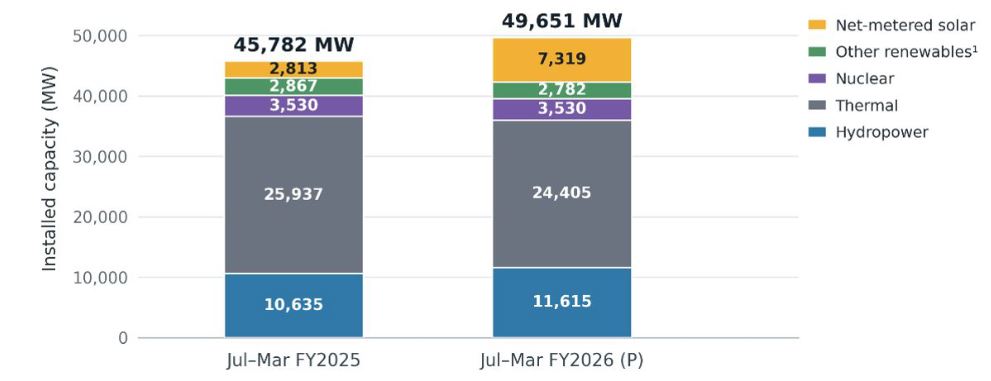
Source: Authors’ construction based on Finance Division, Pakistan Economic Survey 2025–26, Table 14.1. Renewable capacity includes net-metered solar—2,813 MW in March 2025 and 7,319 MW in March 2026. Other renewables = reported renewable capacity less net-metered solar. FY2026 figures are provisional”
The installation of net metered and behind the meter solar is affecting the daily demand pattern of the national grid. It reduces grid demand during the day, especially around midday, but demand surges in the evening when solar output declines. This pattern creates operational difficulties for the power system and the evening ramp requires the demand to be meet from the resources that can respond quickly.
ISMO’s metered hourly grid-demand data for FY2024–25 (1 July 2024–30 June 2025 excluding K-Electric, show substantial variation across months and hours (ISMO, 2025a). Table 1 summarizes monthly recorded demand and afternoon-to-evening increases.
Table 1: Monthly Metered Grid Demand and Ahernoon-to-Evening Increases, FY2024–25, Excluding K-Electric
| Month | Recorded | Recorded | Mean increase, | Largest one-hour increase |
| minimum, MW | maximum, MW | 14:00–20:00, MW | within 12:00–22:00, | |
| MW/hour | ||||
| July 2024 | 12,628 | 23,066 | 711 | 1,555 |
| August 2024 | 11,618 | 22,991 | 903 | 1,337 |
| September 2024 | 12,724 | 20,559 | 2,081 | 1,607 |
| October 2024 | 10,437 | 18,399 | 1,615 | 1,174 |
| November 2024 | 7,848 | 13,639 | 632 | 1,254 |
| December 2024 | 7,251 | 13,127 | 926 | 1,187 |
| January 2025 | 7,867 | 13,466 | 1,821 | 1,283 |
| February 2025 | 6,484 | 12,736 | 2,063 | 1,332 |
| March 2025 | 5,832 | 15,661 | 4,603 | 3,647 |
| April 2025 | 6,976 | 19,346 | 3,689 | 1,800 |
| May 2025 | 8,534 | 22,003 | 2,225 | 2,220 |
| June 2025 | 12,190 | 23,817 | 2,886 | 1,757 |
Source: Authors’ calculations using metered hourly system-demand dataset of ISMO’s for FY2025.
Note: Monthly minimum and maximum demands have been estimated from individual hourly observations. The mean afternoon-to-evening increase is the difference between monthly mean demand at 20:00 and 14:00, expressed in MW. The largest one-hour increase is calculated from actual consecutive hourly observations within 12:00–22:00, expressed in MW/hour. All the estimated values are rounded.
Figure 2 presents monthly mean hourly profiles. The mean increase from 14:00 to 20:00 hrs and reached approximately 4.60 GW in March, 3.69 GW in April and 2.89 GW in June. The largest observed one-hour increase within 12:00–22:00 was approximately 3.65 GW/hour in March. These observations provide a Pakistan-specific basis for assessing flexibility requirements.
Figure 2: Monthly Mean Hourly Grid Demand and Ahernoon-to-Evening Increases, FY2024–25, (Excluding K-Electric)
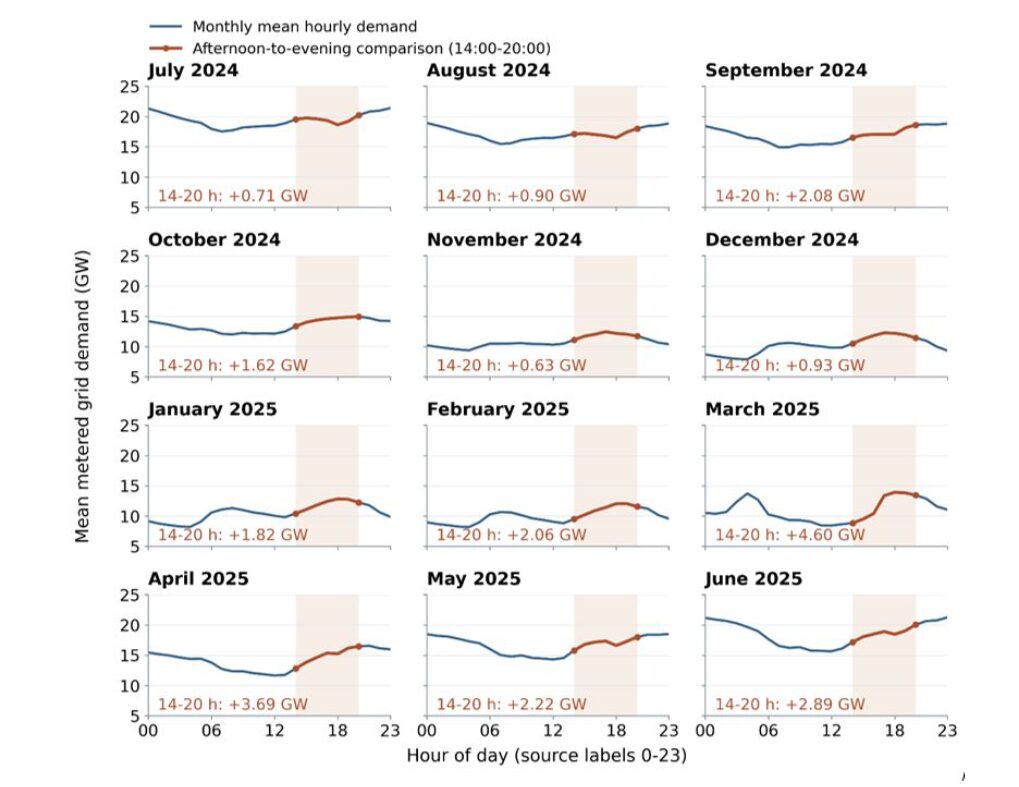
Source: Authors’ calculations using ISMO’s 8,760 metered hourly demand observations. Each profile averages the corresponding hour across all days within the month.
Highlighted segments show the transition between 14:00 and 20:00 hrs.
Following solar PV rollout, there is evidently growing battery rush. This growing adoption of consumer-owned batteries may lower grid consumption even more unless users are incentivized to run these systems in ways that benefit the entire network (IEEFA, 2025; Renewables First, 2026; Rehman & Ali, 2026).
In view of above, the afternoon-to-evening transition becomes operationally important as solar power diminishes, other resources, now may including batteries, must sustain supply. These monthly profiles support assessing storage for scheduled charging, evening discharge and rapid response, alongside flexible generation and demand response. Weather, cooling demand and calendar effects also influence demand, and the contribution of behind-the-meter solar requires separate measurements. Additional flexibility requirements should, therefore, be established after accounting for existing resource capabilities and network constraints. The proposed assessment should determine the required power, duration, response time and location, and compare qualified resources on delivery, total cost and consumer benefit.
Pakistan should not respond by discouraging consumer-financed solar or dismissing new investment as unnecessary. Additional generation, transmission, distribution and storage will continue to be required as demand, electrification and climate risks evolve. New productive uses, such as industrial electrification, electric mobility, cold storage, and data centers can improve the utilization of existing capacity. However, their value will be determined in part by when and where electricity is used. The policy aim is, therefore, to build flexibility: the ability of the power system, producers and consumers to respond efficiently when supply, demand or network conditions change.
2. The Missing Value: Capacity is Paid, Flexibility is Not Fully Valued
Electricity consumers in Pakistan mostly pay for contracted generation capacity and the electricity delivered to the system. A reliable power system, however, requires more than just available megawatts. It must responds to rapid variations of demand, manage network congestion, and restore service following any disruption. Some of these functions are essentially required under the Grid Code or existing agreements, but their costs and contributions are not regularly monitored or transparently valued.
Consumers are already bearing the costs of limited dispatch and part-load operation. NEPRA’s FY2024–25 Performance Evaluation Report records Rs 13.285 billion in Non-Project Missed Volume (NPMV) payments and Rs 44.6 billion in Part Load Adjustment Charges (PLAC) (NEPRA, 2026a). NPMV payments compensate for eligible missed generation under existing contracts and do not measure total renewable-energy curtailment while PLAC reflects fuel-cost adjustments from reduced thermal-plant efficiency at part load. These figures reflect the specific annual charges and do not constitute a complete assessment of flexibility-related costs or potential savings. The proposed assessment shall help to establish a comparable cost baseline across multiple fiscal years, distinguish physical curtailment from contractual compensation, and avoid double counting. Capacity payments compensate contracted availability and adequacy but do not necessarily reward rapid response, sustained delivery or locational value.
This fragmented framework places potential flexibility providers on unequal footing. A hydropower plant, a flexible thermal unit, a battery storage facility, an industrial consumer, and aggregated distributed resources can all support grid stability, yet each operates under a different regulatory and contractual obligation. This undermines the required competitiveness and lower to no incentives for reliable performance. It also obscures three critical distinctions: contracted capacity may not be operationally available due to fuel shortages, outages, or slow start-up times; available electricity generation may not reach a specific location due to network constraints; and an available flexible capacity has little value unless it can be activated, measured, and verified. The contemporary literature consistently emphasizes that flexibility markets work only when products, baselines, prequalification, activation, settlement and coordination between operators are designed as one system (Mentens et al., 2025; Cano-Martínez et al., 2025; Michaelis et al., 2025).
A flexibility mechanism, in this Policy Viewpoint, refers to arrangements through which the system operator or distribution company identifies a specific requirement, procure eligible resources, activate services when required, verify delivery, and make performance-based payments. It does not necessitate a new power exchange and is distinct from a capacity market, which focuses on ensuring sufficient future capacity. A flexibility mechanism determines whether resources can respond at the requisite pace, for the necessary duration, and provide support at the location where it is required.
The mechanism should be technologically neutral, but it should not adopt the same procurement approach for all services. Competitive procurement could potentially be appropriate in cases where requirements are clearly defined and multiple providers can participate. Regulated obligations or bilateral agreements may be preferable for critical system security services or locations with only one capable provider. Table 2 matches Pakistan’s core flexibility requirements, as well as appropriate initial approaches and implementation scenarios. The detailed design should be directed by system requirements and NEPRA-approved rules rather than a preference for a particular technology (NEPRA, 2023).