Protect production by securing inputs, reliable power and export delivery
Executive Summary
Pakistan stands at the lopsided end when a route carrying 25 percentage of global oil trade faces disruption. Approximately 81.6 percent of energy imports of Pakistan are dependent on the Strait of Hormuz. With reported freight surcharge of US$2,000 per container and around PKR 75-unit backup electricity contrite the working class and intimidates the production which further mandates the industrial strain. Pakistan should focus on three aspects: prompt custom clearances, reliable power supple, and fallback plans. The later to be done alongside directing CPEC 2.0 investment to cold chain infrastructure/and commercially feasible input production. The objective is to keep the goods in export cycle and factories in operation.
1. Background
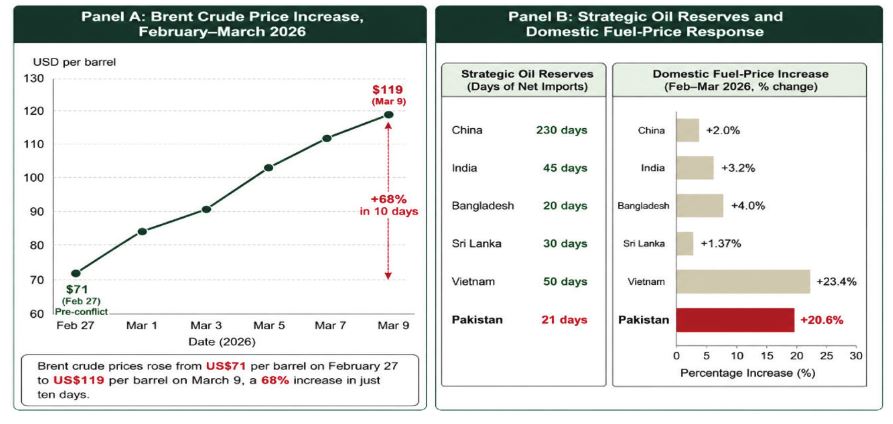
The recent 2026 US–Israel–Iran conflict greatly impacts Pakistan not because its economy is tied imported fuel, as 81.6 percent of its energy is import dependent, industrial goods from abroad, limited buffers, and sea routes that connect it to global markets. Energy disruption interrupts the industry by hiked manufacturing, irrigation and transport prices. As a result, delayed shipments disrupts import supplies, spike freight and insurance cost leading to decline in export margin. Consequently, the price shock is translated to production shock, where firms are limited to inputs and financial supply. Moreover, Brent crude price escalated to US$119 per barrel by March 9 compared to the cost before disruption, US$72.50 per barrel, a 64 percent rise in merely 10 days. The two most exposed industries are textile and agricultural-linked industries at several stages of production value chains.
The situation becomes more concerning as Pakistan’s economy doesn’t have much diversification and has a rigid import profile. Textile industry is linked to several production chains; dyeing, finishing, cotton, synthetic fiber, spinning, and transport. Whereas, agricultural-linked industry related to mills, frozen exports, and gas dependent fertilizers outputs to farms.
Figure 1: Oil Price Shock and Domestic Fuel Price Adjustment across Selected Asian Economies
Source: IEA (2026)
The cases on geopolitical oil disruptions affects majorly in two stages; first order price shocks and second order supply chain shocks. For developing economies, the second order impact is comparatively more damaging than the first impact of oil price hikes.
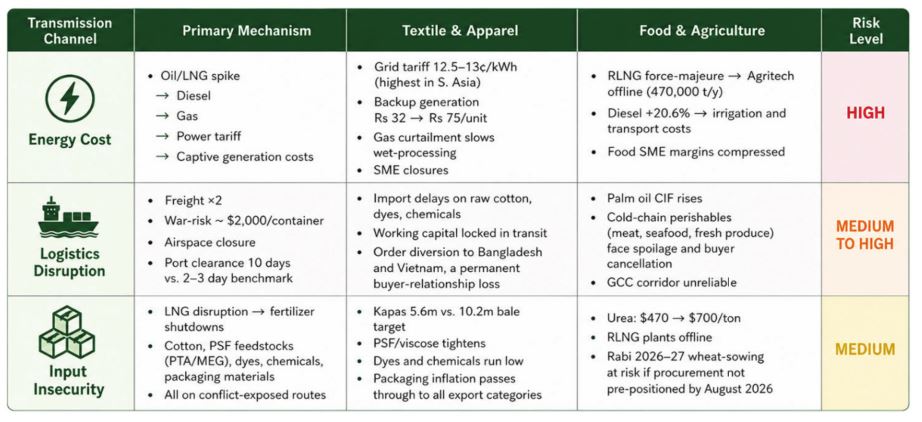
- Energy-cost channel: The rise in international oil and LNG prices shows up quickly in fuel prices, electricity, and gas The cost of moving goods increases, port operations become more expensive, farmers face higher expenses for irrigation and fertilizers, and electricity generation costs rise. Additionally, the running cost of factories will be increased. This represents that fluctuations in energy price are not alone a consumer problem, rather affecting the whole production system.
- Logistics-disruption channel: Higher shipping followed by insurance costs increase the overall cost of imports and The delays in goods take longer to arrive, which ties up money and makes it harder to manage inventory. Extra charges on containers during longer delivery hours feel like an added burden on trade. For industries already working with tight profit margins, even a small increase in shipping costs can hurt their competitiveness.
- Imported-input insecurity channel: The impact of rising energy and shipping costs becomes even more serious when the impact of exports is measures. Delay in import of cotton, fiber feedstock, dyes and packaging material hinders the essential production Consequently, industry with low inventory and limited access to credit (mainly small companies) prone to temporary shutdown, subject to lost export contract.
Table 1 provided below summarizes the transmissions mechanism across Pakistan’s industrial value chains.
Table 1: Supply-Chain Transmission Channels and Sectoral Impacts
Source: Author’s construction
2. Textile Value Chain: A Three-Layer Industrial Shock
Textiles and clothing remain the largest manufacturing and exporting industry of Pakistan, recorded up to US$18 billion and around 59 percent of total merchandise export in FY2025-26. Although, the numbers remained stable throughout the year, the performance of the industry was masked by the disruptions; increased logistic costs, constraints in input imports, and energy prices impact.
The monthly trade data illustrates a clear picture of the immediate impact of the conflict. Due to the disruption and LNG shutdown, textile year-on year exports for March 2026 accounted to US$1.32 billion, 7 percent drop from US$1.4 billion same period last year. However, in April and May 2026, the export numbers bounced back, US$2.47 billion and $2.69 billion respectively. Whereas, the textile exports recorded US$1.65 billion in May 2026, 10.61 rose from April 2026, and 8.23 percent bump from May 2025. The fluctuations align with the timeline of the conflict. Subsequent to the ceasefire, brokered by Pakistan, shipping and input costs started to stabilize. The numbers explain the temporary shock absorption by the textile sector instead of permanent damage. However, the drop in March highlights the conflict-driven logistics lead to rapid fallouts and can alter even the monthly trade profits.
2.1 Primary Input Failure: The Kapas Crisis and Synthetic Fiber Dependence
The primary problem in Pakistan’s textile supply chain starts at the source i.e., cotton. Farmers grew around 5.6 million bales of cotton in the FY2025–26, considerably less than the 10.18 million bales of government’s target. The shortfall accounts for nearly 45 percent, caused by crop pests, farmers shifting to other crops, and unpredictable rain patterns (PCGA, 2026). Moreover, a separate estimate from the US Department of Agriculture supports the case, putting production at around 5.5 million bales. Whereas, the textile industry actually needs about 15 million bales to run smoothly. Concisely, Pakistan simply is not growing enough cotton to meet its own industry’s needs, and this is not a temporary dip, rather an ongoing supply problem.
The current structural supply gap of cotton results in forced reliance on spinning mills on imported cotton, and other fibers. The Strait of Hormuz compounded the challenge of global supply chain. Therefore, in disruptive environment, key shipping routes like the Strait of Hormuz or the Red Sea, it becomes more expensive and less predictable to bring in cotton from major suppliers like the United States, Brazil, and Central Asia. Consequently, delay in imports force spinning operations for firms with limited inventory and workforce in closure or pause in process, resulting in disrupting the production line of dyeing, weaving, and garment manufacturing. Therefore, the conflict amplified the existing agricultural weaknesses and disrupting the continuity of textile value chain.
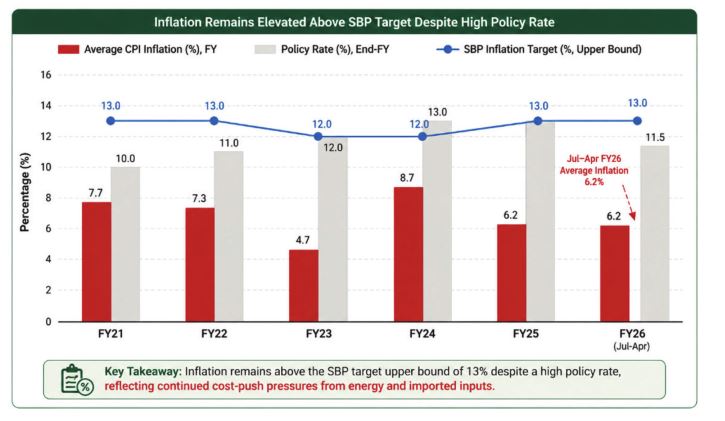
Figure 2: Impact of Energy Cost Shock on Pakistan’s Inflation and Policy Rate (FY2021-2026)
Source: Pakistan Bureau of Statistics (PBS), State Bank of Pakistan (SBP), Ministry of Finance (MoF), 2026
However, the current global tensions did not cause this problem, it simply exposed a weakness that was already there, and made it worse.
Another issue with Pakistan’s raw materials that often gets overlooked: the country’s growing reliance on synthetic and man-made fibers. According to Pakistan’s Textile Policy 2025–30, synthetic fibers have now overtaken cotton worldwide, making up about 74 percent of all fiber used globally (Government of Pakistan, 2025). Within Pakistan, the polyester industry, led by companies like Ibrahim Fibers, LCI Pakistan, Rupali Polyester, and Gatron Industries, supplies around 70 percent of its output to local spinning mills (PACRA, 2026b). The underlying limitation is the polyester production’s dependence on imported raw materials, Purified Terephthalic Acid (PTA) and Monoethylene Glyco (MEG), which are shipped in through the same internationally exposed sea routes. Thus, if the supply routes are disrupted for a long period, PTA and MEG input turns expensive, which squeezes the domestic supply of polyester fiber. Presently, the industry requires polyester as a substitute for cotton. Other fibers like viscose, acrylic, and nylon, which Pakistan imports largely, undergo the same risk. Moreover, in 2025, Pakistan imported around US$1.48 billion worth of man-made synthetic filaments and staple fibers from China alone (UN Comtrade, 2026). If these imports are disrupted as well, it would not offset the cotton shortage, it would only make it worse.
2.2 Supporting Industry Exposure: Dyes, Chemicals, and Packaging
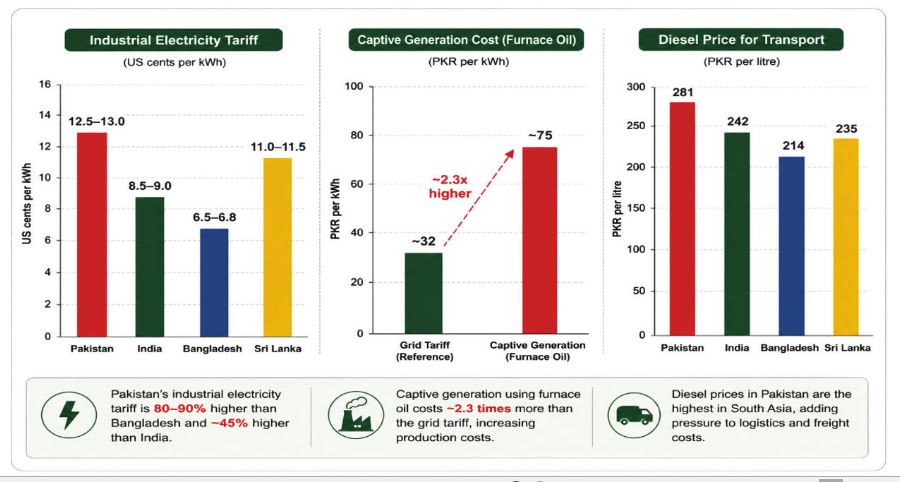
The second risk point to textile supply chain is energy costs. According to the All Pakistan Textile Mills Association (APTMA), Pakistani industries pay roughly 12.5–13.0 US cents per unit of electricity, the highest rate in South Asia. The number accounts to almost double what factories in Bangladesh pay, and about 45 percent more than in India (APTMA, 2026).
Figure 3: Industrial Energy Cost Competitiveness in South Asia
Source: APTMA (2026); SBP (2026); PIPS (2026); MoF (2026).
These rising costs affect every stage of the textile production process. Ginning and spinning consume adequate electricity, dyeing and finishing need both electricity and gas, and moving goods from factories to ports depends mainly on diesel. Hence, electricity, gas, and diesel prices all rise at the same time. Factories are highly unlikely able to switch to cheaper energy sources or keep their costs under control.
Slow logistics further fabricates the condition. According to APTMA (2026), it takes an average of ten days to clear imported industrial inputs through customs in Pakistan, compared to just two to three days internationally. Subsequently, geopolitical tensions cause extra shipping delays, crowded ports, or ships taking longer alternate routes, delivery times stretch out even further. Therefore, it implies that companies’ money gets stuck in transit instead of being used to keep production running and fulfil export orders on time.
Moreover, for Small and medium Enterprises (SMEs) with already limited margins, restricted access to credit, and limited financial reserves, relying on the backup electricity further challenges their production. During the grid outages, SMEs financial capital, due to the power leaves, is consumed more on the raw material, order fulfillment and wages. As a result of prolong or continuous outages threatens the firms to minimize shifts and stop or close production. Thus, the regional tariff comparison understates the challenges adhered by firms that also finance the costly backup generation.
2.3 Export Market Disruption: Delivery Reliability and Competitive Positioning
Collectively, these factors, higher production costs and logistics delays not just only disrupts manufacturers, it also puts Pakistan’s export business at risk. In the textile industry, being reliable frequently carries equal weight equally as offering a good price. Pakistan’s biggest buyers, the EU and GCC markets, import most of the country’s garment and home-textile exports. The delivery deadlines are taken seriously by these countries, stressed by writing it into the contract. Therefore, if a shipment is late, it is not just a one-time hit to revenue, it damages the buyer’s trust. Consequently, it becomes more likely that they will start placing future orders with competitors like Bangladesh, Vietnam, or Cambodia, instead.
However, recent tensions in the region have only worsen these risks. In March 2026, Reuters reported that airspace restrictions over the Middle East disrupted air cargo for fast-fashion shipments from South Asia, and freight costs on those routes shot up as a result. With shipments taking longer and costing more to move, Pakistan is finding it difficult to remain competitive in export segments where speed is everything.
Furthermore, operational challenges, competition from other countries intensifies. The EU–India Free Trade Agreement, signed on 27 January 2026, gives Indian exporters a tariff edge in the European market for at least the next few years, while Pakistan still depends on the GSP+ scheme, which comes with conditions attached and no similar bilateral deal of its own. Therefore, translating the prolonged delivery delays not only cost Pakistan money in the short term. The gap opens space for the regional rivals with cheaper energy, similar labor costs, and better market access (European Commission, 2026).
3. Food Processing and Agriculture-Linked Industry: From Gas Shock to Farm Gate
Pakistan’s food-processing and agriculture-linked industries accounted the second major pillar of the country’s export economy. In addition, with the prior struggling phase, the later event further strained this industry; the recent geopolitical tensions, damaged production by flood, and trade with Afghanistan had dropped after the border closures. During FY2025–26, food-group exports fell sharply by 25 percent to US$5.57 billion, while the country’s food import bill climbed to around US$7.85 billion. The numbers stressing that the current geopolitical disruption is not generating a new problem, it is adding pressure to weaknesses that were already present
3.1 The Urea-Gas Nexus: When an Energy Shock Becomes a Crop Input Crisis
Pakistan’s food industry is the evident fallout of Middle East conflict as the industry runs through fertilizer production. On March 4, 2026, Agritech Limited informed the Pakistan Stock Exchange that Sui Northern Gas Pipelines Limited (SNGPL) declaring force majeure on RLNG supply. Therefore, illustrating no guarantee deliveries, because the ongoing conflict had disrupted LNG production facilities in the Gulf. As a direct result, Agritech’s urea plant in Mianwali, which normally produces around 470,000 tons a year, reported a shutdown. This is not an isolated case either: Pakistan relied on Qatar for its imported LNG, and other producers like Fatimafert (500,000 tons/year) and Pak-Arab (100,000 tons/year) rely on the same RLNG supply through SNGPL, consolidating the import source, leaving them exposed to the same risk.
QAFCO, Qatar’s state-owned fertilizer producer with 5.6 million tons of annual urea capacity, also had to suspend production after the conflict disrupted energy supply chains. This pushed global urea export prices from around $470 per ton before the conflict to over $700 per ton within just a few weeks. The Carnegie Endowment noted that fertilizer companies in India, Bangladesh, and Pakistan all faced production disruptions, turning this into a regional food security concern, not just for Pakistani.