Executive Summary
Pakistan stands at a critical crossroads in its trade and industrial policy. The current tariff system is overly complex, eroding industrial competitiveness, raising consumer costs, and deterring investment. Despite past reforms, it continues to protect inefficiency and limit integration into global value chains. Urgent action is needed to transform tariffs from a barrier into a driver of growth. This brief recommends moving decisively toward a simpler, transparent, and export-oriented tariff regime by rationalizing rates, removing distortive exemptions, and aligning policy with long-term industrial and trade goals. Effective implementation of these reforms will unlock export potential, attract investment in high-value sectors, lower hidden costs, and strengthen fiscal outcomes. The cost of inaction is rising, but timely reform can reshape Pakistan’s economic trajectory for decades.
Policy Hook: Why Tariff Reform Can’t Wait
Pakistan’s complex and protectionist tariff system costs the economy billions each year while eroding competitiveness, inflating consumer prices, and locking industries out of global value chains. Every additional year under the current regime risks slowing export growth, raising production costs, and deepening the trade deficit. Can Pakistan afford to let tariff inefficiencies continue holding back its economic potential?
1. Background & Rationale: From Revenue-Driven Protectionism to GrowthOriented Reform
Pakistan’s existing tariff structure has long been shaped by Regulatory Duties (RDs), Additional
Customs Duties (ACDs), and 5th Schedule exemptions. These tools originally intended for revenue generation and selective protection. Over time, however, these instruments have distorted markets, transformed price signals, and created inefficiencies. Businesses dependent on imported inputs face higher production costs, eroding profitability and discouraging innovation. Consumers pay more for essential goods, while uneven exemptions reduce competition and weaken industrial vitality.
These distortions have also imposed a pronounced anti-export bias. Elevated input costs and complicated refund mechanisms discourage outward-oriented growth, reinforcing inward-looking policies at odds with global integration.
The National Tariff Policy (NTP) 2019-24 was a step toward rationalization, promoting competitiveness and transparency. Until now, its reliance on RDs, ACDs, and exemptions perpetuated complexity and distorted incentives. Pressure from protected groups further entrenched these measures, widening tariff anomalies and limiting progress (PIDE,2020a).
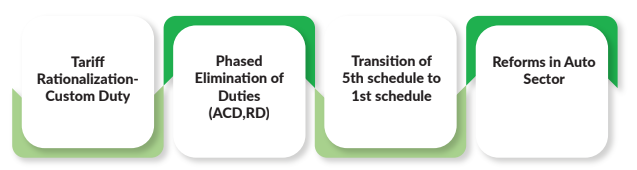
The new National Tariff Policy (2025-30) builds on previous efforts with a clearer focus on export-led growth, anti-export bias reduction, and integration into global value chains. It sets a roadmap to eliminate ACDs within four years and RDs within five, while transitioning products from the 5th to the 1st Schedule (PIDE, 2020b). It also introduces targeted reforms in the auto sector, enhances consumer welfare, and seeks to improve competitiveness. Supported by institutional mechanisms like the Tariff Policy Board and Tariff Policy Centre, the policy aims to boost exports by 10-14%, reduce the trade deficit, and strengthen industrial growth and investment.
Key Measures
Four key measures are mainly declared in new tariff policy are expected to create simple and
transparent tariff regime.
2. Recommendations
To unlock the potential of the NTP (2025-30), it is recommended that policymakers pursue the following strategic actions:
a) Simplify the Tariff Structure and Eliminate Distortions
It is recommended that Pakistan streamline the customs duty slabs from five to four (0%, 5%, 10%, 15%) within five years. Simplifying the structure will reduce complexity, improve predictability, and enable businesses to plan and invest with confidence. Phasing out tariff peaks, particularly those exceeding 20%, will minimize distortions and enhance competitiveness.
b) Eliminate Regulatory and Additional Customs Duties Within a Clear Time Frame
Pakistan must commit to a phased elimination of ACDs within four years and RDs within five.
Duties should be harmonized by product category as lowest on raw materials, moderate on intermediates and capital goods, and highest on consumer goods in order to minimize tariff increase and encourage industrial upgrading. This step will reduce opportunities for rent-seeking and promote a transparent trade environment.
c) Transition from the 5th to the 1st Schedule to Remove Bias
It is recommended that Pakistan transition products currently under the 5th Schedule into the 1st Schedule over five years. Concessions should be generalized or withdrawn where necessary, with new tariff headings created for clarity and the ambiguous “others” category disaggregated. This will provide different opportunities for firms of all sizes, reduce bias toward large players, and simplify compliance.
d) Align Auto Sector Tariffs with Competitiveness and Consumer Choice
Policymakers should implement comprehensive auto sector reforms in line with the Automotive Industry Development and Export Plan (AIDEP 2021-26). From July 2026, this should include significant duty reductions, removal of ACDs and RDs, and revision of key SROs. Allowing the import of older and used vehicles under strict quality and environmental standards will foster competition, expand consumer choice, and accelerate innovation.
e) Integrate Tariff Reform with Complementary Policies
Tariff rationalization alone will not drive export growth. It is recommended that Pakistan align tariff reforms with improvements in logistics, trade facilitation, access to finance, and the regulatory environment. Synergizing these complementary policies will maximize the impact of tariff reforms on industrial expansion, competitiveness, and export diversification (also emphasized by Qadir & Najeeb (2025).