
EXECUTIVE SUMMARY
Pakistan’s minimum wage determination has historically functioned more as a symbolic annual announcement than as a transparent, evidence-based labour market institution. In a period marked by persistent inflationary pressures, food and energy shocks, labour market informality, and rising household vulnerability, minimum wage policy must evolve into a credible macro-social policy instrument capable of protecting workers while remaining economically sustainable and administratively enforceable.
This policy brief proposes a shift from discretionary wage announcements toward a transparent, rules-based framework grounded in official evidence and aligned with International Labour Organization (ILO) principles. Rather than relying on a single indicator or arbitrary adjustment, the proposed approach combines purchasing-power protection, worker-family adequacy checks, labour-market affordability, partial productivity sharing, and provincial implementation realities. The proposed reform architecture rests on four linked elements: transparent evidence-based wage setting, bounded provincial calibration, credible enforcement and compliance mechanisms, and annual reporting on wage-setting evidence and implementation outcomes.
Applying this framework to official data from the Pakistan Bureau of Statistics (PBS), the Ministry of Planning, Development and Special Initiatives, and other government sources supports a recommended national minimum wage reference benchmark of Rs. 45,000 per month for FY2026–27. This benchmark represents the administratively rounded policy application of the hybrid methodology and reflects purchasing-power protection, worker and household adequacy, partial productivity sharing, labour-market affordability, and implementation feasibility. The supporting sensitivity analysis is reported in the integrated annex.
The framework further recommends a “national reference benchmark with provincial calibration” model. Under this approach, the Federal Government would publish a transparent methodology and national reference benchmark. At the same time, provinces would retain constitutional authority to notify wage rates at or above that benchmark, based on local labour-market evidence, affordability conditions, and enforcement capacity. Indicative provincial calibrations suggest Rs. 45,000 for Punjab and KP, Rs. 46,000 for Sindh, and Rs. 45,500 for Balochistan, subject to provincial affordability, sectoral, and compliance reviews. The central contribution of this policy brief is therefore institutional rather than merely numerical. It proposes a minimum wage governance system under which the national benchmark is derived transparently, provincial adjustment is evidence-based and bounded, compliance is progressively strengthened through phased enforcement, and annual reporting holds institutions accountable for whether workers actually receive the notified wage.
The integrated annex provides the estimation formulae, provincial calibration indicators, sensitivity analysis, and core implementation-monitoring indicators supporting the proposed framework.
Evidence Dashboard for Minimum Wage Setting
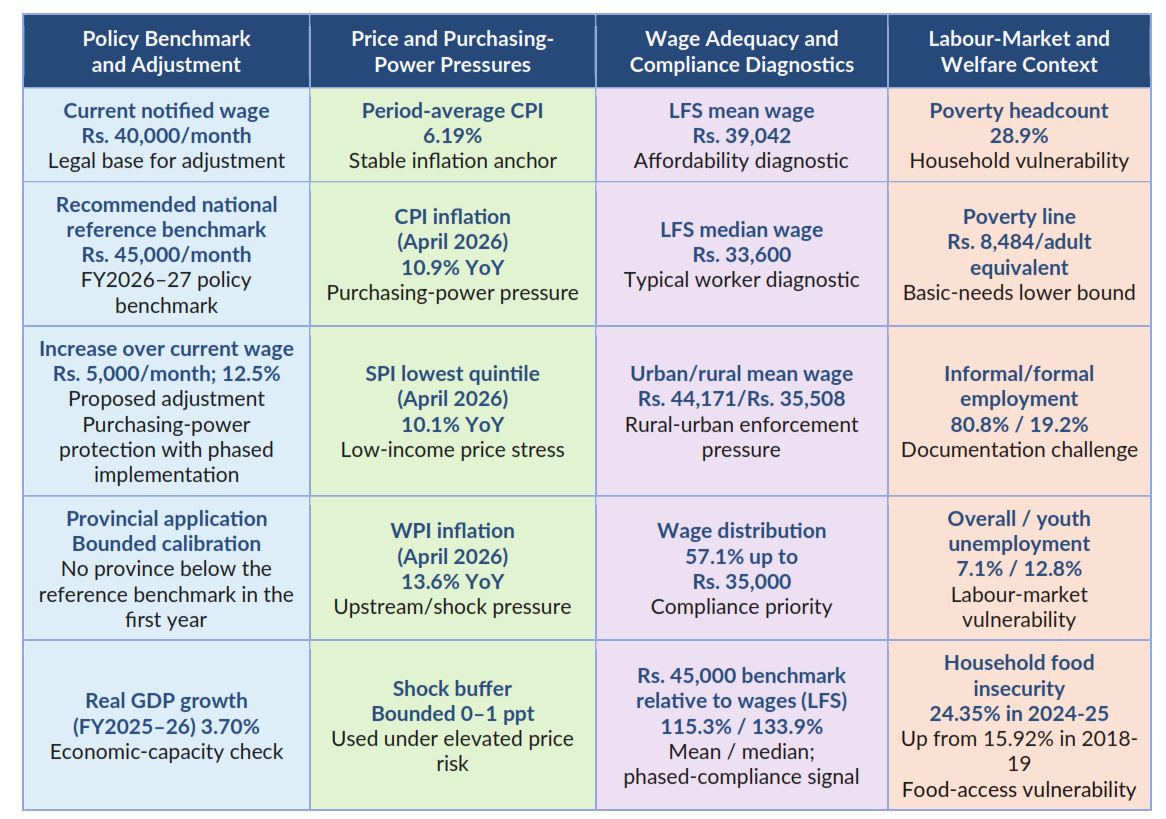
Sources: PBS Monthly Review on Price Indices, April 2026; PBS Labour Force Survey 2024–25; Ministry of Planning, Development and Special Initiatives, poverty estimates; PBS National Accounts.
Notes: Overall/youth unemployment are reported under the PBS current labour-force framework; formal/informal employment shares are reported under the 21st ICLS framework. Benchmark-to-wage ratios are compliance diagnostics, not grounds for reducing the recommended benchmark.
1. Why Pakistan Needs a Credible Minimum Wage System
Pakistan’s minimum wage setting process has long suffered from four major weaknesses: discretionary announcements, weak enforcement, poor provincial coordination, and limited analytical transparency. As a result, announced minimum wages often fail to translate into actual wages paid, particularly in labour-intensive and informal sectors.
Minimum wage policy today has implications extending far beyond labour departments. It directly influences household purchasing power, poverty vulnerability, labour informality, domestic demand, industrial costs, and social stability. In the context of persistent food inflation, external-price shocks, and declining real wages, the credibility of wage-setting institutions has become increasingly important. The challenge, therefore, is not merely determining “what number to announce,” but rather establishing “what rule can credibly protect workers, remain affordable for firms, and be implemented by provinces.” Labour-market vulnerability is further reflected in elevated youth and educated unemployment, reinforcing the need for wage-governance reform to be complemented by employment creation and productivity-enhancing policies.
Following the 18th Constitutional Amendment, the determination and enforcement of minimum wages largely fall within provincial jurisdiction. Consequently, the Federal Government’s role should evolve toward providing a transparent evidence-based benchmark and methodological guidance, while allowing provinces to calibrate and notify wages according to their labour-market conditions and enforcement realities.
In Pakistan’s current economic context, the minimum wage policy has both labour-market and macro-social implications. Where compliance is achieved, protection of low-paid workers’ real earnings can support household consumption, reduce working poverty, and strengthen resilience against food and energy shocks, particularly because lower-income households devote a larger share of income to essential consumption. Over time, improved wage security may also support nutrition, worker retention, and labour productivity. However, where wage increases are not aligned with enterprise capacity or are not effectively enforced, the adjustment may instead result in informality, under-reporting of wages, reduced hiring, or substitution away from low-skilled labour. Minimum wage governance must therefore balance purchasing-power protection with affordability, compliance, and productivity-enhancing measures.
The objective is therefore to transition:
- From discretion to rules
- From symbolic announcements to enforceable compliance
- From isolated labour notifications to integrated macro-social policy
Accordingly, the purpose of this brief is not to advocate wage adjustment in isolation, but to propose an institutional framework for minimum wage governance. The wage benchmark estimated in this brief is one application of that framework, which is built on transparent evidence, bounded provincial calibration, credible enforcement, and annual accountability for implementation outcomes.
2. Conceptual Framework for Evidence-Based Wage Setting
The proposed framework follows the ILO principle that minimum wage setting must balance worker and family needs with economic and institutional realities. No single indicator is sufficient on its own. CPI-only approaches protect purchasing power but ignore affordability and productivity; productivity-only approaches risk excluding vulnerable workers; and poverty-line-only approaches may be socially relevant but economically difficult to sustain as a direct wage-setting rule.
The proposed hybrid framework, therefore, combines five complementary pillars:
i. Purchasing-Power Protection: Average CPI inflation serves as the primary indexation anchor to protect real wages, while SPI and WPI indicators capture low-income price stress and upstream cost pressures.
ii. Worker and Family Adequacy: The framework compares proposed wages with poverty thresholds, household size, Household Integrated Economic Survey (HIES) evidence, transport and utility costs, and basic-needs considerations.
iii. Labour-Market Affordability: Labour Force Survey (LFS) mean and median wages are used as affordability and compliance-risk diagnostics. They are not treated as normative ceilings because observed wages in informal labour markets may reflect weak bargaining power, underemployment, non-compliance, and low-productivity employment structures.
iv. Partial Productivity Sharing: Economic growth and productivity indicators are incorporated as capacity checks rather than dominant determinants. This allows workers to share partially in economic gains while avoiding unsustainable wage escalation.
v. Enforcement and Institutional Feasibility: Provincial enforcement capacity, labour-market informality, sectoral conditions, and administrative feasibility are incorporated to assess whether the notified wage can realistically become an effective wage.
A credible wage-setting framework must also distinguish between the normative wage floor, the effective wage floor, and the transition path between them. The normative floor reflects what workers should receive based on inflation protection, adequacy, vulnerability, and purchasing-power preservation. The effective floor reflects what can realistically be enforced under prevailing labour-market conditions. The transition path is the institutional process through which a notified wage progressively becomes the wage actually received by workers. This distinction is essential for Pakistan because any estimated benchmark must be treated as a policy benchmark whose credibility depends on phased enforcement, digital payroll documentation, procurement-linked compliance, and provincial implementation capacity.
The framework, therefore, produces an evidence-based wage range rather than an arbitrary single figure. It emphasizes calibrated adjustment, affordability, and enforceability rather than automatic escalation.