Executive Summary
Pakistan cannot achieve sustained export-led growth while its freight system remains overwhelmingly road dependent. High logistics costs, higher imported fuel bills, increasing pressure on roads and inefficient freight system raise the cost of production and weaken the competitiveness of Pakistani firms. The freight share of rail is now low, even though it inherited one of South Asia’s largest railway networks. Over time, the number of locomotives and wagons reduced. In addition, underinvestment, institutional fragmentation, limited private participation, and misalignment with industrial policies have made matters worse. About 63 percent of locomotives are 20 years old, and the organization continues to carry significant legacy financial obligations.
International experience shows that competitive economies prioritize rail for long-haul freight. China and India have both established dedicated freight corridors, logistics parks, and introduced institutional reforms. This brief proposes five-point reform agenda focused on freight infrastructure modernization; separation of regulatory, infrastructure and operating functions; transparent private-sector participation and digital freight systems; commercial development of railway land and stations; and strategic alignment with CPEC 2.0. These measures would revitalize Pakistan Railways as a commercially viable logistics backbone for economic transformation through exports, industrial development, and regional connectivity.
Introduction
An efficient logistics system enables competitiveness. The logistics system consists of road, railway, air and sea transportation. Transportation by Air is fast but costly, sea is cost-effective but much time-consuming. Railway transportation is fast and cost-effective compared to roads; fast compared to sea routes (maritime) but more costly (International Transport Forum, 2023). A single one-kilometer-long freight train replaces 72 trucks (Qian, 2025). It carries goods at roughly 165 ton-km per liter compared with about 60.3 ton-km per liter for road transport (World Bank, 2017). This is how in major regional economies, rail is used for much larger share of long-haul freight transportation.
The decline of Pakistan Railways can be traced from its history. After independence, Pakistan inherited an extensive railway network (Hasan, 1971), freight share was 73 percent in earlier decades (Li, Alam, & Wang, 2018), which is now 8 percent (Ministry of Planning, Development and Special Initiatives, 2024). This decline was not inevitable because it remained a neglected sector in terms of resource allocations. It is reflected in Pakistan’s Five-Year Plans (FYPs) record: the first FYP, allocated 70 percent of land-transport spending to railways compared to 30 percent for roads (National Planning Board, 1957). By the Second FYP, the share had fallen to 44.7 percent against 55.3 percent for roads (Planning Commission, Government of Pakistan, 1960). The trend deepened over subsequent decades and fell to 12.5 percent by the Seventh Plan (Ahmed, 2021). The policy priority for roads is still prevalent with PKR 224.50 billion to the National Highway Authority against only PKR 40.65 billion to Pakistan Railways in Public Sector Development Programme 2026-27 (Ministry of Planning, Development & Special Initiatives, 2026).
Political instability has also compounded this structural neglect. The frequent change of government and leadership along with short planning horizons have repeatedly interrupted reform continuity, as successive governments abandoned their predecessors’ initiatives before they could mature. Due to the lack of proper implementation and inconsistency, even repeated restructuring reforms could not bear fruit. It pulled Pakistan Railways into the vicious circle of operational inefficiency and increased public subsidy without any effective improvement in public delivery.
Now, Railway revitalization is not only transport policy concern but also a national economic interest. Under “URAAN PAKISTAN” and the “5-Es Economic Transformation plan”, Pakistan aims to increase its exports. This requires conditions such as low logistics costs and regional connectivity. To achieve these objectives Pakistan needs to restore rail as the primary mode for long-haul freight transportation.
Pakistan’s Freight Transport Imbalance: A Structural Competitiveness Challenge
Pakistan has overlooked railways and prioritized roads in its policies, despite having 7,791 route kilometers of railway network (Pakistan Railways, 2024-25). This insufficient attention resulted in imbalance in freight transportation, where roads carry most of the freight. It has also eroded national competitiveness, industrial productivity, fiscal sustainability, and regional connectivity.
Pakistan Railways’ freight performance since 2010-11 can be categorized in three distinct phases based on freight traffic (Figure 3). Freight traffic initially fell sharply from 2.61 million tons in 2010-11 to just 1.0 million tons in 2012-13. In the second phase, freight volumes increased to 8.3 million tons by 2017-18. This recovery was supported by effective resource utilization, the rehabilitation of existing freight wagons and especially dedicated coal-haulage operations for the Sahiwal Coal Power Project. In the third phase, the freight traffic was stable despite the COVID-19 pandemic, but the heavy floods of 2022 caused it to drop to 5.75 million tons in 2022-23. It reached 7.75 million in 2024-25.
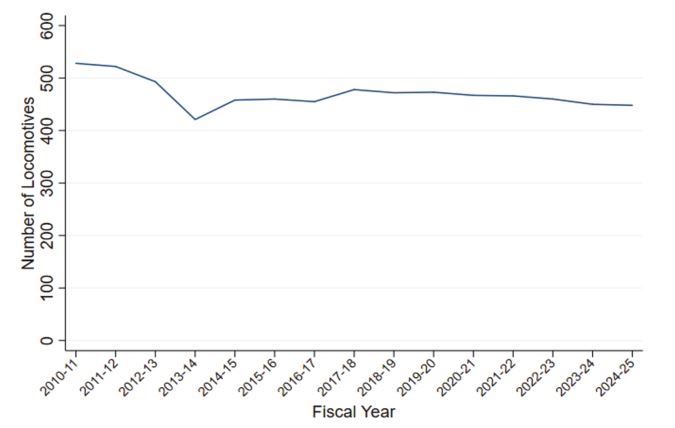
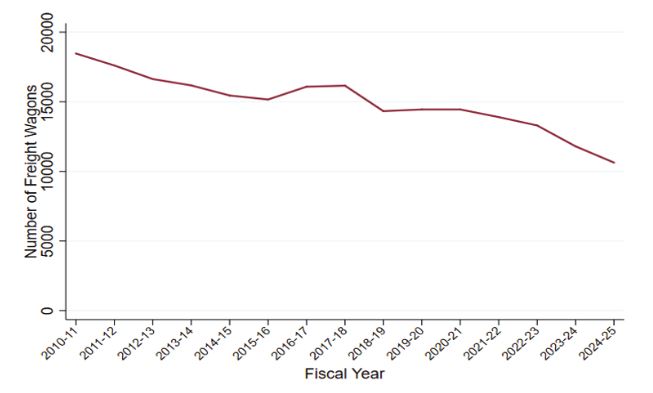
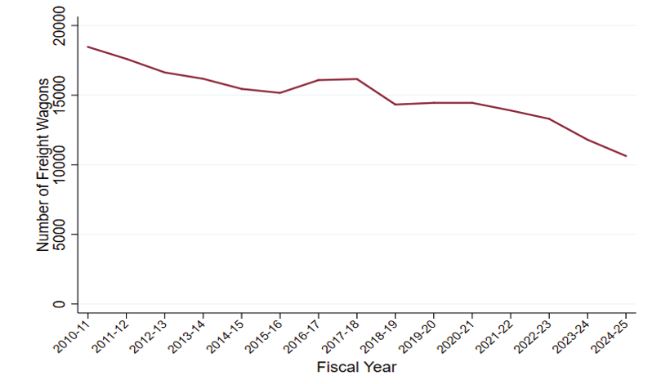
This improvement in performance from 1 to 7.75 million took place even though the locomotives and freight wagons declined in numbers (reflected in Figures 1-2). It reflects the effective utilization of existing assets rather than major expansion of assets. However, most of the freight volume increase was limited to a few bulk-freight contracts, especially the Sahiwal coal operation.
Figure 1: Pakistan Railways’ Number of Locomotives (2010-11 to 2024-25)
Source: (Finance Division, Government of Pakistan, 2026)
Figure 2: Pakistan Railways’ Number of Freight Wagons (2010-11 to 2024-25)
Source: (Finance Division, Government of Pakistan, 2026)
Figure 3: Pakistan Railways’ Freight Volume (2010-11 to 2024-25)
Source: (Finance Division, Government of Pakistan, 2026)
There are many operational constraints such as obsolete infrastructure, inadequate double-tracking capacity, slow operating pace, outdated signaling, and limited freight-handling capacity. On 14 January 2026, Answering to National Assembly’s Committee on Railways, Pakistan railways stated in writing that about 63 percent of locomotives have completed more than 20 years of service (National Assembly of Pakistan, 2026).
Institutional fragmentation further constrains railway performance. Currently, Pakistan Railways simultaneously performs the responsibility for regulation, infrastructure management, and train operations. It makes commercial accountability very difficult, limits operational transparency and fails to attract private investment. Rising legacy costs compound the financial pressures as the pay and pension obligations already consume most of Pakistan Railways’ annual grant-in-aid, and the organization is carrying more than Rs 62.5 billion in pension and retirement dues against its roughly 48,949 employees (Pakistan Railways, 2024-25). These burdens continue to increase, making the cost of delayed reform progressively higher.
The repercussions of roads’ high freight shares are high highway depreciation rates, more congestion, and an increase in public expenditure on road maintenance. The higher road costs weaken the competitiveness of export-oriented sectors such as textiles, cement, fertilizer, steel, minerals, and agriculture. Also, Pakistan is heavily dependent on imported petroleum. This makes the road-dominated system costly, since trucking consumes substantially more fuel per ton-kilometer than rail. Without reliable freight rail, Pakistan’s ambitions for export-led growth and regional integration will not come true.
Lessons From International Experience
Many emerging economies have transformed their railway systems into engines of growth. One of the best examples is China. The 2013 reform created China Railway Corporation, which became China State Railway Group in 2019, separating regulatory functions from commercial railway operations. China State Railway Group subsequently consolidated infrastructure and train operations, while regulatory oversight was assigned to the State Railway Administration (State Council Information Office, People’s Republic of China, 2021). This regulatory-commercial separation, combined with sustained investment in freight corridors, logistics parks, and R&D, and a growing role for private and provincial capital, has driven a sharp expansion in freight capacity; China’s 15th Five-Year Plan extends this further through an “eight vertical, eight horizontal” national rail corridor network (National People’s Congress of the People’s Republic of China, 2026). By contrast, full vertical separation of infrastructure from train operations, is more characteristic of European systems.
Other countries also followed diverse approaches to improve their performance. India followed corporatization, introduced dedicated freight corridors and separated freight from passenger operations, adopted public-private partnerships while retaining public ownership (World Bank, 2021). In the United States railways are operated by the private sector, and it has managed freight railroads under strong regulatory oversight. European countries have ensured multimodal integration between rail, ports, and inland waterways to build sustainable port-hinterland networks (Shayan & Kalejahi, 2026). Japan has adopted modern technology in the form of advanced signaling, predictive maintenance, and automated freight operations (Japan Freight Railway Company, 2026).
The overall lesson is that infrastructure investment alone is not enough, effective planning, commercial governance, advanced digital systems and private participation aligned with industrial and trade policy are prerequisites for successful railway systems.
Policy Recommendations
Revitalizing Pakistan Railways requires more than adding new locomotives. It requires incorporating Pakistan’s industrial, export and economic strategy into railways policy. It also demands coordinated investment in infrastructure, institutional reform, and digital modernization. These efforts must be aligned with the development of ports, special economic zones, and CPEC 2.0. The following five priorities outline a phased, and actionable agenda.
Accelerate Infrastructure Modernization and Prioritize Freight Rail as National Economic Infrastructure
Upgrading and modernization of Main Line (ML-1) should receive top priority in transportation policy. ML-1, which has been pending for years, has now received approval for its first phase, i.e., the Karachi-Rohri section. The government needs to align the project’s pace and standards with international benchmarks. ML-1 will be capable of supporting trains traveling (designed) at 160 km per hour; however, trains are expected to run (planned) up to 120 km per hour (Ranjha & Akhtar, 2023); (National Assembly of Pakistan, 2026). The remaining Rohri-Peshawar section needs careful planning and implementation in a sequenced manner. The government should treat freight through rail as national infrastructure agenda. A due share of PSDP can be assigned to freight-rail development to achieve target of 25% freight (Ministry of Planning, Development and Special Initiatives, 2024). Also, the government needs to attract more investment through public–private partnerships. The small and smart approach of China can also be helpful; initially target 2-3 priority dedicated freight corridor to integrate ports with major industrial cities, and border crossing points. These actions and digital technology adoption will cut costs, significantly increase capacity and reliability of railway. It also demands speeding up the process of environmental and land-acquisition approvals; and the effective implementation of policies.
Reform Railway Governance and Strengthen Institutional Accountability
Institutional restructuring should clearly separate policy formulation, infrastructure management, regulation, and train operations; following the regulatory-commercial separation pursued in China and the fuller vertical separation adopted across Europe. Track access and commercial freight services should be genuinely opened to private operators in the true sense through transparent concession agreements. This will keep ownership in public hands with separate independent economic regulations. The composition of the Pakistan Railways Board (Brain of Railway) which has undergone multiple changes in past needs to be changed, so that a majority of members are railway-sector experts rather than bureaucrats. The competent board would oversee the system in more effective way compared to non-technicals. Pakistan should also consider adopting China’s Asset–Operation–Liability System, which ties individual managers’ incentives directly to the performance, safety, and financial condition of the assets under their responsibility. Along with these reforms, an integrated Enterprise Resource Planning system should connect departmental processes, to improve procurement, coordination, transparency, and data-driven decisions.
Mobilize Private Investment and Digitalize Operations
Private capital should be channeled through transparent PPPs for freight terminals and inland container depots, wagon leasing and container operations, and commercial development of station and land assets, using standardized concession documents and open competitive bidding to attract serious investors. In addition, Pakistan Railways should have a unified integrated Digital Freight Platform containing booking, billing, cargo tracking, maintenance scheduling, and performance reporting, connected to the Pakistan Single Window and major shippers’ ERP systems. Together, private capital and digital integration can enhance operational efficiency, mobilize investment and reduce delays and minimize the fiscal burden.
Monetize Land Assets and Strengthen Provincial Partnerships
Pakistan Railways owns approximately 167,690 acres of land, of which roughly 126,426 acres are under operational use, 19,133 acres reserved for future use, 10,020 acres leased out, 3,956 acres under unauthorized encroachment, 527 acres under regularized Katchi Abadis, 308 acres with commercial potential, and 7,310 acres barren or cultivable (Senate Secretariat, Parliament of Pakistan, 2019). With 461 stations nationwide, excluding halts (Pakistan Railways, 2024-25), there is significant scope to replicate the airport model of non-fare commercial revenue such as shopping centers, offices, and restaurants on underused station land. This requires developing the market strategy currently missing from this business line. Building on the Government of Punjab’s MoU with Pakistan Railways, all provinces should participate in planning suburban rail, regional freight terminals, and industrial connectivity, potentially through dedicated Regional Railway Authorities, with joint federal-provincial financing to align investment with regional priorities.
Align With CPEC 2.0 Through National Coordination
CPEC 2.0 seeks to increase export growth through industrial integration, especially in SEZs. Railway investment should directly support CPEC 2.0 industrial corridors, linking SEZs and export clusters with ports, border crossing points, and international markets. To achieve this, a high-level National Freight Transport Council should bring together the Ministry of Railways, Communications, Maritime Affairs, Commerce, Planning, Industries, and Finance alongside provincial governments and the private sector stakeholders. The council will solve coordination problems that Pakistan’s fragmented transport governance has often lacked. It should oversee the integration, ensuring freight policy is developed under a unified national logistics framework.
Expected Economic Outcomes
If implemented as a coordinated reform package rather than as isolated projects, these five priorities can deliver substantial economy-wide gains:
- Reduce national logistics costs from 6 percent of GDP to 8-9 percent of advanced economies such as the US, Japan, and Singapore (FPCCI, 2025), as rail is used for a larger share of long-haul freight transportations.
- Cut freight transit time between ports and major industrial hubs (Lahore, Faisalabad, Multan, Peshawar) through ML-1 modernization and dedicated freight corridors.
- Lower the transport fuel import bill and national greenhouse gas emissions by attracting long-distance bulk cargo to the more energy-efficient rail network, while increasing road service life by reducing heavy-truck traffic.
- Improve the financial sustainability of Pakistan Railways by raising freight revenue, commercializing land assets, and attracting private investment and easing a subsidy burden already strained by pension and pay costs.
Conclusion
Delaying reform and inaction has significant economic costs which increase over time. Delay in actions may shift freight permanently to road, highways may face greater wear, the fuel import bill may grow, and Pakistan Railways’ pension and pay liabilities may consume a larger share of financial resources. Revitalizing Pakistan Railways does not require creating something new; it requires completing the reforms that are already on the table, including ML-1, governance reform, land monetization, and stronger institutional commitment. This requires recognizing railways as economic infrastructure that supports trade, exports, and industrial
competitiveness. Pakistan’s export ambitions, its CPEC 2.0 corridors, and its fiscal constraints make railway revitalization a priority for this decade, while the existing network, land assets, and traffic base still offer considerable potential.
Note on Use of AI: Generative AI was only used to support grammar checking and sentence restructuring during the drafting of this brief. All research, data interpretation, and policy recommendations are the author’s own.
References
Ahmed, M. I. (2021). Pakistan’s Railways: A Painful History? The Railways in Colonial South Asia.
Finance Division, Government of Pakistan. (2026). Pakistan Economic Survey 2025-26. Islamabad: Finance Division, Government of Pakistan. Retrieved from https://finance.gov.pk/survey/chapter_26/Complete_PES2025_26.pdf
FPCCI. (2025). A Policy Brief on Pakistan’s Logistics Performance and Its Impact on Trade Competitiveness. Karachi: Federation of Pakistan Chambers of Commerce & Industry.
Hasan, S. (1971). Pakistan: The Story Behind its Economic Development. Rawalpindi: Vantage Press. International Transport Forum. (2023). ITF Transport Outlook. Paris: OECD. Retrieved from https://doi.org/10.1787/b6cc9ad5-en
Japan Freight Railway Company. (2026, 08 01). Systems Supporting Freight Rail Transport. Retrieved from https://www.jrfreight.co.jp/en/it.html
Li, X., Alam, K., & Wang, S. (2018). Trend Analysis of Pakistan Railways Based on Industry Life Cycle Theory. Journal of Advanced Transportation, 2018. Retrieved from https://doi.org/10.1155/2018/2670346
Ministry of Planning, Development and Special Initiatives. (2024). 5 Es National Economic Transformation Plan. Islamabad: URAAN PAKISTAN, MPD&SI.
Ministry of Planning, Development & Special Initiatives. (2026). Public Sector Development Programme 2026–27. Islamabad: Ministry of Planning, Development & Special Initiatives, Government of Pakistan.
National Assembly of Pakistan. (2026, 09 21). Standing Committee on Economic Affairs Division meets. Retrieved from National Assembly of Pakistan: https://na.gov.pk/en/pressrelease_detail.php?id=8078 National Assembly of Pakistan. (2026, 01 14). Standing Committee on Railways meets. Retrieved from National Assembly of Pakistan: https://na.gov.pk/en/pressrelease_detail.php?id=7558
National People’s Congress of the People’s Republic of China. (2026). Outline of the 15th Five-Year Plan for National Economic and Social Development of the People’s Republic of China (2026–2030). Beijing: National People’s Congress of the People’s Republic of China.
National Planning Board. (1957). The First Five Year Plan. Karachi: Government of Pakistan Press. Pakistan Railways. (2024-25). Year Book. Lahore: Pakistan Railways.
Planning Commission, Government of Pakistan. (1960). The Second Five Year Plan, 1960–65. Islamabad: Government of Pakistan.
Qian, J. (2025). Transforming Logistics: The Power of Rail Investment. World Bank.
Ranjha, Z. Z., & Akhtar, S. (2023). Is ML-1 a ‘luxury’ or an essential requirement? Lahore: Ministry of Railways, Government of Pakistan. Retrieved from https://www.railways.gov.pk/PublicationDetail/ZDI3MjJmODUtZGFhNi00MDRhLWI2MzgtZmE0Y2RiZWQ 3Zjg0
Senate Secretariat, Parliament of Pakistan. (2019). The Details of Land Owned by Pakistan Railways. Islamabad: Senate Secretariat, Parliament of Pakistan. Retrieved from https://senate.gov.pk/uploads/documents/questions/1578629014_522.pdf
Shayan, N. F., & Kalejahi, N. M. (2026). Inland port sustainability: Systematic review uncovering terminologies, topics, methodologies, and geographical scope. Research in Transportation Business & Management.
State Council Information Office, People’s Republic of China. (2021, January 10). China’s International Development Cooperation in the New Era. Retrieved from State Council Information Office of the People’s Republic of China: http://english.scio.gov.cn/whitepapers/2020-12/22/content_77040131_6.htm
World Bank. (2017). Railways Reform: A Toolkit for Improving Rail Sector Performance. Washington: Transport and ICT.
World Bank. (2021, January 21). India Takes a Quantum Leap in Building New Freight Corridors. Retrieved fromhttps://www.worldbank.org/en/news/feature/2021/01/12/india-takes-a-quantum-leap-in-building-ne w-freight-corridors