
Market Expectations, Macroeconomic Conditions and Policy Assessment
PIDE MONETARY POLICY TRACKER: Pre-MPC scorecard risk dashboard and conditional forward guidance
EXECUTIVE ASSESSMENT
Pakistan enters the September Monetary Policy Committee meeting at a delicate policy juncture. Inflation has reaccelerated, but the evidence does not yet point to generalized demand overheating. The policy challenge is therefore not simply to react to a higher inflation print, but to distinguish between a first-round price shock and the emergence of persistent, broad-based inflation.
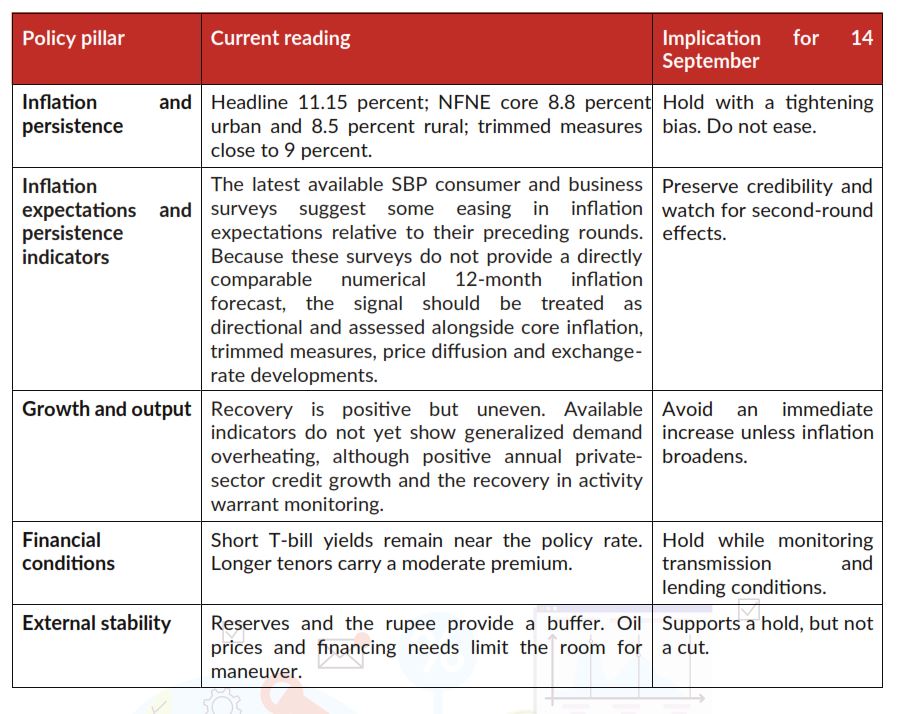
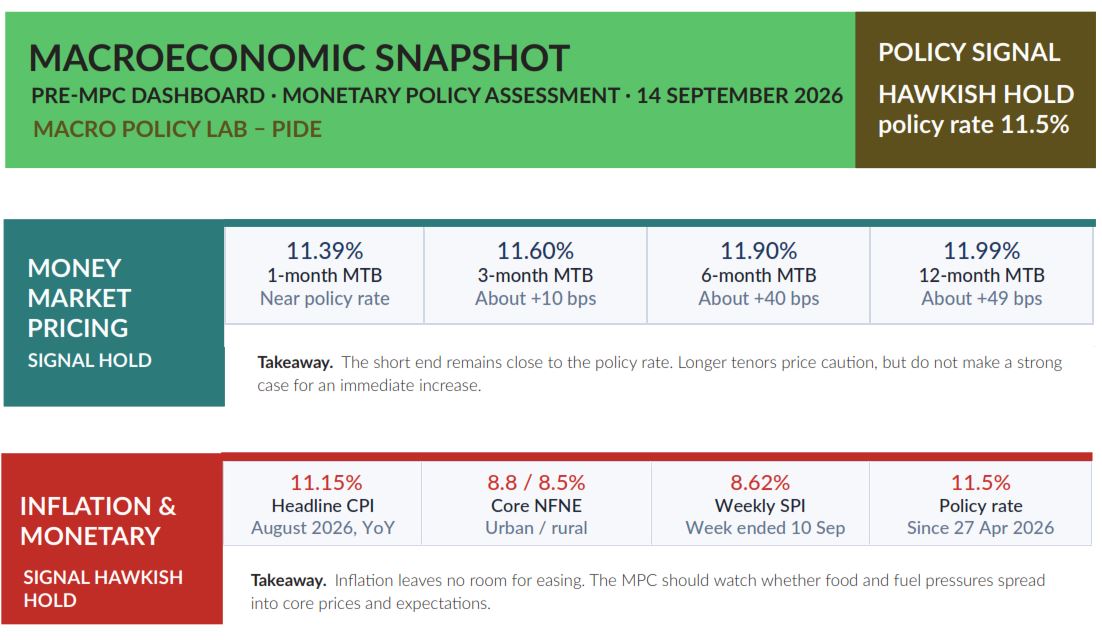
Headline inflation rose sharply to 11.15 percent in August, from 9.2 percent in July. More importantly for monetary policy, urban and rural NFNE core inflation reached 8.8 and 8.5 percent, while trimmed inflation stood close to 9 percent. The rise in underlying measures warrants vigilance and effectively rules out monetary easing. It does not, however, by itself establish the case for another rate increase.
Much of the immediate inflationary pressure continues to originate in food, energy and transport, with recent fuel and electricity adjustments adding further near-term pressure. Monetary policy cannot reverse these first-round relative-price shocks. Its critical task is to prevent them from propagating into core inflation, services prices, wages, inflation expectations and the exchange rate. The rise in trimmed inflation is therefore an important warning signal: the risk of propagation has increased and must be watched closely.
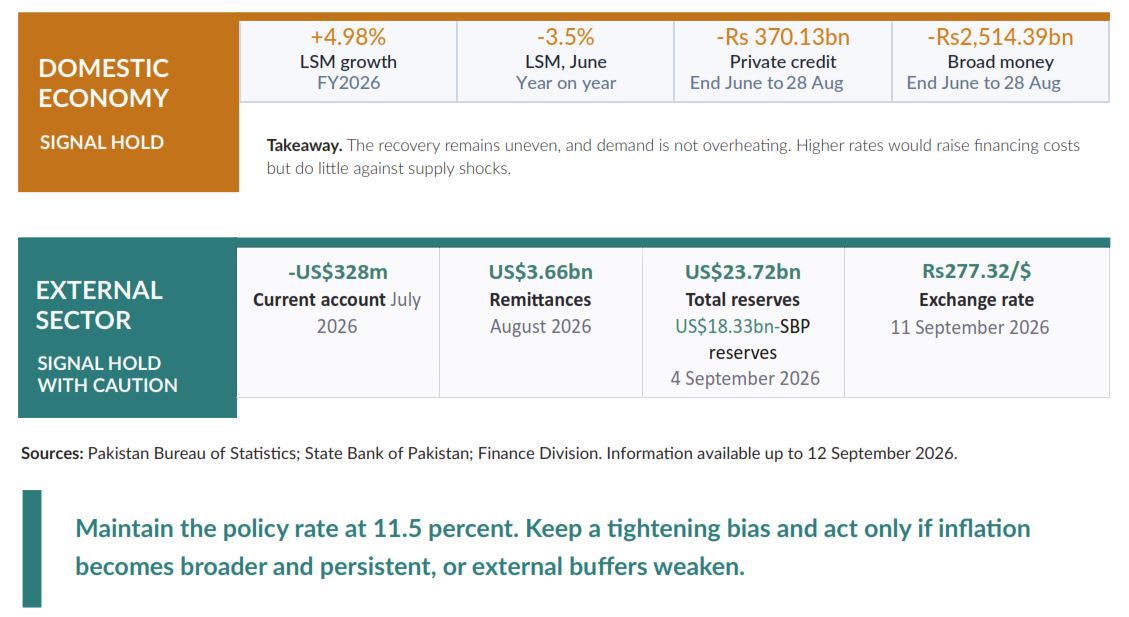
On the demand side, the evidence remains mixed rather than inflationary. Economic activity is recovering, but unevenly. Recent money and credit developments do not indicate a generalized overheating cycle, although positive annual private-sector credit growth warrants monitoring. At the same time, the previous monetary tightening continues to transmit through KIBOR, deposit and lending rates, strengthening the case for allowing the existing stance more time to work.
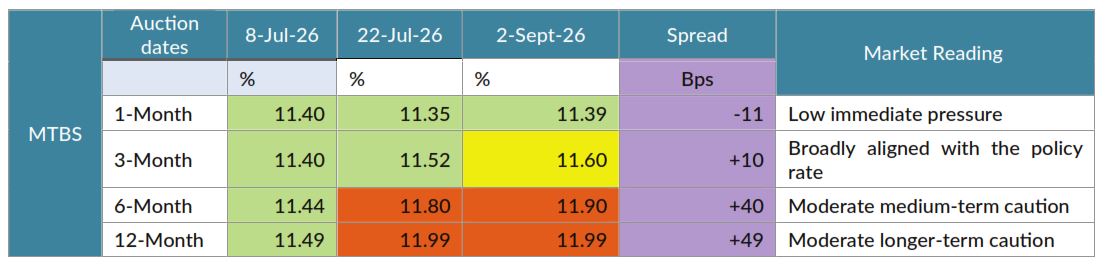
Financial-market pricing similarly calls for caution rather than an immediate policy response. Short-term Treasury yields remain close to the policy rate, while longer maturities carry a moderate premium. This is consistent with a hold while signaling medium-term inflation concern, rather than providing a compelling market case for an immediate hike.
The policy decision must ultimately be forward-looking. The relevant question is not whether the nominal policy rate remains marginally above today’s headline inflation, but whether the forward-looking real policy rate remains sufficiently restrictive to return inflation toward its medium-term objective while preserving external stability and avoiding unnecessary damage to the recovery.
PIDE recommends maintaining the policy rate at 11.5 percent. The appropriate stance is a hawkish, conditional hold. Inflation is too elevated and uncertain to permit easing, but the evidence does not yet justify another increase. Further tightening should be triggered by clear evidence that the current price shock is becoming broader, persistent and embedded through accelerating core and trimmed inflation, worsening price diffusion, deteriorating inflation expectations, or sustained exchange-rate and reserve pressures. Easing should wait until disinflation is firmly re-established across both headline and underlying measures.
PIDE POLICY CALL
Maintain the policy rate at 11.5 percent with a tightening bias. The stance should remain restrictive and explicitly data dependent. Further tightening should follow sustained acceleration in core and trimmed inflation, broader price diffusion, worsening inflation expectations, or sustained exchange-rate and reserve pressure. Easing should wait until disinflation is firmly re-established across headline and underlying measures and the forward-looking real policy rate remains sufficiently positive.
PIDE DECISION FRAMEWORK: FIVE PILLARS OF THE POLICY CALL
The policy call comes from the combined reading of five pillars. No single data point carries the decision.
Table 1: Five Pillars of the September 2026 Monetary Policy Decision
 MONEY-MARKET PRICING IS CONSISTENT WITH A HOLD
Treasury-bill yields provide useful market evidence, but they should not dictate the MPC decision. The one-month yield remains below the policy rate, and the three-month yield is close. The premium rises across the six- and twelve-month tenors. These yields reflect banking-system liquidity, government borrowing requirements, auction supply and term premium. They should therefore not be interpreted as pure market expectations of the next MPC decision.
Table 2: Treasury Bill Yields and the Money-Market Signal
Source: State Bank of Pakistan; PIDE analysis.
Short-term yields support a hold. The premium at six- and twelve-months points to moderate inflation caution, not an immediate policy-rate increase.
LENDING TRANSMISSION IS OPERATING BUT INCOMPLETE
Higher KIBOR, deposit rates and outstanding lending rates have followed the April policy-rate increase. The adjustment in rates on new lending has been smaller. Bank lending spreads have narrowed: the spread between new lending and fresh deposit rates declined from 3.91 percentage points in March to 3.66 percentage points in July, while the spread on outstanding loans and deposits fell from 3.49 to 3.16 percentage points. These comparisons indicate that transmission is operating, although the movements should not be read as pure causal effects because market conditions and changes in loan and deposit composition also matter. Since the April tightening is still transmitting through KIBOR, deposit and lending rates, another increase should require clearer evidence that underlying inflation or expectations are worsening, particularly if stronger credit demand also points to rising domestic demand.
Table 3: Changes in Market Lending and Deposit Rates Since March 2026
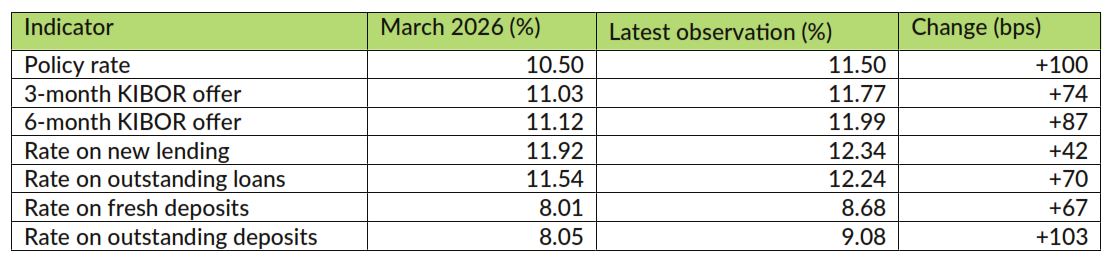
Source: State Bank of Pakistan. KIBOR observations are for 11 September 2026; lending and deposit rates are for July 2026.
INFLATION RISKS REQUIRE CONTINUED VIGILANCE
August interrupted the easing seen in July. Headline inflation rose to 11.15 percent, while urban and rural NFNE core inflation reached 8.8 and 8.5 percent. Trimmed inflation also increased to 8.9 percent in urban areas and 9.1 percent in rural areas. The rise in trimmed measures matters because it shows that pressure is no longer confined entirely to a few administered prices. The restrictiveness of the monetary stance should be assessed against expected inflation over the policy horizon, rather than the latest headline inflation rate alone. SBP’s July baseline projected inflation to stabilize near the upper bound of its 5-7 percent target range by June As an illustrative benchmark, comparing the 11.5 percent policy rate with the 7 percent upper bound gives a margin of 4.5 percentage points. This is not a precise forward-looking real policy rate, which depends on expected inflation over the policy horizon. Even so, it suggests that the current stance remains restrictive under the baseline. The cushion would narrow if food, fuel and administered-price shocks propagate into underlying inflation and expectations.