

Key Highlights
- Pakistan’s annually budgets are immediately destroyed by external commodities shocks. This occurs as a result of policymakers setting fiscal targets based on extremely optimistic tax estimates and strict deficit limitations without allowing for any margin of error.
- To meet its revenue goals, the government depends on the petroleum charge and SBP profit transfers. It is incorrect to refer to this as a planned policy since it just serves to emphasize how flawed traditional tax collection is.
- There is hardly any financial room left over after skyrocketing debt servicing expenses. Ministers worry and make rash end-of-year spending cuts as revenue declines.
- Salaries and pensions are examples of operational costs that cannot be eliminated immediately. Because of this fact, long-term infrastructure projects are often abandoned in order to meet short-term deficit targets.
- With an open contingency plan, Pakistan can end this cycle. Predictable rules take the place of erratic emergency cuts when automatic budget modifications are linked to real-time revenue data.
1. Introduction: The Budget Credibility Gap in Retrospect
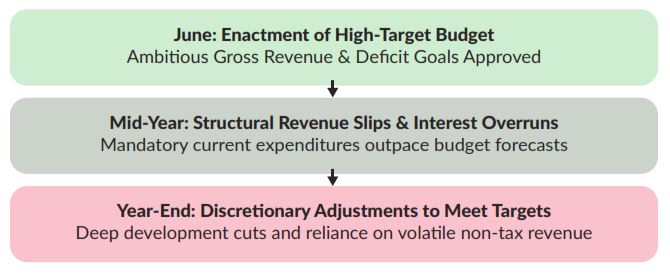
Federal budgets are meant to be reliable economic road maps. In actuality, preliminary estimates seldom match actual results. The main issue? By neglecting three recurrent wildcards, changing interest rates, currency depreciation, and abrupt increases in domestic inflation, budget statements frequently overstate net revenues.Without built-in stabilizing buffers, the state views the budget as a static document, leaving its long-term development plans highly vulnerable to an unexpected mid-year collapse. In order to ensure long-term economic stability, this policy approach examines structural weaknesses in Pakistan’s federal budgetary process and provides a methodical, data-driven backup plan. The structural drift shown in Figure 1 below illustrates this operational vulnerability:
Figure 1: Pakistan’s Structural Fiscal Drift
1.1 Empirical Evidence: Decoding the Budget Deviation Matrix
To demonstrate this operational volatility over the full fiscal horizon, Table 1 details the structural variance between initial Budget Estimates (B.E.) and final actual outturns (Actual Outturn minus Budget Estimate) from FY2021 to FY2026.
| Table 1[1]: Federal Fiscal Deviation Matrix (Actual Outturns minus Budget Estimates, Rs. Billion) | ||||||
| Fiscal Indicator | FY2021 | FY2022 | FY2023 | FY2024 | FY2025 | FY2026 |
| REVENUE-SIDE DEVIATIONS | ||||||
| FBR Taxes | -198.70 | 313.80 | -300.86 | -103.99 | -1,225.71 | -1120.59 |
| Non-Tax Revenues | -104.58 | -894.58 | -224.27 | 87.45 | 211.43 | 31.05 |
| Gross Federal Revenues | -303.28 | -580.78 | -525.13 | -16.54 | -1,014.28 | -1,089.54 |
| Transfer to Provinces | -132.10 | 177.02 | -149.53 | -135.37 | -583.98 | -537.22 |
| Net Federal Revenues | -172.18 | -757.79 | -375.60 | 118.84 | -430.30 | -552.31 |
| EXPENDITURE-SIDE & MACRO DEVIATIONS | ||||||
| Total Federal Expenditure | 107.77 | 863.09 | 1,753.43 | 337.98 | -1,840.83 | -2,290.31 |
| Current Expenditure | 3.17 | 928.32 | 2,023.03 | 729.12 | -1,388.82 | -1,279.73 |
| Markup Payments | -196.90 | 122.75 | 1,745.86 | 857.31 | -887.58 | -1,259.02 |
| Total Development Expenditure | -97.42 | -405.89 | -127.97 | -407.82 | -625.03 | -154.06 |
| Federal PSDP | 17.30 | -341.89 | 16.03 | -217.82 | -351.03 | -82.27 |
| Federal Fiscal Deficit | 279.95 | 1,620.88 | 2,129.03 | 219.14 | -1,410.53 | -1,738.00 |
| Overall Primary Balance | 718.72 | 2,068.45 | 827.11 | 37.69 | -694.05 | 464.19 |
| Overall Fiscal Deficit | 208.00 | 1,840.00 | 2,724.00 | 295.00 | -848.00 | -1,723.57 |
| Nominal GDP (Rs Billion) | 55,836 | 66,624 | 84,069 | 106,045 | 114,794 | 126,870 |
| Federal Fiscal Deficit (% of GDP) | 0.50 | 2.43 | 2.53 | 0.21 | -1.23 | -1.37 |
Source: Ministry of Finance, Federal Consolidated Civil Accounts & Fiscal Operations Summary (FY2021–FY2026 Provisional Actual Outturns).
(Note: Deviation = Actual Outturn minus Budget Estimate. Figures for FY2026 reflect provisional full-year actual outturns against original budget targets. A positive (+) value indicates an overrun or over-collection relative to the budget; a negative (-) value indicates an underrun or revenue shortfall.)
The underlying reasons for Pakistan’s structural budget credibility gap are illustrated by the previously cited empirical aberrations. Early budget projections are not realistic implementation plans, but rather optimistic policy intent. The desire to display minor headline budget deficits and primary surplus targets can occasionally limit baseline predictions during the planning stage. Federal budget managers predict low-interest rate pathways, aggressive tax revenue growth, and understated baseline inflation to make these goals fiscally feasible on paper. These optimistic baseline assumptions eventually fall apart when actual macroeconomic shocks occur, such as the fast cycle of monetary tightening between FY2022 and FY2024. Rising policy rates prompted real markup payments to exceed early predictions by an unprecedented Rs. 1,745.86 billion in FY2023 and Rs. 857.31 billion in FY2024 because debt servicing obligations are legally nonnegotiable. These systematic spending overruns lead to an uncoordinated, emergency adjustment procedure because the federal government cannot fail to satisfy its financial obligations in the middle of the year. The state’s main shock absorber is long-term public investments because it lacks a preauthorized contingency cushion. Consequently, a substantial reduction of Rs. 341.89 billion in FY2022, Rs. 217.82 billion in FY2024, and Rs. 351.03 billion in FY2025 would be made to the Federal Public Sector Development Programme (PSDP). Furthermore, rather than genuine structural restraint, compressed spending variations in FY2025 (Rs. -1,840.83 billion) and FY2026 (Rs. -2,290.31 billion) actually show reactive emergency expenditure constraints and an excessive dependence on erratic nontax windfalls.
Markup Forecasting Gaps and Downstream Fiscal Distortions
Skewed Expenditure Trends: A staggering 99.2% of the Rs. 1,279.73 billion decreases in Total Current Expenditure may be attributed to the markup deviation of Rs. 1,269.19 billion. In real terms, the government’s daily operating expenditures were essentially unchanged from the original goals.
Illusion of Deficit Control: Rather than being a combination of structural revenue increase or real expenditure restriction, the Rs. 1,344.00 billion (or 1.06% of GDP) improvement in the Federal Fiscal Deficit was almost completely (94.4%) a windfall from interest rate over-budgeting.
2. Structural Realities and the One-Off Cushion Trap
A detailed analysis of long-term government trends reveals the precise causes of these persistent disparities in spending. The most severe pressure points are caused by the exponential increase in federal mark-up payments. Debt servicing expenses came to Rs. 3,182.43 billion in FY2022. They rapidly increased to Rs. 5,695.92 billion the next year, then to Rs. 8,159.83 billion in FY2024, and finally to a substantial peak of Rs. 8,887.42 billion by FY2025. Fixed debt servicing now accounts for more than half of all federal spending due to the state’s fiscal flexibility being effectively pushed out by this enormous 179.26 percent increase in domestic interest commitments. Debt servicing continues to be the main structural cause of Pakistan’s spending volatility, despite provisional actual outturns for FY2026 showing a downward baseline adjustment to Rs. 6,937.45 billion due to monetary easing.
Figure 2: Markup Trap and Expenditure Overruns: A Chronology

Source: Ministry of Finance, Federal Consolidated Civil Accounts & SBP Annual Reports (FY2022–FY2026 Provisional Actuals), Table 2 (‘Gross Federal Receipts & Debt Servicing Outturns’).
Debt servicing remains a primary driver of expenditure variance, with FY2026 showing a substantial savings adjustment of Rs. 1,259.02 billion against original budget estimates due to monetary easing. The federal government has been compelled to move away from wide tax base improvements and instead heavily rely on transient, unstable non-revenue streams in order to avoid a total fiscal collapse in the face of these strict spending demands. With collections rising from Rs. 127.53 billion in FY2022 to an unprecedented Rs. 1,220.21 billion in FY2025, the petroleum levy has been heavily used as an instant revenue source. In order to compensate for deficiencies in tax collection, the excess profits of the State Bank of Pakistan, which increased from Rs. 371.19 billion in FY2023 to a noteworthy Rs. FY2025 budget aims aggressively account for PKR 2,619.60 billion from these sources. However, relying significantly on unpredictable buffers is risky. The budget’s underlying structural imbalances are revealed when the safety net collapses due to a sudden change in domestic liquidity or a decline in global commodities prices.
3. An Integrated Data-Driven Fiscal Contingency Framework
The process takes comprehensive structural accountability and openness to bring Pakistan’s budget process into compliance with international financial management norms. This framework provides a useful model for any emerging country experiencing significant fiscal shocks, even if it was created with Pakistan’s institutional environment in mind.
The Petroleum Levy, State Bank of Pakistan profit transfers, Public Sector Development Program allocations, and Benazir Income Support Program spending are the four distinct domestic policy channels that are the focus of the whole strategy.
Three fundamental operational mechanisms are necessary for execution:
- establishing precise baseline guidelines
- Mid-year policy triggers that are automated
- Ring-fencing capital investments with strong returns.
Note on Parameter Calibration:
Core economic benchmarks must be routinely adjusted by the Planning Commission and the Ministry of Finance to reflect changing budgetary realities.
Four essential inputs are used in institutional adjustments: historical revenue variance, sovereign borrowing costs, project appraisal criteria, and Medium-Term Fiscal Framework targets.
This system is anchored by three adaptable initial parameters:
• A quarterly markup overestimated trigger of 10%
• A project return criterion of 10 to 15 percent
• A central bank profit target of PKR 1000 billion
Pillar One: Rule-Based Social Protection Reallocation
- Rather than being integrated into regular government spending, any petroleum levy revenue that surpasses quarterly targets is automatically ring-fenced.
- These additional monies go straight into certain social safety nets at times of high inflation, increasing support under the Benazir Income Support Program.
- With a regressive methodology that mostly affects low-income families and raises domestic costs, the petroleum levy collects approximately PKR 1.2 trillion yearly. This precaution alleviates a significant burden.
Pillar Two: Institutional Debt Reduction Buffers
- Targeted debt repurchases immediately address the primary cause of expenditure instability by reducing compound interest costs at their source without the need for additional levies.
- Central bank profits over the PKR 1000 billion baseline should be used right away to repurchase high-yield domestic debt in order to swiftly accomplish this.
- Conventional strategies, such as creating primary surpluses or extending loan maturities, eventually reduce budgetary pressure, but they do so too slowly in times of extreme crisis.
- In any case, it is imperative to move away from routine budget reliance on central bank profits because of their excessive volatility, which renders them an unreliable source for day-to-day government operations.
Pillar Three: Quantitative PSDP Prioritization Triggers
- Every public investment project must go through a required pre-audit to classify spending into different strategic goals before any funds are disbursed.
- The haphazard, last-minute cuts of the past are replaced by a transparent project classification system established by this methodical pre-audit.
- Strict debt servicing obligations currently require the Public Sector Development Program to absorb the effect anytime tax revenues fall short, making the establishment of this organization crucial.
| Project Tier | Classification Metric | Mandatory Contingency Rule |
| Tier One
(Strictly Protected) |
Strategic infrastructure, water security projects, or any work exceeding 75 percent physical completion. | Legally shielded from mid-year budget cuts to preserve long-term economic growth. |
| Tier Two
(Partial Deferral) |
Moderately performing schemes with economic returns between 10 and 15 percent. | Subject to proportional, time-bound funding pauses if overall revenue targets fall short. |
| Tier Three
(Immediate Suspension) |
Early-stage initiatives, unapproved regional schemes, or projects with economic returns below 10 percent. | Automatically suspended to absorb the fiscal shock if quarterly mark-up overruns exceed 10 percent. |
4. Policy Implications and Structural Recommendations
- Officials are forced to make irrational budget projections due to intense pressure to demonstrate compliance with strict IMF deficit objectives, which causes ongoing fiscal instability.
- When interest rates rise or import receipts fall, ministers are forced to cut development budgets in order to absorb the shock because salaries and debt payments cannot be suspended.
- By trading reactive crisis management for institutional stability, a rule-based contingency approach addresses this structural defect at its source.
- Legislators must enact legislation linking non-tax revenue windfalls directly to debt relief and social safety nets in order to secure this.
- Protecting critical infrastructure, energy, and water projects from mid-year cuts alters the political environment while averting expensive delays and lost economic growth.
- Lastly, providing hard data to support these fiscal regulations lowers state borrowing costs, reassures rating agencies, and restores policy predictability.
References
Government of Pakistan, Ministry of Finance. 2026. Annual Budget Statements and Federal Consolidated Civil Accounts (FY 2021-22 to FY 2025-26). Finance Division, Islamabad.
International Monetary Fund. 2026. Pakistan: Third Review Under the Extended Arrangement Under the Extended Fund Facility and Second Review Under the Resilience and Sustainability Facility Arrangement—Press Release; Staff Report; and Statement by the Executive Director for Pakistan. IMF Staff Country Report No. 26/101, Washington, DC.
Pakistan Institute of Development Economics. 2026. The Budget Credibility Gap: Structural Rigidities, Non-Tax Revenues, and Fiscal Resilience in Pakistan. PIDE Policy Research Series, Islamabad.
State Bank of Pakistan. 2025. Annual Report on the Operations and Profit Distribution of the Central Bank. SBP Data Platform, Karachi.
World Bank. 2025. Pakistan Public Expenditure Review: Managing Exploding Mark-up Obligations and Safeguarding Development Spending. World Bank Group, Washington, DC.
[1] ‘Federal Fiscal Deficit’ measures the net execution gap of the Federal Consolidated Fund, whereas ‘Overall Fiscal Deficit’ reflects the consolidated national balance including provincial cash surpluses/deficits.