The Middle East Conflict and Its Implications for Pakistani Migrant Workers
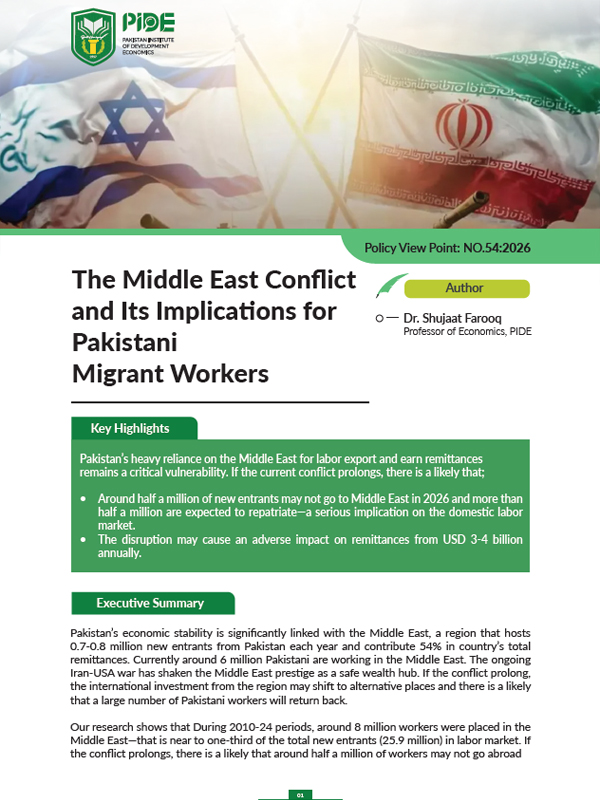
Pakistan’s economic stability is significantly linked with the Middle East, a region that hosts 0.7-0.8 million new entrants from Pakistan each year and contribute 54% in country’s total remittances. Currently around 6 million Pakistani are working in the Middle East. The ongoing Iran-USA war has shaken the Middle East prestige as a safe wealth hub. If the conflict prolong, the international investment from the region may shift to alternative places and there is a likely that a large number of Pakistani workers will return back.
Our research shows that During 2010-24 periods, around 8 million workers were placed in the Middle East—that is near to one-third of the total new entrants (25.9 million) in labor market. If the conflict prolongs, there is a likely that around half a million of workers may not go abroad this year, and another half a million could be forced to repatriate. This combined influx will have serious implications on domestic labor market, particularly in Khyber Pakhtunkhwa and Punjab, where migration traditionally absorbs nearly one-third of new labor entrants.
Remittances, which currently constitute 10% of Pakistan’s GDP and exceed the value of total goods exports, face a potential decline of USD 3-4 billion. Such a shortfall would destabilize the exchange rate and widen the current account deficit.
Introduction
Most countries rely on three main channels to earn foreign exchange; export, remittances and foreign direct investment (FDI). In Pakistan’s case, exports have remained largely stagnant due to several structural constraints and recorded an 8.7% decline during first seven months of FY26. FDI inflows over the last two decades remain modest and limited to few sectors, averaging USD 1-2 billion annually. These inflows are largely dependent on political situation and prevailing economic environment. In contrast, workers’ remittances have demonstrated consistent and robust growth over the past twenty-five years, increasing from approximately USD 1 billion to nearly USD 40 billion this year. This steady rise has made remittances a critical and relatively stable source of foreign exchange for the country.
The Middle East countries provide enormous employment opportunities for Pakistani Workers by providing temporary migration where on average a worker’s stay is 7-10 years. The top-five destination for Pakistani workers are Saudi Arabia, United Arab Emirates (UAE), Oman, Bahrain and Qatar. An overpoweringly large reliance on these countries for jobs and remittances is a cause of concern for Pakistan due to the heightened vulnerability associated with having so many workers in a few places that are not immune to economic fluctuations [1].
Over the last four decades, the Middle East has successfully attracted global elite due to tax-free income, business friendly policies and security. The luxury real-estate market has steadily grown and alone in 2025, around 9,800 millionaires moved to Dubai, bringing USD 63 billion in wealth [2, 3]. The population of expatriates is around 52% of the total population in the Gulf states, it goes to above 85% for UAE and Qatar—a backbone of the labor market. These expats are the lifeline of country as they provide talent, labor and investment [4].
The launch of Dubai International Financial Center (DIFC) in 2004 attracted international firms to setup their offices in Dubai. By 2025 it become an economic hub hosting over 290 banks, 102 hedge funds, 500 wealth management firms and 1,289 family-related entities [5]. Besides investment friendly policies, the rise of Dubai was also shaped by the search for safety, i.e., civil conflict in Syria, Arab spring, Russian-Ukraine war, etc.
The ongoing Iran-USA war has shaken the Middle East’s long build prestige as a safe wealth hub. Iran’s reciprocal strikes have not only caused physical damage but also has undermine the psychological confidence that took around four decades to build the image. The history shows that in 60s and 70s of the previous century, Beirut was also a thriving hub of tourism and international investment but civil war traumatized it, and perhaps the Middle East might also face a similar situation. The longer the war continues, the more expats would move to alternative locations and international investment in UAE would compromise. Ultimately, the true impact will hinge on how long the conflict lasts and how deeply it affects regional security.
This policy brief aims to answer some pertinent question that how much the Iran-USA-Israel war would interrupt the overseas migration, both outflows and return flows. It also examines how Pakistan can strengthen future reintegration efforts for returning migrants by incorporating lessons from unforeseen crises and developing more resilient support mechanisms.