Executive Summary
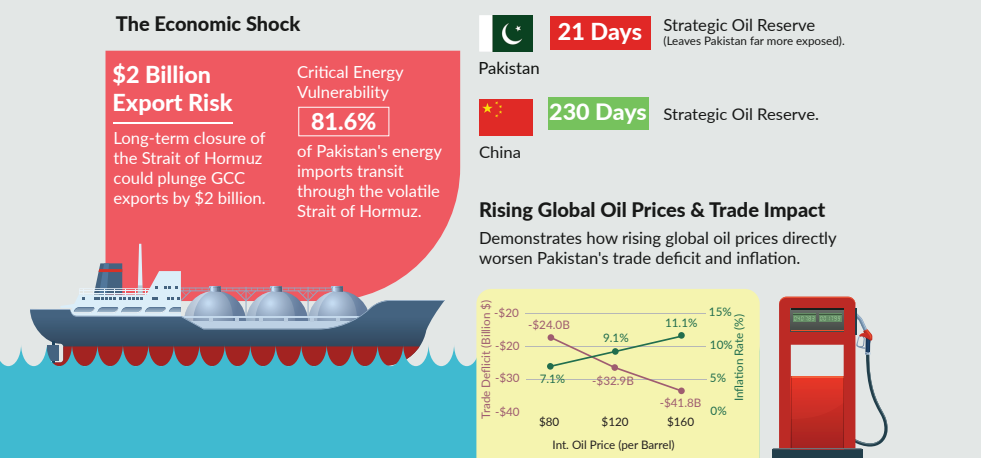
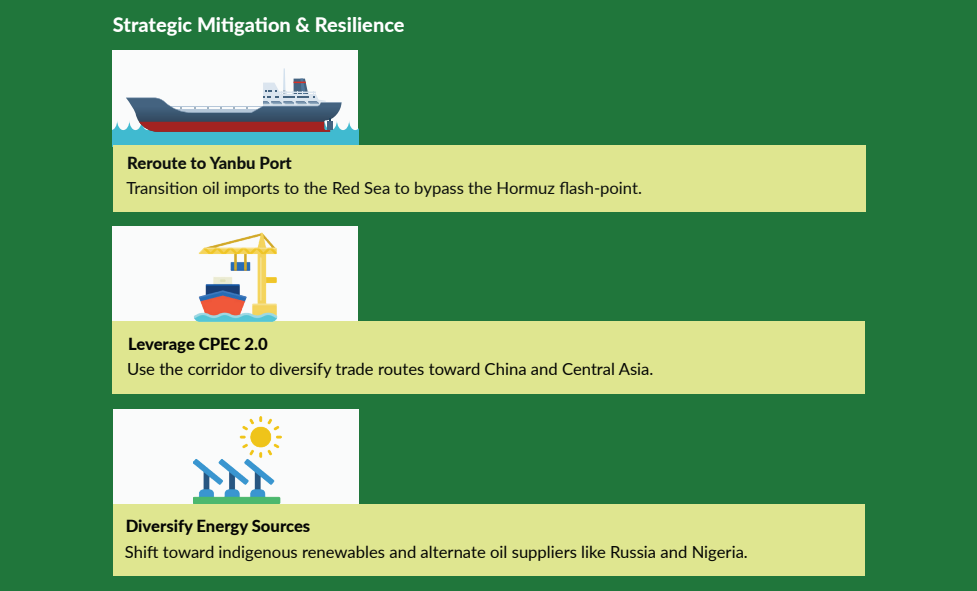
The ongoing confrontation between the US-Israel and Iran in the Mideast has evolved from a regional political dispute into a global economic crisis. The conflict has destabilized the Mideast and thus has disrupted Pakistan direct and indirect trade to the GCC countries and other regions. The crisis threatened Pakistan external sector and can potentially decrease Pakistan direct export to the GCC countries by $1.5 to $2 billion depending on the closure of the Strait of Hormuz while decline in Pakistan imports from the GCC countries, predominantly energy, could drop by $3 billion. The latter could destabilize Pakistan local production and global exports. At the same time, high energy prices will increase Pakistan import bill by $4.5 billion and will increase Pakistan current account deficit and external debt. The crisis could also worsen Pakistan’s balance of payments position by reducing export earnings and remittance inflows and thus the pressure on reserves could once again become unsustainable. Furthermore, the border trade situation with neighboring countries is already strained, and the ongoing war in the Middle East will decrease Pakistan border trade with Iran. Higher oil prices also imply a return to double-digit inflation, reversing the stabilization achieved during FY25. To mitigate these risks and maintain robust energy supply, the study suggest that Pakistan must reroute oil imports to Yanbu port in the Red Sea. Pakistan also needs to diversify oil imports and should leverage CPEC 2.0 to as a robust alternate trade market. These measures are important to absorb external shocks. This crisis is a test case for producers in rapidly changing global landscape; where the survival will count more on competitiveness, innovation and efficiency rather than on external support.
Crisis at the Strait
The Impact of Middle East Instability on Pakistan’s Trade
Introduction
The closure of significant trade routes and sudden rise in the energy prices has turned the US-Israel-Iran conflict in the Middle East into a global economic crisis. The ongoing war in the Middle East has not only halted international trade in the Gulf region but it also disrupted the global energy supply chain. Therefore, we consider that the crisis will adversely and disproportionately affect countries like Pakistan. The crisis has potential to compound external sector disconcerts of developing countries if it lasts longer.
Literature on trade and development suggests that international trade plays a significant role in promoting growth and development by increasing allocation efficiency and by providing consumers with greater choice[1] (Elliot, 2009). International trade also facilitates development by encouraging foreign investment and by helping technology transfer (Shah et al., 2022) and thus it paves a way for rapid economic development (Dollar and Kraay, 2004; Rodrik, 2001; Shahid and Amna, 2023). Policy maker in Pakistan employed international trade as a mean to achieve the end goal of development but a number of factors such as economic instability, expensive energy, lack of skilled labor, poor governance and policy inconsistency did not allow the country to fully reap the benefits of international trade. Therefore, these structural vulnerabilities exposed Pakistan trade to external shocks on a number of occasions such as in 2008 demand driven energy crisis and in Covid-19 led supply chain disruption. The current Middle East crisis is an addition to the long list of external shocks and it is going to test Pakistan external sector on many fronts.
US and Israel attacked Iran on February 28, 2026 and in response, Iran attacked Israel and the US bases in the UAE, Bahrain, Qatar and in Saudi Arabia. Iran also closed the Strait of Hormuz to pressurize the US and her allies and thus choked 20 percent of the global energy supply and a significant portion of merchandise trade. Currently, Pakistan trade heavily relies on the Middle East. Therefore, the Strait closure brought Pakistan export to the GCC (Gulf Cooperation Council) countries to a standstill and her imports, especially of oil and LNG, sharply declined.
In the last few decades, Pakistan trade increased but not in a balanced manner. Pakistan imports registered strong growth and reached to $60 billion in 2025 while Pakistan exports remained lackluster and hovered around $32 billion at the same period of time. As a result, Pakistan trade deficit increased and it became unmanageable. The ongoing crisis can put pressure on Pakistan trade deficit and can distort her external sector balances. Therefore, this study tries to understand how the crisis in the Middle East is going to affect Pakistan’s trade and external sector and what measures Pakistan needs to take in order to curtail the adverse impact of the crisis on Pakistan export, import and trade deficit.