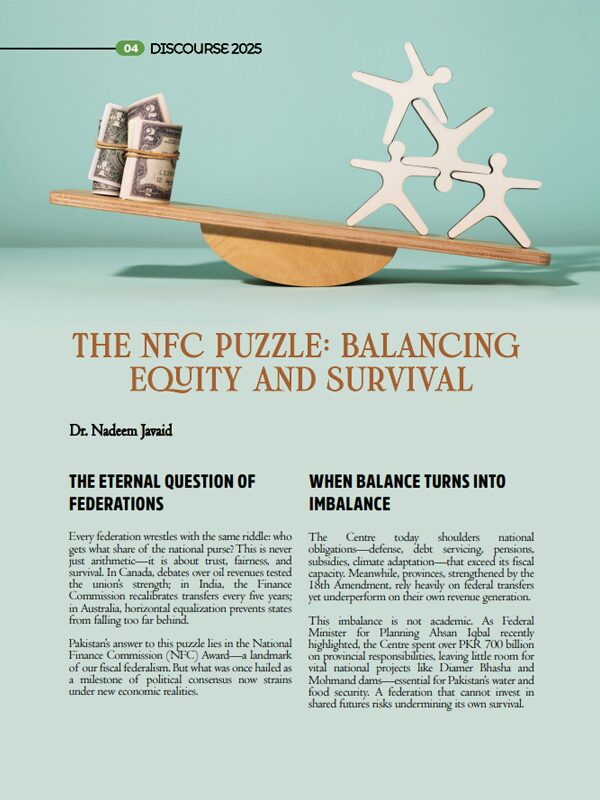
The NFC Puzzle: Balancing Equity and Survival
The Eternal Question of Federations
Every federation wrestles with the same riddle: who gets what share of the national purse? This is never just arithmetic—it is about trust, fairness, and survival. In Canada, debates over oil revenues tested the union’s strength; in India, the Finance Commission recalibrates transfers every five years; in Australia, horizontal equalization prevents states from falling too far behind.
Pakistan’s answer to this puzzle lies in the National Finance Commission (NFC) Award—a landmark of our fiscal federalism. But what was once hailed as a milestone of political consensus now strains under new economic realities.
When Balance Turns into Imbalance
The Centre today shoulders national obligations—defense, debt servicing, pensions, subsidies, climate adaptation—that exceed its fiscal capacity. Meanwhile, provinces, strengthened by the 18th Amendment, rely heavily on federal transfers yet underperform on their own revenue generation.
This imbalance is not academic. As Federal Minister for Planning Ahsan Iqbal recently highlighted, the Centre spent over PKR 700 billion on provincial responsibilities, leaving little room for vital national projects like Diamer Bhasha and Mohmand dams—essential for Pakistan’s water and food security. A federation that cannot invest in shared futures risks undermining its own survival.
Why the Centre Still Matters
The logic is straightforward: only the Centre can build dams that supply water across provinces, highways that knit the nation together, and climate defenses that shield all regions. Yet when the federal share of the divisible pool was cut from 56% to 42.5% in 2010, it created a stark mismatch between obligations and resources. Today, development has been pushed to the margins, while debt and defense dominate.
Other federations understood this risk early. Australia’s Commonwealth government directly finances strategic water and energy projects. India’s Centre runs flagship education and health schemes to ensure national cohesion. Pakistan, too, must restore the Centre’s fiscal space if it is to drive transformation.
Provinces: Autonomy Without Accountability
The 18th Amendment delivered historic autonomy. But autonomy without responsibility is dangerous. More than a decade later, provinces still raise less than 1% of their GDP in taxes. The services sector contributes over 57% of GDP, yet provinces collect less than 0.5% in tax revenue from it. Agriculture income tax and property taxes remain grossly underutilized.
Worse, provinces themselves deny Provincial Finance Commission (PFC) Awards, leaving districts and local governments dependent on provincial handouts. This double centralization—provinces leaning on the Centre, districts leaning on provinces—creates a distorted fiscal pyramid where accountability is weakest at the grassroots.
The result? Provinces enjoy political space to spend but not the responsibility to raise. Citizens are left with weak schools, hospitals, and municipal services, while the Centre borrows heavily, squeezing out investment in national projects.
Rethinking the NFC Formula: From Population to Performance
The flaw of the NFC lies not in its vision but in its incentives. With population as the overwhelming criterion, it rewards size, not performance. Pakistan needs an evolved formula that encourages responsibility and resilience:
- Prioritize human development – link part of transfers to improvements in education, health, nutrition, and gender equity.
2. Correct population incentives – current 2.6% annual growth may be inflated by the perverse incentive of larger shares for larger populations; the formula must encourage population control and responsible planning.
3. Reward revenue effort – provinces must be incentivized to tax agriculture, services, and property.
4. Incorporate climate resilience – reward investments in water management, forests, and adaptation.
5. Reserve a federal development share – protect funding for strategic national projects like dams, grids, and digital infrastructure.
This redesign would shift fiscal federalism from entitlement to effort, from consumption to investment.
NFC and Pakistan’s Transformation Ambition
Pakistan aspires to become a $1 trillion economy by 2035 under the Uraan Pakistan initiative. But such ambitions demand bold, long-term investments. A fiscally crippled Centre and complacent provinces cannot deliver them.
Other federations show the way. In Germany, states co-finance federal programs, ensuring joint ownership of progress. Pakistan must, likewise, make fiscal federalism a ladder for growth, not a tug-of-war over shares.
Towards a New Fiscal Contract
The way forward is political courage and cooperation. Provinces must recognize that a stronger federation ultimately strengthens them. The Centre must protect autonomy but insist on responsibility. Together, they must design a new fiscal contract that:
– Links transfers partly to provincial tax effort and service delivery.
– Guarantees a federal share for national projects.
– Strengthens intergovernmental forums for joint planning and monitoring.
– Empowers districts by ensuring provinces implement Provincial Finance Commissions.
From Division to Collaboration
The NFC must no longer be seen as a contest of “who gets more.” Instead, it must evolve into a compact of shared responsibility and shared prosperity. If Pakistan truly seeks resilience and prosperity, fiscal federalism must become the foundation of collaboration, not competition.
In that lies the solution to the puzzle: equity for provinces, space for the federation, empowerment for local governments, and incentives for population stability.
Dr. Nadeem Javaid (SI) is a renowned academician and policy expert currently serving as the Vice Chancellor, Pakistan Institute of Development Economics.