
Abstract
This knowledge brief examines the state of trade facilitation in Pakistan based on the UN Global Survey on Digital and Sustainable Trade Facilitation. Pakistan’s overall trade facilitation implementation stands at 74.2 percent in 2025. With the current level of implementation, Pakistan lags behind its peer economies across several measures of trade facilitation. Specifically, Pakistan performs well in transparency and domestic paperless trade. However, it faces persistent gaps in customs formalities cross-border digital integration and inclusive facilitation for SME and women traders. Based on empirical analysis, this study finds that all trade facilitation measures related to general and digital facilitation, covering both border and cross-border procedures, exert positive effects on exports. Customs formalities and transparency carry the largest estimated effects, highlighting that procedural simplification and regulatory predictability yield the greatest export gains. Cross-border paperless trade presents the most immediate opportunity. Policy priorities center on accelerating customs reform and investing in cross-border digital connectivity.
1. Introduction
While tariff barriers have been lowered substantially under multilateral and regional agreements, border-related costs become central to trade policy. These costs arising from procedural complexity, documentary requirements and institutional fragmentation remain a constraint on export competitiveness particularly in developing economies. For Pakistan, manufacturing exports have stagnated relative to peer economies. In this context, it is pertinent to formulate policy aiming at reducing these friction costs. Trade facilitation measures have a significant positive impact on bilateral trade, with effects that are often stronger for non-OECD countries (Masood and Martinez-Zarzoso, 2023). Full implementation of digital trade facilitation alone is estimated to reduce trade costs by an average of 13 percent in the Asia-Pacific region (United Nations, 2022). Given this context, the current brief uses the UN Global Survey on Digital and Sustainable Trade Facilitation to benchmark Pakistan’s performance against peer economies. Moreover, we identify implementation gaps and present evidence on the export promotion role of the improvement in trade facilitation measures.
2. Theoretical Foundations
Trade facilitation reduces trade costs by streamlining the procedures, documentation and institutional processes related to border clearance. Implementing these measures results in lowering bilateral trade costs, which in turn raises the volume of bilateral exports. For instance, trade effect of implementing the WTO Trade Facilitation Agreement is estimated to reduce custo-
ms clearance time for imports by 3.7 days and for exports by 1.9 days; which is equivalent to a tariff reduction of 3.5 to 7 percent (de Melo et al., 2024). Similarly, improvements in port efficiency and e-commerce infrastructure are also found to increase overall trade volumes (Zhou and Choi, 2022).
The UN Global Survey on Digital and Sustainable Trade Facilitation, launched in 2025, compiles data biannually. This survey organizes facilitation measures into three pillars. General trade facilitation covers transparency, customs formalities and inter-agency coordination. The second category covers digital trade facilitation comprised of paper-based processes into electronic ones, compressing processing time and eliminating physical document queues at the border. Similarly, sustainable trade facilitation extends these gains to SMEs, agricultural exporters and women traders. In this way, it ensures that reform benefits reach beyond large well-resourced firms. Table 1 summarizes each pillar and its specific facilitation channels.
Table 1. Trade Facilitation Measures and Their Channels of Effect on Trade.
| Subcategory | Effect on Trade |
| (A) General Trade Facilitation | |
| Transparency | Advance publication of regulations and rulings eliminates regulatory uncertainty, reducing compliance disputes and border delays before shipment. |
| Formalities | Risk-based inspections, pre-arrival processing and AEO programs replace blanket physical checks with targeted clearance, cutting border dwell time and associated costs. |
| Institutions | A national facilitation committee and consolidated border controls under Customs eliminate inter-agency duplication, which helps convert individual reforms into system-level efficiency gains. |
| (B) Digital Trade Facilitation | |
| Paperless Trade | Electronic Single Windows and digital declaration systems allow a single submission to reach all agencies simultaneously replacing paper-based sequential approvals and slashing processing time. |
| Cross-Border Paperless | The electronic exchange of certificates of origin, SPS certificates, and customs documents between trading partners enables pre-arrival clearance; which helps eliminatephysical queues of documents at the border. |
| (C) Sustainable Trade Facilitation | |
| SMEs | Extending AEO eligibility and Single Window access to small firms ensures that efficiency gains from reform reach beyond large exporters, reducing the cost burden on smaller traders. |
| Agriculture | Electronic SPS certification and fast-track treatment for perishables address the twin challenges of strict time sensitivity and heavy documentation that disproportionately burden agri-exporters. |
| Women’s Participation | Targeted legal frameworks and committee representation remove gender-specific procedural barriers, broadening trader participation and strengthening the supply-side response to export opportunities. |
Source: Authors’ compilation based on UN Global Survey on Digital and Sustainable Trade Facilitation, 2025.
3. Pakistan’s Performance in Comparative Perspective
As per the latest survey in 2025 Pakistan’s overall Trade Facilitation Index stands at 74.2 percent. Table 2 shows level of implementation of trade facilitation measures across different categories.
Table 2. Implementation of Trade Facilitation Measures in Pakistan, 2025
| 1. General Trade Facilitation
1.1 Transparency |
3. Sustainable Trade Facilitation
3.1 Trade Facilitation for SMEs |
|
| · Online publication of import-export regulations
· Advance notification of trade regulations |
· Trade-related information measures for SMEs
· SMEs in committee(s) on trade facilitation · Other special measures for SMEs |
|
| · Stakeholder consultation on draft regulations
· Advance rulings on tariff classification and origin · Independent appeal mechanism |
||
| · SMEs in AEO scheme
· SMEs access Single Window |
||
| 1.2 Customs Formalities | 3.2 Agricultural Trade Facilitation | |
| · Pre-arrival processing | · SPS national standards and accreditation bodies | |
| · Risk management
· Post-clearance audits · Publication of average cargo release times · Trade facilitation for authorized operators · Expedited shipments · Acceptance of copies for trade formalities |
· E-Application/issuance of SPS certificates | |
| · SPS testing and laboratory facilities
· Special treatment for perishable goods |
||
| 3.3 Women’s Participation | ||
| · Trade facilitation strategy for women participation
· Trade facilitation measures benefiting women |
||
| · Release of goods prior to final duty determination | · Women in national trade facilitation committees | |
| 1.3 Institutional Arrangements | 4. Other Trade Facilitation Measures | |
| · National committee on trade facilitation | 4.1 Trade Facilitation for E-Commerce | |
| · Legal framework for border agency cooperation
· Agencies delegating border controls to Customs |
· Customs duties waived on small value shipments
· Immediate release procedures for e-commerce |
|
| 2. Digital Trade Facilitation | · E-Customs declarations by postal operators | |
| 2.1 Paperless Trade | · Legal framework for cross-border e-commerce
· AEO program for cross-border e-commerce |
|
| · Automated Customs System
· E-Single Window System · E-Submission of Customs declarations · E-Submission of Air Cargo Manifests · Electronic issuance of certificates of origin · E-Payment of Customs duties |
||
| 4.2 Green Trade Facilitation | ||
| · Facilitation of sustainability reporting for trade
· Facilitation of legitimate trade in waste |
||
| · Trade facilitation of green/climate-smart goods
· eCITES application/issuance/exchange |
||
| · Internet access for Customs and border agencies
· E-permits for import/export · E-Application for Customs refunds |
4.3 Trade Finance for Trade Facilitation | |
| · Laws and regulations for electronic transactions |
| · Electronic exchange of Customs Declaration
· Electronic exchange of Certificate of Origin · Electronic exchange of SPS certificates |
| · Legal framework for digital authentication |
| · Paperless collection of letters of credit payments |
Note: Colors show implementation status (dark green = full; light green = partial; light red = pilot; dark red = not implemented). Source: United Nations Global Survey on Digital and Sustainable Trade Facilitation, 2025.
However, the average implementation score of its peer group is 83.6 percent1. The gap to the regional frontier, India at 93.6 percent and Malaysia at 90.3 percent, is approximately 19 percentage points reflecting uneven reform progress across pillars. In the next subsection, we present a comparative view of trade facilitation performance.
3.1 General Trade Facilitation
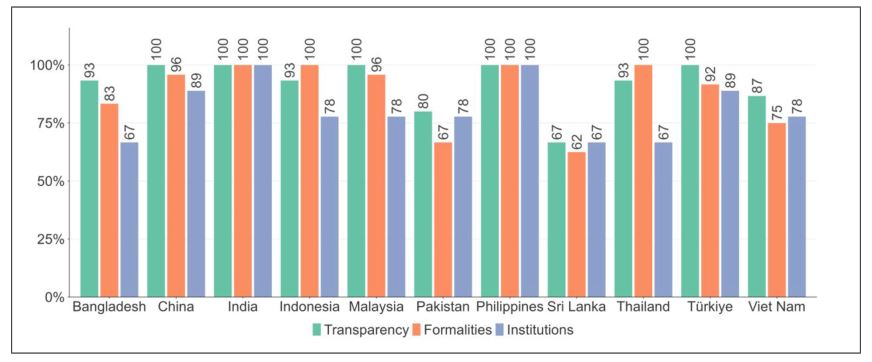
To begin with, Pakistan performs reasonably on transparency (80 percent) but records the lowest formalities score in the peer group (66.7 percent), indicating that risk-based inspection, pre-arrival processing, and AEO programmes remain only partially implemented2. The score of trade facilitation institutions is 77.8 percent, reflecting a functioning national facilitation committee but incomplete delegation of controls to Customs (Figure 1).
Figure 1. Trade Facilitation Implementation: General Subcategories, 2025 (% implementation)
Source: UN Global Survey on Digital and Sustainable Trade Facilitation , 2025.
3.2 Digital Trade Facilitation
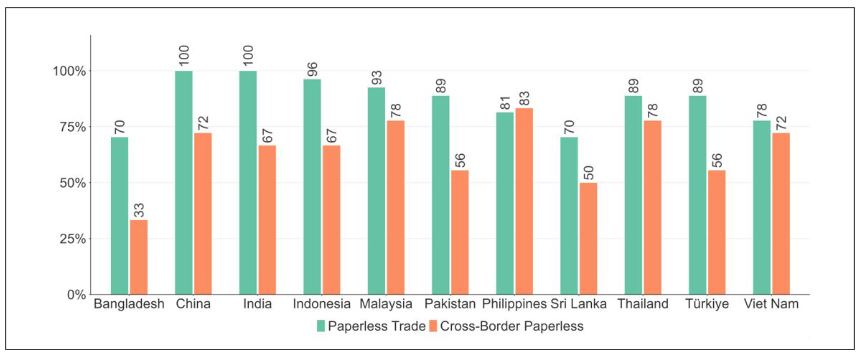
Next, we come to the second pillar namely digital trade facilitation which represents the most advanced area of implementation. Within this pillar, domestic paperless trade stands at 88.9 percent is Pakistan’s strongest area, reflecting mature automated Customs systems and an operational e-Single Window. In comparison, cross-border paperless trade stands at 55.6 percent, indicating weaker digital connectivity with trading partners Addressing this gap requires both diplomatic engagement alongside technical investment. Any progress in this area depends on coordinated efforts with the trading partners (Figure 2).
Figure 2. Trade Facilitation Implementation: Digital Subcategories, 2025 (% implementation)
Source: UN Global Survey on Digital and Sustainable Trade Facilitation, 2025.
3.3 Sustainable Trade Facilitation
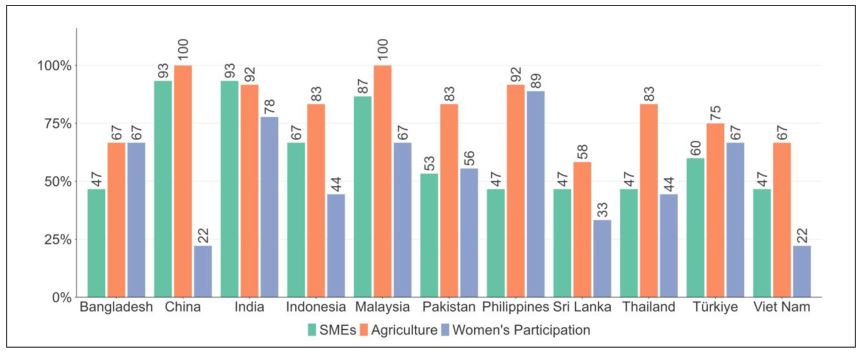
Finally, the third pillar relates to sustainability, that includes trade facilitation coverage for the inclusion of women and support for SME.. Pakistan’s score for SME facilitation (53.3 percent) and women’s participation (55.6 percent) remains the lowest within the peer group. This suggests that the that the reforms efforts have not translated into equally broad access to trade opportunities. In agriculture the situation is more favorable at 83.3 percent. Taken together, these figures indicate that the gains from the existing reforms are largely concentrated amongst large formal exporters (Figure 3).
Figure 3. Trade Facilitation Implementation: Sustainable Subcategories, 2025 (% implementation)
Source: UN Global Survey on Digital and Sustainable Trade Facilitation, 2025.
4. Trade Effect of Facilitation Measures
Following the comparative review of status of implementation of various trade facilitation measures for Pakistan and its peers, this brief also contributes evidence on the trade effects of these measures. Our analysis is based on trade facilitation subcategories across a multi-country panel. For Pakistan, several constraints related to port infrastructure quality and informal payments at the border. These constraints limit how far formal reform progress translates into actual cost reductions.
For an empirical assessment, this study estimates the effect of trade facilitation measures on manufacturing exports using the structural gravity model. The trade facilitation measures affect bilateral trade cost as cargo movement across borders. The specification includes exporter-time and importer-time fixed effects to absorb multilateral resistance. In the assessment we take care of the fact that trade costs are different as trade flows from country A to country B as compared to the flow in reverse direction from B to A (Baier et al., 2019). Trade flows cover both international and domestic transactions drawn from the International Trade and Production Database for Estimation (Borchert et al., 2022), with domestic trade measured as output minus exports (Yotov, 2022). We focus on the general facilitation and digital facilitation measures in this study.
The findings show that all six trade facilitation subcategories exert positive and statistically significant effects on manufacturing exports (Figure 4). Among the general measures formalities carry the largest coefficient (0.082): a ten-percentage-point improvement is associated with approximately 8.2 percent higher manufacturing exports. Next facilitation measures related to transparency follows closely (0.063), confirming the export premium from regulatory predictability. Institutional reforms also have a positive impact, although the magnitude is smaller (0.022), suggesting that their contribution is primarily through an enabling environment rather than effecting exports directly. On the digital side, the measures related to paperless trade procedure are also found to have a positive effect on exports. The electronic exchange of required documents (i.e., the cross-border paperless trade facilitation), similarly promotes trade by reducing processing time. Given Pakistan’s high domestic paperless score but weak cross border digital connectivity, the estimates for cross border paper less trade points to a substantial unrealized digital gains from improving the digital linkages with trading partners. The overall Trade Facilitation (TF) Index coefficient (0.083) confirms that aggregate reform progress compounds individual measure effects.
Figure 4. Estimated Effects of Trade Facilitation Measures on Manufacturing Exports.
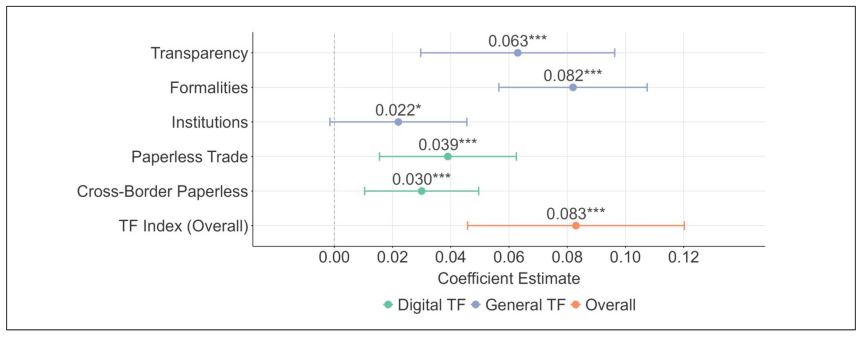
Note: Point estimates with 95% confidence intervals. PPML with exporter-time, importer-time, and directional country-pair fixed effects. Robust standard errors clustered at country-pair level. *** p<0.01, * p<0.10.
Source: Authors’ estimates.
5. Conclusion and Policy Implications
Pakistan’s trade facilitation framework has made meaningful progress in transparency and domestic digitalization, but persistent gaps in customs formalities, cross-border digital integration, and inclusive facilitation leave substantial export potential unrealized. Empirical estimations confirm that each facilitation pillar carries an independent and economically significant export effect, with formalities reform and cross-border digital connectivity offering the largest near-term gains. Closing Pakistan’s facilitation gap with the regional frontier is a quantifiable trade policy lever. Implementation of several of the currently partially implemented and non-implemented measures can help Pakistan improve its export competiveness. In this regard, following are the priority areas of policy action.
a) Accelerate Customs Formalities Reform
The lowest formalities score in the peer group and the largest estimated coefficient, makes it a key area for policy attention. Reforms should focus on the implementation of on Risk-based inspection, strengthening post-clearance audits, publication of average release times, and extension of AEO benefits should be prioritized. The effective implementation and operational performance needs to be prioritized rather than legislative adoption alone.
b) Invest in Cross-Border Digital Connectivity
Pakistan’s substantial progress in domestic paperless infrastructure suggests that remaining constraint lies in interoperability with trading partners. The greater use of electronic exchange of certificates of origin, SPS certificates, and customs declarations requires compatible systems and mutual agreements and arrangements. Pakistan should pursue cross-border digital integration through regional platforms like the APTA, ECO, and SCO and also developing bilateral paper less trade corridors with major export destinations.
c) Extend Facilitation Benefits to SMEs and Women-Led Enterprises
The relatively lower scores of SME facilitation and women’s participation indicate that the benefits have not reached these groups. s Simplified AEO eligibility, mobile-accessible Single Window interfaces and trade information programmes targeting women traders would help broaden the participation These measures, once established, would further enhance the proliferation of any trade facilitation measure to the broader segment.
References
Baier, S. L., Yotov, Y. V., and Zylkin, T. (2019). On the widely differing effects of free trade agreements: Lessons from twenty years of trade integration. Journal of International Economics, 116, 206-226.
Borchert, I., Larch, M., Shikher, S., and Yotov, Y. V. (2022). The international trade and production database for estimation (ITPD-E). International Economics, 169, 139-160.
de Melo, J., Sorgho, Z., and Wagner, L. (2024). Reducing wait times at customs to boost trade: How implementing the Trade Facilitation Agreement can expand trade among AfCFTA countries. Journal of African Economies.
Masood, A., and Martinez-Zarzoso, I. (2023). Trade effects of trade facilitation revisited. Economics Letters.
United Nations. (2022). Results and implications of the United Nations Global Survey on Digital and Sustainable Trade Facilitation 2021 for Asia and the Pacific. SSRN Electronic Journal.
United Nations Economic and Social Commission for Asia and the Pacific (UNESCAP). (2025). UN Global Survey on Trade Facilitation and Paperless Trade Implementation 2025. United Nations.
Yotov, Y. V. (2022). On the role of domestic trade flows for estimating the gravity model of trade. Contemporary Economic Policy, 40(3), 526-540.
Zhou, X., and Choi, C. H. (2022). Analysis of the impact of trade facilitation on China’s bilateral trade. Korea Association for International Commerce and Information.