Since 2007, Pakistan has experienced three rounds of global shocks[1] affecting energy prices: 2007-2008, 2022, and the latest episode in 2025-26, which is linked to the Middle East conflict. Every shock has followed almost the same sequence of events, such as, a depletion of foreign exchange reserves, weakening of the currency, increase in inflation, and vanishing fiscal space to deal with anything else. Table 1 highlights the parallels among the three shocks with different causes, but the same mechanism of transmission and the same short-run policy response.
Table 1. Three Global Energy Shocks and Pakistan’s Exposure
| Period | Trigger | Peak Oil Price / Impact | Currency & Inflation | Outcome |
| 2007–08 | Global commodity price surge | Oil price roughly doubled, June 2007–June 2008 | Reserves fell from >$13bn buffer, inflation increased, FDI declined by < 20%, foreign exchange reserves fell to $5bn | Growth slowdown, subsidy-led measures |
| 2022 | Russia–Ukraine war | Crude rose > $120/barrel | Inflation ~20%; currency depreciation 28% by mid-2023 | LNG cargoes lost to higher bidders; IMF bailout |
| 2025–26[2] | Middle East conflict / Strait of Hormuz risk | Monthly oil import bill jumped from $300m to $800m | Trade deficit up 43.5% m/m (April 2026) | Renewed austerity; reserve-crisis risk flagged |
| Sources:Dawn & Global oil shock shatters Pakistan as trade deficit balloons in April: Report | ||||
This isn’t a tale of a bad year, but a tale of structural dependency. Only 10% of Pakistan’s power comes from indigenous sources (6% from renewable and 4% from nuclear sources). Pakistan’s dependency on imported fuel to meet 40% of energy demands has increased its vulnerability in terms of increasing fuel prices globally. For instance, in the 2022 shock alone, Pakistan’s cost for LNG imports reached $4.9 billion per annum, and according to Bloomberg, Pakistan lost the cargoes to richer nations that could afford to pay triple the price, eventually securing replacements at prices 230% higher than the usual rate[3]. Meanwhile, the peak cost of coal imports was $419/tonne in 2022. These consequences had a far-reaching effect that went beyond the control, such as plant closures, doubling or tripling of household energy bills (that accounted for 15-20% of their income), nationwide strikes, and even an IMF bailout to prevent default. An estimate is that every $10 rise in Brent crude adds $1.8–2.0 billion to Pakistan’s annual import burden[4]. These episodes teach the same lesson that a country relying on the energy generated mostly by imported fuel will never be able to control its own destiny. The lesson is impossible to ignore now for the next episode.
2- One Shock Affecting Every Level of the Economy
Dependency on imported fuels serves as a transmission mechanism, driving a global price change into the entire national economy via the whole range of channels, including trade balance and household electricity bills. The fuel shocks increase transport costs and food prices, reducing the purchasing power and raising the cost of living. The perfect example here is the power sector circular debt that continues growing despite the government’s efforts to reduce it through refinancing rather than through any structural reforms. Pakistan failed to meet its own IMF target of bringing down its circular debt to Rs 1.614 trillion by end-FY26, and the actual figure stood at about Rs 1.92 trillion in May 2026[5].
3. The Global Money Shifts towards Clean Energy
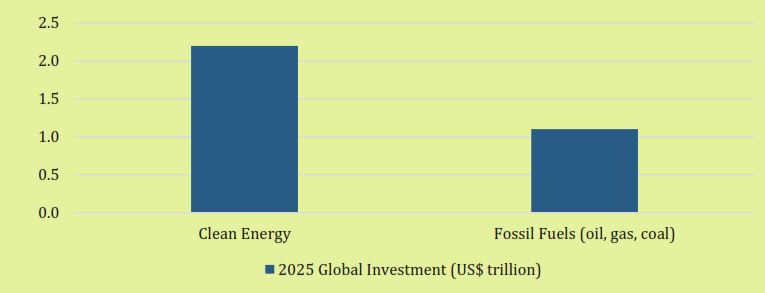
Calculating the economic costs of fuel reliance, the world has made a decisive shift to invest in clean energy, which now attracts roughly two times more capital than fossil fuels (Figure 1). The latest IEA’s World Energy Investment 2025 forecasts record high global energy investment of $3.3 trillion in 2025 in clean energy technologies[6].
Figure 1. Global Energy Investment by Category, 2025 (US$ trillion)
Globally, investments in solar PV were forecast to attract $450 billion in 2025[7]. An indigenous shift towards solarization is already underway. Pakistan has imported around 17 GW of solar PV panels in 2024 alone, the highest volume by far for any country in the world that year. Total imports by mid-2025 are estimated at 45-51 GW of solar PV, matching the total installed capacity of the national grid itself[8][9]. Net-metered rooftop solar capacity has grown from 583 MW in 2022-23 to 1,181 MW in 2023-24 and then jumped again to 2.8 GW in only ten months of the FY2024-25 year, taking the total past 5-6 GW[10]. One estimate suggests a total on-grid and off-grid installed solar PV capacity of roughly 34 GW[11]. One recent industry estimate suggests that this bottom-up solar transition in Pakistan has already resulted in cumulative savings of $12 billion in avoided fuel imports since 2020, and will continue to deliver savings of $6.3 billion in FY2026[12].
4. Pakistan Needs to Work with Already Existing Indigenous Resources
Pakistan’s indigenous renewable resource base is sufficient, so it does not have to import resources for clean energy (Figure 2). The indigenous energy resources sidestep the ship route, the currency exchange, or the Strait of Hormuz to remain accessible. They are the sole energy investment type for which Pakistan’s financial outlays remain in-country rather than being exported as an import bill.
Figure 2. Hydro and Wind: Technical Potential vs. Installed Capacity (GW)
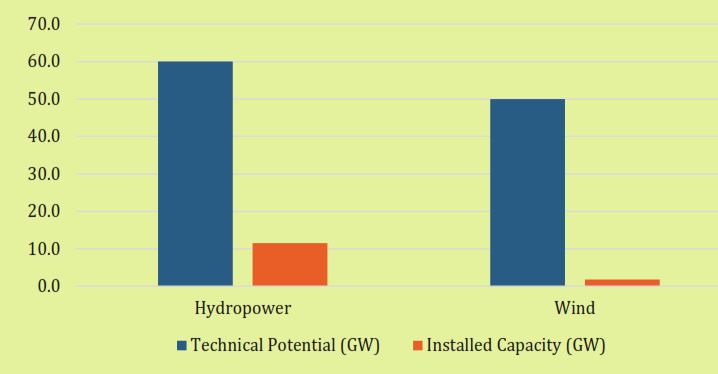
The technical potential of indigenous renewable resources of Pakistan is significant and is underutilized. A Comparison between technical potential and existing installed capacity[13] illustrates the magnitude of the opportunity (Table 2). Biomass supplies an additional 25 million tons/year of feedstock from agricultural and industrial residues (bagasse and crop residue), a resource which is inherently local and rural, not related to port terminals.
Table 2. Pakistan’s Indigenous Renewable Potential vs. Installed Capacity (GW)
| Resource | Technical/Economic Potential | Installed Today | Utilization |
| Hydropower | 60 GW (IRENA) | 11.5 GW | 19% |
| Wind | 50 GW (Sindh/Balochistan corridor, IRENA) | 1.8 GW | 4% |
| Solar (utility-scale) | Abundant; not resource-constrained | 0.8 GW utility + ~5.7 GW net-metered | Rapidly growing |
| Biomass | 25 million tonnes/year feedstock | 0.25 GW (bagasse) | Early stage |
| Source: https://www.irena.org/News/pressreleases/2018/Apr/Pakistan-RRA | |||
5. The Financing Instruments
Pakistan already has financing instruments that serve as functioning access points into the global clean-capital pool. These financial instruments have been employed previously (Table 3). The problem does not rest on the nonexistence of tools but rather their scale and reliability. A United Nations Common Country Analysis reflects that Pakistan’s international adaptation financing has lagged, when compared to climate-vulnerable counterparts such as Bangladesh and the Philippines, with inferior fiscal buffers. Likewise, Pakistan’s adaptation financing gap is significantly larger than its mitigation gap[14]. In late 2026, the Finance Minister of Pakistan emphasized the need to focus more on an efficient utilization of existing tools to build out indigenous capital markets[15].
Table 3. Pakistan’s Green Financing Instruments in Use
| Instrument | Year | Size | Purpose |
| Green bond[16] | 2021 | $500 million | First sovereign green bond issuance |
| Green Sukuk[17] | 2025 | PKR 20 billion | Domestic Islamic green financing instrument |
| ADB climate resilience loan[18] | 2024 | $500 million | Climate & disaster risk reduction; supports green sukuk issuance |
| Panda bond (ADB/AIIB-backed)[19] | 2026 | ~CNY 1.75bn (~$258m) | First RMB sovereign bond; water, energy & health infrastructure |
According to the analysis by the International Growth Centre (IGC)[20], Pakistan’s climate action plan aims for 60% of renewable energy generation and 30% of electric vehicles by 2030. The funding required for it will be 15% internal, while 35% will come internationally.
6. Ways Forward and Conclusion
In less than twenty years, Pakistan has had the same shock of imported energy for the third time, and in all instances, the transmission channel has always been the same, fuel prices in international markets increase, import bill increases, reserves deplete, currency depreciates, and inflation ensues, with households facing the final cost via electricity and food prices. Around the world, financial markets have long figured out that the solution lies in clean energy, with $2.2 trillion being invested in it in 2025. There is no need for Pakistan to rely on importing itself out of such a cycle; it already has one of the least-tapped hydropower and wind energy resources in the region, a genuine grassroots solar revolution underway, and a few but growing number of instruments for green financing which it has shown it knows how to utilize.
The following are some recommendations to tackle this issue.
- Institutionalize and manage the risks associated with a citizen-driven solar revolution rather than penalizing it with taxes. The current explosion of rooftop solar projects in Pakistan is clear evidence of the existence of genuine need for energy independence, which is being met through the funding of households and corporates; however, it has been organic in nature and has now led to issues of cost-sharing (equity issues) and integration in the grid as the NEPRA rethinks the net metering policies. Policy can actually harness this trend in its favor by combining the latest changes in the net metering and buy back policies with concessional financing schemes to increase adoption among lower and middle class households.
- Direct the investments of new electricity generation capacity towards indigenous hydro, wind and solar capacities. Given the fact that there is 60 GW hydro and 50 GW of wind power yet to be harnessed, any additional megawatt of indigenous power generation will reduce the vulnerability of the economy against any future fuel shocks in addition to decreasing the reliance on fuel-import-indexed contracts and thus reducing the circular debt issue. This should be one of the criteria in the IGCEP.
- Expand green capital market access in a planned and purposeful manner by leveraging the existing tools that have been demonstrated to work. Green sukuk, ADB/AIIB-enabled bonds, and the recently introduced Panda bond demonstrate the potential for Pakistan to access both concessional and market-based green capital provided the instruments are structured properly. The approach would be to leverage these instruments as the financing template – larger and more frequent green bonds or sukuk, blended finance models involving MDBs’ guarantees to attract private finance (the Panda bond’s guarantee approach) and a focus on adaptation finance, which is lagging behind peers with similar vulnerability levels.
Anjeela Khurram is an Assistant Professor, CACCRE, PIDE
[1] Stability as strategy in an energy crisis – Newspaper – DAWN.COM
[2] Global oil shock shatters Pakistan as trade deficit balloons in April: Report
[3] Energy Crisis in Pakistan: New Policy Approach Is Crucial
[4] Pakistan’s energy challenge
[5] Circular debt hits Rs1.84tr
[6] Executive summary – World Energy Investment 2025 – Analysis – IEA
[7] Record energy investment forecast and more top energy stories | World Economic Forum
[8] The Perfect Storm Fueling Pakistan’s Solar Boom | World Resources Institute
[9] GSR 2025 | Snapshot: Pakistan
[10] Ibid
[11] TransitionZero
[12] Pakistan’s energy challenge
[13] Renewable Energy Can Build Prosperity and Improve Energy Security in Pakistan
[14] CCA 2024 updateUN Pakistan_climate financing_CLEAN_ed_26feb25_.pdf
[15] Pakistan pursuing green bonds, sukuk to mobilise climate finance: FinMin
[16] https://unfccc.int/sites/default/files/2025-09/Pakistan_NDC3.0_24%20Sep.pdf
[17] Ibid
[19] AIIB, ADB Support Panda Bond Issuance for Green Projects in Pakistan
[20] How Pakistan can finance its greenhouse gas emissions reduction | International Growth Centre