
Executive Summary
The disruption in the Strait of Hormuz in early 2026 briefly redirected regional cargo flows toward Pakistan’s ports, with Karachi recording an unprecedented surge in transhipment activity and Gwadar receiving its first dedicated transhipment vessel call. While these developments highlighted Pakistan’s strategic location outside the Gulf risk zone, they also demonstrated that temporary geopolitical disruptions alone cannot sustain long-term transhipment growth. Once regional stability returns, cargo will flow back to established hubs unless Pakistan strengthens its commercial competitiveness.
This Policy View argues that Gwadar can become a preferred regional transhipment hub only if shipping lines choose it on commercial merit rather than crisis-driven necessity. It proposes five mutually reinforcing reforms; improving commercial competitiveness through competitive pricing, digital customs, dredging, and security; securing long-term commitments from major liner operators; systematically diverting bulk cargo to build throughput; developing an inclusive blue economy around Gwadar’s fishing sector; and establishing Gwadar as Balochistan’s principal mineral export gateway. Together, these reforms provide a commercially grounded roadmap for transforming Gwadar into a preferred regional transhipment hub under CPEC 2.0.
1. THE STRATEGIC MOMENT — AND WHY PAKISTAN KEEPS MISSING IT
Roughly one-fifth of the world’s seaborne oil and liquefied natural gas transits the Strait of Hormuz. Following military escalation between the United States, Israel, and Iran in early 2026, war-risk insurance premiums surged, and shipping lines sought lower-risk alternatives, temporarily diverting cargo to Karachi, Port Qasim, and for the first time Gwadar. The episode highlighted Pakistan’s strategic potential as a regional transhipment hub during periods of maritime disruption.
The impact was immediate. Karachi Port handled more transhipment containers during March 2026 than in the whole of 2025, while the government authorised bulk and break-bulk cargo under transhipment arrangements for the first time. On the same day, Gwadar received its first dedicated transshipment vessel call, a symbolic milestone demonstrating the commercial opportunities created by regional shipping disruptions.
Despite recent gains, Gwadar remains constrained by limited draft depth, the absence of scheduled liner services, and gaps in commercial competitiveness. Unless these structural constraints are addressed, diverted cargo is likely to return to established regional hubs as shipping conditions normalize.
Unlike Gulf ports located inside or adjacent to the chokepoint, Gwadar sits outside it while remaining directly connected to the East-West lanes linking East Asia, the Middle East, Africa, and Europe. That geographic advantage is real. But geography has never been enough on its own — Singapore, Jebel Ali, Salalah, and Colombo all succeeded primarily through integrated logistics ecosystems: competitive pricing, anchor shipping-line partnerships, digital trade facilitation, and industrial cargo generation. Gwadar must compete on those same commercial fundamentals rather than rely on future geopolitical crises.
2. WHERE GWADAR STANDS — THE SCALE OF THE UNDERUTILISATION GAP
The core problem is not a lack of infrastructure. Gwadar has a deep-sea berth. It has a bulk terminal designed for roughly 11 million tonnes a year. It sits inside a Special Economic Zone intended to generate industrial cargo. The problem is that almost none of this capacity is actually being used.
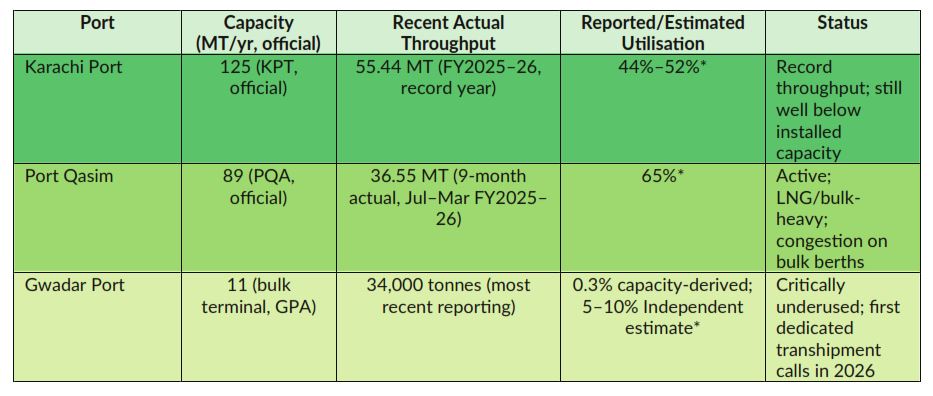
Source: Official capacity: Karachi Port Trust (kpt.gov.pk, port statistics) and Port Qasim Authority (pqa.gov.pk, o cial site). Karachi throughput: KPT FY2025–26 annual performance review, as reported in Business Recorder, “KPT handles 55.44mt of cargo in FY26,”1 August 2026. Port Qasim throughput: Port Qasim Authority nine-month performance data, as reported in The Express Tribune, “Port Qasim cargo rises 8.2% despite fewer ships,” 1 April 2026. Gwadar throughput: Business Recorder, “Revitalising Gwadar port before establishing new ports,” 2026. Independent utilisation estimates, using a di erent denominator methodology, are drawn from Business Recorder, “Clean ports, strong economy: ght for transparency in maritime sector,” 2 April 2026. For Gwadar, 34,000 tonnes against the 11-million-tonne design capacity implies approximately 0.3% capacity-derived utilisation, while an independent estimate reports 5–10% using a di erent denominator. These gures are reported transparently and should not be treated as directly interchangeable.
Three structural constraints explain Gwadar’s underutilisation. First, the absence of a rail connection to the national network makes inland transport significantly more expensive than routing cargo through Karachi. Second, limited industrial activity in the Free Zone generates little local cargo. Third, Gwadar remains weakly integrated into global liner networks, with only limited scheduled international shipping services. Together, these constraints prevent the port from converting its strategic location into sustained commercial activity.
Table 2 — Annual Vessel Calls: Pakistan vs. Regional Comparators (2025 Baseline)
| Port | Country | Annual Vessel Calls |
| Sohar | Oman | 4,807 |
| Colombo | Sri Lanka | 4,310 |
| Karachi Port | Pakistan | 1,600 |
| Port Qasim | Pakistan | 1,535 |
| Chabahar | Iran | 41 |
| Gwadar | Pakistan | 22 (pre-2026 baseline) |
Source: Report presented to the Senate Standing Committee on Planning, Development and Special Initiatives, Government of Pakistan, as reported in Pro t by Pakistan Today, “Pakistan’s port charges highest in region, weighing down Gwadar’s growth: report,” 17 May 2025.
Colombo demonstrates that long-term transshipment success depends on liner connectivity, operational efficiency, and competitive pricing rather than a superior geographic location alone. Gwadar possesses similar strategic potential but must strengthen these commercial fundamentals before it can emerge as a regional hub.
3. PILLAR ONE — COMPETING ON COMMERCIAL TERMS
Successful transhipment hubs compete on commercial performance rather than geography alone. Shipping lines prioritise turnaround time, berth availability, predictable schedules, digital customs procedures, and overall logistics costs when selecting ports. Unless Gwadar can compete on these fundamentals, crisis-driven vessel calls are unlikely to evolve into regular scheduled services.
3.1 Port -Choice Framework for Gwadar
Shipping lines do not select transhipment hubs on geography alone. Port-choice research identifies a combination of monetary, time, operational, traffic, location and liner-related factors as determinants of hub selection. In particular, shipping lines consider port charges, turnaround time, berth and terminal reliability, vessel accessibility, cargo availability, feeder connectivity and the frequency of liner services.
For Gwadar, this implies that a lower tariff is necessary but not sufficient to attract sustained transhipment volumes. The port must offer a competitive bundle of price, time, reliability and network connectivity relative to established hubs such as Colombo, Salalah and Jebel Ali. The relevant policy objective is therefore to reduce the generalized cost of choosing Gwadar while simultaneously improving the operational and network conditions that determine shipping-line choice.
The framework can be represented as:
Port choice = f (price, turnaround time, berth reliability, draft/accessibility, cargo availability, feeder connectivity, customs efficiency, security and liner-service frequency).
The proposed reforms in this Policy View target these determinants directly: pricing addresses monetary costs; digital customs reduce time and transaction costs; dredging improves accessibility and reliability; anchor agreements strengthen liner connectivity; and cargo-generation policies increase the traffic base available to shipping lines.
3.2 Formalising the Framework: A Discrete-Choice (MNL) Specification
The determinants identified above can be formalised as a discrete-choice model of shipping-line hub selection, following the multinomial logit (MNL) tradition established in the port-choice literature (Malchow and Kanafani, 2004; Nir et al., 2003; Tiwari, Itoh and Doi, 2003; Kavirathna, 2018). For a carrier evaluating a candidate set of hub ports j {Gwadar, Colombo, Jebel Ali, Salalah, Sohar, Chabahar}, the probability that the carrier selects Gwadar (j = G) for a given service string is