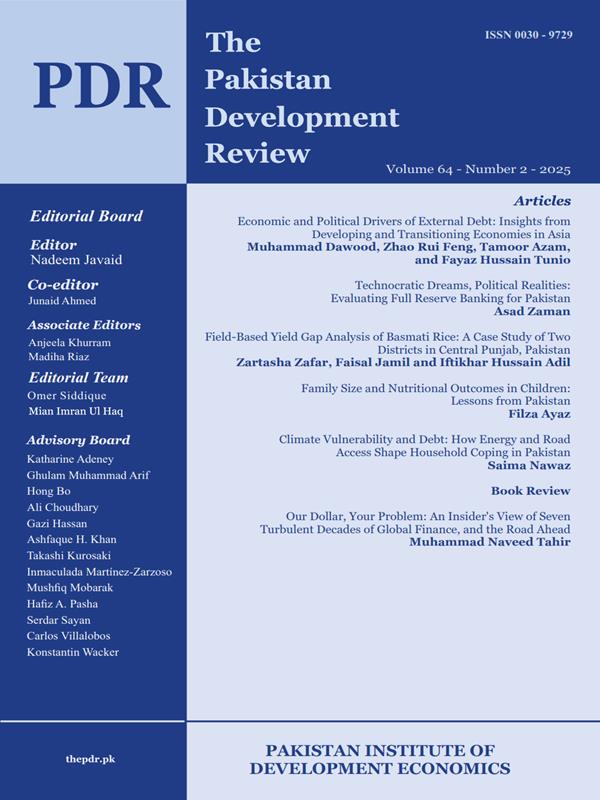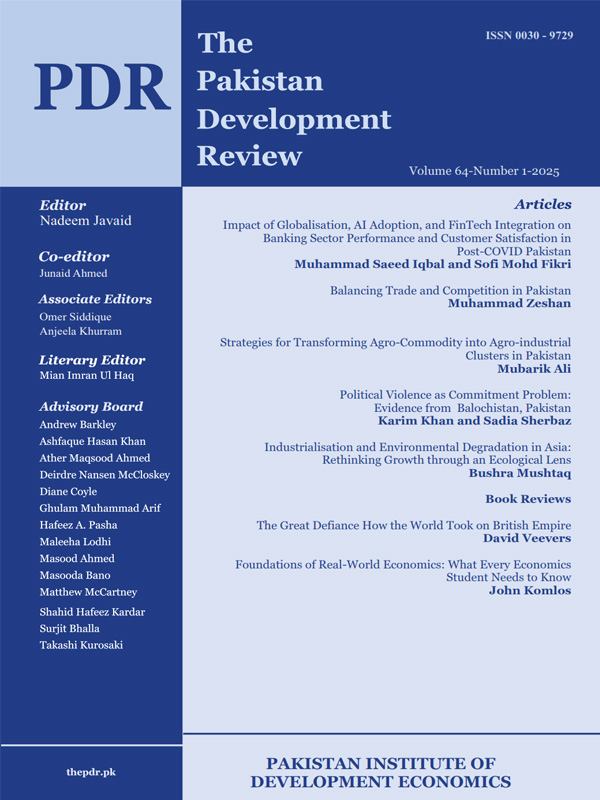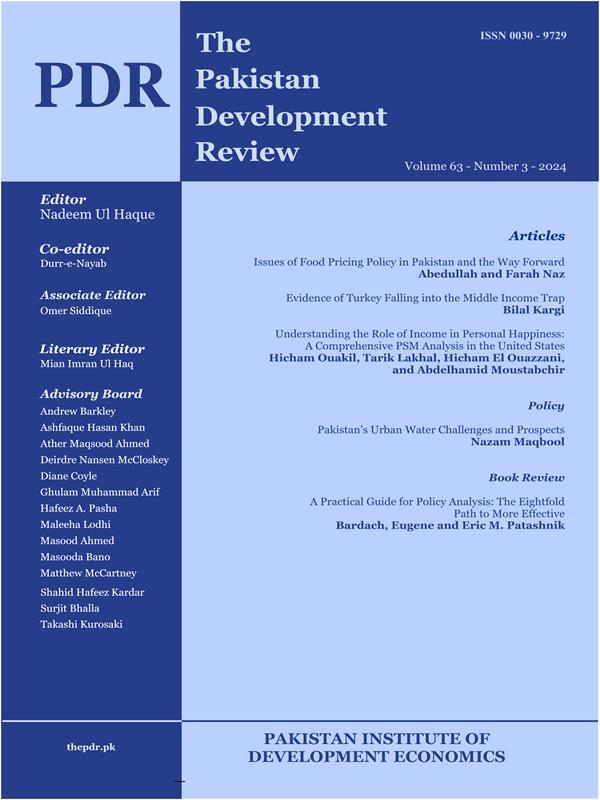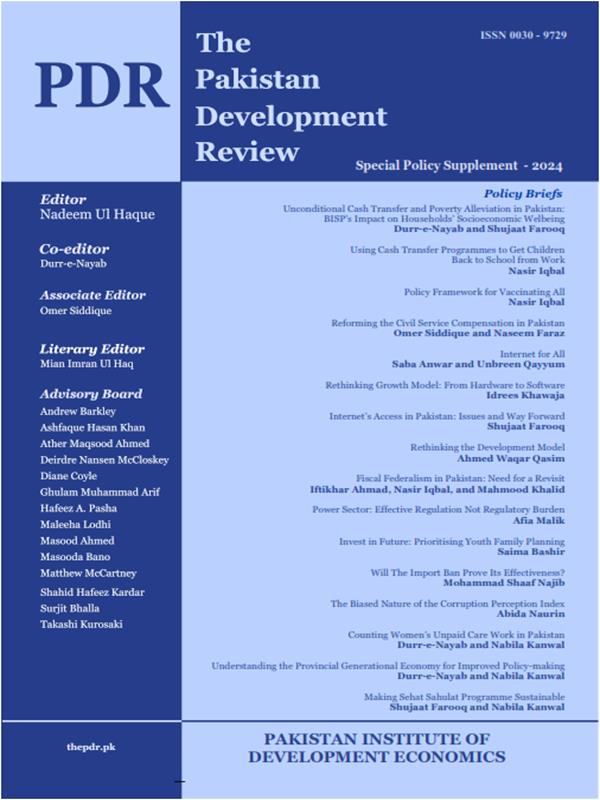
THE PAKISTAN DEVELOPMENT REVIEW 

About Journal

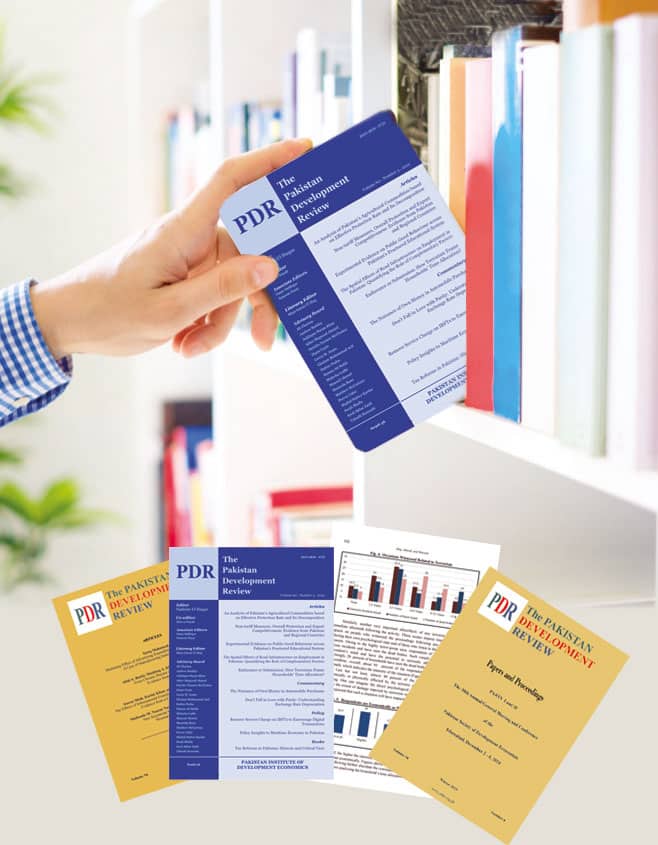
The Pakistan Development Review is an internationally refereed journal published regularly by the Pakistan Institute of Development Economics since 1961. The journal focuses on economics and related social sciences and welcomes theoretical and empirical contributions in relevant disciplines with a particular emphasis on Pakistan’s socio-economic issues. The journal is published on a tri-annual basis. The journal’s editorial and advisory boards consist of more than 18 renowned scholars in the fields of economics and related social sciences. They actively participate in refereeing the papers and also render valuable advice on other related matters.

CURRENT ISSUE 2025 - Vol 64, No 1
QR Code https://file.pide.org.pk/pdfpdr/issue/pdr-2025-v64i1.pdf
QR Code https://file.pide.org.pk/pdfpdr/2025/25-52.pdf
QR Code https://file.pide.org.pk/pdfpdr/2025/73-95.pdf
YEARS
0 +
RESEARCH PAPERS
0 +
AUTHORS
0 +
ISSUES
0 +

LATEST ISSUES

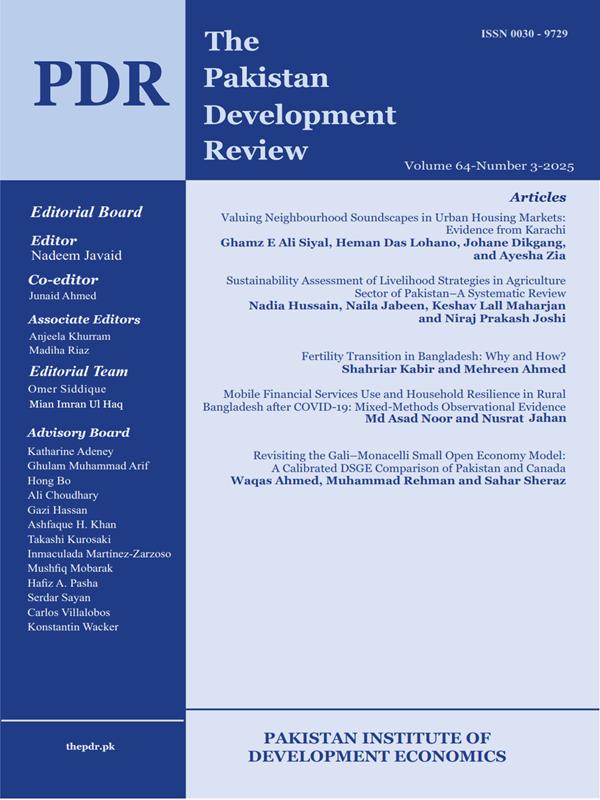
pdr-vol-64-no-1-2025-feature
Vol. 64 No.1-2025
pdr-vol-63-no-3-2024
Vol. 63 No.3-2024
pdr-2024-special-policy-supplement
Special Policy Supplement
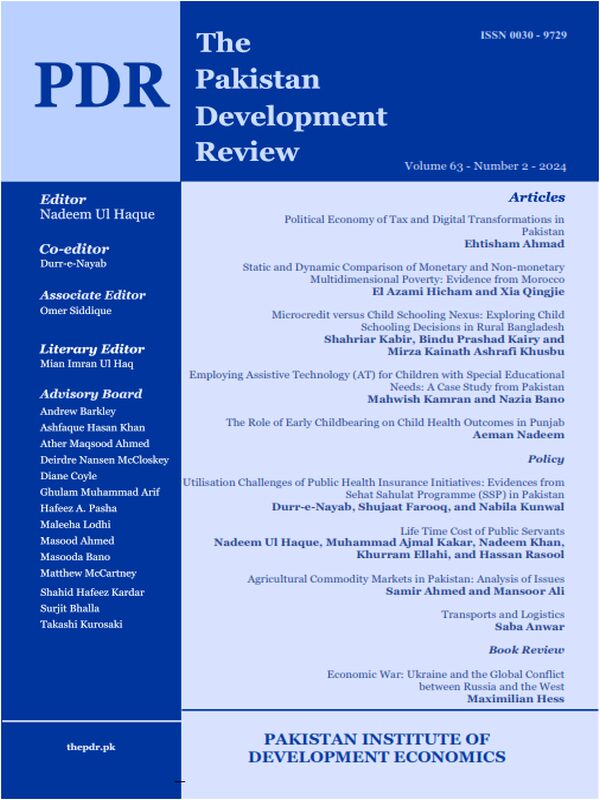
Vol. 63 No.2-2024 Featured Image
Vol. 63 No.2-2024
Vol. 63 No.1-2024 Featured Image
Vol. 63 No.1-2024
The PDR Volume 62 issue 4 - 2023
Vol. 62 No.4-2023
Call for Papers · Special Issue

Climate Change, Climate Justice & Climate Finance — Development in South Asia

A special issue of the Pakistan Development Review on climate and development scholarship for Pakistan and South Asia.

Pakistan Development Review (PDR) · Pakistan Institute of Development Economics (PIDE), Islamabad
Background & rationale

Why this issue, why now

Developing countries across South Asia bear a disproportionate share of climate costs despite contributing relatively little to historical emissions. Pakistan exemplifies this asymmetry: recurrent floods, intensifying heatwaves, water stress in the Indus Basin, and agricultural losses impose enormous economic and social burdens even as the country pursues growth, poverty reduction, and structural transformation.

South Asia shares structural vulnerabilities that make a regional lens necessary — transboundary river systems, monsoon variability, glacier melt in the Himalaya–Karakoram–Hindu Kush, and rising climate‑induced migration. This issue brings together empirical and theoretical contributions on climate and development across the region, with Pakistan as a central, though not exclusive, lens — serving as a reference for policymakers, development partners, and researchers.

Objectives
  • Rigorous, policy‑relevant research on climate & development in South Asia, focused on Pakistan.
  • An evidence base for adaptation, mitigation, and financing strategies.
  • Stronger regional academic collaboration and visibility.
  • Innovative methods — causal inference, spatial econometrics, ML for climate risk.
  • Recognition of emerging scholarship via a Best Paper Award.
Framing questions
  • How effective are current climate finance mechanisms in South Asia?
  • What policies enhance resilience while sustaining growth?
  • How can mitigation be balanced with development priorities?
  • What institutional reforms improve climate governance?
Scope & thematic areas

What we're looking for

Economic & policy analysis

  • Climate impacts on productivity, growth, macro costs
  • Climate budgeting, fiscal policy, adaptation finance
  • Development planning under climate uncertainty
  • Resilient infrastructure & Indus Basin water governance
  • Climate finance effectiveness, loss & damage, green finance

Environmental & social dimensions

  • Climate justice, ecological debt, intergenerational equity
  • Climate‑induced migration and displacement
  • Agricultural adaptation and food security
  • Regional climate cooperation and governance
  • Distributional impacts, poverty and vulnerability
  • Energy transition, green industrialization, just transition
Editorial approach

Co‑edited by experts with complementary expertise in environmental policy and development economics. The issue prioritizes rigorous economic and policy analysis and welcomes quantitative, qualitative, mixed‑methods, and econometric contributions; interdisciplinary work and South Asian scholars and institutions are especially welcome.
Dr. Muhammad Imran Chaudhry
Development Economics
King Fahd University of Petroleum and Minerals, Saudi Arabia
Dr. Madiha Riaz
Environmental Policy
Pakistan Institute of Development Economics (PIDE), Islamabad
Submission guidelines
  • Full papers: 4,000–6,000 words incl. references & appendices.
  • Must follow PDR submission guidelines.
  • Double‑blind peer review for all submissions.
  • Not under review elsewhere at time of submission.
  • Optional 300‑word abstract by 30 Sep 2026 for early feedback.
  • Preference for policy‑relevant, empirically rigorous work.
  • Recent econometric methods (causal inference, spatial, ML) encouraged.
  • Mention the Special Issue title on the paper.